The Era of Population Deflation: The Future Belongs to 'Super Individuals + AI + Web3'

marsbitPublicado a 2026-01-20Actualizado a 2026-01-20

Resumen

The article "The Era of Population Deflation: The Future Belongs to 'Super Individuals + AI + Web3'" argues that global population decline is not merely a labor issue but a fundamental structural shift that will redefine economic and technological systems. Key points include: - Population collapse (e.g., China’s birth rate halving in 7 years) erodes labor supply, content creation, and long-term demand for assets like real estate and pensions. - AI is not just an efficiency tool but a structural solution to replace human labor, enable exponential productivity growth, and empower "super individuals" and solo creators. - Web3 provides the infrastructure for trustless collaboration, transparent value distribution, and programmable rules in a low-trust, low-human environment. - Together, AI and Web3 form a complete response: AI handles production, while Web3 enables decentralized coordination and economic participation for both humans and AI agents. The article advises investors to focus on AI, productivity tools, and Web3 infrastructure, and urges individuals to become AI-augmented, platform-independent, and self-sovereign economic units.

Author: Amelia I Biteye Content Team

Over the past century, almost all economic growth models have assumed one premise: the next generation will be larger than the current one.

More people mean a more abundant labor force, a larger consumer market, and more predictable long-term returns.

But this premise is failing globally.

China, Japan, South Korea, Europe, and even the United States - declining birth rates are shifting from "statistical data" to a structural reality.

And when "people" are no longer the most abundant, cheapest, and most replicable factor of production, the entire narrative of technology and institutions will be forced to rewrite.

The emergence of Web3 and AI is not an accidental technological wave but an inevitable response to the era of population deflation.

I. Population Cliff: The Underestimated Systemic Risk

When discussing population decline, many debates only focus on "labor shortage."

But if you only understand it as a "labor issue," you severely underestimate its destructive power.

What population deflation truly erodes are three deeper layers of structure.

Labor: From a Cyclical Problem to an Irreversible Structural Scarcity
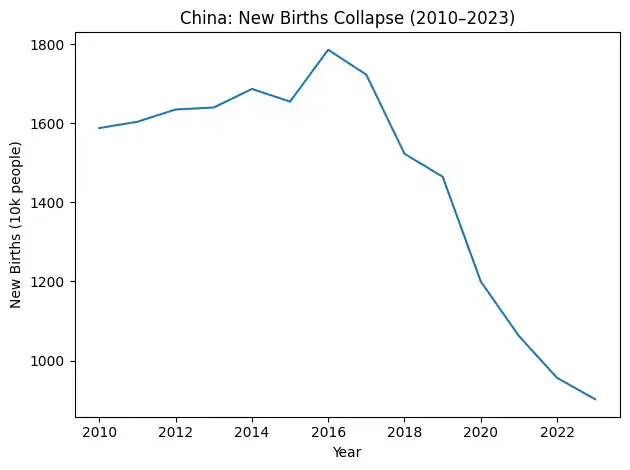
China's Birth Population Cliff (2010–2023)

Visually, what you see is not a "decline" but a clear cliff-like drop.

Taking China as an example:

  • 2016: approximately 17.86 million newborns

  • 2023: approximately 9 million newborns

  • 2025: expected to fall below 8 million

Halved in just 7 years.

What does this mean?

Those born in 2023 will enter the labor market around 2045: not "a bit fewer," but "half as many."

This is not a cyclical fluctuation but a structural collapse of the population.

More critically, this trend has been confirmed by long-term projections: according to the UN's "World Population Prospects 2022" report, China's working-age population (15–64 years) will decrease by approximately 170 million between 2020 and 2050.

In the past, business systems assumed: "People can always be hired; it's just a matter of price."

In the era of population deflation, the problem changes.

Delayed retirement, immigration, and birth subsidies are slow variables.

But business systems cannot wait twenty years.

This is precisely where all technological narratives begin to transform.

Attention and Creator Supply Shrink Simultaneously: Web2's Hidden Fatal Flaw

A declining young population brings not only a reduction in labor but also a more hidden, more fatal problem: Who will produce content, and who will consume it?

  • Declining number of content producers

  • Slower diffusion of new culture and narratives

  • Failure of platform traffic growth logic

Web2's reliance on the "user growth → traffic → advertising → commissions" model is essentially built on population expansion.

When new users no longer appear, platforms begin to compete internally, rules change frequently, and trust between creators and platforms collapses.

This is Web2's most difficult structural flaw to repair in the era of population deflation.

Systemic Collapse on the Long-Term Demand Side: Long-Termism Forced to Be Revalued

Real estate, education, long-term consumer goods, pension systems...

The commonality of these systems is: they all assume that there will be more people in the future.

When this assumption is broken, all "long-termist assets" will be repriced.

II. Why Is AI a Necessity in the Era of Population Deflation?
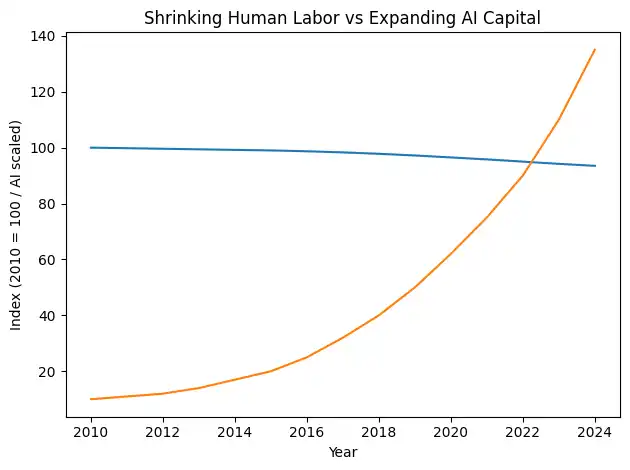
Human Labor Contraction vs. AI Capital Exponential Expansion

One side is a slow but certain decline, the other is exponential growth. The only "labor force" that can still expand is not human.

If population deflation changes the problem itself, then AI is becoming the only viable answer.

AI Is Not an Efficiency Tool but a "De-humanizing Tool"

We are accustomed to describing AI as an "efficiency tool."

But in the real world, it does not solve efficiency problems but a structural one: the system no longer needs so many people.

AI customer service, AI content generation, AI research assistants, AI trading systems - their significance is not to make people 20% faster but to remove "people" from the necessary conditions of the system.

In a population-deflated world, the real question is no longer: "Can we hire someone for this position?" but: "Does this环节 still require human participation?"

AI is not replacing inefficient people; it is rewriting the entire society's assumption of dependence on "human labor."

AI Is the Only Labor Force Capable of Exponential Growth

  • Population: Linear growth, even negative growth

  • AI: Computing power, models, data → Exponential expansion

This is also why, despite extreme macroeconomic uncertainty, capital still chooses to heavily invest in AI.

Because in the era of population deflation, only AI has the "ability to scale."

AI Allows the "Individual" to Become a Production Unit Again
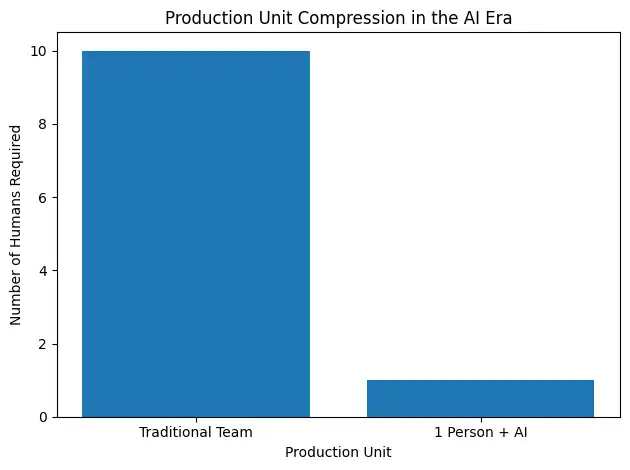
Production Unit Compression Diagram (Team → Individual + AI)

From a "10-person team" to "1 person + AI," production units are being rapidly compressed.

AI is giving rise to a new organizational form:

  • One-person companies

  • Super individuals

  • Solo Founders

  • AI Native creators

When society cannot mass-produce young people, the system can only choose to: amplify the individual.

III. What Role Does Web3 Play Here?

If AI solves "who will do the work," then Web3 solves a more fundamental problem:

In an era of fewer people, how do we collaborate, distribute, and build trust?

How to Collaborate at Low Cost in an Era of Fewer People?

DAOs, Permissionless collaboration, project-based contributions—

Web3 restructures "organizations" from long-term employment relationships into temporary, flexibly combinable collaboration networks.

When hiring people becomes increasingly expensive, trust and settlement must be automated.

How to Distribute Value in an Era of Fewer People?

In an era where labor becomes scarce, if value distribution is not transparent, the system will quickly lose participants.

Tokens, on-chain incentives, and instant settlement do not address "speculation" but a practical problem:

How to make scarce labor willing to stay and continue to build?

How to Build Long-Term Trust in an Era of Fewer People?

The younger generation's trust in long-term commitments is collapsing:

  • Distrust in pensions

  • Distrust that platforms won't change rules

  • Distrust in long-term incentives from centralized institutions

Smart contracts and on-chain rules essentially answer:

When there aren't enough people and not enough trust, can the rules execute themselves?

IV. Web3 + AI: The Complete Solution for the Era of Population Deflation

An increasingly clear judgment is forming: Web3 is not a competitor to AI but the institutional shell for the AI era.

What do AI Agents need?

  • Identity

  • Wallet

  • Autonomous transaction capability

  • Programmable rules

These are precisely the native capabilities of Web3.

In the near future, we may see:

  • AI-native companies

  • AI autonomous DAOs

  • AI-to-AI economic collaboration

In this system, humans may no longer be the largest group of economic participants.

V. Final Thoughts: What Does This Mean for the Individual?

For the individual, it is a harsh but real fact: you will no longer be lifted by the红利 of "population growth."

But it also意味着 new windows of opportunity:

  • AI amplifies individual productivity

  • Web3 allows individuals to directly participate in global systems

  • A world with fewer people is反而 more friendly to high-cognition, high-action individuals

If you are an investor/creator, here is actionable advice from Biteye:

For investors:

  • Population deflation is a 20–30 year-level certain variable, not macroeconomic noise

  • All business models relying on "population expansion" should be discounted valuations

  • Only three categories are truly worth long-term attention:

    • AI that can directly replace human labor

    • Tools that amplify individual productivity

    • Web3 infrastructure that operates in low-trust environments

For creators / individuals:

  • Stop assuming "the platform will give you long-term returns"

  • Try to turn yourself into:

    • A node that can be amplified by AI

    • A personal brand that can migrate across platforms

    • An independent production unit capable of direct settlement

After all, in the era of population deflation: the system will not take care of you, but the system needs you.

This is not an era of more and more people,

but an era where each individual must become stronger and stronger; and what you must rely on are AI and Web3.


Lecturas Relacionadas

The AI Agent Era Accelerates Its Arrival: Questflow Defines a New Paradigm of Financial Intelligence with On-Chain AI Brokerage

The AI Agent era is accelerating, with the CB Insights AI 100 list highlighting global investment confidence. The focus has shifted from whether AI works to its speed of deployment and ability to manage complex workflows, with autonomous AI Agents driving this transformation. At the forefront is Questflow, a Singapore-based startup redefining financial intelligence through its on-chain AI brokerage. Unlike tools that merely provide data dashboards, Questflow deploys AI Agents that proactively scan markets, form judgments, and execute trades via a conversational interface—operating 24/7 without requiring manual confirmation for each decision. This embodies the new AI paradigm of agents capable of executing multi-step workflows autonomously. Questflow's mission is to democratize institutional-grade trading intelligence. Historically reserved for the ultra-wealthy, this capability is now accessible starting from just $1 through Questflow's "AI Clone + Copy Trade" model. The platform charges only a 1% execution fee, aligning its incentives directly with users and eliminating traditional management or performance fees. The timing is opportune, aligning with key trends identified by CB Insights: the scalable deployment of AI Agents, accelerated AI adoption in financial services, and the maturation of on-chain infrastructure. With robust liquidity on platforms like Hyperliquid and Polymarket, alongside advancements in AI reasoning and non-custodial wallet security, Questflow is positioned to merge the roles of broker, fund, and exchange into a single, accessible platform for millions.

链捕手Hace 20 min(s)

The AI Agent Era Accelerates Its Arrival: Questflow Defines a New Paradigm of Financial Intelligence with On-Chain AI Brokerage

链捕手Hace 20 min(s)

Why Pricing Social Interactions is Doomed to Fail?

Titled "Why Putting a Price on Social Interaction Is Doomed to Fail," this article critiques attempts to monetize social networks directly through SocialFi models, arguing their inevitable failure stems from a fundamental misunderstanding of media dynamics. Using Marshall McLuhan's theory of "hot" and "cold" media, the author posits that social networks are inherently "cold" media. Their value isn't contained in individual posts but is co-created through user participation, interpretation, and fragmented, ongoing interaction (e.g., replies, shares). This ambiguity and need for user involvement are core to their function. The article asserts that SocialFi projects like Friend.tech failed because introducing real-time, tradable financial pricing (a definitive "hot" signal) into this "cold" environment doesn't add a layer—it replaces the medium's essence. The unambiguous price signal overshadows and nullifies the nuanced, participatory social signal. Users become traders, not participants, and when speculative profits vanish, the underlying social ecosystem—never genuinely cultivated—collapses entirely. This principle extends beyond crypto. The author argues platforms like Twitter have gradually "heated up" through metrics (likes, retweets counts, algorithmically defined value), shifting users from participants to performers and eroding organic engagement. The solution isn't to abandon capital but to manage its entry point. Successful models like Substack, Patreon, or Bandcamp allow capital to "condense" at specific, isolated nodes (e.g., subscriptions, one-time payments) without permeating and "heating" every social interaction. They preserve the core "cold," participatory medium while enabling monetization at designated boundaries. The NFT boom and bust serves as a stark parallel: the ancient "cold" medium of collecting (valued for story, community, gradual accumulation) was rapidly destroyed by platforms that introduced real-time floor prices, rarity scores, and trading dashboards, transforming collectors into speculators and vaporizing cultural value when prices fell. The core lesson: "Liquidity equals heat." Injecting high liquidity and definitive pricing into a "cold" participatory medium doesn't optimize it; it fundamentally alters and destroys its value-creating mechanism. The future lies not in pricing every social gesture but in finding precise, non-invasive points for capital to condense without overheating the entire ecosystem.

marsbitHace 28 min(s)

Why Pricing Social Interactions is Doomed to Fail?

marsbitHace 28 min(s)

Jensen Huang's CMU Speech: In the AI Era, Don't Just Watch, Build

Jensen Huang, CEO of NVIDIA and a first-generation immigrant, delivered the commencement address to Carnegie Mellon University's class of 2026. He shared his personal journey from a humble background to founding NVIDIA, emphasizing resilience, learning from failure, and the responsibility that comes with leadership. Huang framed the present moment as the dawn of the AI revolution, a shift he believes is more profound than previous computing waves. He described AI as fundamentally resetting computing—moving from human-written software to machines that understand, reason, and use tools. This will create a new industry for generating intelligence and transform every sector. While acknowledging AI's potential to automate tasks and displace some jobs, Huang distinguished between the *tasks* of a job and its core *purpose*. He argued AI will augment human capability, not replace humans. The real risk, he stated, is not AI itself, but people being left behind by those who effectively use AI. He presented AI as a generational opportunity for massive infrastructure investment—in chip factories, data centers, energy grids, and advanced manufacturing—that could re-industrialize nations like the U.S. and bridge the digital divide by making computing and intelligent tools accessible to all. Huang called for a balanced approach: advancing AI safely and responsibly, establishing prudent policies, ensuring broad access, and encouraging universal participation. He urged the graduates not to fear the future but to engage with optimism and ambition, reminding them of CMU's motto, "My heart is in the work." His core message was clear: this is their moment to actively build and shape the AI-powered future, not merely observe it.

marsbitHace 1 hora(s)

Jensen Huang's CMU Speech: In the AI Era, Don't Just Watch, Build

marsbitHace 1 hora(s)

Trading

Spot
Futuros

Artículos destacados

Cómo comprar ERA

¡Bienvenido a HTX.com! Hemos hecho que comprar Caldera (ERA) sea simple y conveniente. Sigue nuestra guía paso a paso para iniciar tu viaje de criptos.Paso 1: crea tu cuenta HTXUtiliza tu correo electrónico o número de teléfono para registrarte y obtener una cuenta gratuita en HTX. Experimenta un proceso de registro sin complicaciones y desbloquea todas las funciones.Obtener mi cuentaPaso 2: ve a Comprar cripto y elige tu método de pagoTarjeta de crédito/débito: usa tu Visa o Mastercard para comprar Caldera (ERA) al instante.Saldo: utiliza fondos del saldo de tu cuenta HTX para tradear sin problemas.Terceros: hemos agregado métodos de pago populares como Google Pay y Apple Pay para mejorar la comodidad.P2P: tradear directamente con otros usuarios en HTX.Over-the-Counter (OTC): ofrecemos servicios personalizados y tipos de cambio competitivos para los traders.Paso 3: guarda tu Caldera (ERA)Después de comprar tu Caldera (ERA), guárdalo en tu cuenta HTX. Alternativamente, puedes enviarlo a otro lugar mediante transferencia blockchain o utilizarlo para tradear otras criptomonedas.Paso 4: tradear Caldera (ERA)Tradear fácilmente con Caldera (ERA) en HTX's mercado spot. Simplemente accede a tu cuenta, selecciona tu par de trading, ejecuta tus trades y monitorea en tiempo real. Ofrecemos una experiencia fácil de usar tanto para principiantes como para traders experimentados.

303 Vistas totalesPublicado en 2025.07.17Actualizado en 2025.07.17

Cómo comprar ERA

Discusiones

Bienvenido a la comunidad de HTX. Aquí puedes mantenerte informado sobre los últimos desarrollos de la plataforma y acceder a análisis profesionales del mercado. A continuación se presentan las opiniones de los usuarios sobre el precio de ERA (ERA).

活动图片