The Era of IoT: Will Your Robotic Vacuum Steal Your Cryptocurrency?

marsbitPublicado a 2026-01-18Actualizado a 2026-01-18

Resumen

In the era of IoT, smart home devices like robotic vacuum cleaners pose significant risks to cryptocurrency security. These easily hackable devices can be exploited to record password inputs or steal seed phrases. With an estimated 18.8 billion IoT devices globally and over 820,000 daily attacks, vulnerabilities are increasing. Examples include a hacked coffee machine displaying ransomware messages, a casino’s smart fish tank leaking 10GB of data, and office door sensors secretly mining Monero. Researchers warn that compromised devices could even destabilize power grids by synchronizing high-energy appliances. To protect against such attacks, experts recommend setting strong passwords, using separate guest networks for IoT devices, disconnecting unused gadgets, and keeping software updated. Avoiding smart devices entirely is another extreme but effective precaution.

Original Title: 'Help! My robot vac is stealing my Bitcoin': When smart devices attack

Original Author: Felix Ng, Cointelegraph

Original Compilation: Deep Tide TechFlow

Smart robotic vacuums and other smart home devices are easily hacked and can be used to record your password inputs or seed phrases.

Imagine waking up one morning to find your robotic vacuum out of control, your refrigerator demanding a ransom, and your cryptocurrency and bank account funds wiped out.

This isn't a scene from Stephen King's 1986 horror film "Maximum Overdrive"—a story about a rogue comet triggering a global machine killing spree.

Instead, it's the real risk that could occur if hackers infiltrate your computer through the smart devices in your home. With the global number of IoT devices expected to reach 18.8 billion and an average of about 820,000 IoT attacks occurring daily, the likelihood of this scenario is increasing.

"Insecure IoT devices (such as routers) can become entry points into home networks," said Tao Pan, a researcher at blockchain security company Beosin, in an interview.

As of 2023, the average U.S. household has 21 connected devices, and one-third of smart home device consumers have experienced a data breach or scam in the past 12 months.

"Once hacked, attackers can move laterally to access connected devices, including computers or phones used for cryptocurrency transactions, and can also capture login credentials between the device and the exchange. This is particularly dangerous for users who use APIs for cryptocurrency trading," he added.

So, what exactly can hackers steal from your home, and what damage can they cause?

"Magazine" has collected some of the most bizarre hacking incidents from recent years, including a case where an access control sensor was hacked to mine cryptocurrency. We've also compiled some practical tips to protect your data and cryptocurrency security.

Hacking the Coffee Maker

In 2019, Martin Hron, a researcher at cybersecurity company Avast, demonstrated how easily hackers can access home networks and their devices.

He chose a simple target: remotely hacking his own coffee maker.

Hron explained that, like most smart devices, the coffee maker used default settings that allowed the device to connect to WiFi without a password, making it easy to upload malicious code to the machine.

"Many IoT devices first connect to the home network through their own WiFi network, which is only used to set up the device. Ideally, consumers would immediately secure this WiFi network with a password," Hron explained.

"But many devices do not come with a password to protect the WiFi network from the factory, and many consumers do not set one," he added.

Original video link: Click here

"I could do whatever I wanted because I could replace the firmware, the software that operates the coffee maker. And I could replace it with whatever I wanted. I could add features, delete features, and also break through the built-in security measures. So, I could do whatever I wanted," he said in a video released by Avast.

In his demonstration, Hron displayed a ransom note through the coffee maker, locking the device until a ransom was paid.

<极mg style="max-width:100%;overflow:hidden;" src="https://d1x7dwosqaosdj.cloudfront.net/images/2026-01/bf438ab12b0b45c48aa7d25836df54ff.jpg" alt="">

You could choose to turn off the device, but that would mean you'd never get coffee again

(Avast/YouTube)

However, beyond displaying a ransom note, the coffee maker could also be used for more malicious actions, such as turning on the heater to create a fire hazard or喷射沸水 to threaten the victim.

More frighteningly, it could quietly become an entry point into the entire network, allowing hackers to monitor your bank account information, emails, and even crypto seed phrases.

Hacking the Casino Fish Tank

One of the most famous cases occurred in 2017 when hackers transferred 10GB of data by hacking into a connected fish tank in the lobby of a Las Vegas casino.

The fish tank was equipped with sensors for regulating temperature, feeding, and cleaning, which were connected to a computer on the casino's network. The hackers entered other areas of the network through the fish tank and sent data to a remote server in Finland.

The fish tank might have looked something like this

<极m>(Muhammad Ayan Butt/ Unsplash)

Although the casino had deployed常规的 firewalls and antivirus software, the attack was successful. Fortunately, the attack was quickly identified and handled.

Nicole Eagan, CEO of cybersecurity company Darktrace, told the BBC at the time: "We stopped it immediately, and no damage was done." She added that the growing number of internet-connected devices means "it's a hacker's paradise out there."

Door Sensors Can Also Secretly Mine

In 2020, in offices closed globally due to the COVID-19 pandemic, cybersecurity company Darktrace discovered a secret cryptocurrency mining operation—hackers were using a server controlling office biometric access for illegal mining.

The clue to this incident came from the server downloading a suspicious executable file from an external IP address that had never appeared on the network before. Subsequently, the server repeatedly connected to external endpoints associated with the Monero mining pool.

This type of attack is called "cryptojacking." Microsoft's Threat Intelligence team found more such cases in 2023, with hackers targeting Linux systems and smart devices connected to the internet.

Microsoft's investigation found that attackers launch attacks by brute-forcing Linux and IoT devices connected to the internet. Once inside the network, they install backdoor programs and then download and run cryptocurrency mining malware. This not only causes electricity bills to soar but also directs all mining proceeds directly into the hacker's wallet.

Cases of this cryptojacking are层出不穷, with one of the latest involving embedding cryptojacking code into fake 404 HTML pages.

Hacking Smart Devices: Destroying the Power Grid

More frighteningly, security researchers at Princeton University once proposed a hypothesis: if hackers could control enough high-energy-consuming devices, such as 210,000 air conditioners, and turn them on simultaneously, it could cause a power outage equivalent to the population of California—about 38 million people.

极

(Unsplash)

These devices would need to be concentrated in a certain part of the power grid and turned on simultaneously to cause certain power lines to overload, damaging or triggering the protective relays on the lines to shut them off. This would shift the load to the remaining lines, further stressing the grid and ultimately triggering a chain reaction.

However, this scenario would require precise malicious timing, as grid fluctuations are common during special weather conditions (such as heat waves).

The Robotic Vacuum Is Watching You

Last year, robotic vacuums in various parts of the United States suddenly started up on their own. It turned out that hackers had discovered a serious security vulnerability in a Chinese-made Ecovac robotic vacuum.

According to reports, hackers could remotely control these devices, using them to scare pets, shout profanities at users through built-in speakers, and even use built-in cameras to spy on users' homes.

An image from the live feed of a hacked Ecovac robotic vacuum

(ABC News)

"A serious problem with IoT devices is that many manufacturers still pay insufficient attention to security issues," said cybersecurity company Kaspersky.

It goes without saying that if hackers have video footage of you entering passwords or recording seed phrases, the consequences would be disastrous.

How to Protect Yourself from Smart Device Hacks?

Look around, and you might find that almost every device in your home is connected to the internet—robotic vacuums, digital photo frames, doorbell cameras. So how do you keep your Bitcoin safe?

One option is to adopt the method of professional hacker Joe Grand: completely avoid using any smart devices.

"My phone is the smartest device in my home, but even then, I use it reluctantly, only for navigation and communication with family," he once told "Magazine." "But smart devices? Absolutely not."

Avast's Hron said the best approach is to ensure you set passwords for smart devices and avoid using default settings.

Other experts recommend using a separate guest network for IoT devices, especially those that don't need to share a network with computers and phones; disconnecting devices when not in use; and keeping software up to date.

Additionally, there are paid search engines that can help users view the connected devices in their homes and potential vulnerabilities.

Recommended Reading:

RootData 2025 Web3 Industry Annual Report

Binance Power Shift: The Dilemma of a 300 Million User Empire

Beyond Stablecoins: Circle Releases 2026 Strategy Report, Internet Financial System Has Fully Emerged

InfoFi Narrative Collapses, Kaito, Cookie, and Others相继关停 Related Products

Preguntas relacionadas

QWhat is one of the main security risks associated with smart home appliances like robot vacuums?

ASmart home appliances like robot vacuums can be easily hacked to record password inputs or mnemonic phrases, potentially leading to the theft of cryptocurrencies and bank funds.

QHow did a researcher demonstrate the vulnerability of IoT devices using a coffee machine?

AResearcher Martin Hron from Avast demonstrated that a smart coffee machine could be easily hacked by exploiting its default settings, which allowed him to upload malicious code, display a ransom note, and potentially access the entire home network.

QWhat was the unusual method hackers used to steal data from a Las Vegas casino in 2017?

AHackers stole 10GB of data from a Las Vegas casino by infiltrating the network through a connected fish tank equipped with sensors for temperature, feeding, and cleaning.

QWhat is 'cryptojacking' and how can IoT devices be involved?

ACryptojacking is a type of cyber attack where hackers use compromised devices, such as IoT systems, to mine cryptocurrencies like Monero without the owner's knowledge, consuming electricity and sending the mining rewards to the attacker's wallet.

QWhat are some recommended measures to protect against IoT device hacks?

ARecommended measures include setting strong passwords for smart devices, avoiding default settings, using a separate guest network for IoT devices, disconnecting devices when not in use, and keeping software updated.

Lecturas Relacionadas

After Marvell's 32% Surge, the Chinese Chip Family Behind It Emerges

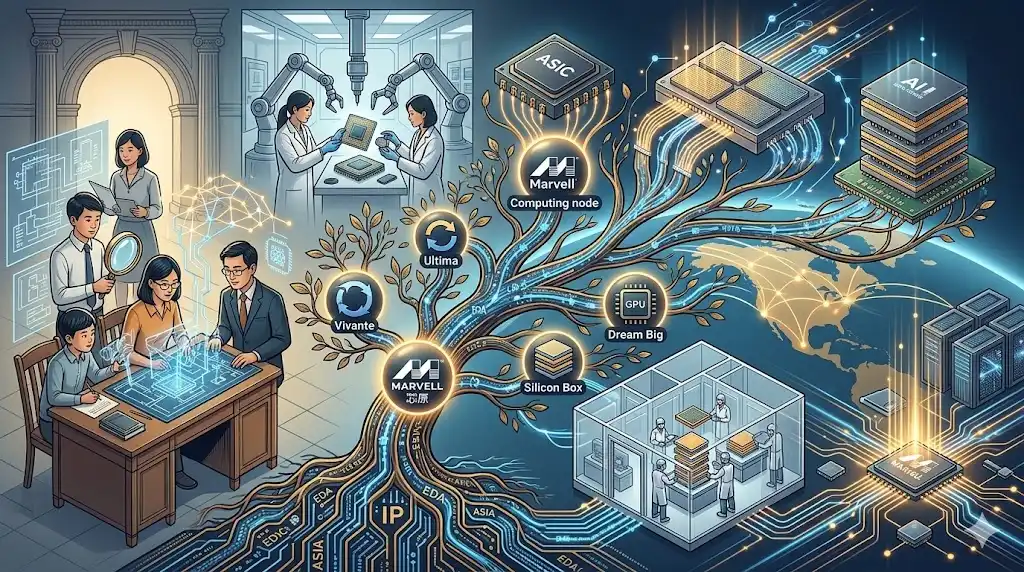
The stock price of Marvell Technology surged 32.5% on June 2nd, driven by NVIDIA CEO Jensen Huang highlighting its custom ASICs and optical interconnects as core to AI data center architecture. This event brought attention to the Chinese semiconductor family behind Marvell: the Dai siblings. The story centers on three siblings, all UC Berkeley graduates, whose three-decade entrepreneurial journey aligns with major semiconductor industry shifts. In 1995, youngest sister Dai Wei Li co-founded Marvell with her husband Sehat Sutardja and his brother, focusing on storage controllers. Eldest brother Dai Wei Min founded EDA company Ultima, later sold to Cadence, and later founded VeriSilicon (芯原) in China, becoming a leading semiconductor IP provider. Second brother Dai Wei Jin co-founded EDA firm Silicon Perspective (sold to Cadence) and GPU IP company Vivante, later acquired by VeriSilicon. The combined "Dai-Sutardja" family network extends beyond Marvell. Their ventures and investments form a comprehensive ecosystem for the post-Moore's Law, chiplet era. Key holdings include: Dream Big Semiconductor (AI SuperNICs, acquired by Arm), Alphawave (high-speed SerDes IP, acquired by Qualcomm), and Silicon Box (a chiplet advanced packaging foundry). VeriSilicon itself thrives on the AI ASIC and IP boom in China. Collectively, the family's AI infrastructure-related portfolio is estimated at over $22 billion. Their strategy represents a distinct path: building critical components for open standards and key manufacturing capacity in the chiplet era, rather than pursuing standalone AI chip dominance. While this path may not create the next NVIDIA, it has enabled repeated successful exits and sustained influence within the global semiconductor industry.

marsbitHace 50 min(s)

After Marvell's 32% Surge, the Chinese Chip Family Behind It Emerges

marsbitHace 50 min(s)

Microsoft is Afraid of Being Marginalized by AI Giants

Microsoft, once the defining force of the PC era, now faces a familiar challenge in the AI age: the risk of being relegated to a profitable but invisible infrastructure provider. This anxiety was laid bare at Build 2026, where CEO Satya Nadella unveiled a major strategic pivot. The catalyst was a quiet April agreement that dissolved Microsoft's exclusive licensing and cloud-hosting deal with OpenAI, its once-vital partner. This erased Microsoft's key AI moat. With OpenAI and Anthropic defining AI applications and gaining enterprise traction—even within Microsoft's own ranks—Nadella had to answer: without exclusivity, what is Microsoft's role? The answer was a suite of seven in-house AI models, a developer-focused AI workstation (Surface RTX Spark Dev Box), and, most crucially, the Agent 365 platform for enterprise AI governance. The models, notably targeting Anthropic's strengths in coding and enterprise, signal a defensive move. However, the broader strategy is to make the models themselves less decisive. Financially, Microsoft's AI revenue is strong, driven largely by Azure running others' models. Yet its user-facing products like Copilot show weak penetration and engagement. Microsoft earns infrastructure money but lacks direct user mindshare. Nadella's core fear is being "hollowed out." As OpenAI and Anthropic prepare for IPOs and gain financial independence, they may build their own infrastructure, threatening Azure's lucrative AI revenue stream. Microsoft's window is to entrench itself deeper: not as the model creator, but as the indispensable platform for securely deploying, managing, and governing all AI models within the enterprise through Agent 365. Build 2026 revealed Microsoft's bet: in the AI era, the ultimate power lies not in any single model, but in the enterprise "operating system" that controls them. Nadella is determined to ensure Microsoft is the driver of this new era, not just a passenger.

marsbitHace 1 hora(s)

Microsoft is Afraid of Being Marginalized by AI Giants

marsbitHace 1 hora(s)

CPU, Quietly Returning to the Center of the AI Computing Power Stage

Over the past three years, AI computing power narratives have been dominated by GPUs. However, starting in 2026, this story began to shift. While training large models remains GPU-intensive, the rapid growth of inference and AI agent workloads, which require high levels of task orchestration, concurrency, and data flow management, has highlighted a renewed critical role for CPUs. These are tasks GPUs are not designed to handle. Intel's recent launch of the Xeon 6+ processor, built on its Intel 18A process and featuring up to 288 efficiency cores (E-cores), exemplifies this strategic pivot. It is positioned not as a mere companion to GPUs but as the essential "control plane" for AI infrastructure, optimized for high-density, energy-efficient, and high-throughput workloads characteristic of AI agents and inference. This "CPU resurgence" is not about CPUs outperforming GPUs in raw computation. It reflects a systemic bottleneck: as AI scales from training single models to deploying countless intelligent agents, the demand for coordination and data handling surges. Major cloud providers are also developing their own high-density ARM-based server CPUs for similar workloads. However, Intel's success with this strategy faces significant challenges. Competition includes NVIDIA's integrated CPU-GPU solutions, the expanding adoption of cloud vendors' in-house ARM CPUs, and the crucial market test of Intel's 18A manufacturing process against rivals like TSMC's N2. In conclusion, CPUs are indeed reclaiming a central, though redefined, role in AI compute—managing the complex orchestration that enables massive-scale AI deployment. While the trend is clear, which company will ultimately lead this CPU resurgence remains an open question to be decided in the data centers of 2027 and beyond.

marsbitHace 1 hora(s)

CPU, Quietly Returning to the Center of the AI Computing Power Stage

marsbitHace 1 hora(s)

Trading

Spot
Futuros

Artículos destacados

Cómo comprar ERA

¡Bienvenido a HTX.com! Hemos hecho que comprar Caldera (ERA) sea simple y conveniente. Sigue nuestra guía paso a paso para iniciar tu viaje de criptos.Paso 1: crea tu cuenta HTXUtiliza tu correo electrónico o número de teléfono para registrarte y obtener una cuenta gratuita en HTX. Experimenta un proceso de registro sin complicaciones y desbloquea todas las funciones.Obtener mi cuentaPaso 2: ve a Comprar cripto y elige tu método de pagoTarjeta de crédito/débito: usa tu Visa o Mastercard para comprar Caldera (ERA) al instante.Saldo: utiliza fondos del saldo de tu cuenta HTX para tradear sin problemas.Terceros: hemos agregado métodos de pago populares como Google Pay y Apple Pay para mejorar la comodidad.P2P: tradear directamente con otros usuarios en HTX.Over-the-Counter (OTC): ofrecemos servicios personalizados y tipos de cambio competitivos para los traders.Paso 3: guarda tu Caldera (ERA)Después de comprar tu Caldera (ERA), guárdalo en tu cuenta HTX. Alternativamente, puedes enviarlo a otro lugar mediante transferencia blockchain o utilizarlo para tradear otras criptomonedas.Paso 4: tradear Caldera (ERA)Tradear fácilmente con Caldera (ERA) en HTX's mercado spot. Simplemente accede a tu cuenta, selecciona tu par de trading, ejecuta tus trades y monitorea en tiempo real. Ofrecemos una experiencia fácil de usar tanto para principiantes como para traders experimentados.

369 Vistas totalesPublicado en 2025.07.17Actualizado en 2026.06.02

Cómo comprar ERA

Discusiones

Bienvenido a la comunidad de HTX. Aquí puedes mantenerte informado sobre los últimos desarrollos de la plataforma y acceder a análisis profesionales del mercado. A continuación se presentan las opiniones de los usuarios sobre el precio de ERA (ERA).

活动图片