The End of Single-Factor Cryptography

marsbitPublicado a 2026-06-05Actualizado a 2026-06-05

Resumen

The article "The End of Single-Factor Crypto" posits a fundamental shift in the cryptocurrency ecosystem. It argues the era where crypto asset valuations were predominantly driven by, and correlated with, Bitcoin's price is ending. The space is bifurcating into two distinct economies: endogenous and exogenous. The endogenous economy represents traditional crypto, where token and project values are directly tied to crypto market prices. The emerging exogenous economy comprises projects and businesses that may utilize blockchain technology or tokens but derive their fundamental value from external, non-crypto factors like consumer demand, subscription revenue, or real-world utility. Examples include AI inference platforms like Venice, fintech lenders using blockchain for efficiency, and stablecoin/payment infrastructure companies acquired by giants like Mastercard and Stripe. This shift means investment analysis must change. For exogenous assets, evaluating traditional business fundamentals—such as revenue streams, unit economics, and competitive moats—becomes more critical than tracking Bitcoin charts. While endogenous assets like Bitcoin remain relevant, the growth of the exogenous category is driven by measurable demand independent of crypto price cycles, paving the way for a new, more diversified market phase. Consequently, crypto is evolving from a single-factor, reflexive asset class into a multifaceted ecosystem with varied drivers and investment theses.

Written by: Charlie

Compiled by: Block Unicorn

Lately, our discussions have touched less and less on cryptocurrency. We end up talking about lending businesses, AI subscription models, and the payment channels that Stripe and Mastercard are fighting over. Last Friday, we discussed how the upcoming trillion-dollar IPOs of OpenAI, SpaceX, and Anthropic will affect broader financial markets. Even when a cryptocurrency project is mentioned, halfway through the discussion, you realize that no one has mentioned "token price."

This shift is also reflected in our recent reporting content. In the past two weeks, our reporting focus has shifted to stories from the fringes of the cryptocurrency space. For example, fintech companies using blockchain as infrastructure, consumer products where tokens serve as distribution mechanisms rather than the product itself, and cases of infrastructure companies with valuations unrelated to cycles being acquired. Whether Bitcoin is $100,000 or $70,000, these developments continue to advance.

This article was originally published by Hepworth Iron Capital. This week's piece builds a framework for this phenomenon. Charlie Booth argues that the era of cryptocurrency as a single Bitcoin-sensitive factor is ending, paving the way for a new cycle driven by non-cryptocurrency factors rather than cryptocurrency prices.

Historically, cryptocurrency trading has been one of the factors sensitive to Bitcoin's price. But that situation is ending.

The crypto economy is bifurcating into two types: an endogenous economy and an exogenous economy.

The former is traditional cryptocurrency: the value of tokens and projects depends on the price of cryptocurrency. The latter is just cryptocurrency in name, with its value increasingly detached from cryptocurrency prices.
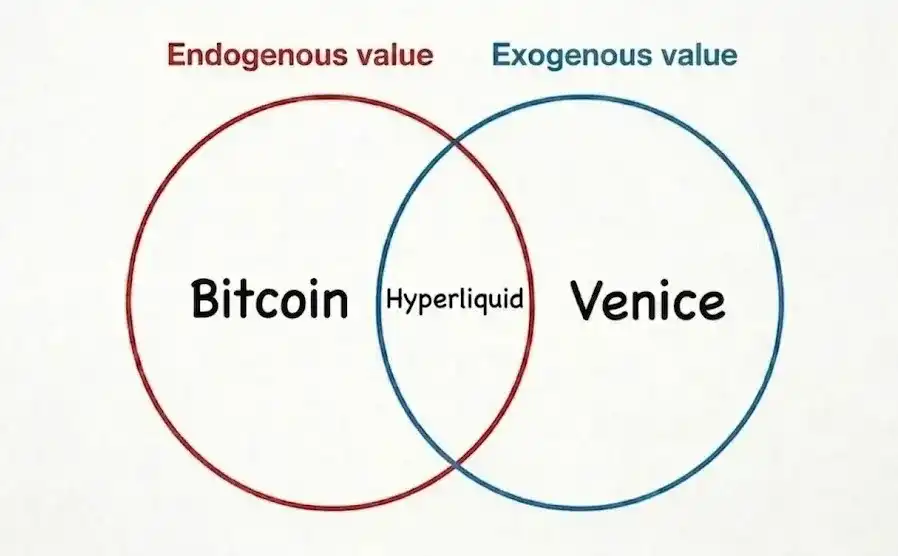
Bitcoin's value stems from its characteristics, which are reflected in its price. Price increases reinforce people's perception of its characteristics. At the peak of a bull market, Bitcoin is seen as an interstellar currency, the scarcest digital credential known to mankind. At the trough of a bear market, it's viewed as a digital collectible without any cash flow.

Hyper-liquidity lies between the endogenous and exogenous groups. Most of its business still relies on cryptocurrency prices, but both supply and demand are expanding. Much of the on-chain financial infrastructure resides here, with underlying assets shifting toward tokenized real-world assets.
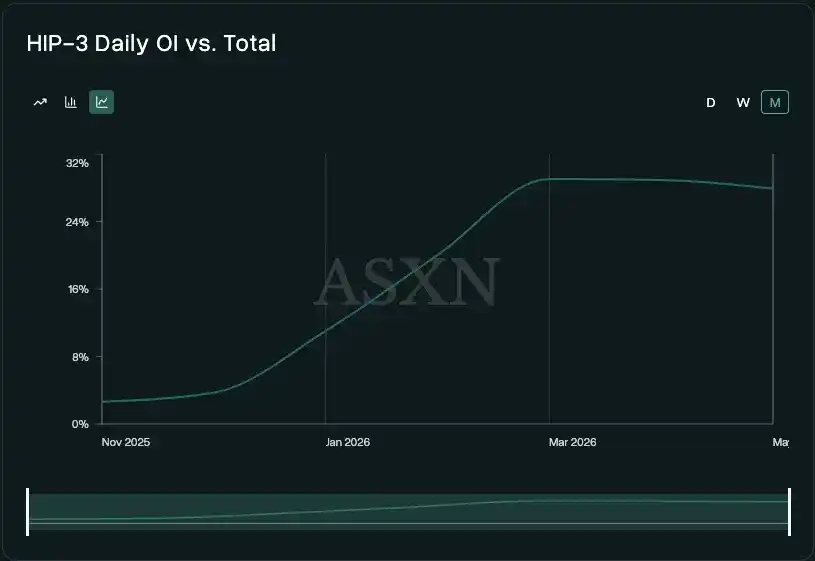
HIP-3 open interest can roughly represent non-cryptocurrency-related open interest. HIP-3 accounts for about 30% of total hyper-liquidity open interest, up from about 4% in November 2025. HIP-4 (Outcome Markets) is expected to further drive this ratio while attracting new demand (traders) and new supply (markets, assets).

Looking at purely exogenous factors, the drivers behind projects like Venice are completely independent of the cryptocurrency market. While user profiles overlap, their business model resembles consumer-facing AI more than Uniswap. Uniswap still primarily relies on users trading assets with endogenous value, making its business closely tied to the price of those assets. Venice, on the other hand, packages private multimodal reasoning into a "use + subscribe" model.
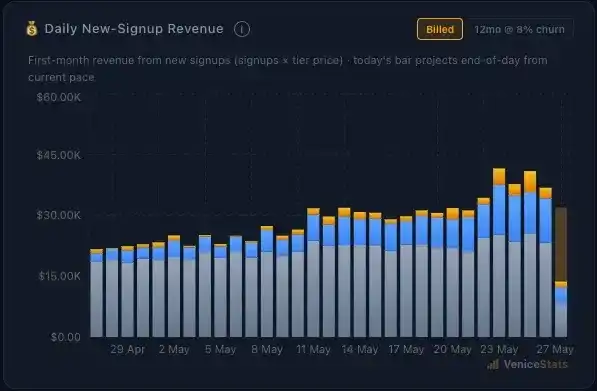
Venice's only connection to cryptocurrency is its choice of tokens as a tool to measure business value, and the fact that some of its derivatives suppliers happen to have a cryptocurrency label. Perhaps, this is also influenced by the deep understanding of cryptocurrency held by Venice's manager, Erik Voorhees, who believes that if applied properly, tokens can be excellent marketing tools.

Figure 1 is a simple example from the listed equity space: a fintech lender using its self-developed blockchain to reduce home equity loan approval time to under five minutes. Blockchain technology is incidental; the business model is key.

The large-scale emergence and growth of the exogenous category in both listed equity and token markets are significant. Historically, purely bottom-up investing has been difficult to achieve because most business models were highly sensitive to cryptocurrency prices. Cryptocurrency has never been devoid of exogenous narratives; every "blockchain, not Bitcoin" cycle promised such narratives. But in most cases, these narratives eventually reverted to the cryptocurrency beta category because demand never truly materialized, revenue didn't materialize (and if it did, it wasn't absorbed by tokens), and once token prices stopped rising, there was nothing left behind.

What's different this time is that you can answer who is paying and why, demand is measurable in many cases and is less reflexive, and the performance of tokens as a tool is gradually improving (more on this later). Venice's registration revenue is real money users pay for inference. When cryptocurrency prices fall, there's no obvious reason for it to reverse because it was never a function of price. You now have two things previous cycles lacked: sustained usage, and buyers investing based on fundamentals rather than just narrative.

Take the stablecoin sector in private markets as an example. In March 2026, Mastercard agreed to acquire BVNK for up to $1.8 billion, just 15 months after BVNK completed its Series B funding with a valuation of $750 million. According to Stripe's annual letter, Bridge (acquired by Stripe for $1.1 billion in February 2025) grew fourfold annually within Stripe. This growth is unrelated to cryptocurrency cycles.

This is not a bearish prediction for the endogenous asset class. Just as gold, and even small gold mining companies, have their place in an investment portfolio, Bitcoin and endogenous asset classes have their value and timing. But fundamentally, different drivers may continue to affect their performance and correlation. You can see these two relationships in the data:
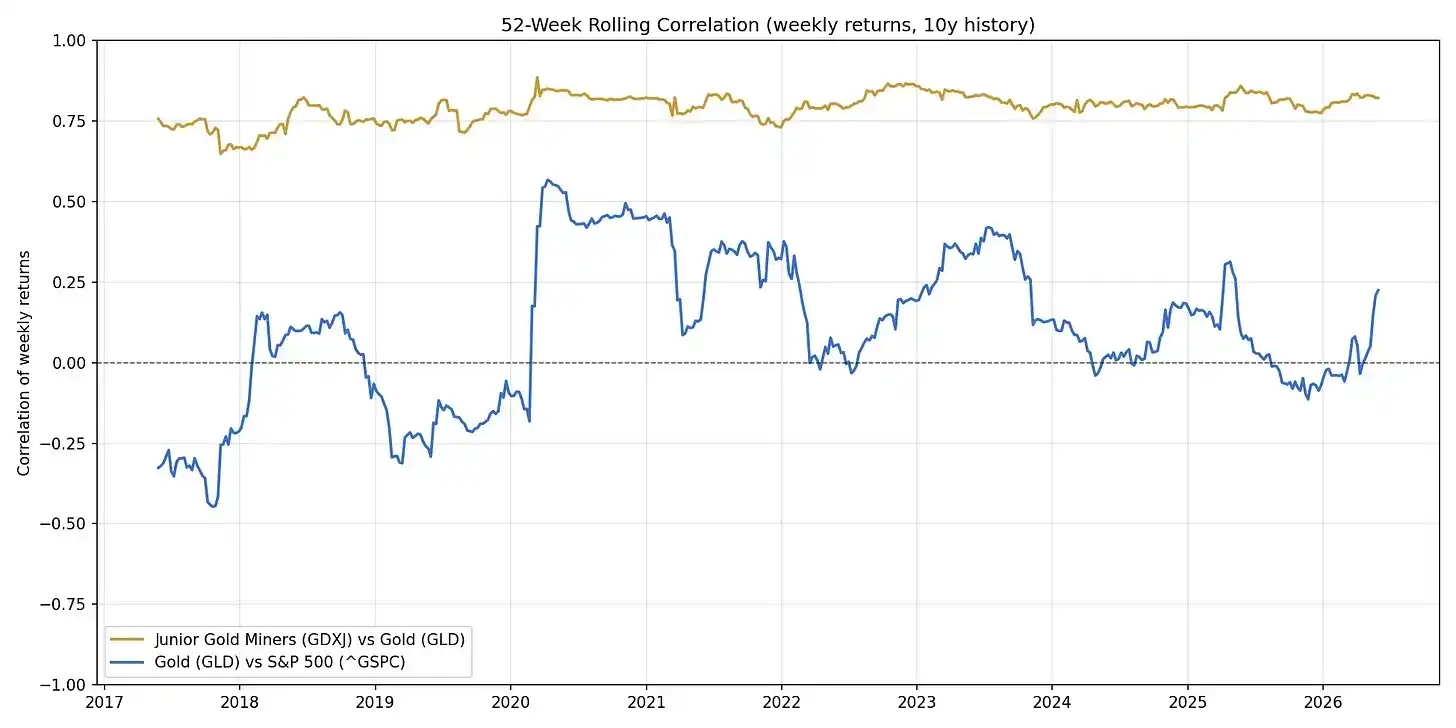
This metaphor can be visualized: small gold miners have a correlation with gold that rarely strays beyond the 0.75 range. Cryptocurrency now trades much the same way: small miners correlate with Bitcoin like gold, while leveraged trades bet on the same underlying asset. The blue line represents another relationship. Gold and the S&P 500 have some macroeconomic correlation, but they trade based on their own distinct drivers. This is the ultimate destination for exogenous asset classes. Over time, these assets should shift from the gold-related line toward the blue line, transitioning from leveraged proxy assets to independent assets occasionally correlated with economic conditions.
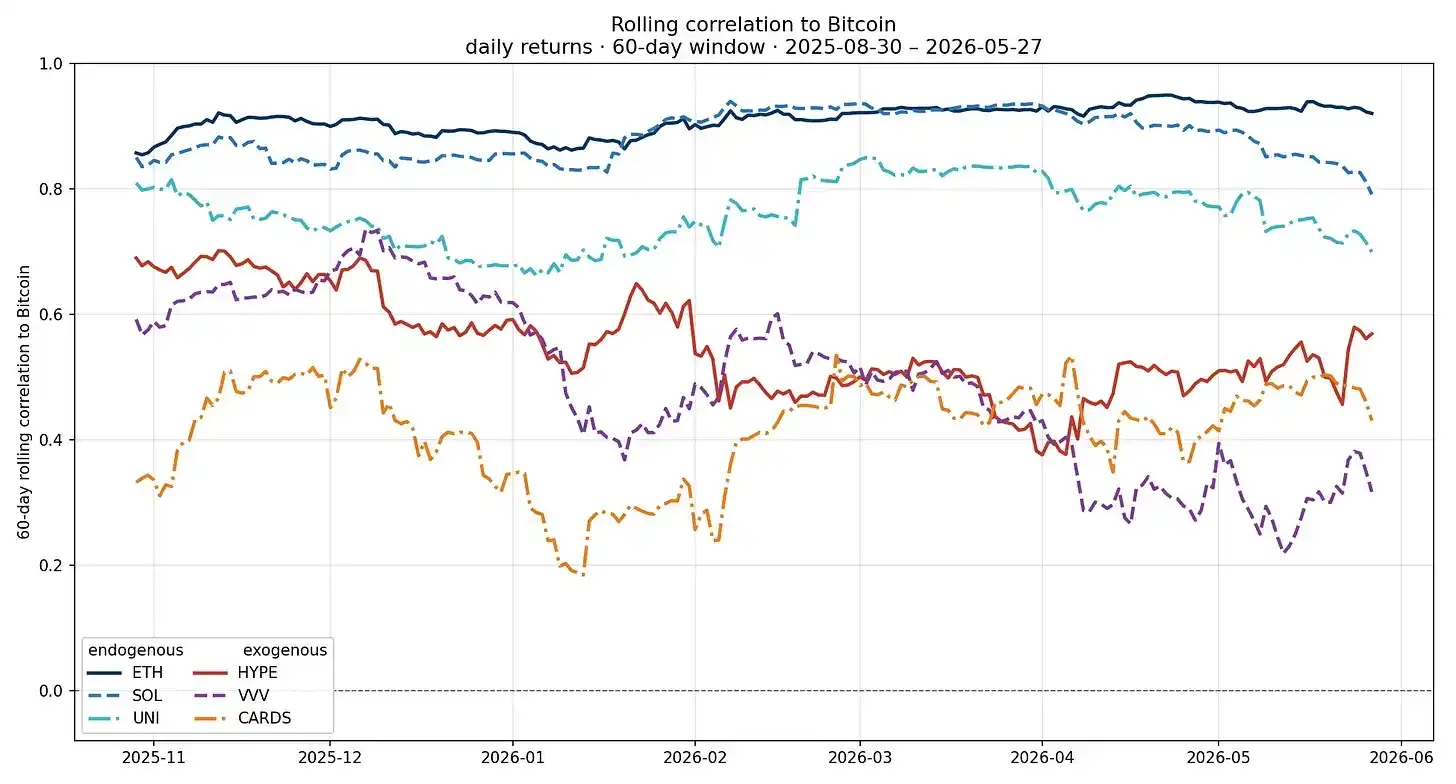
These exogenous names are examples, illustrating the point and also serving as exceptions to it.

Many "endogenous" assets still move closely with Bitcoin. Some exogenous assets have declined, but the time window is too short to mean anything yet. Fundamentals change first; correlation changes later.

This changes the analytical approach. The exogenous category needs underwriting like any ordinary business: who pays for the product, how unit economics work, and where the moat is. Bitcoin price is no longer the most important variable; your analysis sounds like that of a fintech investor with strange custody arrangements.

Some exciting "exogenous" categories, in no particular order, with various notes:

  • On-chain exchanges and brokers
  • Credit / redemption solutions for long-tail tokenization (Grove Basin looks interesting in this regard)
  • Real crypto x AI (private inference, distributed open-source model training, similar to Nous Research's Psyche)
  • Neobanks (I prefer more privacy-focused platforms like Payy and Raycash, and the programmable privacy infrastructure supporting them, like Aztec and Zama, is also interesting).
  • Lending (Morpho is becoming the institutional standard akin to the repo market, while smaller companies like Valinor and 3jane target interesting niches in private credit)
  • Stablecoin and real-world asset / tokenization issuers
  • Payment channels (In broad payment channels, Stripe and Tempo are currently the ones to beat; in proxy payments, it's currently Coinbase).
  • Non-financial consumer crypto (e.g., products like Venice and Collector Crypt, these special cases show that assigning value from non-crypto businesses to tokens can enhance market value and adoption).
  • Agent economy (The key lies in the coordination between access-layer agents and suppliers/creators, which is less fungible than the rails. Cloudflare is well-positioned, but whether it taxes traffic or merely sells switches remains to be seen).

Currently, the most enduring way to invest in this theme is equity, not tokens. Quality tokens are the exception; they can play a larger role only if the tokens themselves improve, which requires joint efforts from regulators and the industry. There's been some progress on both regulatory and transparency fronts: the CLARITY Act on the regulatory side, and efforts by companies like Blockworks to improve transparency. Tokens have a long way to go.

None of this changes the key point. The drivers are shifting from a single factor to multiple factors; the work is no longer interpreting Bitcoin charts but funding businesses. Don't be confused in the next decade about why "cryptocurrency" no longer moves in unison as it once did.


Preguntas relacionadas

QWhat is the main argument presented in the article about the evolution of the crypto economy?

AThe article argues that the era of 'single-factor crypto'—where all cryptocurrency assets and projects were primarily driven by and sensitive to Bitcoin's price—is ending. The crypto economy is bifurcating into an 'endogenous' economy (traditional crypto, value tied to crypto prices) and an 'exogenous' economy (projects using crypto or blockchain where value is driven by non-crypto factors like real business fundamentals).

QAccording to the author, what distinguishes 'exogenous' crypto projects from 'endogenous' ones?

AExogenous crypto projects are distinguished by having business models and value drivers that are independent of cryptocurrency prices. Their demand and revenue are based on real-world use cases and fundamentals (e.g., AI subscription services, fintech lending, payment channels), rather than being a reflexive function of the price of Bitcoin or other crypto assets.

QWhat example does the article use to illustrate a project in the 'exogenous' category?

AThe article uses 'Venice' as a key example. Venice packages private multimodal AI inference into a 'usage + subscription' model. Its revenue comes from users paying for inference, and its success is not inherently tied to crypto market cycles, even though it may use tokens as a tool for marketing or measuring business value.

QHow does the article suggest the investment analysis approach should change for 'exogenous' crypto assets?

AFor exogenous crypto assets, investment analysis should shift from primarily interpreting Bitcoin price charts to underwriting businesses like a traditional venture or equity investor. This involves assessing who pays for the product, how unit economics work, and where the business's competitive moat lies, as Bitcoin price is no longer the most critical variable.

QWhat does the article imply about the future correlation between different types of crypto assets and Bitcoin?

AThe article implies that endogenous assets will likely remain highly correlated with Bitcoin (like small gold miners to gold), while exogenous assets should see their correlation with Bitcoin decrease over time. They are expected to evolve from being leveraged proxies for crypto prices into independent assets whose performance is driven by their own specific, often non-crypto, fundamentals.

Lecturas Relacionadas

After Three Consecutive Quarters of Decline, Can the Crypto Market Find a Window for Stabilization in Q3?

The cryptocurrency market has just concluded its worst-performing quarter since 2022, with total capitalization dropping 12.6% to $2.1 trillion. All core metrics indicate capital is leaving the sector, not just rotating within it. Bitcoin fell 14.2% and Ethereum dropped 25.4% in Q2, breaking their previous correlation with US tech stocks. A key driver is the reversal in US spot Bitcoin ETF flows, which saw a net outflow of approximately $4.67 billion in Q2, including a record monthly outflow near $4.5 billion in June. While recent data suggests long-term holders are accumulating again, sustained ETF outflows mean continued selling pressure. Market focus is now singularly on the Federal Reserve. The upcoming July FOMC meeting is seen as the most critical event for Q3. A dovish signal could support Bitcoin reclaiming a $68,000-$84,000 range, while a hawkish stance might establish a new trading band around $50,000-$56,000. Additionally, regulatory uncertainty persists, with the progress of the crucial *CLARITY Act* stalling in the Senate, reducing its perceived 2026 passage probability to 40-45%. Despite the broad downturn, a few sectors showed growth. Prediction markets saw nominal volume surge 48.7% year-over-year to $113.8 billion, and tokenized collectibles transaction volume rose 143% quarterly to $1.4 billion. The Real-World Asset (RWA) tokenization sector also continued steady growth, now representing ~$28.1 billion in on-chain value. The market's foundation for an extreme crash appears limited, with Bitcoin price hovering near its 200-week moving average. However, the trading paradigm has shifted from narrative-driven speculation to decisions based on price action, policy developments, and interest rate expectations, making a broad sentiment-driven rally unlikely in the near term.

marsbitHace 3 hora(s)

After Three Consecutive Quarters of Decline, Can the Crypto Market Find a Window for Stabilization in Q3?

marsbitHace 3 hora(s)

BIT Trading Moment: BTC Still Suppressed by Weekly 200 EMA, Rejection May Restart Decline; Storage and Semiconductors that Surged Last Night Begin Falling in Evening Trading

**Crypto & Stock Market Wrap: Bitcoin Tests Resistance, Stocks Retreat After AI Surge** Bitcoin consolidates around $66,000, facing key resistance near $68,000—an area seen as a major psychological and technical hurdle where previous rallies have failed. Analysts note the cryptocurrency is caught between its 200-week moving average (~$63,333) and 200-week EMA (~$68,328). A clear break above $68k is needed to signal a stronger bullish trend, while a rejection could lead to a retest of $63k support. Market sentiment remains cautious, with low futures open interest pointing to a low-liquidity rebound rather than a full bull market. Bitcoin spot ETFs saw another $203 million inflow. US stock futures pointed lower after a strong Tuesday session led by a massive rebound in semiconductors and memory stocks. The rally was fueled by renewed optimism about AI-driven hardware demand, with Micron, SanDisk, and SK Hynix surging. However, those gains reversed in pre-market trading. Super Micro Computer (SMCI) soared over 20% after hours on strong guidance and a record backlog. Other standouts included Rocket Lab and nuclear energy plays Oklo and X-Energy. Rising oil prices (Brent above $91) and climbing Treasury yields (10-year near 4.64%), however, are reigniting inflation concerns and acting as a headwind for equities. In Asia, markets were mixed. South Korea's KOSPI pared early gains to close slightly higher as semiconductor stocks like SK Hynix gave back initial surges. Japan's Nikkei edged lower as the yen hit a fresh 38-year low against the dollar, raising fears of potential market intervention. Key events to watch include the Samsung Galaxy launch, AMD's AI event, and a slew of major tech earnings from Alphabet, Tesla, and IBM after the close on Wednesday, followed by the ECB meeting and Intel's earnings on Thursday.

marsbitHace 3 hora(s)

BIT Trading Moment: BTC Still Suppressed by Weekly 200 EMA, Rejection May Restart Decline; Storage and Semiconductors that Surged Last Night Begin Falling in Evening Trading

marsbitHace 3 hora(s)

Former CFTC Chairman, Circle President Tarbert: Preaching Long-Termism While Cashing Out $30 Million Himself

Former CFTC Chairman and Circle President Heath Tarbert has consistently advocated for a long-term vision in public, urging patience from investors as Circle’s stock price has fallen significantly from its peak. However, it has been revealed that since Circle’s IPO, Tarbert has continuously sold his CRCL shares through pre-arranged trading plans, cashing out approximately $30 million, without making any public market purchases. This contrast between his public messaging and personal actions has drawn criticism. Tarbert joined Circle in July 2023 as Chief Legal Officer, leveraging his regulatory experience to help guide the company through its IPO and expansion. Despite promoting stablecoins as long-term infrastructure, he established a 10b5-1 trading plan just before Circle went public, leading to substantial stock sales over the following year. In March 2026, he initiated another plan to sell more shares. His career trajectory highlights a pattern of moving between high-level regulatory roles and influential positions in the financial sector. After resigning as CFTC Chairman in early 2021, he joined Citadel Securities as Chief Legal Officer just 27 days later, during a period of intense regulatory scrutiny for the firm. He later joined Circle, aiding its efforts to navigate regulatory challenges for its public listing. While Tarbert's expertise in policy and compliance is valuable to companies like Circle, his actions—advocating long-term confidence while personally divesting—raise questions about the alignment between his public statements and his private financial decisions, leaving investors who followed his advice to bear the market risks.

marsbitHace 3 hora(s)

Former CFTC Chairman, Circle President Tarbert: Preaching Long-Termism While Cashing Out $30 Million Himself

marsbitHace 3 hora(s)

Gate Research Institute: The 'Wall Street-ization' Wave of Crypto Financial Products – Competition or Integration?

The article titled "Gate Research Institute: Are Crypto Financial Products Sparking a 'Wall Street' Wave—Competition or Convergence?" explores the evolving relationship between the crypto ecosystem and traditional finance (TradFi). The piece begins by reflecting on Bitcoin's original 2009 vision of decentralization, disintermediation, and moving away from banks. It then contrasts this with the 2024 landscape, where key crypto assets like Bitcoin are increasingly held through Wall Street products like ETFs issued by giants like BlackRock. The article questions whether this signifies that TradFi is systematically taking over the rights to issue, price, custody, and distribute crypto financial assets. The core argument is that this is not a zero-sum takeover but rather a bidirectional convergence where each side addresses the other's weaknesses. Crypto offers 24/7 global markets, programmable settlement, and open access but lacks compliant channels, institutional-grade custody, deep fiat liquidity, and mainstream distribution. TradFi possesses these but is constrained by legacy systems, limited operating hours, and slow settlement. Two primary convergence paths are highlighted: * **Path A (CEX to TradFi):** Exemplified by Gate, which has progressed from offering tokenized stocks and CFDs to providing direct, real stock trading (US, Hong Kong, South Korea) within its platform, using USDT. * **Path B (TradFi to Crypto):** Exemplified by Robinhood, which has integrated crypto trading, acquired exchanges like Bitstamp, and is moving traditional assets like stocks onto the blockchain via tokenization and its own Layer 2. Both paths are ultimately competing to become the next-generation, unified financial account—a "super account" where users can seamlessly trade cryptocurrencies, stocks, ETFs, RWA (Real World Assets), and tokenized treasury products in one interface. The growth of RWA and tokenized treasuries (e.g., BlackRock's BUIDL) is presented as the asset-layer fusion, providing stable, yield-bearing assets on-chain and acting as a bridge between the two worlds. In conclusion, the "Wall Street-ization" of crypto is framed as a mutual transformation. Decentralized ideals persist in the protocol layer, while at the application layer, a more efficient, global, and accessible unified capital market is emerging from this convergence. The future competition lies not between crypto exchanges and stockbrokers, but between platforms vying to offer the most comprehensive asset coverage, liquidity, and user experience within a single account.

marsbitHace 3 hora(s)

Gate Research Institute: The 'Wall Street-ization' Wave of Crypto Financial Products – Competition or Integration?

marsbitHace 3 hora(s)

Trading

Spot
活动图片




