The dollar is weakening – The next crypto rally might start from Japan

ambcryptoPublicado a 2026-04-07Actualizado a 2026-04-07

Resumen

The article discusses how the weakening US dollar, combined with Japan's rising bond yields, could trigger the next cryptocurrency rally. Japan's 10-year bond yield has reached a multi-decade high of 2.42%, signaling persistent inflation and potential monetary tightening by the Bank of Japan. This has caused the yen to stabilize after a period of weakness, impacting the JPY/USD pair. Concurrently, cooling US Treasury yields are contributing to a softer US Dollar Index (DXY). Historically, a weaker dollar leads investors to rotate capital from traditional safe-haven assets into riskier ones like crypto, seeking higher returns. Analysts, including Peter Schiff, suggest an overvalued dollar could be a key catalyst for capital flowing into crypto markets. The convergence of these factors—rising Japanese yields reshaping global capital flows and a softening dollar—creates a favorable macro environment for a potential crypto market rally.

The ongoing West Asia crisis is still creating ripple effects across global markets. And Japan is becoming a clear case study.

Data from Trading Economics shows Japan’s 10-year bond yield climbing to 2.42%, the highest level in nearly three decades.

Rising yields point to persistent inflation pressure, leaving the Bank of Japan with little room to cut rates. Instead, markets are slowly starting to price in the possibility of further tightening.

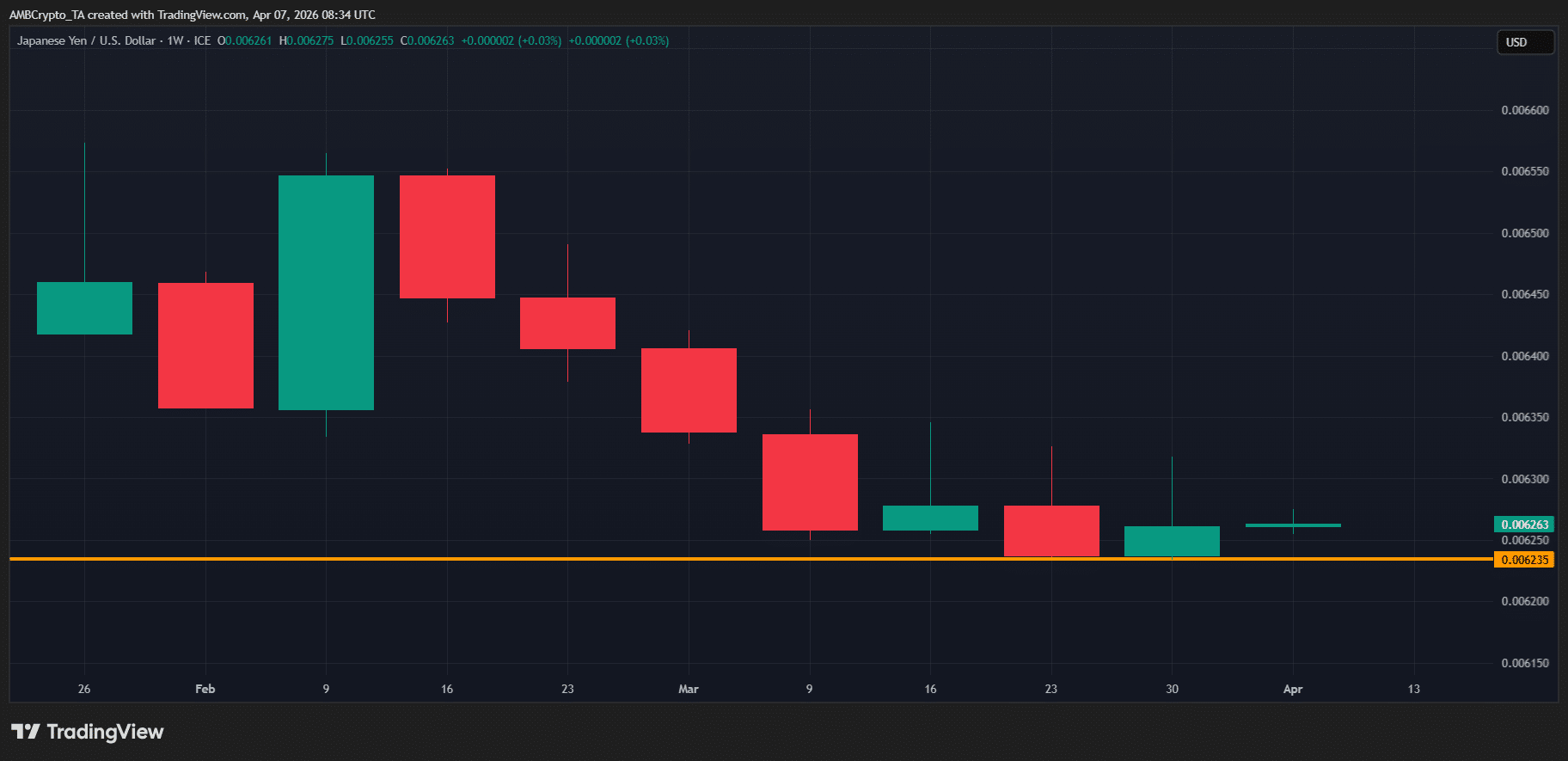
Notably, the currency market is already reacting. Throughout most of March, the JPY/USD pair moved into consolidation, and a similar structure is now forming in April, potentially signaling a local bottom.

For crypto markets, this is a macro signal worth paying attention to.
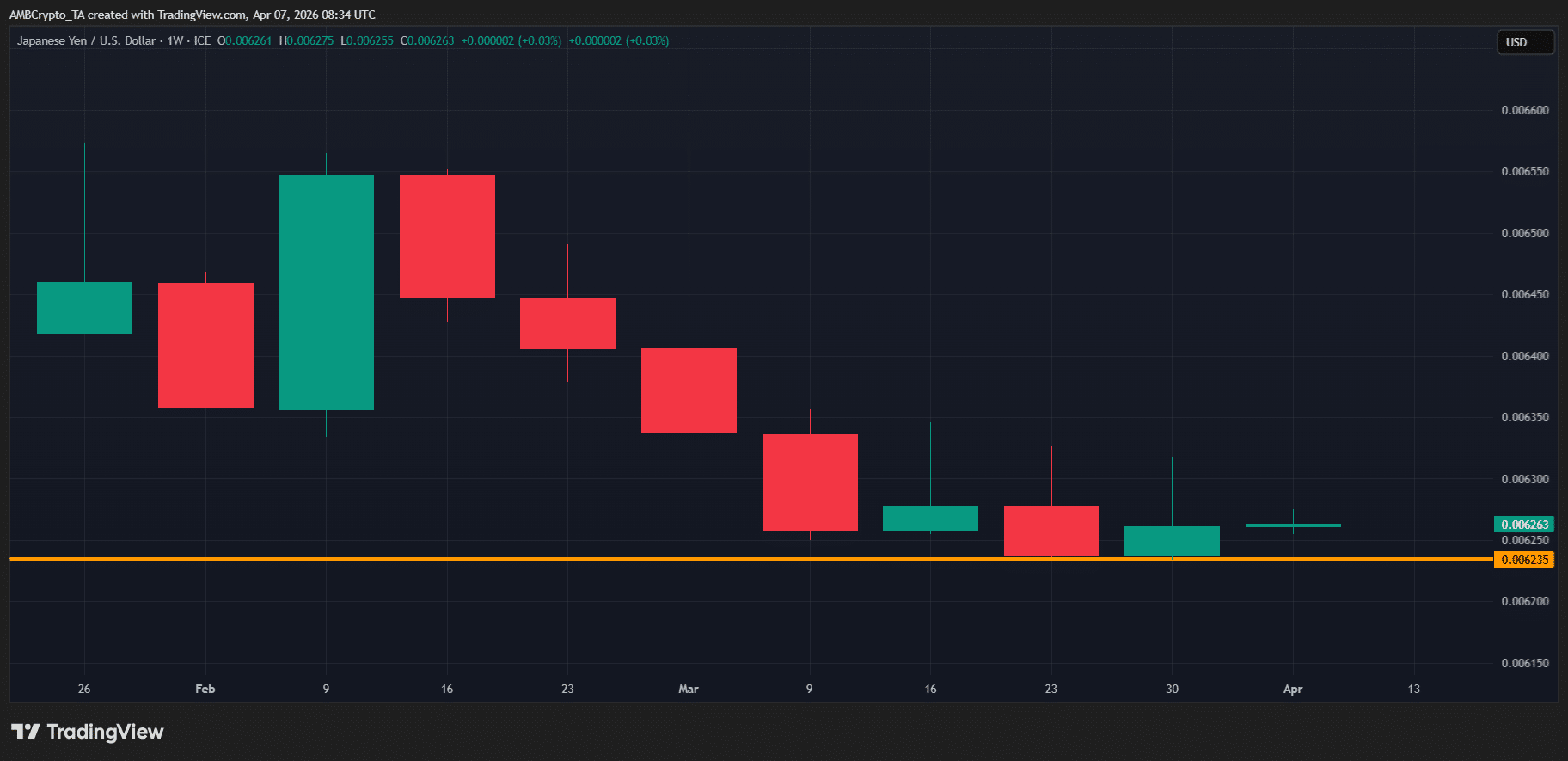
Source: TradingView (JPY/USD)

From a technical standpoint, rising bond yields usually point to capital rotating toward traditional safe-haven assets as investors prepare for tighter monetary conditions and the possibility of further rate hikes.

At the same time, the choppy behavior in the JPY/USD pair reflects the aftereffect of this adjustment phase.

In simple terms, the yen appears to be transitioning from sustained weakness into a stabilization phase. However, the bigger takeaway for crypto is what this means for the U.S. Dollar Index (DXY).

Historically, periods of dollar weakness have triggered capital rotation into risk assets, as yields from traditional safe havens become less competitive compared to the faster upside potential seen in equities and crypto.

Naturally, that raises a key question: Could a weaker dollar give crypto the macro tailwind it needs to break through the current FUD?

Analysts point to an overvalued dollar as crypto’s catalyst

U.S. Treasury yields are cooling off, and the dollar is starting to reflect it.

According to Trading Economics, the 10-year U.S. Treasury yield has dropped nearly 3% from its late-March peak of 4.43%, the highest level since July 2025.

This pullback highlights how ongoing geopolitical tensions have weighed on inflation and put the Fed in a tricky spot. The cooldown, however, now points to a shift in market expectations, with investors starting to price in a softer monetary stance.

Notably, the impact is showing up in markets. The DXY is down 0.35% this week after topping 100, while the total crypto market cap has rallied 3.5% since kicking off April’s run.

Taken together, this reinforces Peter Schiff’s point: An overvalued dollar can act as a catalyst for capital rotation into risk assets, including crypto.
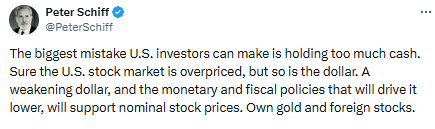
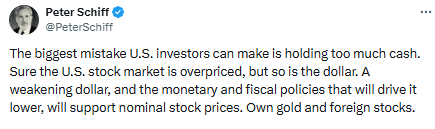
Source: X

In this context, Japan’s yield jumping to a multi-year high starts to carry real weight. Economically, rising Japanese yields are starting to shift global capital flows, as investors rotate into the yen and Japanese bonds, reshaping liquidity patterns.

When combined with a softening dollar, this setup becomes even more significant, creating conditions that could support inflows into risk assets like crypto.

For investors, this is a key macro signal to watch closely, highlighting where capital might flow next.


Final Summary

  • Japan’s multi-year high yields are reshaping capital flows, creating favorable conditions for crypto.
  • An overvalued dollar, as Peter Schiff highlights, can act as a key catalyst driving crypto inflows.


Preguntas relacionadas

QWhat is the significance of Japan's 10-year bond yield reaching 2.42%?

AJapan's 10-year bond yield climbing to 2.42% is the highest level in nearly three decades, indicating persistent inflation pressure and limiting the Bank of Japan's ability to cut rates, with markets starting to price in further monetary tightening.

QHow is the currency market, specifically the JPY/USD pair, reacting to these economic conditions?

AThe JPY/USD pair moved into consolidation throughout most of March and is forming a similar structure in April, which potentially signals a local bottom and a transition of the yen from sustained weakness into a stabilization phase.

QAccording to the article, what historical relationship exists between the U.S. dollar and risk assets like crypto?

AHistorically, periods of dollar weakness have triggered capital rotation into risk assets, as yields from traditional safe havens become less competitive compared to the faster upside potential seen in equities and crypto.

QWho is cited as pointing out that an overvalued dollar can act as a catalyst for crypto, and what evidence supports this view?

APeter Schiff is cited, and the evidence includes the DXY dropping 0.35% after topping 100 while the total crypto market cap rallied 3.5%, indicating a shift in capital flows.

QWhat is the combined effect of Japan's rising yields and a softening U.S. dollar, according to the analysis?

AThe combination of Japan's multi-year high yields shifting global capital flows and a softening U.S. dollar creates significant conditions that could support inflows into risk assets like cryptocurrency.

Lecturas Relacionadas

Bitcoin Withdrawals Continue: 8 Years of Storage in a Coldcard Cold Wallet Ended in Zero

Coldcard Hardware Wallet Hacked: Losses Mount Due to Vulnerable Seed Generation A critical vulnerability in Coldcard hardware wallets has led to a continued wave of fund thefts. According to Galaxy Research, the total stolen has reached 1,367.05 BTC (approx. $88.6 million) from 4,585 addresses, a significant increase from the initial 594.5 BTC reported on July 30, 2026. Most of the stolen funds remain on the attackers' addresses. The issue is not with the current firmware, which Coinkite has updated, but with seed phrases generated on vulnerable devices between March 2021 and the release of fixed firmware versions. Due to a programmer error, devices switched from using a hardware random number generator to the software-based Yasmarang generator, which was initialized with publicly accessible data like the chip's serial number. This made the seed phrases predictable through offline brute-force attacks, meaning wallets remain at risk until funds are moved to a new wallet generated with the patched firmware. Affected devices include Mk2/Mk3 with firmware 4.0.1–4.1.9 (and up to 5.0.3), Mk4/Mk5 up to version 5.6.0, and Q models up to 1.5.0Q. The only exceptions are seeds created with a high-entropy method like at least 50 independent dice rolls or a strong unique BIP-39 passphrase. All other owners must generate a new seed on the fixed firmware and transfer their assets. A case highlighting the human impact involves a 39-year-old long-term investor who lost 2 BTC (approx. $130,000) in minutes. He had accumulated the Bitcoin over eight years through physical labor, viewing it as a financial lifeline and a retirement plan in a country suffering from hyperinflation. His story underscores that even conservative "buy and hold in cold storage" strategies can be compromised by such underlying technical flaws. From a technical perspective, this incident echoes historical failures where weak random number generators undermined cryptographic security, challenging the assumption that offline storage is automatically foolproof.

cryptonews.ruHace 1 hora(s)

Bitcoin Withdrawals Continue: 8 Years of Storage in a Coldcard Cold Wallet Ended in Zero

cryptonews.ruHace 1 hora(s)

Trading

Spot
活动图片