The Dilemmas and Future of Web3 Chinese Entrepreneurs

marsbitPublicado a 2025-12-15Actualizado a 2025-12-15

Resumen

In the increasingly mainstream crypto industry, Chinese entrepreneurs appear to be receding from the center stage. While early Chinese-founded projects like Binance, OKX, and Bitmain once dominated sectors such as exchanges and mining, a noticeable decline in the visibility and influence of new-generation Chinese entrepreneurs has emerged since the 2020 DeFi Summer. Three major factors contribute to this trend. First, regulatory crackdowns and shifting geopolitical dynamics in China disrupted local crypto activities, forcing entrepreneurs to relocate overseas and lose their native market advantages in user acquisition and community building. Second, capital preferences have shifted structurally toward欧美-led ventures due to better compliance alignment and exit opportunities, leaving Chinese projects at a funding disadvantage. Third, a mismatch exists between the skill sets of Chinese engineers—who excel in B2C applications—and the industry’s earlier focus on B2B infrastructure development. Notable exceptions, like Hyperliquid’s Jeff Yan, highlight the rising importance of multicultural backgrounds. Many successful new-wave founders have Western education or experience, enabling better integration into global ecosystems. The article concludes that future success in crypto will depend less on cultural origin and more on cross-cultural collaboration, long-term technical commitment, and adaptive resilience amid regulatory complexity.

Author: Hu Tao, ChainCatcher

As the crypto industry becomes increasingly mainstream, Chinese entrepreneurs seem to be moving further away from the center stage.

There was a time when projects founded by Chinese entrepreneurs occupied half of the industry, including well-known cryptocurrency exchanges such as Binance, OKX, Bybit, Bitget, Gate, HTX, and Bitmart. This was even more true in the mining sector, where projects like Bitmain, Canaan, and Spark Pool held significant positions. Their commonality is that they were all established in 2017-2018 or even earlier.

Although figures like Changpeng Zhao, Mingxing Xu, Jihan Wu, and Justin Sun continue to be active on the front lines of the industry, a general consensus has gradually formed since the DeFi Summer boom in 2020: the visibility and influence of the new generation of Chinese entrepreneurs in the global crypto industry have declined, and no leaders comparable to the previous generation have yet emerged. Given this gap, what has happened to the ecosystem of Chinese entrepreneurs, and where do future opportunities lie?

Regulatory and Geopolitical Reshaping: The First Impact on the Ecosystem Disruption

The most significant factor over the past five years has been the drastic changes in regulatory and geopolitical environments.

Starting in 2021, China significantly increased its regulatory efforts on cryptocurrency-related activities, swiftly shutting down previously gray-area scenarios such as trading and mining. In recent market trends, almost any popular concept has been flagged by regulators, from earlier ICOs, NFTs, and digital collectibles to recent payment and real-world asset initiatives. This undoubtedly limits the inflow and support of quality resources into the Chinese crypto ecosystem.

These crackdowns not only accelerated the relocation of mining and exchange businesses but, more critically, deprived Chinese entrepreneurs of a native market with natural network effects, a dense talent pool, and capital aggregation advantages, forcing them to develop in unfamiliar overseas environments.

In the early crypto ecosystem, many explosively growing Chinese projects rapidly accumulated users through the mobilization mechanisms of Chinese internet communities: WeChat group fission, KOL networks, media matrices, offline gatherings... These channels were once among the most efficient systems for spreading crypto narratives. However, regulatory changes have largely rendered this system ineffective.
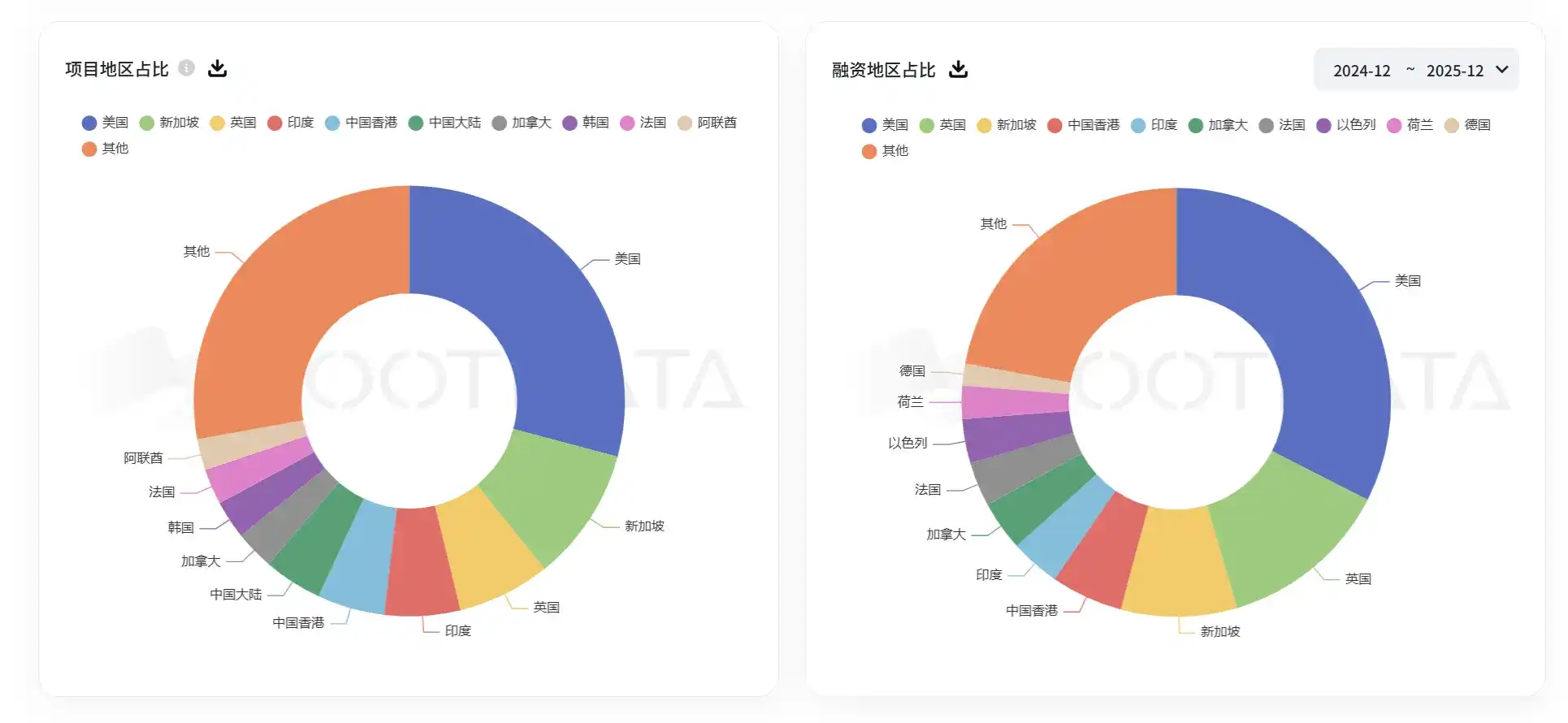
Proportion of projects and funding amounts from Mainland China in the industry. Source: RootData

Following this, the industry's power center quickly shifted to Europe and the United States—driven by U.S. compliance leadership, the influx of institutional capital, and increasingly mature regulatory frameworks, shaping an industry order starkly different from that of 2017–2018. New narratives, regulatory landscapes, and capital structures naturally favor English-speaking markets and compliance-oriented entrepreneurial teams. For instance, prediction markets, which have certain gambling-like properties, are unlikely to emerge in the Chinese-speaking market due to strict regulations on gambling.

In such an industry environment, the new generation of Chinese entrepreneurs also finds it harder to gain "default trust" from global media, regulators, capital, and users, requiring more trial and error costs in marketing, compliance, and other areas compared to similar Western projects.

Shift in Capital Preferences: The Second Impact on the Ecosystem Disruption

If regulatory and geopolitical barriers constitute the first impact, then the "structural shift in preferences" from the capital market side further exacerbates the marginalization trend of Chinese entrepreneurs in the new cycle.

In today's industry environment, without strong VC funding and resource support, projects are at a disadvantage in user acquisition, token listings, and narrative building. Chinese entrepreneurs are already at a disadvantage on the funding front.

Due to the poor performance of altcoins and a significant decline in investment returns, Chinese-background VCs have substantially reduced their investment frequency over the past 2-3 years, with some halting entirely. Chinese entrepreneurs face constrained options in both fundraising and exit paths. When dealing with Western-dominated VCs, Chinese projects struggle to leverage advantages due to language and cultural differences, leading to a continued decline in the amount and number of funding rounds secured by Chinese projects in recent years.

This year, the crypto industry has seen a wave of IPOs and acquisitions, with companies like Circle and Gemini successfully listing on U.S. stock exchanges, and Coinbase and Ripple frequently making acquisitions. This has significantly boosted confidence among entrepreneurs and VCs, but these developments have largely bypassed Chinese projects. It can be said that Western projects are enjoying the institutional红利 (benefits) of the crypto industry's mainstreaming.

From the perspective of mainstream capital, Western projects have inherent advantages in compliance, cultural alignment, and exit strategies. Chinese projects, unless they possess exceptional team composition and technical backgrounds, find it difficult to win the favor of Western capital.

Misalignment of Skill Sets and Industry Maturity: The Third Impact on the Ecosystem Disruption

Over the past decade, the main theme of the crypto industry has consistently been infrastructure and tooling sectors. Although there have been iterations of new concepts like DeFi, NFTs, gaming, and inscriptions, most have failed to become mainstream projects.

In a previous interview with ChainCatcher, Jason Kam, founder of Folius Ventures, stated that the development of Web3 over the past 5 to 10 years has been about laying the foundation, focusing more on product categories and states. This has been a decade偏重于 (leaning towards) ecosystem, infrastructure, tools, and consensus-building. In other words, a decade of B2B products.

The West has three generations of extremely talented engineers who are very adept at building this B2B ecosystem. In contrast, the Asia-Pacific region mainly has young engineers from the 80s and 90s generations, whose career paths developed alongside the wave of China's B2C industry starting around 2005. In other words, their engineering experience is in B2C and applications, which is格格不入 (incompatible) with the development trajectory of blockchain. Therefore, they might not excel in public chains and infrastructure.

"If Asia-Pacific entrepreneurs compete with Western entrepreneurs on the To C front, I believe Asia-Pacific entrepreneurs are at no disadvantage; in fact, they have advantages. Their strengths lie in their rich product experience and their highly aggressive tactics for capturing market share."

Although Chinese entrepreneurs have proven this point in the more Web2-like exchange sector, and in on-chain C-end products, the昙花一现 (short-lived) success of Stepn demonstrated the talent of Chinese entrepreneurs in C-end products, the overall market explosion for consumer-grade products has been slow to arrive. This is closely related to the maturity of industry infrastructure; the market has not yet reached the "comfort zone" for Chinese entrepreneurs.

Entrepreneurs with Multicultural Backgrounds Are Becoming Industry Leaders

Strictly speaking, there have been new representative cases of Chinese entrepreneurs in recent years. Jeff Yan, founder of Hyperliquid, is of Chinese descent. His parents were immigrants from China, and he was born and raised in Palo Alto, California. He later attended Harvard University, majoring in mathematics and computer science. After graduation, Jeff joined high-frequency trading giant Hudson River Trading as a quantitative trader. In 2022, Jeff founded Hyperliquid and, with a philosophy of "small but refined," no VC backing, and user-driven growth, built it into one of the fastest-growing giants in the crypto industry in recent years.

However, although Hyperliquid is one of the most successful projects this cycle with "Chinese heritage" involvement, it is difficult to view it as a continuation of the influence of Chinese entrepreneurs. Jeff is almost never active in the Chinese ecosystem, projects almost entirely Western values externally, and has never expressed himself in Chinese. The rise of Jeff and Hyperliquid highlights a fact: in the new cycle, Chinese heritage can still produce global influence, but the prerequisite is integration into the mainstream cultural system, not reliance on the old path of Chinese entrepreneurship. Relying solely on one cultural system can only make you a regional leader, not achieve outstanding results in the globalization process.

In fact, the founders of many well-known Chinese projects that have become sector leaders this cycle mostly have multicultural backgrounds, having studied in Europe or the US至少 (at least) at the university level. Examples include Sean Ren, founder of Sahara; Yu Hu, founder of Kaito; and Erick Zhang, founder of BuidlPad. Their long-term experience in the West plays a significant role in their development path.

Indeed, entrepreneurs with multicultural backgrounds are more popular in the crypto industry. For example, Ethereum's founder, Solana's founder, and Binance's founder Changpeng Zhao all immigrated from China/Russia to North American countries during their childhood. The collision of different political systems and cultures allowed these entrepreneurs to recognize the value of blockchain in empowering individual sovereignty earlier and take rapid action. They prioritize cultural inclusivity in team building, resource对接 (connection), and daily operations, ultimately making it easier to gain the favor of users from different regional cultural backgrounds.

The inherent borderless nature of crypto, conflicting and磨合 (grinding in/adapting) with the regulatory and interest demands of various countries, will dominate the development trend of the crypto industry for a long time. Chinese entrepreneurs indeed face increasing challenges against the backdrop of multiple Sino-US conflicts and the mainstreaming of the crypto industry. However, as the industry recently faces skepticism towards gambling tendencies, nihilism, and the disproval of more project concepts, the development态势 (situation) of Chinese entrepreneurs may no longer be a critical industry issue. What truly deserves attention is: as speculative growth and narrative泡沫 (bubbles) gradually recede, who can continue to invest in the long-term value of decentralized technology and redefine the industry's direction through real products and verifiable innovation.

The core competitiveness of the future industry landscape will depend more on whether founding teams possess cross-cultural collaboration skills, long-termist technological investment capabilities, and institutional understanding and organizational resilience in the face of regulatory uncertainty. Regardless of cultural or national origin, those who can persistently excel in these dimensions may become the true beneficiaries of the next cycle. In other words, the secret to success in the crypto industry has never been about "where they are from" but about "what they can achieve."


Preguntas relacionadas

QWhat are the main challenges faced by Chinese Web3 startups in recent years?

AThe main challenges include: 1) Stricter regulatory policies in China since 2021, which cut off domestic crypto activities and forced migration to overseas markets; 2) Shift in VC preferences towards欧美 projects due to compliance advantages and better exit opportunities; 3) A mismatch between the B2C-focused experience of Chinese engineers and the infrastructure-heavy, B2B-oriented nature of Web3 development in the past decade.

QHow has the regulatory environment in China impacted Chinese Web3 entrepreneurs?

AChina's intensified crypto regulations since 2021 have banned trading, mining activities, and restricted resources for concepts like ICOs, NFTs, and RWAs. This dismantled the efficient Chinese marketing ecosystem (WeChat, KOL networks, offline events), forced projects to relocate abroad, and reduced global trust in Chinese startups, increasing their compliance and marketing costs.

QWhy are Chinese Web3 projects receiving less venture capital funding compared to欧美 projects?

AChinese VCs have reduced investments due to poor altcoin performance and lower ROI.欧美 VCs prefer欧美 projects for their compliance readiness, cultural alignment, and better exit prospects (e.g., IPOs, acquisitions). Chinese projects struggle to attract欧美 capital unless they have exceptional technical teams, leading to a decline in funding amounts and counts.

QWhat advantages do Chinese entrepreneurs have in Web3, according to Folius Ventures' Jason Kam?

AJason Kam noted that Chinese engineers have strong B2C product expertise and aggressive market capture tactics from China's internet boom. In consumer-facing (To C) products, Chinese entrepreneurs are competitive or even advantaged compared to欧美 counterparts, as seen in exchange successes and StepN's brief rise, though infrastructure maturity limits broader C-end product breakthroughs.

QHow are multicultural backgrounds becoming important for success in Web3 entrepreneurship?

AMulticultural founders (e.g., Hyperliquid's Jeff Yan, Sahara's Sean Ren) often have exposure to diverse cultures, frequently through education or upbringing in欧美 countries. This fosters cross-cultural collaboration, compliance awareness, and global user appeal. Early exposure to different systems also heightens appreciation for blockchain's value in personal sovereignty, aiding in building inclusive, resilient teams and products.

Lecturas Relacionadas

If the AI Bubble Is Already Bursting, Who Will Truly Survive?

If the AI Bubble is Bursting, Who Will Remain? The debate over an AI bubble is intensifying, with figures like Ray Dalio warning of high levels and Jensen Huang seeing immense, early-stage opportunity. Both views hold truth: a speculative bubble in capital markets likely exists, mirroring the dot-com era, but the underlying technological shift is real and transformative. History shows that while bubbles burst—wiping out overvalued companies and speculative capital—they often leave behind critical physical and digital infrastructure. The dot-com bust, for instance, eliminated many firms but left the global fiber optic networks and data centers that enabled the rise of Amazon, Netflix, and cloud computing. Today's massive AI infrastructure investments (projected at trillions by 2030) in data centers, power, cooling, and GPUs may follow a similar path, creating the foundation for future applications. A key divergence from past bubbles is the "Jevons Paradox" effect in AI. As the cost of AI inference has plummeted by over 99.7% since 2023, enterprise spending on AI has skyrocketed. Cheap "tokens" have unlocked vast, previously uneconomical use cases, moving AI from simple chatbots into core business workflows—code generation, legal document review, scientific simulation, and financial analysis. The market is now in a phase of self-correction, weeding out superficial "API-wrapper" startups, but this cleansing process strengthens the ecosystem. The long-term trajectory is clear. The value is gradually shifting from capital expenditure (CapEx) on hardware to operational expenditure (OpEx) on transformative applications. As AI becomes a utility, the winners will be firms that deeply integrate it to solve vertical industry problems in law, healthcare, finance, and manufacturing. The泡沫 will recede, but the foundational shift towards an AI-powered era across all sectors is irreversible. The underlying productive force of AI contains no bubble.

marsbitHace 24 min(s)

If the AI Bubble Is Already Bursting, Who Will Truly Survive?

marsbitHace 24 min(s)

If the AI Bubble Is Already Bursting, Who Will Truly Remain?

**Summary: If the AI Bubble is Bursting, What Will Remain?** The debate around an AI bubble is intensifying, with figures like Ray Dalio warning of high valuations while Jensen Huang sees immense opportunity. This echoes the dot-com bubble, which saw massive wealth destruction but ultimately left behind critical infrastructure like undersea cables and broadband, enabling future giants like Amazon and Netflix. Similarly, today's AI boom involves trillions invested in data centers, power, cooling, and GPUs, while application-layer revenue remains comparatively modest. This investment-disparity signals a bubble. However, the core technological progress is real and accelerating. AI inference costs have plummeted by over 99.7% since 2023, making intelligence increasingly cheap and accessible. This cost collapse is unlocking vast new demand. Instead of reducing spending, enterprises are tripling their AI cloud expenditure. Cheap "tokens" enable AI to move beyond simple chatbots into complex workflows—automating code writing, legal document review, financial analysis, and scientific research. This follows "Jevons's paradox": improved efficiency leads to greater total consumption. The market is now undergoing a necessary purification, weeding out "API-wrapper" startups with no real moat. The deeper evolution involves a shift from capital expenditure (CapEx) on infrastructure to operational expenditure (OpEx) on value-creation in applications. While hardware vendors currently profit most, long-term value will migrate to AI-native firms solving vertical industry problems. Ultimately, a market correction will cleanse speculative excess but will not reverse the AI+ trend. The massive physical and algorithmic infrastructure being built will endure, becoming a cheap, utility-like foundation. Just as the internet became indispensable to all industries post-2000, AI is poised to empower and redefine every sector, moving society irreversibly toward an intelligence-augmented era. The bubble may burst, but the underlying productive momentum is solid.

链捕手Hace 31 min(s)

If the AI Bubble Is Already Bursting, Who Will Truly Remain?

链捕手Hace 31 min(s)

Microsoft CEO: In the AI Era, How Do You Define a Company's Moat?

Microsoft CEO Satya Nadella argues that in the AI era, a company's true competitive edge, or "moat," is not determined by choosing the single most powerful model, but by its ability to build a continuous "learning loop." This system integrates and evolves by connecting human workflows, domain expertise, organizational judgment, and employee experience. He posits that future companies will accumulate two types of capital: Human Capital (employee knowledge, judgment, creativity) and "Token Capital" (a firm's own built and owned AI capabilities). Importantly, AI amplifies rather than devalues human capital. Human direction is essential to guide progress, as computational power alone is aimless. The core opportunity lies in creating a closed-loop system where human and token capital reinforce each other in a compound, self-improving cycle. A company must be able to preserve its unique institutional knowledge—its "company veteran" expertise—even if it switches underlying general-purpose AI models. This requires private evaluation benchmarks, reinforcement learning environments based on internal data, and queryable knowledge bases. Nadella warns against a future where economic value is concentrated by a few dominant models that commoditize entire industries' knowledge. Instead, the priority should be building a broad "frontier ecosystem" where every company, industry, and nation can own its learning loop. This allows organizations to retain control of their intellectual property, amplify employee capabilities, and ensure the economic value created by AI is captured within their own businesses and communities. True corporate sovereignty in the AI age comes from turning organizational knowledge into a compounding system that creates enduring, defensible value.

marsbitHace 1 hora(s)

Microsoft CEO: In the AI Era, How Do You Define a Company's Moat?

marsbitHace 1 hora(s)

ETFs Are Just the Ticket: The True Institutionalization of Bitcoin Is Happening Where You Can't See It

Beyond the Bitcoin ETF spotlight, a deeper institutionalization is underway, leveraging Bitcoin as a foundational financial primitive. Institutions are using Bitcoin for purposes long reserved for assets like U.S. Treasuries and gold: as collateral for loans, insurance reserves, and the backbone of rated bonds. Examples include a Barbados-based insurer capitalizing with $40M in Bitcoin reserves and Ledn's $188M securitization of Bitcoin-backed loans, which received the first-ever investment-grade rating (BBB-) from S&P for a digital asset-backed security. This structure was stress-tested during a 27% price drop in early 2026, triggering automatic liquidations that functioned as designed but revealed the systemic risk of synchronized selling across leveraged positions. Infrastructure is evolving to support this, with platforms like Anchorage Digital's Atlas network enabling secure, institutional-grade settlement and collateral management. Strategies like basis trades and corporate treasuries (exemplified by companies like MicroStrategy issuing billions in equity and debt to fund Bitcoin acquisitions) further integrate Bitcoin into financial mechanics. While ETFs solved "how to own" Bitcoin, these developments answer "what to do with it," embedding the asset into the working machinery of finance—as collateral upon which loans, derivatives, and structured products are built. The real, enduring institutional shift is happening in these largely invisible plumbing and financing systems.

marsbitHace 1 hora(s)

ETFs Are Just the Ticket: The True Institutionalization of Bitcoin Is Happening Where You Can't See It

marsbitHace 1 hora(s)

ZEC Co-Founder Responds to Orchard Vulnerability: No Signs of Theft, Orchard Pool to Be Sealed

ZEC Co-Founder Addresses Orchard Vulnerability: No Signs of Theft, Plans to Sunset Orchard Pool A security vulnerability was recently discovered in Zcash's Orchard shielded pool, raising key concerns. The primary questions are whether the flaw was exploited, if user funds are safe, whether users can verify the total ZEC supply, and if other similar vulnerabilities exist. Analysis suggests the vulnerability was likely not exploited prior to its discovery. It was found proactively by a researcher using specialized tools, not due to an active breach. The development team and mining pools acted quickly to contain the issue. Typical financially-motivated attacks would likely have left visible on-chain evidence, which has not been observed. User funds in Orchard are considered safe and should be recoverable, assuming no prior exploitation. If the flaw was never used, all legitimate funds can be withdrawn. The article outlines risks associated with moving funds to transparent addresses or other pools, but concludes that leaving assets in place is a reasonable option. Currently, users cannot independently verify that the total ZEC supply hasn't been inflated due to this bug. However, the planned Ironwood network upgrade is designed to resolve this. It will permanently close the Orchard pool to new deposits and internal transfers, allowing only withdrawals. This mechanism will cap total withdrawals at the amount of legitimately deposited funds, enabling anyone to cryptographically verify the supply post-upgrade. Multiple teams, including Shielded Labs, have conducted extensive audits focused on counterfeiting vulnerabilities, assisted by advanced AI tools. No additional flaws of this type have been found so far, increasing confidence that no other similar undisclosed vulnerabilities exist. In summary, evidence indicates the Orchard bug was probably not used, user funds are secure, and no other counterfeiting flaws are currently known. The upcoming Ironwood upgrade will restore users' ability to independently verify the total ZEC supply, closing this chapter.

Foresight NewsHace 1 hora(s)

ZEC Co-Founder Responds to Orchard Vulnerability: No Signs of Theft, Orchard Pool to Be Sealed

Foresight NewsHace 1 hora(s)

Trading

Spot
Futuros
活动图片




