The Brutal Reckoning of the Public Chain Market in 2025: The Thriving Casino, The Fake Ghost Town, and VC's Harvesting Scheme

marsbitPublicado a 2025-12-18Actualizado a 2025-12-18

Resumen

Crypto Public Chains Face a Reality Check: A Grim Settlement in 2025 The crypto market, often perceived as a lens of soaring market caps and futuristic promises, reveals a starkly different reality when analyzed through on-chain fee data. A deep dive into DeFiLlama’s “Fees by Chain” metrics exposes a severe structural issue: the public chain ecosystem is dominated by profit concentration, while the long tail languishes in zombification. Notable examples highlight this disparity. Algorand, a chain backed by Turing Award-winning cryptography, recorded a meager $17 in daily protocol revenue despite a billion-dollar valuation. Similarly, Cardano, a top-ten asset by market cap, generates only around $6,000 in daily fees, indicating a lack of substantial economic activity beyond basic transfers. In contrast, the chains capturing real value are those serving clear, immediate demands. Tron leads with $1.24 million in daily fees, powered primarily by its role as a low-cost payment rail for USDT transfers. Solana follows with nearly $600,000, driven largely by its vibrant on-chain casino of meme coin trading and speculation. Base, backed by Coinbase’s distribution power, has also emerged as a serious contender. These cases underscore that proven, fee-generating business models in crypto are currently limited to payments, high-frequency speculation, and Ethereum’s role as a settlement layer. The analysis further reveals the failure of the VC-driven model. Newer chains like Sui, Sei,...

Author: BlockWeeks Block Weekly

In the cryptocurrency market, if you only look at Market Cap, you see a thriving, flourishing digital utopia. Valuations in the tens of billions of dollars, grand technical whitepapers, the aura of Turing Award winners... everything looks like the dawn of the next generation of the internet.

But if you put on a different pair of glasses—glasses that only see "On-Chain Real Revenue (Fees)"—you see a completely different, even spine-chilling picture: In this so-called trillion-dollar market, the vast majority of "unicorns" are actually zombies that have long stopped breathing.

Recently, BlockWeeks conducted a detailed analysis of the "Fees" data for public chains from DeFiLlama, and we discovered an unavoidable structural problem: The crypto public chain ecosystem has entered an era of "extreme profit concentration and collective zombification of the long tail."
The core data in this article is sourced from the "Fees / Revenue by Chain" panel on DeFiLlama (capture time: December 16, 2025). The "Fees" defined here refer to the total fees paid by users on-chain (top-line), an approximate indicator for measuring the scale of on-chain economic activity, not the protocol's net retained income (Protocol Revenue). This article aims to use this public, unified standard to examine the on-chain value capture capability of various public chains.

I. The $17 Humiliation: The Demise of the Technological Utopia

According to the public data we captured from DeFiLlama, the most alarming number is not the million-dollar giants at the top, but the $17 at the bottom.

This is the daily total protocol revenue for Algorand—a chain once crowned the "blockchain trilemma solver," founded by Turing Award winner Silvio Micali, and boasting top-tier technical credentials.

You read that correctly, not $170,000, but $17.
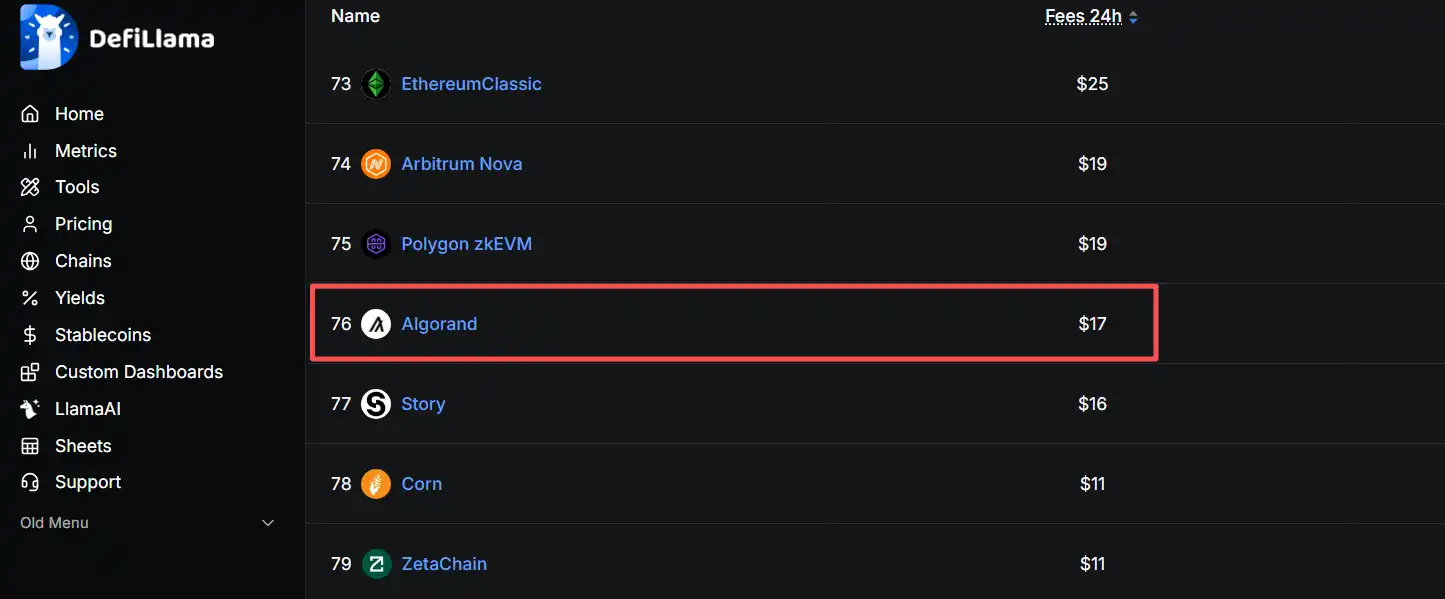
At this very moment, Algorand's market capitalization remains in the billion-dollar range. A "digital nation" valued at a billion dollars generates a direct tax revenue from its digital economy that isn't enough to buy four lattes at Starbucks. It shows that despite possessing the most advanced decentralized technology, without real, sustained application demand, its economic value capture capability approaches zero.

This is not just Algorand's embarrassment; it is the death knell for the entire "classic public chain" camp.

Look at Cardano (ADA), a behemoth steadily ranked in the top ten by market cap, with millions of token holding addresses. Yet the data tells us its recent average daily on-chain transaction fees hover around $6,000. This means that aside from asset transfers between holders and network maintenance staking, that chain lacks commercial activity significant enough to generate substantial fees—no large-scale lending, no high-frequency trading, no real, paid value exchange.

These public chains are like luxurious empty cities built at great expense in the middle of a desert. The infrastructure is complete, the roads are wide, the city hall (foundation) is well-funded, but no residents (active paying users) are seen on the streets. Their method of sustaining operation is often for the city hall to continuously sell off reserves (dumping tokens) to cover operational costs.

II. An Ugly Victory: Who is Actually Capturing Value?

When shifting focus to the top of the list, a fact that makes "technological purists" even more uncomfortable emerges: The ones making the most money are often not the most "elegant" or "decentralized" in terms of technology.

Topping the list is Tron, with average daily fees as high as $1.24 million. In the eyes of many elitists, Tron might hardly be considered "technical." But the market voting with its feet gives the ultimate answer: Payments are a rigid demand. Tron carries the vast majority of global USDT on-chain transfer demand. In this industry full of speculation and bubbles, Tron has inadvertently become the only payment application layer adopted at mass scale (Mass Adoption)—even if it merely serves as a shadow banking channel for fiat currencies.

One could say: Payments, the oldest and most basic internet need, is currently the only Mass Adoption in the Crypto world. Tron's success is a powerful mockery of all project teams that pursue "perfect technology" while ignoring "real demand."

Close behind is Solana, with average daily fees nearing $600,000. Its success logic is even more straightforward: It is the world's most active on-chain casino. Meme coins, high-frequency DEX trading, front-running—these activities contribute the vast majority of its fees. Solana's moat is no longer TPS, but "attention traffic." The rise of Base is even more disruptive (approx. $105k daily): it proves that distribution channels are far more important than the technology itself. Backed by Coinbase's huge user base, Base delivers a dimensional打击 to other L2s.

This provides a cruel and clear revelation: The current Crypto market has only two and a half business models that have been verified to generate large-scale on-chain fees—low-cost payments (Tron), high-frequency speculation (Solana/Base), and the asset settlement layer (Ethereum), which is being eroded by L2s.

Beyond these, those once highly anticipated "enterprise-level applications," "supply chain traceability," and "Web3 social" have, in the face of cold on-chain fee data, at least at this stage, not yet demonstrated scaled付费 demand.

III. The VC-Led Dilemma: Why "Peak at Launch"?

This data also reveals another deep crisis: The narrative model for new L1/L2s driven by massive venture capital (VC) funding is facing a brutal reality check regarding monetization.

We see that new public chains like Sui (approx. $12k daily), Sei (approx. $320 daily), and Starknet (approx. $10k daily), which launched with great fanfare and raised hundreds of millions of dollars, have on-chain fee revenues severely disconnected from their fully diluted valuations (FDV) of tens or even hundreds of billions.

The standard playbook of the past few years has been: VC investment -> Team piles on technical highlights -> Attract airdrop farmers to inflate metrics -> Token lists on exchanges creating wealth -> Retail investors buy into the narrative -> Airdrop farmers exit -> On-chain activity metrics plummet.

This is why many new chains show astonishing TPS and hundreds of thousands of daily active users at launch, only to quickly become "ghost towns" months later. Because those users are mercenaries, not residents. When airdrop expectations are met, when incentive subsidies stop, the real, organic demand is exposed for what it is—daily fees of a few thousand or tens of thousands of dollars simply cannot support the dream of a billion-dollar valuation.

We are facing a severe case of "block space inflation." The industry has built too many chains, too many L2s, too many Data Availability (DA) layers, but innovation at the application layer is extremely scarce. It's like, in the early days of broadband internet,狂热ly laying成千上万条光纤, but Netflix, YouTube, or any killer app that must consume that bandwidth hasn't been born yet.

IV. Investor Awakening: From "Listening to Stories" to "Checking the Books"

For a long time, the valuation logic of the crypto market has been built on "P/E ratio of dreams". The grander the narrative, the richer the imagination, the higher the market cap could soar.

But 2024-2025 is becoming a watershed moment. As macro liquidity tightens and institutional investors demand more substantial returns, the market is being forced to return to rationality.

For investors, the logic must change:

  1. Beware of "Zombie Coins": If a project has a market cap in the tens of billions but daily on-chain fees of only a few hundred or thousand dollars, this extreme case of "unworthiness" is often the starting point for a long-term decline. Its only support—community faith—will eventually run out.

  2. Focus on "Positive Cash Flow" Capability: Look for ecosystems where users are willing to持续 pay for services even without token incentives. Tron's stablecoin transfer fees, Base and Solana's transaction fees, are direct reflections of real demand.

  3. Acknowledge "Channels and Ecosystems are King": Base's success proves that pure technical superiority can hardly be a moat anymore. Giants entering with massive user bases (like Coinbase), or native communities capable of nurturing狂热 cultures, are more valuable assets at this stage. Purely technical public chains, if they cannot solve the "who will use it and why" problem, will ultimately become academic showpieces like Algorand.

  4. See Through the VC Game: Stop paying for false繁荣 driven by subsidies and airdrops.

Facing the harsh reality of $17 in daily revenue, rather than paying for grand narratives and empty "digital ghost towns," it's better to tighten your purse strings and turn to the few ecosystems that can generate real cash flow and have active paying users.

This is not to deny the long-term value of all technological exploration, but rather a necessary清算 of the current畸形的 valuation system. Only when the market learns to pay for "value actually generated," rather than透支 for "stories promised in the future," can this industry usher in a truly healthy dawn.

Important Notes and Evaluation Framework

The core of this article is to use the unified, public ruler of "On-Chain Fees" to measure the "Immediate Value Capture Capability" of various public chains. When reading and citing the conclusions of this article, please be sure to understand the following key context and limitations:

1. General Context

  • Differences in Development Stage: Some public chains may be technologically advanced but are in their early stages, and their user base has not yet formed scale effects. The data in this article reflects the "current state," not the "ultimate potential."

  • Impact of Fee Models: Some public chains are designed to pursue ultra-low transaction fees (Gas Fee), and their native token prices are low. This means that even if the number of on-chain transactions is considerable, the "total fee revenue" denominated in USD appears微小. This suggests that evaluating such chains should combine indicators like number of transactions, number of active addresses, but the upper limit of their economic throughput denominated in USD remains an objective fact.

2. Evaluation Notes for Specific Types of Chains

For a fairer discussion, we provide the following evaluation ideas for specific types of projects:

Chain Type This Article's Evaluation and Suggestion
Storage/Service Networks

(e.g., Filecoin, Arweave)

There is indeed a difference in scope. The core value of these networks lies in storage/retrieval services, and their revenue model differs from simple transaction fees. DeFiLlama's "Fees" metric may severely underestimate their actual commercial activity. If you are an investor, you should focus on examining their storage market capacity, active storage deals, and real storage revenue streams.
Off-Chain/Consortium Business-Driven Public Chains

(e.g., some enterprise chains)

The data has limitations. DeFiLlama only统计 public on-chain activity, and BlockWeeks完全认同 this point. But we同样 wonder, if the main value of a public chain is not reflected on-chain, then what supports the market capitalization of its publicly issued tokens used for on-chain governance and security?
Technically Low-Fee/High-TPS Public Chains The design初衷 is good. However, extremely low per-transaction fees mean the value captured by the chain itself and its validators is extremely low. The success of this model must rely on extremely high transaction volume to compensate for the low price disadvantage. If low fees fail to attract massive transaction volume, its economic model may face challenges.
Chains with Ecosystem Traffic Concentrated on CEXs Hard to evaluate. If a public chain's on-chain economic activity is weak and cannot generate sufficient fees, then its practical value and value capture capability as a "decentralized settlement layer" or "smart contract platform" are low. Its value might be closer to a mere "digital collectible."

We始终 believe that in a world of highly concentrated profits, projects in the long tail are almost sentenced to fate unless they find unique application scenarios (like gaming or specific AppChains). Only platforms that can generate cash flow through real, sustained user demand have the potential to survive long-term and outperform the market.


Preguntas relacionadas

QWhat is the core metric used in the article to evaluate the health and value capture of public blockchains, and why is it considered crucial?

AThe core metric is on-chain fees (total fees paid by users), as it serves as a direct, public, and unified proxy for measuring the scale of real economic activity and value capture on a blockchain, moving beyond market cap narratives to assess actual usage and demand.

QAccording to the article, which two and a half business models have been validated to generate significant on-chain fees in the current crypto market?

AThe two and a half validated business models are: 1) Low-cost payments (exemplified by Tron's USDT transfers), 2) High-frequency speculation (exemplified by Solana and Base's meme coin and trading activity), and the half being the settlement layer for assets (Ethereum), which is being increasingly fragmented by Layer 2 solutions.

QWhat does the '17 dollars' figure associated with Algorand represent, and what broader point does it illustrate about the public blockchain space?

AThe '17 dollars' represents Algorand's daily on-chain fee revenue at the time of the analysis. It illustrates the critical point that even a blockchain with advanced technology and a high market capitalization can have near-zero economic value capture if it lacks real, sustained application demand and user activity, making it a 'zombie chain'.

QWhat is the primary criticism the article levels against the venture capital (VC)-driven model for launching new Layer 1 and Layer 2 blockchains?

AThe article criticizes the VC-driven model for creating a cycle of 'artificial prosperity': massive funding -> technical hype -> airdrop farming to inflate metrics -> token listing and wealth generation for insiders -> retail investors buying the narrative -> farmers leaving -> a cliff-like drop in on-chain activity. This reveals a lack of organic demand and results in valuations that are severely disconnected from meager on-chain fee revenue.

QHow does the article suggest investors should change their evaluation framework when assessing blockchain projects, moving away from traditional crypto valuation methods?

AThe article suggests investors shift from valuing narratives ('storytelling') to scrutinizing financial fundamentals ('checking the books'). Key recommendations include: avoiding 'zombie coins' with high valuations but negligible fees, focusing on chains that generate positive cash flow from real user-paid fees, prioritizing distribution channels and vibrant communities over pure technical specs, and seeing through the artificial cycles created by VC and airdrop farming games.

Lecturas Relacionadas

IREN's Insanity: Selling Miners, Buying GPUs, Stock Price Up 16%

IREN, a Bitcoin mining company, saw its stock price surge 16% after releasing its quarterly earnings on May 8th. The surge was not driven by Bitcoin's price, but by the company's radical strategic shift away from cryptocurrency mining and towards AI infrastructure. The company reported a $140 million impairment charge after decommissioning and listing for sale 5,800 of its Bitmain S21 Pro mining rigs. It also maintains a policy of selling all mined Bitcoin daily, holding zero crypto assets. Despite this dismantling of its core business, investor sentiment was positive due to IREN's aggressive pivot into AI. This shift is backed by massive, long-term contracts. IREN announced a new 5-year, $3.4 billion collaboration with NVIDIA, which includes an equity investment commitment. This follows a previously secured 5-year, $9.7 billion GPU cloud services agreement with Microsoft. To support these deals, IREN acquired European data center capacity and cloud software capabilities. Management targets 480 megawatts of AI capacity, 150,000 GPUs, and $3.7 billion in annual recurring revenue by late 2026. While other North American miners are exploring hybrid "mining + AI" models, IREN is making a clean break, betting entirely on the booming demand for AI compute power. The move highlights a broader industry trend where the value of mining hardware is declining while GPU-based AI infrastructure is in critically short supply.

marsbitHace 37 min(s)

IREN's Insanity: Selling Miners, Buying GPUs, Stock Price Up 16%

marsbitHace 37 min(s)

Trading

Spot
Futuros

Artículos destacados

Qué es $S$

Entendiendo SPERO: Una Visión General Completa Introducción a SPERO A medida que el panorama de la innovación continúa evolucionando, la aparición de tecnologías web3 y proyectos de criptomonedas juega un papel fundamental en la configuración del futuro digital. Un proyecto que ha atraído la atención en este campo dinámico es SPERO, denotado como SPERO,$$s$. Este artículo tiene como objetivo reunir y presentar información detallada sobre SPERO, para ayudar a entusiastas e inversores a comprender sus fundamentos, objetivos e innovaciones dentro de los dominios web3 y cripto. ¿Qué es SPERO,$$s$? SPERO,$$s$ es un proyecto único dentro del espacio cripto que busca aprovechar los principios de descentralización y tecnología blockchain para crear un ecosistema que promueva la participación, la utilidad y la inclusión financiera. El proyecto está diseñado para facilitar interacciones de igual a igual de nuevas maneras, proporcionando a los usuarios soluciones y servicios financieros innovadores. En su esencia, SPERO,$$s$ tiene como objetivo empoderar a los individuos al proporcionar herramientas y plataformas que mejoren la experiencia del usuario en el espacio de las criptomonedas. Esto incluye habilitar métodos de transacción más flexibles, fomentar iniciativas impulsadas por la comunidad y crear caminos para oportunidades financieras a través de aplicaciones descentralizadas (dApps). La visión subyacente de SPERO,$$s$ gira en torno a la inclusividad, buscando cerrar brechas dentro de las finanzas tradicionales mientras aprovecha los beneficios de la tecnología blockchain. ¿Quién es el Creador de SPERO,$$s$? La identidad del creador de SPERO,$$s$ sigue siendo algo oscura, ya que hay recursos públicos limitados que proporcionan información de fondo detallada sobre su(s) fundador(es). Esta falta de transparencia puede derivarse del compromiso del proyecto con la descentralización, una ética que muchos proyectos web3 comparten, priorizando las contribuciones colectivas sobre el reconocimiento individual. Al centrar las discusiones en torno a la comunidad y sus objetivos colectivos, SPERO,$$s$ encarna la esencia del empoderamiento sin señalar a individuos específicos. Como tal, comprender la ética y la misión de SPERO sigue siendo más importante que identificar a un creador singular. ¿Quiénes son los Inversores de SPERO,$$s$? SPERO,$$s$ cuenta con el apoyo de una diversa gama de inversores que van desde capitalistas de riesgo hasta inversores ángeles dedicados a fomentar la innovación en el sector cripto. El enfoque de estos inversores generalmente se alinea con la misión de SPERO, priorizando proyectos que prometen avances tecnológicos sociales, inclusión financiera y gobernanza descentralizada. Estas fundaciones de inversores suelen estar interesadas en proyectos que no solo ofrecen productos innovadores, sino que también contribuyen positivamente a la comunidad blockchain y sus ecosistemas. El respaldo de estos inversores refuerza a SPERO,$$s$ como un contendiente notable en el dominio de proyectos cripto que evoluciona rápidamente. ¿Cómo Funciona SPERO,$$s$? SPERO,$$s$ emplea un marco multifacético que lo distingue de los proyectos de criptomonedas convencionales. Aquí hay algunas de las características clave que subrayan su singularidad e innovación: Gobernanza Descentralizada: SPERO,$$s$ integra modelos de gobernanza descentralizada, empoderando a los usuarios para participar activamente en los procesos de toma de decisiones sobre el futuro del proyecto. Este enfoque fomenta un sentido de propiedad y responsabilidad entre los miembros de la comunidad. Utilidad del Token: SPERO,$$s$ utiliza su propio token de criptomoneda, diseñado para servir diversas funciones dentro del ecosistema. Estos tokens permiten transacciones, recompensas y la facilitación de servicios ofrecidos en la plataforma, mejorando la participación y la utilidad general. Arquitectura en Capas: La arquitectura técnica de SPERO,$$s$ apoya la modularidad y escalabilidad, permitiendo la integración fluida de características y aplicaciones adicionales a medida que el proyecto evoluciona. Esta adaptabilidad es fundamental para mantener la relevancia en el cambiante paisaje cripto. Participación de la Comunidad: El proyecto enfatiza iniciativas impulsadas por la comunidad, empleando mecanismos que incentivan la colaboración y la retroalimentación. Al nutrir una comunidad sólida, SPERO,$$s$ puede abordar mejor las necesidades de los usuarios y adaptarse a las tendencias del mercado. Enfoque en la Inclusión: Al ofrecer tarifas de transacción bajas e interfaces amigables para el usuario, SPERO,$$s$ busca atraer a una base de usuarios diversa, incluyendo a individuos que anteriormente pueden no haber participado en el espacio cripto. Este compromiso con la inclusión se alinea con su misión general de empoderamiento a través de la accesibilidad. Cronología de SPERO,$$s$ Entender la historia de un proyecto proporciona información crucial sobre su trayectoria de desarrollo y hitos. A continuación se presenta una cronología sugerida que mapea eventos significativos en la evolución de SPERO,$$s$: Fase de Conceptualización e Ideación: Las ideas iniciales que forman la base de SPERO,$$s$ fueron concebidas, alineándose estrechamente con los principios de descentralización y enfoque comunitario dentro de la industria blockchain. Lanzamiento del Whitepaper del Proyecto: Tras la fase conceptual, se lanzó un whitepaper completo que detalla la visión, los objetivos y la infraestructura tecnológica de SPERO,$$s$ para generar interés y retroalimentación de la comunidad. Construcción de Comunidad y Primeras Interacciones: Se realizaron esfuerzos de divulgación activa para construir una comunidad de primeros adoptantes y posibles inversores, facilitando discusiones en torno a los objetivos del proyecto y obteniendo apoyo. Evento de Generación de Tokens: SPERO,$$s$ llevó a cabo un evento de generación de tokens (TGE) para distribuir sus tokens nativos a los primeros seguidores y establecer liquidez inicial dentro del ecosistema. Lanzamiento de la dApp Inicial: La primera aplicación descentralizada (dApp) asociada con SPERO,$$s$ se puso en marcha, permitiendo a los usuarios interactuar con las funcionalidades centrales de la plataforma. Desarrollo Continuo y Alianzas: Actualizaciones y mejoras continuas a las ofertas del proyecto, incluyendo alianzas estratégicas con otros actores en el espacio blockchain, han moldeado a SPERO,$$s$ en un jugador competitivo y en evolución en el mercado cripto. Conclusión SPERO,$$s$ se erige como un testimonio del potencial de web3 y las criptomonedas para revolucionar los sistemas financieros y empoderar a los individuos. Con un compromiso con la gobernanza descentralizada, la participación comunitaria y funcionalidades diseñadas de manera innovadora, allana el camino hacia un paisaje financiero más inclusivo. Como con cualquier inversión en el espacio cripto que evoluciona rápidamente, se anima a los posibles inversores y usuarios a investigar a fondo y participar de manera reflexiva con los desarrollos en curso dentro de SPERO,$$s$. El proyecto muestra el espíritu innovador de la industria cripto, invitando a una mayor exploración de sus innumerables posibilidades. Mientras el viaje de SPERO,$$s$ aún se desarrolla, sus principios fundamentales pueden, de hecho, influir en el futuro de cómo interactuamos con la tecnología, las finanzas y entre nosotros en ecosistemas digitales interconectados.

72 Vistas totalesPublicado en 2024.12.17Actualizado en 2024.12.17

Qué es $S$

Qué es AGENT S

Agent S: El Futuro de la Interacción Autónoma en Web3 Introducción En el paisaje en constante evolución de Web3 y las criptomonedas, las innovaciones están redefiniendo constantemente cómo los individuos interactúan con las plataformas digitales. Uno de estos proyectos pioneros, Agent S, promete revolucionar la interacción humano-computadora a través de su marco agente abierto. Al allanar el camino para interacciones autónomas, Agent S busca simplificar tareas complejas, ofreciendo aplicaciones transformadoras en inteligencia artificial (IA). Esta exploración detallada profundizará en las complejidades del proyecto, sus características únicas y las implicaciones para el dominio de las criptomonedas. ¿Qué es Agent S? Agent S se presenta como un marco agente abierto innovador, diseñado específicamente para abordar tres desafíos fundamentales en la automatización de tareas informáticas: Adquisición de Conocimiento Específico del Dominio: El marco aprende inteligentemente de diversas fuentes de conocimiento externas y experiencias internas. Este enfoque dual le permite construir un rico repositorio de conocimiento específico del dominio, mejorando su rendimiento en la ejecución de tareas. Planificación a Largo Plazo de Tareas: Agent S emplea planificación jerárquica aumentada por la experiencia, un enfoque estratégico que facilita la descomposición y ejecución eficiente de tareas complejas. Esta característica mejora significativamente su capacidad para gestionar múltiples subtareas de manera eficiente y efectiva. Manejo de Interfaces Dinámicas y No Uniformes: El proyecto introduce la Interfaz Agente-Computadora (ACI), una solución innovadora que mejora la interacción entre agentes y usuarios. Utilizando Modelos de Lenguaje Multimodal de Gran Escala (MLLMs), Agent S puede navegar y manipular diversas interfaces gráficas de usuario sin problemas. A través de estas características pioneras, Agent S proporciona un marco robusto que aborda las complejidades involucradas en la automatización de la interacción humana con las máquinas, preparando el terreno para una multitud de aplicaciones en IA y más allá. ¿Quién es el Creador de Agent S? Si bien el concepto de Agent S es fundamentalmente innovador, la información específica sobre su creador sigue siendo elusiva. El creador es actualmente desconocido, lo que resalta ya sea la etapa incipiente del proyecto o la elección estratégica de mantener a los miembros fundadores en el anonimato. Independientemente de la anonimidad, el enfoque sigue siendo en las capacidades y el potencial del marco. ¿Quiénes son los Inversores de Agent S? Dado que Agent S es relativamente nuevo en el ecosistema criptográfico, la información detallada sobre sus inversores y patrocinadores financieros no está documentada explícitamente. La falta de información disponible públicamente sobre las bases de inversión u organizaciones que apoyan el proyecto plantea preguntas sobre su estructura de financiamiento y hoja de ruta de desarrollo. Comprender el respaldo es crucial para evaluar la sostenibilidad del proyecto y su posible impacto en el mercado. ¿Cómo Funciona Agent S? En el núcleo de Agent S se encuentra una tecnología de vanguardia que le permite funcionar de manera efectiva en diversos entornos. Su modelo operativo se basa en varias características clave: Interacción Humano-Computadora Similar a la Humana: El marco ofrece planificación avanzada de IA, esforzándose por hacer que las interacciones con las computadoras sean más intuitivas. Al imitar el comportamiento humano en la ejecución de tareas, promete elevar las experiencias de los usuarios. Memoria Narrativa: Empleada para aprovechar experiencias de alto nivel, Agent S utiliza memoria narrativa para hacer un seguimiento de las historias de tareas, mejorando así sus procesos de toma de decisiones. Memoria Episódica: Esta característica proporciona a los usuarios una guía paso a paso, permitiendo que el marco ofrezca apoyo contextual a medida que se desarrollan las tareas. Soporte para OpenACI: Con la capacidad de ejecutarse localmente, Agent S permite a los usuarios mantener el control sobre sus interacciones y flujos de trabajo, alineándose con la ética descentralizada de Web3. Fácil Integración con APIs Externas: Su versatilidad y compatibilidad con varias plataformas de IA aseguran que Agent S pueda encajar sin problemas en ecosistemas tecnológicos existentes, convirtiéndolo en una opción atractiva para desarrolladores y organizaciones. Estas funcionalidades contribuyen colectivamente a la posición única de Agent S dentro del espacio cripto, ya que automatiza tareas complejas y de múltiples pasos con una intervención humana mínima. A medida que el proyecto evoluciona, sus posibles aplicaciones en Web3 podrían redefinir cómo se desarrollan las interacciones digitales. Cronología de Agent S El desarrollo y los hitos de Agent S pueden encapsularse en una cronología que resalta sus eventos significativos: 27 de septiembre de 2024: El concepto de Agent S fue lanzado en un documento de investigación integral titulado “Un Marco Agente Abierto que Usa Computadoras Como un Humano”, mostrando las bases del proyecto. 10 de octubre de 2024: El documento de investigación fue puesto a disposición del público en arXiv, ofreciendo una exploración profunda del marco y su evaluación de rendimiento basada en el benchmark OSWorld. 12 de octubre de 2024: Se lanzó una presentación en video, proporcionando una visión visual de las capacidades y características de Agent S, involucrando aún más a posibles usuarios e inversores. Estos marcadores en la cronología no solo ilustran el progreso de Agent S, sino que también indican su compromiso con la transparencia y la participación comunitaria. Puntos Clave Sobre Agent S A medida que el marco Agent S continúa evolucionando, varios atributos clave destacan, subrayando su naturaleza innovadora y potencial: Marco Innovador: Diseñado para proporcionar un uso intuitivo de las computadoras similar a la interacción humana, Agent S aporta un enfoque novedoso a la automatización de tareas. Interacción Autónoma: La capacidad de interactuar de manera autónoma con las computadoras a través de GUI significa un salto hacia soluciones informáticas más inteligentes y eficientes. Automatización de Tareas Complejas: Con su metodología robusta, puede automatizar tareas complejas y de múltiples pasos, haciendo que los procesos sean más rápidos y menos propensos a errores. Mejora Continua: Los mecanismos de aprendizaje permiten a Agent S mejorar a partir de experiencias pasadas, mejorando continuamente su rendimiento y eficacia. Versatilidad: Su adaptabilidad en diferentes entornos operativos como OSWorld y WindowsAgentArena asegura que pueda servir a una amplia gama de aplicaciones. A medida que Agent S se posiciona en el paisaje de Web3 y criptomonedas, su potencial para mejorar las capacidades de interacción y automatizar procesos significa un avance significativo en las tecnologías de IA. A través de su marco innovador, Agent S ejemplifica el futuro de las interacciones digitales, prometiendo una experiencia más fluida y eficiente para los usuarios en diversas industrias. Conclusión Agent S representa un audaz avance en la unión de la IA y Web3, con la capacidad de redefinir cómo interactuamos con la tecnología. Aunque aún se encuentra en sus primeras etapas, las posibilidades para su aplicación son vastas y atractivas. A través de su marco integral que aborda desafíos críticos, Agent S busca llevar las interacciones autónomas al primer plano de la experiencia digital. A medida que nos adentramos más en los reinos de las criptomonedas y la descentralización, proyectos como Agent S sin duda desempeñarán un papel crucial en la configuración del futuro de la tecnología y la colaboración humano-computadora.

429 Vistas totalesPublicado en 2025.01.14Actualizado en 2025.01.14

Qué es AGENT S

Cómo comprar S

¡Bienvenido a HTX.com! Hemos hecho que comprar Sonic (S) sea simple y conveniente. Sigue nuestra guía paso a paso para iniciar tu viaje de criptos.Paso 1: crea tu cuenta HTXUtiliza tu correo electrónico o número de teléfono para registrarte y obtener una cuenta gratuita en HTX. Experimenta un proceso de registro sin complicaciones y desbloquea todas las funciones.Obtener mi cuentaPaso 2: ve a Comprar cripto y elige tu método de pagoTarjeta de crédito/débito: usa tu Visa o Mastercard para comprar Sonic (S) al instante.Saldo: utiliza fondos del saldo de tu cuenta HTX para tradear sin problemas.Terceros: hemos agregado métodos de pago populares como Google Pay y Apple Pay para mejorar la comodidad.P2P: tradear directamente con otros usuarios en HTX.Over-the-Counter (OTC): ofrecemos servicios personalizados y tipos de cambio competitivos para los traders.Paso 3: guarda tu Sonic (S)Después de comprar tu Sonic (S), guárdalo en tu cuenta HTX. Alternativamente, puedes enviarlo a otro lugar mediante transferencia blockchain o utilizarlo para tradear otras criptomonedas.Paso 4: tradear Sonic (S)Tradear fácilmente con Sonic (S) en HTX's mercado spot. Simplemente accede a tu cuenta, selecciona tu par de trading, ejecuta tus trades y monitorea en tiempo real. Ofrecemos una experiencia fácil de usar tanto para principiantes como para traders experimentados.

847 Vistas totalesPublicado en 2025.01.15Actualizado en 2025.03.21

Cómo comprar S

Discusiones

Bienvenido a la comunidad de HTX. Aquí puedes mantenerte informado sobre los últimos desarrollos de la plataforma y acceder a análisis profesionales del mercado. A continuación se presentan las opiniones de los usuarios sobre el precio de S (S).

活动图片