The Bitcoin Inheritance Challenge: How to Help Your Family Recover Your Assets?

比推Publicado a 2026-03-18Actualizado a 2026-03-18

Resumen

Self-custody of Bitcoin fundamentally changes estate planning. A robust inheritance plan must protect assets during the owner’s lifetime while ensuring designated individuals can recover them after death. Bitcoin’s key advantage—bypassing banks and custodians—also complicates inheritance, as the network only recognizes cryptographic keys, not legal documents. Key challenges include balancing security and accessibility, managing technical complexity for non-expert heirs, preserving privacy, and ensuring long-term viability. Common solutions include: 1. Custodial Inheritance: Relies on exchanges or institutions, sacrificing self-custody benefits for familiar legal processes. 2. DIY Inheritance: Ranges from simple seed-phrase handovers to complex multisig setups. High autonomy but requires technical competence from heirs. 3. Assisted Custody: Uses a service provider for multisig setup and recovery guidance, improving usability but depending on the provider’s longevity. 4. On-Chain Collaborative Inheritance: Combines assisted recovery with on-chain fallbacks (e.g., timelocks), ensuring access even if the provider fails. The strongest plans integrate a smooth, guided recovery path with a durable on-chain backup. Regular testing and updates are crucial. Inheritance isn’t just a technical issue—it must align with legal frameworks and family circumstances. Ultimately, a well-designed Bitcoin inheritance plan ensures assets remain secure, private, and recoverable for generati...

Author: Nunchuk

Compiled by: AididiaoJP, Foresight News

Original title: "After You're Gone": How Should Bitcoin Be Inherited?


Self-custody is changing the way we plan for inheritance. A good Bitcoin inheritance plan must: protect your Bitcoin during your lifetime, while also ensuring that designated individuals can successfully recover these assets after you pass away.

Bitcoin grants individuals a rare ability: to hold wealth without relying on banks, brokerages, or custodial institutions. This is one of its greatest advantages.

But it is precisely this feature that makes inheritance exceptionally difficult.

For traditional assets, there is usually an intermediary institution. Banks can freeze accounts, verify documents, cooperate with courts, and transfer control. Bitcoin is completely different. The network does not recognize heirs, death certificates, probate documents, nor does it handle customer service requests. It only recognizes keys and spending conditions.

This leads to a simple but severe problem: the very characteristics that make Bitcoin difficult to steal also make it difficult to inherit.

Why Bitcoin is Different

Bitcoin inheritance is essentially a "recovery design" problem: who can access the Bitcoin, under what conditions, and through what safeguards.

The first challenge is the contradiction between security and accessibility. During your life, you need strong protection against theft, coercion, and operational errors; after you die or become incapacitated, you want trusted individuals to have a clear path to recovery. These two goals are often in conflict.

The second challenge is complexity. Many powerful Bitcoin setups (especially multisig) might be clear to the designer, but they can be completely incomprehensible to a spouse, children, trustees, or executors who don't regularly use Bitcoin. A plan that only a calm, technical person can operate is likely to fail when recovery is truly needed.

The third challenge is privacy. Inheritance planning exposes sensitive information: who owns Bitcoin, roughly how much, and who will inherit it. A poorly designed plan creates unnecessary risks for both the owner and the heirs.

The fourth challenge is time. A true inheritance plan might need to remain effective for years or even decades. This means evaluating a solution not just on whether it works today, but on whether it can outlast devices, assumptions, and even the companies involved in its setup.

This is more important than many realize. An inheritance plan that relies on a specific company existing forever might be convenient, but it is certainly not durable.

Six Questions to Ask Yourself

Every Bitcoin inheritance solution involves trade-offs. The simplest way to compare them is to ask six questions:

  • Autonomy: Does it preserve your full control over the assets, or does it rely on a company, custodian, trustee, or legal process to function?

  • Security: During your lifetime, does it effectively prevent Bitcoin from being stolen, coerced, or accidentally misplaced?

  • Heir Experience: Can your designated heirs actually recover the funds without confusion or making fatal mistakes?

  • Privacy: How much sensitive information about you or your family does this solution expose?

  • Flexibility: Is it easy to update the plan when beneficiaries, timelines, or family circumstances change?

  • Legal Compatibility: If needed, can it work alongside wills, trusts, or trustee systems?

No single solution excels in all dimensions, but these six questions make the trade-offs clear.

Four Common Solutions

1. Custodial Inheritance

The most traditional method is to keep Bitcoin on an exchange, in an ETF, with a brokerage, or with another custodian, and let the traditional legal system handle the transfer.

Its appeal is obvious: accounts are tied to identity, there are statements, customer support, and a relatively clear legal process for heirs.

But the cost is also clear: the institution holds the private keys. This means whether the assets can be withdrawn depends on the institution's policies, compliance processes, jurisdiction, and its ability to survive long-term. Heirs might face the dual hurdles of both the legal system and the trading platform. The concentration of vast amounts of sensitive customer data in one place also introduces privacy and security risks that don't exist with self-custody.

This approach is feasible, but its way of solving the inheritance problem essentially abandons the core value proposition of self-custodying Bitcoin.

2. DIY Inheritance

DIY inheritance covers a broad spectrum. At the simplest end is single-signature handover: directly leaving the seed phrase, hardware wallet, or a complete recovery backup to heirs. At the complex end are multisig and timelock setups built with open-source tools.

These should not be conflated.

From a security perspective, the most vulnerable is the simple single-signature handover. Each additional seed phrase backup is another target for theft, especially when a single person or location can unlock the entire wallet. Leaving complete recovery materials in a home safe, office drawer, or bank safety deposit box with no additional protection is even riskier.

Adding a BIP39 passphrase can improve this situation, but it brings new risks: there's no checksum to detect transcription errors; short passphrases can be brute-forced; long and complex passphrases might be impossible for the owner or heirs to accurately reproduce years later, locking them out of the wallet.

On the other end, well-designed DIY multisig or timelock scheme can be extremely robust. Many experienced Bitcoin users choose this path for good reason. But the cost is operational: the responsibility for setup, maintenance, and recovery falls entirely on the owner and their heirs, with often no one to ask for help if something goes wrong.

If executed properly, DIY can offer极强的 (extremely strong) autonomy and security, but it demands more from everyone involved.

3. Service-Assisted Collaborative Custody

There is a middle path: collaborative custody. In this model, the owner still uses a multisig setup, but a service provider assists with account setup, key management, recovery operations, and the inheritance process.

Compared to pure custody or pure DIY, this is a definite step forward. The owner retains more control, while heirs get assistance when needed.

Most of these services handle the inheritance logic off-chain: waiting periods, proof of life checks, beneficiary arrangements, and recovery processes are coordinated through the service provider's systems, rather than being directly encoded into the Bitcoin chain's spending conditions.

This has clear benefits. Off-chain inheritance is easier to update. If the owner wants to change beneficiaries, adjust waiting periods, or set up more complex phased distribution plans, off-chain operations are usually much more convenient than fully on-chain solutions.

The cost is the reliability of the recovery path. Whether inheritance can be realized still depends on whether the service provider exists and is willing to cooperate when the heirs make a request.

For many families, this is still a good choice, especially when guided recovery and operational flexibility are important.

4. On-Chain Collaborative Inheritance

A newer model builds on collaborative support by adding an on-chain fallback option.

The owner still gets the security of multisig and the guidance of a service provider, but the recovery path for inheritance is also written into the Bitcoin chain's spending rules. For example, using a timelock to set a deadline, after which the spending conditions automatically change, allowing heirs to recover the funds on their own even if the service provider is unavailable.

This is an important change in risk control: the recovery path is anchored in Bitcoin's rules, not just dependent on the continued cooperation of a single service provider.

This model, of course, also has costs. Because part of the plan is enforced on-chain, it is less convenient to adjust. Modifying inheritance timing or plan structure might require moving funds and paying network fees.

But for holders who want collaborative support while also having a long-term reliable backup, on-chain inheritance is a significant advancement.
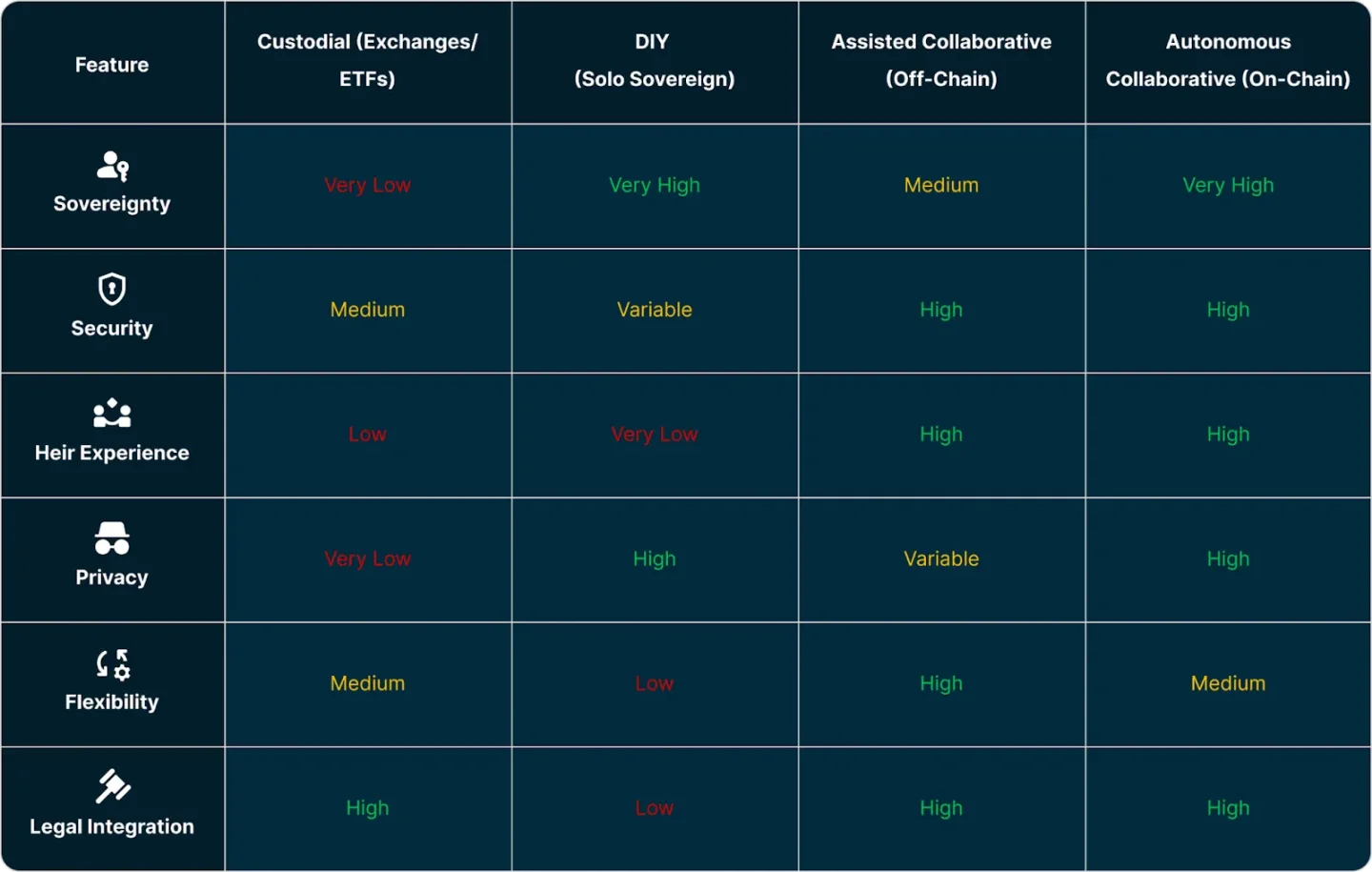
Where the Real Trade-offs Lie

When comparing modern inheritance solutions, the most meaningful question isn't "which is best," but "what are you most trying to optimize for?"

Off-chain collaborative solutions often excel in flexibility: easy to update, adaptable to family changes, and simple to adjust over time.

On-chain collaborative solutions often excel in durability: the fallback path is designed to work even if the service provider fails, which is crucial for inheritance plans that need to remain effective for decades.

Many families could reasonably choose either. The key is what matters most to you.

If you view Bitcoin as generational wealth, then durability should be a core consideration.

Smooth Path + Last Line of Defense

Most Bitcoin inheritance solutions tend to lean towards two extremes.

One end sacrifices autonomy for convenience: easy to understand, but heavily reliant on institutions, identity verification, or service provider cooperation.

The other end sacrifices usability for autonomy: reduces trust in third parties, but places the complex technical burden on the heirs, and at their most vulnerable time.

The most robust方案 (solution) combines both paths.

The first is the smooth path: when the service provider is available and everything is normal, heirs recover the assets through a guided process that is smooth, low-stress, and error-resistant.

The second is the last line of defense: a recovery path enforced by the Bitcoin network, executable even if the service provider disappears.

This combination is important because it aligns with real inheritance scenarios: most people want their families to receive help, not face complex technical operations alone; simultaneously, very few are willing to entrust their legacy to a company that "must exist forever."

Estate Planning is Still Important

A common misconception is that Bitcoin inheritance must either completely脱离 (break away from) the traditional system or be fully integrated into the traditional financial system.

In reality, many families need a hybrid model.

Some holders want Bitcoin transferred directly and privately to their families. Others want trustee involvement, for example, for phased distribution, protecting minor children, or integrating with existing trusts. Some want to clarify their intentions with legal documents, while keeping the actual recovery path out of public probate records.

A good Bitcoin inheritance solution should support these different choices.

Therefore, it helps to think about two questions separately: Who should receive these assets? Who can actually recover these assets?

A will or trust can clarify intentions, define beneficiaries, and set legal obligations, but it doesn't itself solve the "how to recover" problem. Conversely, a purely technical recovery solution cannot bypass tax, reporting, and inheritance law requirements.

The most comprehensive plans consider both levels clearly.

Common Mistakes

Many inheritance plans fail for very ordinary reasons.

One mistake is assuming a spouse, child, or executor will "figure it out." Possessing a hardware wallet does not equate to understanding the recovery process.

Another mistake is concentrating too much power in a single point: one document, one device, one envelope that can completely unlock the funds. This certainly facilitates inheritance, but it also facilitates theft.

Another mistake is overestimating the security of a "passphrase" without thinking through the human factors in recovery. A passphrase can indeed enhance the security of a single-signature setup, but only if there is true operational discipline in every step of creation, storage, and communication.

Finally, many people make a plan once and never revisit it. Beneficiaries may change, devices may fail, family relationships may shift. A Bitcoin inheritance plan is not a static object, but a system that needs regular review.

A Simple Action List

Inheritance planning can start simple, as long as each step is intentional and regularly revisited.

  • Step 1: Determine who should inherit your Bitcoin, and whether these individuals have the ability to handle self-custody directly. Some can receive Bitcoin directly, others might need a trustee, phased handover, or guided assistance.

  • Step 2: Choose an appropriate security model based on the size of the assets and the situation of the heirs. The larger the amount, the more important multisig and formal inheritance design become.

  • Step 3: Store secrets and instructions separately. Private keys, hardware devices, and "instruction manuals" (explaining how to recover) are best kept separate, and preferably not given to the same person.

  • Step 4: Clarify what you value most. Some families are better suited for flexible off-chain coordination, others need an on-chain fallback that can outlive the service provider.

  • Step 5: Test the plan. Not with all assets, but enough to verify that the recovery path is actually usable. A plan never rehearsed is just a theory.

  • Step 6: Review your plan after major life events and periodically. Marriage, divorce, childbirth, death, moving, service providers changing – all can affect whether the original plan remains sound.

The Final Question: The True Test of Self-Custody

It's easy to think of inheritance as something to deal with "later." But in reality, it is the ultimate test of whether a custody solution is truly robust.

Custodial solutions offer familiarity, but at the cost of reintroducing reliance on institutions. DIY solutions can be excellent if technically sound, but demand more from both the owner and the heirs. Off-chain collaborative inheritance improves usability and flexibility. On-chain collaborative inheritance adds a robust long-term backup.

The most important recent advancement in this field is inheritance design that combines guided recovery with autonomous on-chain fallbacks.

For holders who want Bitcoin to become generational wealth, this shift in direction makes a lot of sense. The goal is no longer just "leaving instructions," but "leaving a recovery path that is secure, private, and operable in the long term."


Twitter:https://twitter.com/BitpushNewsCN

Bitpush TG Discussion Group:https://t.me/BitPushCommunity

Bitpush TG Subscription: https://t.me/bitpush

Original link:https://www.bitpush.news/articles/7620845

Preguntas relacionadas

QWhat is the core challenge of Bitcoin inheritance according to the article?

AThe core challenge is the conflict between security and accessibility: Bitcoin's design makes it difficult to steal, but this same feature also makes it difficult for intended heirs to recover the assets after the owner's death or incapacitation.

QWhat are the four common solutions for Bitcoin inheritance mentioned in the article?

AThe four common solutions are: 1. Custodial Inheritance, 2. DIY Inheritance, 3. Service-Assisted Collaborative Custody, and 4. On-Chain Collaborative Inheritance.

QWhat key advantage does an On-Chain Collaborative Inheritance model provide?

AIt provides a robust, permanent backup recovery path that is enforced by the Bitcoin network's rules, ensuring the inheritance plan remains executable even if the service provider goes out of business or is unavailable.

QWhat is a major pitfall of relying solely on a 'passphrase' for security in a DIY inheritance plan?

AIt introduces new risks: there is no checksum to detect transcription errors; a short passphrase could be brute-forced; and a long, complex one might be impossible for the owner or heirs to accurately reproduce years later, potentially locking them out of the wallet.

QWhat is the recommended first step in creating a Bitcoin inheritance plan?

AThe first step is to determine who should inherit the Bitcoin and assess whether those individuals have the capability to handle self-custody directly, or if they would require a trustee, a staged handover, or guided assistance.

Lecturas Relacionadas

Trading

Spot
Futuros

Artículos destacados

Qué es BITCOIN

Entendiendo HarryPotterObamaSonic10Inu (ERC-20) y Su Posición en el Espacio Cripto En los últimos años, el mercado de criptomonedas ha sido testigo de un aumento en la popularidad de las monedas meme, capturando el interés no solo de los comerciantes, sino también de aquellos que buscan compromiso comunitario y valor de entretenimiento. Entre estos tokens únicos se encuentra HarryPotterObamaSonic10Inu (ERC-20), un proyecto intrigante que mezcla referencias culturales en el tejido de las criptomonedas. Este artículo profundiza en los aspectos clave de HarryPotterObamaSonic10Inu, explorando sus mecanismos, ethos impulsado por la comunidad y su relación con el paisaje cripto más amplio. ¿Qué es HarryPotterObamaSonic10Inu (ERC-20)? Como su nombre sugiere, HarryPotterObamaSonic10Inu es una moneda meme construida sobre la blockchain de Ethereum, clasificada bajo el estándar ERC-20. A diferencia de las criptomonedas tradicionales que pueden enfatizar la utilidad práctica o el potencial de inversión, este token prospera en el valor de entretenimiento y la fuerza de su comunidad. El proyecto tiene como objetivo fomentar un entorno donde los usuarios comprometidos puedan reunirse, compartir ideas y participar en actividades inspiradas por diversos fenómenos culturales. Una característica notable de HarryPotterObamaSonic10Inu es su cero impuestos en las transacciones. Este atractivo elemento tiene como objetivo incentivar el comercio y la participación comunitaria, sin cargos adicionales que puedan disuadir a los comerciantes de pequeña escala. El suministro total de la moneda está establecido en mil millones de tokens, una cifra que marca su intención de mantener una circulación sustancial dentro de la comunidad. Creador de HarryPotterObamaSonic10Inu (ERC-20) Los orígenes de HarryPotterObamaSonic10Inu están algo envueltos en misterio; los detalles sobre el creador siguen siendo desconocidos. El desarrollo de este token carece de un equipo identificable o de un plan explícito, lo cual no es inusual dentro del sector de monedas meme. En cambio, el proyecto ha surgido de manera orgánica, con su progreso muy dependiente del entusiasmo y la participación de su comunidad. Inversores de HarryPotterObamaSonic10Inu (ERC-20) En cuanto a inversiones externas y respaldo, HarryPotterObamaSonic10Inu también sigue siendo ambiguo. El token no lista ninguna fundación de inversión conocida o apoyo organizacional significativo. En cambio, la savia del proyecto es su comunidad de base, que informa su crecimiento y sostenibilidad a través de la acción colectiva y el compromiso en el espacio cripto. ¿Cómo Funciona HarryPotterObamaSonic10Inu (ERC-20)? Como una moneda meme, HarryPotterObamaSonic10Inu opera principalmente fuera de los marcos tradicionales que a menudo rigen el valor de los activos. Hay varios aspectos distintivos que definen cómo funciona el proyecto: Transacciones Sin Impuestos: Sin tarifas impositivas en las transacciones, los usuarios pueden comprar y vender el token libremente sin preocuparse por costos ocultos. Compromiso Comunitario: El proyecto prospera en la interacción comunitaria, aprovechando plataformas de redes sociales para crear entusiasmo y facilitar la participación. Las discusiones, el intercambio de contenido y el compromiso son elementos cruciales que ayudan a expandir su alcance y fomentar la lealtad entre los seguidores. Sin Utilidad Práctica: Cabe señalar que HarryPotterObamaSonic10Inu no ofrece utilidad concreta dentro del ecosistema financiero. Más bien, se clasifica como un token principalmente para actividades de entretenimiento y comunitarias. Referencia Cultural: El token incorpora astutamente elementos de la cultura popular para atraer interés, conectando con entusiastas de los memes y seguidores de las criptomonedas por igual. HarryPotterObamaSonic10Inu ejemplifica cómo las monedas meme operan de manera diferente a los proyectos de criptomonedas más tradicionales, ingresando al mercado como construcciones sociales innovadoras en lugar de activos utilitarios. Cronología de HarryPotterObamaSonic10Inu (ERC-20) La historia de HarryPotterObamaSonic10Inu está marcada por varios hitos notables: Creación: El token surgió de un meme viral, capturando la imaginación de muchos entusiastas de las criptomonedas. Las fechas específicas de creación no están disponibles, subrayando su ascenso orgánico. Listado en Exchanges: HarryPotterObamaSonic10Inu ha llegado a varios exchanges, permitiendo un acceso y comercio más fácil por parte de la comunidad. Iniciativas de Compromiso Comunitario: Actividades continuas destinadas a mejorar la interacción comunitaria, incluyendo concursos, campañas en redes sociales y generación de contenido por parte de fanáticos y defensores. Planes de Expansión Futuros: La hoja de ruta del proyecto incluye el lanzamiento de una colección de NFT, mercancía y un sitio de comercio electrónico relacionado con sus temas culturales, involucrando aún más a la comunidad e intentando añadir más dimensiones a su ecosistema. Puntos Clave Sobre HarryPotterObamaSonic10Inu (ERC-20) Naturaleza Impulsada por la Comunidad: El proyecto prioriza la participación colectiva y la creatividad, asegurando que la involucración de los usuarios esté a la vanguardia de su desarrollo. Clasificación como Moneda Meme: Representa la epítome de las criptomonedas basadas en el entretenimiento, diferenciándose de los vehículos de inversión tradicionales. Sin Afiliación Directa con Bitcoin: A pesar de la similitud en el nombre del ticker, HarryPotterObamaSonic10Inu es distinto y no tiene relación con Bitcoin u otras criptomonedas establecidas. Enfoque en la Colaboración: HarryPotterObamaSonic10Inu está diseñado para crear un espacio para la colaboración y el intercambio de historias entre sus poseedores, proporcionando una vía para la creatividad y el vínculo comunitario. Perspectivas Futuras: La ambición de expandirse más allá de su premisa inicial hacia NFTs y mercancías describe un camino para que el proyecto potencialmente ingrese a avenidas más tradicionales dentro de la cultura digital. A medida que las monedas meme continúan capturando la imaginación de la comunidad de criptomonedas, HarryPotterObamaSonic10Inu (ERC-20) se destaca debido a sus lazos culturales y su enfoque centrado en la comunidad. Si bien puede no encajar en el molde típico de un token impulsado por la utilidad, su esencia radica en la alegría y la camaradería fomentadas entre sus seguidores, destacando la naturaleza en evolución de las criptomonedas en una era cada vez más digital. A medida que el proyecto continúa desarrollándose, será importante observar cómo las dinámicas comunitarias influyen en su trayectoria en el cambiante paisaje de la tecnología blockchain.

1.3k Vistas totalesPublicado en 2024.04.01Actualizado en 2024.12.03

Qué es BITCOIN

Cómo comprar BTC

¡Bienvenido a HTX.com! Hemos hecho que comprar Bitcoin (BTC) sea simple y conveniente. Sigue nuestra guía paso a paso para iniciar tu viaje de criptos.Paso 1: crea tu cuenta HTXUtiliza tu correo electrónico o número de teléfono para registrarte y obtener una cuenta gratuita en HTX. Experimenta un proceso de registro sin complicaciones y desbloquea todas las funciones.Obtener mi cuentaPaso 2: ve a Comprar cripto y elige tu método de pagoTarjeta de crédito/débito: usa tu Visa o Mastercard para comprar Bitcoin (BTC) al instante.Saldo: utiliza fondos del saldo de tu cuenta HTX para tradear sin problemas.Terceros: hemos agregado métodos de pago populares como Google Pay y Apple Pay para mejorar la comodidad.P2P: tradear directamente con otros usuarios en HTX.Over-the-Counter (OTC): ofrecemos servicios personalizados y tipos de cambio competitivos para los traders.Paso 3: guarda tu Bitcoin (BTC)Después de comprar tu Bitcoin (BTC), guárdalo en tu cuenta HTX. Alternativamente, puedes enviarlo a otro lugar mediante transferencia blockchain o utilizarlo para tradear otras criptomonedas.Paso 4: tradear Bitcoin (BTC)Tradear fácilmente con Bitcoin (BTC) en HTX's mercado spot. Simplemente accede a tu cuenta, selecciona tu par de trading, ejecuta tus trades y monitorea en tiempo real. Ofrecemos una experiencia fácil de usar tanto para principiantes como para traders experimentados.

4.7k Vistas totalesPublicado en 2024.12.12Actualizado en 2025.03.21

Cómo comprar BTC

Qué es $BITCOIN

ORO DIGITAL ($BITCOIN): Un Análisis Integral Introducción al ORO DIGITAL ($BITCOIN) ORO DIGITAL ($BITCOIN) es un proyecto basado en blockchain que opera en la red Solana, cuyo objetivo es combinar las características de los metales preciosos tradicionales con la innovación de las tecnologías descentralizadas. Aunque comparte un nombre con Bitcoin, a menudo referido como “oro digital” debido a su percepción como un refugio de valor, ORO DIGITAL es un token separado diseñado para crear un ecosistema único dentro del paisaje Web3. Su meta es posicionarse como un activo digital alternativo viable, aunque los detalles sobre sus aplicaciones y funcionalidades aún están en desarrollo. ¿Qué es ORO DIGITAL ($BITCOIN)? ORO DIGITAL ($BITCOIN) es un token de criptomoneda diseñado explícitamente para su uso en la blockchain de Solana. A diferencia de Bitcoin, que proporciona un papel de almacenamiento de valor ampliamente reconocido, este token parece centrarse en aplicaciones y características más amplias. Aspectos notables incluyen: Infraestructura Blockchain: El token está construido sobre la blockchain de Solana, conocida por su capacidad para manejar transacciones de alta velocidad y bajo costo. Dinámicas de Suministro: ORO DIGITAL tiene un suministro máximo limitado a 100 cuatrillones de tokens (100P $BITCOIN), aunque los detalles sobre su suministro circulante no se han divulgado actualmente. Utilidad: Si bien las funcionalidades precisas no están delineadas explícitamente, hay indicios de que el token podría ser utilizado para diversas aplicaciones, potencialmente involucrando aplicaciones descentralizadas (dApps) o estrategias de tokenización de activos. ¿Quién es el Creador de ORO DIGITAL ($BITCOIN)? En la actualidad, la identidad de los creadores y el equipo de desarrollo detrás de ORO DIGITAL ($BITCOIN) sigue siendo desconocida. Esta situación es típica entre muchos proyectos innovadores dentro del espacio blockchain, particularmente aquellos alineados con las finanzas descentralizadas y fenómenos de monedas meme. Si bien tal anonimato puede fomentar una cultura impulsada por la comunidad, intensifica las preocupaciones sobre la gobernanza y la responsabilidad. ¿Quiénes son los Inversores de ORO DIGITAL ($BITCOIN)? La información disponible indica que ORO DIGITAL ($BITCOIN) no tiene patrocinadores institucionales conocidos ni inversiones destacadas de capital de riesgo. El proyecto parece operar en un modelo de peer-to-peer centrado en el apoyo y la adopción de la comunidad en lugar de rutas de financiamiento tradicionales. Su actividad y liquidez se sitúan principalmente en intercambios descentralizados (DEX), como PumpSwap, en lugar de plataformas de trading centralizadas establecidas, lo que resalta aún más su enfoque de base. Cómo Funciona ORO DIGITAL ($BITCOIN) Los mecanismos operativos de ORO DIGITAL ($BITCOIN) pueden elaborarse en función de su diseño blockchain y atributos de red: Mecanismo de Consenso: Al aprovechar el único proof-of-history (PoH) de Solana combinado con un modelo de proof-of-stake (PoS), el proyecto asegura una validación de transacciones eficiente que contribuye al alto rendimiento de la red. Tokenómica: Si bien los mecanismos deflacionarios específicos no se han detallado extensamente, el vasto suministro máximo de tokens implica que podría atender microtransacciones o casos de uso nicho que aún están por definirse. Interoperabilidad: Existe el potencial de integración con el ecosistema más amplio de Solana, incluyendo varias plataformas de finanzas descentralizadas (DeFi). Sin embargo, los detalles sobre integraciones específicas permanecen no especificados. Cronología de Eventos Clave Aquí hay una cronología que destaca hitos significativos relacionados con ORO DIGITAL ($BITCOIN): 2023: El despliegue inicial del token ocurre en la blockchain de Solana, marcado por su dirección de contrato. 2024: ORO DIGITAL gana visibilidad al estar disponible para trading en intercambios descentralizados como PumpSwap, permitiendo a los usuarios comerciar contra SOL. 2025: El proyecto presencia actividad de trading esporádica y potencial interés en compromisos liderados por la comunidad, aunque no se han documentado asociaciones notables o avances técnicos hasta el momento. Análisis Crítico Fortalezas Escalabilidad: La infraestructura subyacente de Solana soporta altos volúmenes de transacciones, lo que podría mejorar la utilidad de $BITCOIN en varios escenarios de transacción. Accesibilidad: El potencial bajo precio de trading por token podría atraer a inversores minoristas, facilitando una participación más amplia debido a oportunidades de propiedad fraccionada. Riesgos Falta de Transparencia: La ausencia de patrocinadores, desarrolladores o un proceso de auditoría conocidos públicamente puede generar escepticismo sobre la sostenibilidad y confiabilidad del proyecto. Volatilidad del Mercado: La actividad de trading depende en gran medida del comportamiento especulativo, lo que puede resultar en una volatilidad de precios significativa y en incertidumbre para los inversores. Conclusión ORO DIGITAL ($BITCOIN) surge como un proyecto intrigante pero ambiguo dentro del ecosistema de Solana en rápida evolución. Si bien intenta aprovechar la narrativa del “oro digital”, su alejamiento del papel establecido de Bitcoin como refugio de valor subraya la necesidad de una diferenciación más clara de su utilidad y estructura de gobernanza previstas. La aceptación y adopción futura dependerán probablemente de abordar la actual opacidad y de definir sus estrategias operativas y económicas de manera más explícita. Nota: Este informe abarca información sintetizada disponible hasta octubre de 2023, y pueden haber ocurrido desarrollos más allá del período de investigación.

83 Vistas totalesPublicado en 2025.05.13Actualizado en 2025.05.13

Qué es $BITCOIN

Discusiones

Bienvenido a la comunidad de HTX. Aquí puedes mantenerte informado sobre los últimos desarrollos de la plataforma y acceder a análisis profesionales del mercado. A continuación se presentan las opiniones de los usuarios sobre el precio de BTC (BTC).

活动图片