The Art of Speculation: When Coin Launches Become a Mind-Reading Game Centered on Leaders' Social Dynamics

比推Publicado a 2026-01-08Actualizado a 2026-01-08

Resumen

The article "The Art of Reading Between the Lines: When Coin Listings Become a Game of Guessing Leaders' Social Cues" critiques the culture of speculation and sycophancy in the cryptocurrency space, particularly around Binance’s listing process. It draws a parallel to a Shandong dining custom where the fish head is pointed toward the guest of honor as a sign of respect—a tacit social rule that requires intuition rather than explicit instruction. The piece centers on a recent event where He Yi, Binance’s co-founder, posted a cryptic New Year’s tweet saying “我踏马来了” (roughly: “Here the f*ck I come”). Shortly after, a community-created meme token with the same name was listed on Binance Alpha, despite He Yi’s earlier statements against favoritism and “insider coins.” The author argues that this reflects a deeper cultural issue: the shift from merit-based innovation to a system where success depends on interpreting the subtle hints of influential figures. Unlike traditional industries where technical skill or product quality drive progress, the crypto industry often prioritizes access to information, relationships, and the ability to please key decision-makers. The piece suggests that this “Shandong mindset”—where insiders learn to “read the room” rather than challenge or create—undermines transparency and rewards those who excel at flattery rather than genuine contribution. While He Yi may not have directly endorsed the token, the very fact that her social media activity can t...

Author: Kuli, Shenchao TechFlow

Original Title: Where the Fish Head Faces He Yi: Crypto Has Its Shandong-Style Politics Too


There's a rule at Shandong banquets: when the fish is served, the head must face the seat of honor.

Whoever it faces is the main guest and must drink first. This isn't written down anywhere, but everyone in Shandong knows it. No one teaches you; you just learn it.

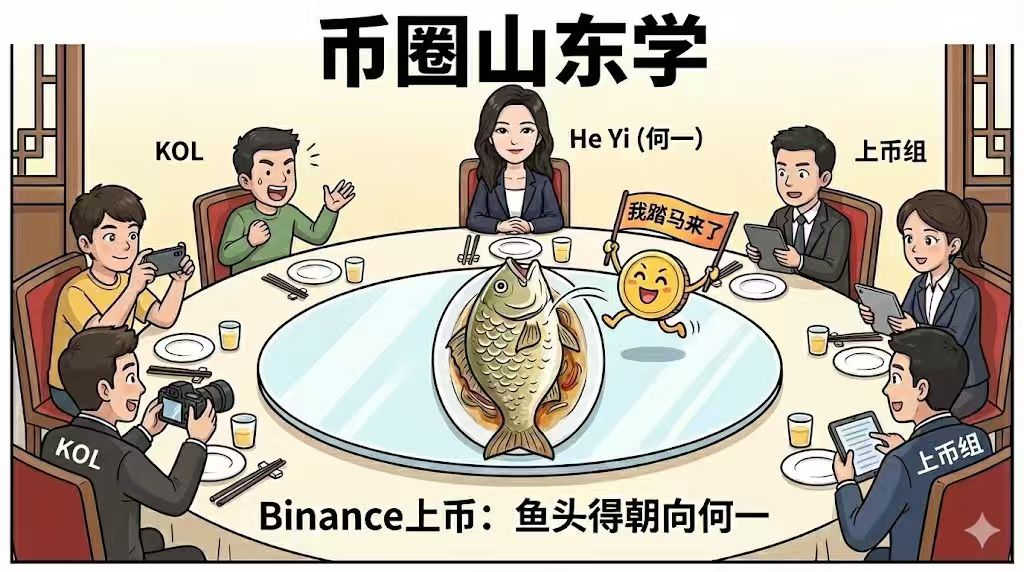
Recently, someone drew a picture called "Crypto Shandong-Style Politics." A group of people sit around a table eating fish, with He Yi in the seat of honor, flanked by KOLs, the listing team, and social media editors.

Caption: For a Binance listing, the fish head must face He Yi.
On January 1st, He Yi posted a New Year's tweet. Riding a white horse by the seaside, caption in four characters:

我踏马来了 (Wǒ tà mǎ lái le - I've f*cking arrived).

A fine New Year's greeting. "Tà mǎ" (踏马), the Year of the Horse, with a bit of playful homophonic wordplay.

Today, Binance Alpha listed a new token called "我踏马来了" (I've F*cking Arrived). It was community-made, with no direct connection to He Yi.

But look at this chain: First Sister tweets, the community creates a token, Alpha lists it.

No one needs to give any orders in the middle.

Last year, Binance was hounded by accusations of "BFF coins," alleging shady listing practices and利益输送 (interest conveyance/corruption). He Yi responded several times, saying they were reflecting, adjusting, and even created Alpha as a screening pool.

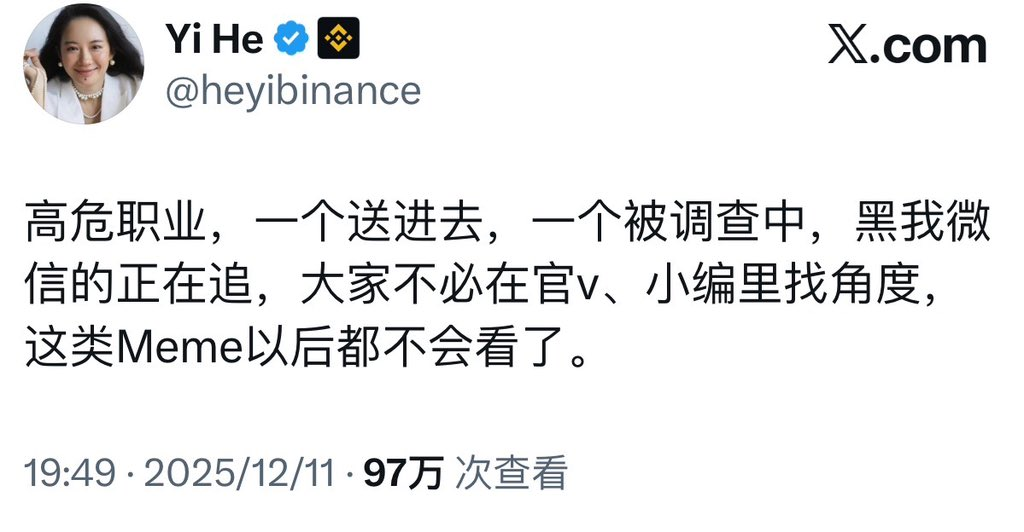
In December, she also tweeted saying, don't try to find angles in our official tweets about various Memes; we won't pay attention to this kind of thing anymore.

28 days later, her New Year's tweet became a new token on Alpha.
What was the problem with BFF coins? It was about backdoor deals, favoritism,利益输送 (interest conveyance/corruption).

These require evidence, a paper trail, a specific "BFF."

But "I've F*cking Arrived" doesn't need any of that.

No backdoor, no favoritism, no利益输送. First Sister posted a picture, and the people below just started moving on their own.

This perhaps touches on the essence of Shandong-style politics: the leader doesn't need to speak; you have to figure it out yourself.

Someone in the community commented that Alpha is now just a tool for currying favor, its purpose is to make First Sister happy.

Crude wording, but it describes a certain atmosphere.

When a platform's direction starts revolving around someone's social media activity, when "which coin to list" becomes "guess what she likes," rules cease to matter.

What matters is揣摩 (speculation/reading intentions).

Some put it more harshly: If you want to know if an industry has a future, ask one question—In this industry, do people who are good at flattery succeed more easily than people who are good at doing the work?

If the answer is "yes," then this industry is on the decline.

In crypto, this trick really works. And the most successful ones, everyone knows which direction the flattery should be aimed.

The core resources in the AI circle are technology and products; you have to deliver. Jensen Huang won't allocate you GPUs just because you call him daddy every day.

The core resources in the crypto circle are listing power, traffic, and who knows the news first. These things aren't in the code; they're in people's hands.

Things in people's hands must be obtained through human methods.

The more Shandong-style politics prevails, the more it relies on connections and information asymmetry, not innovation and technology.

He Yi might not even know about this. A small MEME worth a few million market cap isn't enough to bother the Co-CEO.

But that's precisely the problem.

She doesn't need to know. The fish head will turn by itself.

This is really much more efficient than BFF coins.

BFF coins at least required a BFF. Shandong-style politics only requires an atmosphere.

And those who see through this set of rules and implement them thoroughly are, in a way, also talented.

After all, in this society, people laugh at the poor, not the prostitute. (笑贫不笑娼 - A saying criticizing societal values that scorn poverty but overlook the means of acquiring wealth).


Twitter:https://twitter.com/BitpushNewsCN

BitPush TG Discussion Group:https://t.me/BitPushCommunity

BitPush TG Channel: https://t.me/bitpush

Original link:https://www.bitpush.news/articles/7601064

Preguntas relacionadas

QWhat is the core argument of the article 'The Art of Speculation: When Coin Listings Become a Mind-Reading Game Around a Leader's Social Media'?

AThe article argues that in the crypto space, especially around Binance, the process of token listings has shifted from being based on innovation and technology to a culture of揣摩 (speculation/guessing) where community members and projects try to interpret the social media posts of leaders like He Yi to gain favor, rather than relying on formal rules or merit.

QWhat is 'Shandong Study' (山东学) as described in the article, and how does it relate to Binance's token listing process?

A'Shandong Study' is a metaphor derived from a Shandong dining custom where the fish head is pointed towards the guest of honor. In the context of Binance, it symbolizes a culture where participants automatically align their actions (like creating and listing tokens) to please or anticipate the preferences of leader He Yi, without any explicit instruction, mimicking the unspoken rule of the dining tradition.

QHow does the article contrast the 'Shandong Study' phenomenon with the previous '闺蜜币' (close-friend coin) controversy at Binance?

AThe '闺蜜币' controversy involved allegations of explicit favoritism, backdoor deals, and利益输送 (benefit transfer) through personal connections. In contrast, the 'Shandong Study' phenomenon requires no direct orders or concrete relationships; it operates through an implicit atmosphere where community members spontaneously act to please the leader based on social media cues, making it more efficient and less traceable than the 'close-friend coin' issue.

QAccording to the article, what does the success of the meme token '我踏马来了' (I'm Coming on Horseback) demonstrate about the current state of the crypto industry?

AThe success of '我踏马来了'—a token created and listed on Binance Alpha simply because it was inspired by He Yi's tweet—demonstrates that in the crypto industry, success can be driven by揣摩 (speculating on) and catering to the preferences of influential leaders rather than technological innovation or product merit, indicating a reliance on人际关系 (relationships) and information asymmetry.

QWhat critical question does the article suggest asking to determine if an industry has a future, and what is the implied answer for the crypto space based on the examples given?

AThe article suggests asking: 'In this industry, do people who are good at flattery succeed more easily than those who are good at doing actual work?' The implied answer for the crypto space is 'yes,' as the examples show that tokens gaining traction through揣摩 (speculation) and alignment with leaders' social media are successful, suggesting the industry may be declining if this culture persists.

Lecturas Relacionadas

From South Korea to the United States: Blue-Collar Jobs Are Becoming Increasingly Popular, Thanks to AI

AI is reshaping the labor market's value proposition. The traditional four-year college degree is losing its appeal as a guaranteed career path, while skilled blue-collar trades like electricians, welders, and plumbers are experiencing historic demand and wage premiums. This shift is driven by dual pressures: AI's displacement of certain white-collar roles and a booming need for physical infrastructure and data center construction. Data confirms the trend. In the U.S., vocational school revenue surged, and a significant portion of recent layoffs are AI-related. Surveys show a majority of Gen Z adults plan to pursue blue-collar work, citing better job security against AI automation. Vocational education interest has exploded recently. Experts cite a psychological shift as younger generations seek tangible, AI-resistant careers and avoid high student debt. In many cases, salaries for skilled trades now match or exceed those requiring a bachelor's degree. In South Korea, semiconductor vocational high schools boast near-total employment, with graduates securing high-paying roles at companies like Samsung. The shortage is structural, exacerbated by a retiring baby boomer workforce and massive infrastructure projects. Companies like JPMorgan Chase, Meta, and Lowe's are investing heavily in training programs. However, overcoming historical stigma and a "perception gap" around trade careers remains a key challenge to closing the talent gap.

marsbitHace 1 hora(s)

From South Korea to the United States: Blue-Collar Jobs Are Becoming Increasingly Popular, Thanks to AI

marsbitHace 1 hora(s)

Qualcomm: AI Hype Subsides, When Will Smartphones Emerge from the Gloom?

Qualcomm reported its Q3 FY2026 results (ending June 2026), with revenue of $9.95B, down 4% YoY but above expectations. Gross margin declined to 53.1%, pressured by rising costs across manufacturing and memory. Key business segments showed mixed performance: Handset revenue fell 19.6% YoY to $5.09B, dragged by an 11% decline in non-Apple Android shipments and weaker high-end mix. Conversely, Automotive revenue surged 61% to $1.59B, and IoT grew 9% to $1.83B. Core operating profit dropped 41% YoY due to margin compression and higher expenses. Management's Q4 FY2026 guidance projects revenue of $9.7B-$10.5B, in line with consensus, but Non-GAAP EPS guidance of $2.05-$2.25 fell short of expectations. Amidst persistent weakness in its core handset market, Qualcomm is pursuing growth in AI, focusing on Edge AI (smartphones, PCs, automotive) and Data Center AI. Its data center strategy includes four pillars: AI accelerators (e.g., AI200), commercial CPUs (Dragonfly C1000), custom silicon, and connectivity solutions. While these initiatives initially boosted its stock, concerns over AI capital expenditure sustainability have since erased those gains. The company targets $5B in data center revenue for FY2027 and $15B for FY2029. The report concludes that with the traditional handset business still under pressure, the data center opportunity is currently viewed as a longer-term option, and a more conservative valuation based on core operations may be warranted until AI contributions materialize.

marsbitHace 1 hora(s)

Qualcomm: AI Hype Subsides, When Will Smartphones Emerge from the Gloom?

marsbitHace 1 hora(s)

From TPU to Self-Evolving Agents: How Jeff Dean Predicts the Next Step in AI

At the 2026 YC Startup School, Jeff Dean outlined his vision for AI's next phase, shifting focus from simply scaling models to building intelligent, autonomous systems. He believes AI's progress is no longer just about creating smarter models, but about integrating them into systems capable of long-term, iterative work, automated experimentation, and continuous learning. This evolution moves the competition from "who has the bigger model" to "who can best organize intelligence." Dean suggests AI capabilities are now comparable to a junior engineer, enabling the automation of complex workflows. However, the true challenge and opportunity lie in managing these AI "workers" at scale. He emphasizes the importance of **context engineering**—structuring tools, memory, and feedback loops—over raw model power. For startups, this means building deep expertise in niche domains where general models currently fail (near 0-1% success rates), leveraging proprietary data, specialized tools, and domain-specific evaluators. A recurring theme is re-examining fundamental constraints. Dean's past work, like moving Google's search index to memory or creating the TPU, stemmed from questioning outdated assumptions about hardware and cost. He sees similar inflection points today, particularly in **specialized inference hardware** to drastically reduce latency and energy consumption for real-time Agent operation. Notably, he points out that in modern AI systems, the dominant cost is often not computation but **data movement**. Reliable, long-running Agents require robust system design, borrowing concepts from distributed computing like checkpointing, state management, and parallel exploration to handle failures and maintain progress over days or weeks. As AI automates execution, the scarcest human skills will shift to **defining clear specifications**, **judging what problems are worth solving** (taste), and designing effective feedback loops. Ultimately, Dean's framework prioritizes understanding the problem deeply, identifying the true bottlenecks, and systematically building closed-loop systems where AI can not only perform tasks but also improve AI itself.

marsbitHace 1 hora(s)

From TPU to Self-Evolving Agents: How Jeff Dean Predicts the Next Step in AI

marsbitHace 1 hora(s)

Trading

Spot
活动图片





