The Ambitions of Kalshi, MTS, and a16z

marsbitPublicado a 2026-06-07Actualizado a 2026-06-07

Resumen

"Kalshi, MTS, and a16z's Ambition" explores prediction markets as a focal point for investors in 2025. The article traces their intellectual evolution from Hayek's ideas on distributed knowledge to Robin Hanson's logarithmic market scoring rule (LMSR), which incentivizes truth-telling. Venture firm Andreessen Horowitz (a16z) invested in prediction market platform Kalshi, valuing it at $220 billion. a16z argues these markets offer "presence"—a way for individuals to actively engage with and influence world events through financial bets, countering modern detachment. This transforms participants into "super observers" and grants the platform authority in defining event truth and importance. The piece positions prediction markets as a key component of a16z's envisioned "new media" empire. This strategy involves rapid, high-intensity content across platforms to "take over the timeline." Media company MTS exemplifies this with its constant news livestreams. Ultimately, Kalshi's value lies in its "reality distortion field"—the power to shape perception through the credibility of real-money markets, making it a potent tool within a16z's broader media and influence architecture.

Authors: Matou, Big Screwing

Prediction markets might be the only area in 2025 that can simultaneously excite the distinguished dollar fund investors, crypto natives, and media practitioners.

There are many reasons to be bullish on it, such as the regulatory arbitrage between state and federal betting laws in the US, the massive transaction fees brought by the extreme extrapolation of 0DTE, and the convergence of the content industry with light betting, and so on.

But today, we won't talk about these. Let's change direction and discuss the spirit behind prediction markets and how this spirit aligns with a16z, which champions the banner of "New Media," becoming one of the most crucial pieces in its new media empire.

The Spiritual Chronology of Prediction Markets

The product of a prediction market is simple (at least on the surface): it turns the object of a binary option bet into any event or information. However, the underlying spiritual core has evolved through several eras.

The earliest discussions about prediction markets actually come from Hayek. In his view, knowledge is unevenly distributed, and the market, as a coordination mechanism, mobilizes information from every corner of society. From vendors to experts, different people's judgments about the future converge into a price on the order book within the prediction market.

This discussion is the most ancient, but also the most frequently cited today. When you see marketing posts talking about "probability aggregation markets," "truth machines," etc., they all stem from Hayek's The Use of Knowledge in Society, published nearly a hundred years ago.

The torch was then passed to Robin Hanson after Hayek. The man still surfs Twitter with high intensity, debating with crypto natives. His main contribution lies in designing a mechanism called the Logarithmic Market Scoring Rule (LMSR), which makes it more beneficial for those who know the truth to tell it. This design basically established the paradigm for current prediction market design.

With such an incentive mechanism in place, information holders in various corners are motivated to contribute their information and participate in the market. Extrapolating further, it seems such markets could also be used for public governance. Opening a market for every future issue, letting people vote with real money, the future scenario would then be constructed in the changing odds on the order book. This utopia is called Futarchy, formed from "future" and the suffix "-archy" meaning governance.
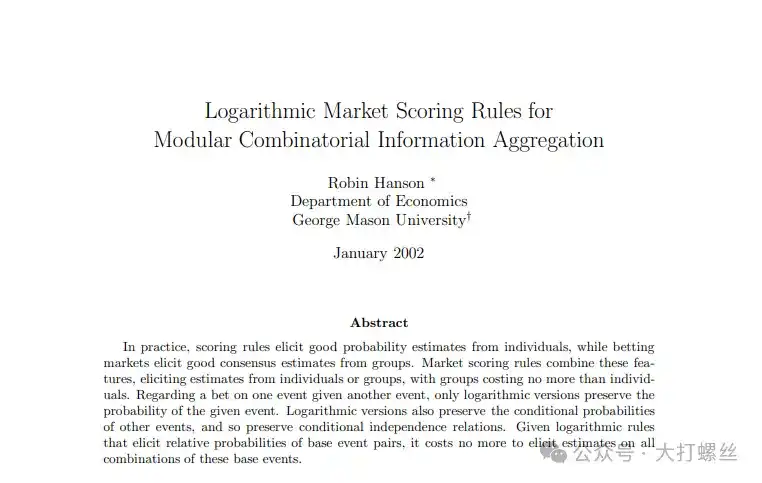
Seminal Work: A Logarithmic Market Scoring Rule for Modular Information Aggregation

The above belongs to the official history, the kind you'd cover in a timeline lecture in a university microeconomics class. However, I believe that metaphysical discussions about prediction markets after this point are largely meaningless until a16z set its sights on this field.

Presence and New Media

a16z came into contact with the prediction market company Kalshi in 2024, then invested in its $5 billion round in August 2025 (the discount, if any, is currently unknown). Kalshi's valuation has now reached a staggering $22 billion, hailed as the fastest-growing company outside of AI (in terms of valuation).

After establishing its position, a16z activated its media machine, writing a series of long articles about why Kalshi is one of the most important companies of our time. Frankly, while the exchange and casino business is enticing, due to potential compliance pressures and moral risks, it never commands high PE multiples in the market. Clearly, a16z's vision extends beyond this.

So, where exactly does Kalshi, or the entire prediction market sector, hold its importance? a16z's answer is "Presence."

At our current juncture, human contact with the world is actually separated by a thin layer of plastic film—somewhat like only being able to browse the front end of a webpage while knowing nothing about its back-end construction. You can consume the front-end's audiovisual experience, narratives, and even "real feelings," but you cannot change or be present.

Not to mention, clearly in the not-too-distant future, even the transformation of the real world will be gradually outsourced to agents. So, what role do humans have in the historical process? It seems we're only left to bury our heads in light-colored sheets and cry after eating and drinking.

However, prediction markets offer a way to intervene, called prediction. It requires you to place bets with real money, then, like buying a ticket to enter a stadium, participate and observe the fluctuation of probabilities throughout the process, willingly bearing theta decay, and even screenshotting the prediction market probabilities, forwarding them in all group chats, loudly declaring your position and the viewpoint behind it.

This feeling is profoundly anti-cynical. In an instant, the infinite distances, the countless people, the selection of the cardinal, the depth of snow in New York, the rise and fall of crude oil within five minutes, and even whether Jesus will return in 2026, all become relevant to you. The uncertainty and powerlessness of postmodernity collapse under your potent predictions. You are no longer a gambler; you are an esteemed super-observer, a prophet of your tribe, a calm bystander of history.

When enough people start using, discussing, and relying on this medium, the authority of the market itself begins to rise. Kalshi will grant the ultimate interpretative power over an event's: 1. Authenticity 2. Significance. This is undoubtedly a key component in the new media empire envisioned by a16z.
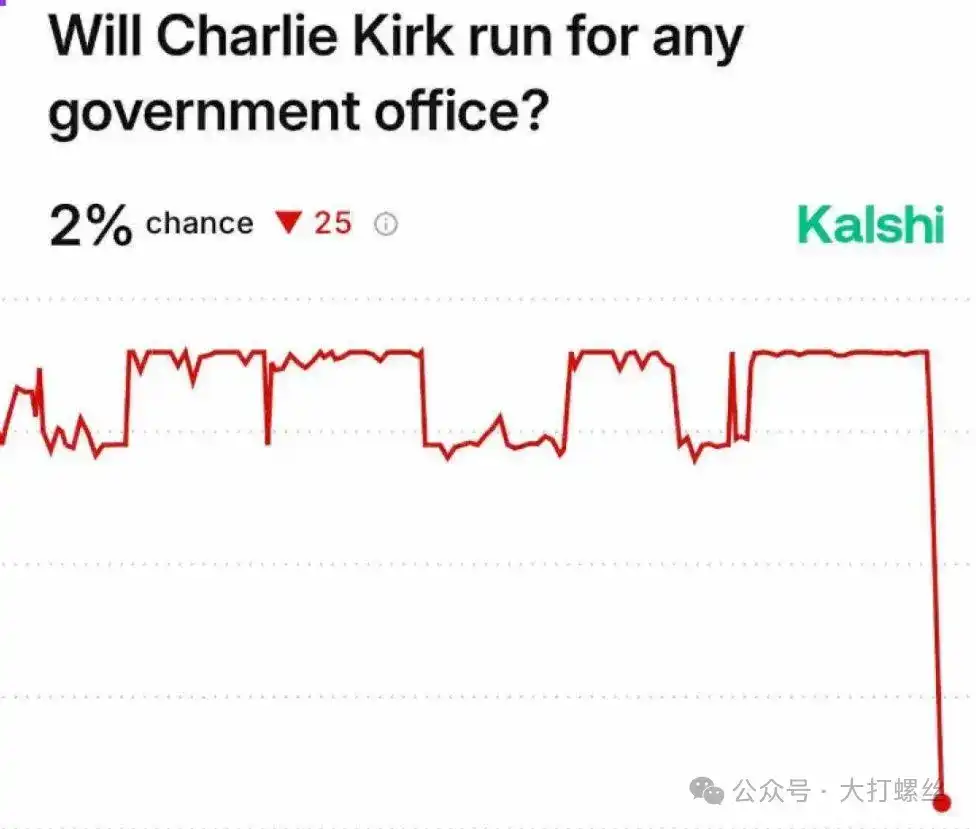
One chart explaining the assassination of Charlie Kirk

Case Study: MTS

Finally, let's talk about this new media as defined by a16z. From the first-generation In-house Media championed by a16z and YC, to the second-generation VCs emerging from media like 20VC and Not Boring Capital, to the final stage where media like TBPN are acquired by companies and institutions, media power has been constantly shifting and decentralizing. The battleground for public opinion has also moved from blogs and TV programs to Twitter and podcasts.

Talking about VCs also needing to do content, build brands, and help founders with distribution is already old news in 2026. The new media a16z talks about is a full-spectrum project, covering upstream narrative setting, midstream product financing and promotion, to downstream customer acquisition—all within its scope, and at a pace far beyond what traditional media and agencies can comprehend.

What previously might have taken 3-6 months to plan, the new media will execute within weeks: founder podcasts, short video clips, AI-generated launch videos, newsletters about the company's spirit and development plans, etc., releasing information with extremely high intensity in an extremely short time. They call this "taking over the timeline."

Perhaps with all the noise from various self-media and AI-generated information, we just have to be even noisier. And our noise is more important than yours.

MTS (full name "Monitoring The Situation") embodies this philosophy, conducting 24/7 live news coverage on Twitter, putting a series of political figures, tech founders, and key figures in hot news stories on mic, then slicing and disseminating the content. They claim to only report on the most important thing happening in the world right now, until the next more important thing happens.

MTS Interviewing Robinhood

Looking back at Kalshi now, everything clicks. Relying solely on volume and a16z's endorsement, media like MTS can certainly survive, but their influence beyond a16z's light cone remains limited, more akin to a fraternity media or campus club publication. But prediction markets are different; the trading volume and positions are real money, seemingly possessing a certain detached, third-party coldness and persuasiveness.

Imagine, if you were a staunch MAGA supporter, seeing on Kalshi that the market for a Republican victory in the midterm elections had reached tens of billions in trading volume, but the price for the YES option for victory had dropped to $0.1, wouldn't you have a moment of doubt—do the Capitol Hill elites already know the result? Has the fair information market already given a picture of the future?

This is perhaps the core reason Kalshi is worth $22 billion. This kind of reality distortion field is not often seen in human history being obtained by a private company.
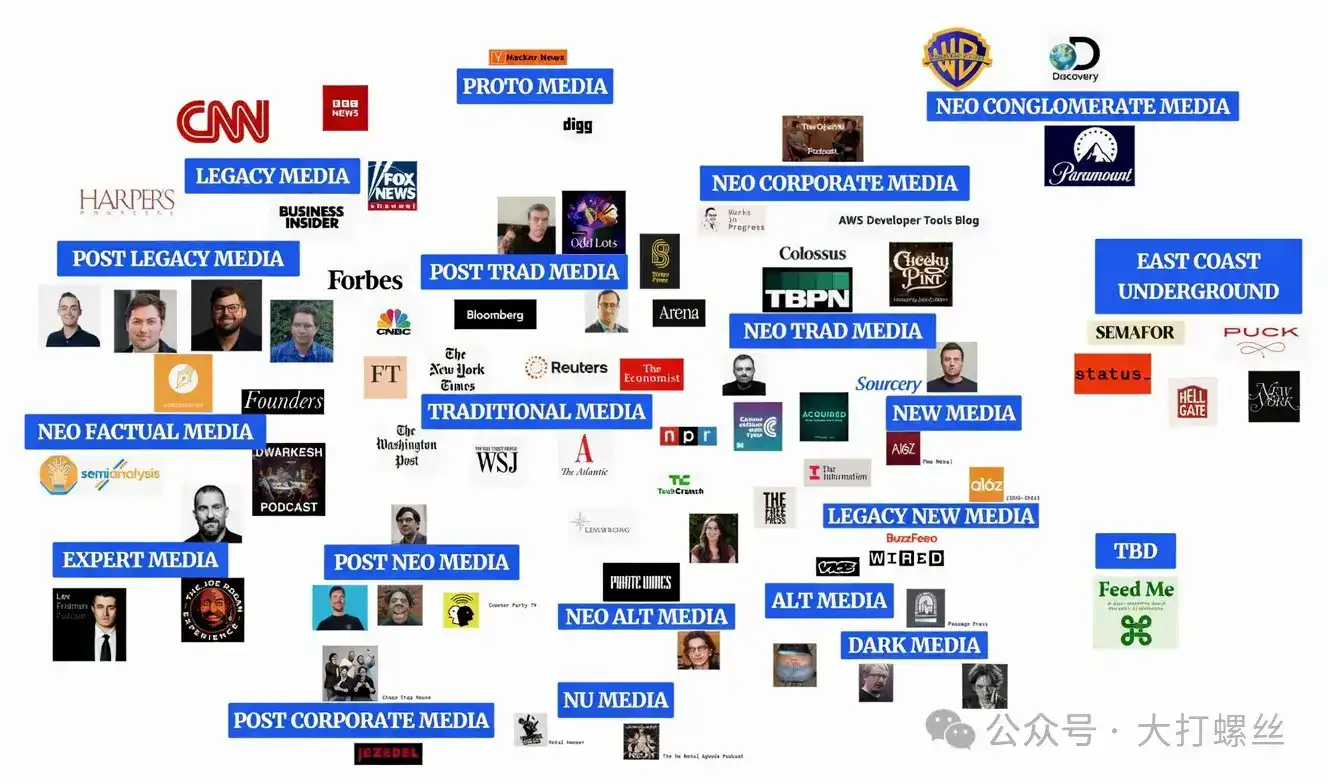
TBPN New Media Landscape

References:

[1] Alex Danco, “Prediction: the successor to postmodernism,” Andreessen Horowitz, October 10, 2025.

[2] Alex Danco, “Prediction Path Screenshots: A New Kind of Meme,” Andreessen Horowitz, October 10, 2025.

[3] F. A. Hayek, “The Use of Knowledge in Society,” The American Economic Review, Vol. 35, No. 4, pp. 519–530, 1945.

[4] Erik Torenberg, Ben Horowitz, and Marc Andreessen, “a16z’s New Media Playbook,” Andreessen Horowitz Podcast, February 27, 2026.


Preguntas relacionadas

QAccording to the article, what is the core reason why Kalshi is valued at $22 billion?

AThe core reason is that Kalshi possesses a 'reality-distorting force field' or significant influence. As a prediction market, its trading volumes and positions, backed by real money, grant it an authoritative, independent, and persuasive quality. It can shape perceptions of event authenticity and importance, effectively giving a private company a rare level of influence over how reality is interpreted and understood.

QWhat concept does a16z propose as the key value proposition of prediction markets, beyond just being a gambling platform?

Aa16z proposes 'presence' or 'a sense of being present' as the key value proposition. Prediction markets offer a way for individuals to actively engage with and influence world events through prediction and financial stake. This counters postmodern feelings of detachment and powerlessness, transforming users from passive observers into active 'super observers' and 'prophets' who participate in shaping the narrative of history.

QHow does the article describe the evolution of the 'spiritual core' or theoretical foundation of prediction markets?

AThe article describes a spiritual chronology: 1) **Friedrich Hayek**: Viewed markets as mechanisms for aggregating distributed, fragmented knowledge across society. 2) **Robin Hanson**: Designed the Logarithmic Market Scoring Rule (LMSR), creating incentives for truth-telling and establishing the modern design paradigm for prediction markets. He also theorized 'Futarchy,' a governance system based on prediction markets. 3) **a16z Era**: Shifted the discussion from abstract theory to practical application, emphasizing prediction markets as a new media form that provides 'presence' and narrative authority.

QWhat is MTS, and how does it exemplify a16z's vision of 'New Media'?

AMTS (Monitoring The Situation) is a media company that practices 24/7 live news broadcasting on platforms like Twitter, featuring interviews with key figures. It exemplifies a16z's 'New Media' vision through its extreme speed and intensity in information dissemination—a strategy called 'taking over the timeline.' It rapidly produces content across formats (podcasts, video clips, newsletters) to dominate the narrative, asserting that its coverage is more important and louder than the noise of other media.

QWhat role does the article suggest prediction markets like Kalshi play within a16z's envisioned 'New Media Empire'?

AWithin a16z's 'New Media Empire,' prediction markets like Kalshi serve as a crucial component that provides authoritative, objective-seeming validation. While media outlets like MTS generate noise and narrative, Kalshi offers the perceived 'cold, hard truth' of market-based probabilities backed by real money. This combination allows a16z to influence both the narrative (through media) and the perceived factual basis of reality (through prediction markets), creating a powerful system for shaping public perception and discourse.

Lecturas Relacionadas

After Three Consecutive Quarters of Decline, Can the Crypto Market Find a Window for Stabilization in Q3?

The cryptocurrency market has just concluded its worst-performing quarter since 2022, with total capitalization dropping 12.6% to $2.1 trillion. All core metrics indicate capital is leaving the sector, not just rotating within it. Bitcoin fell 14.2% and Ethereum dropped 25.4% in Q2, breaking their previous correlation with US tech stocks. A key driver is the reversal in US spot Bitcoin ETF flows, which saw a net outflow of approximately $4.67 billion in Q2, including a record monthly outflow near $4.5 billion in June. While recent data suggests long-term holders are accumulating again, sustained ETF outflows mean continued selling pressure. Market focus is now singularly on the Federal Reserve. The upcoming July FOMC meeting is seen as the most critical event for Q3. A dovish signal could support Bitcoin reclaiming a $68,000-$84,000 range, while a hawkish stance might establish a new trading band around $50,000-$56,000. Additionally, regulatory uncertainty persists, with the progress of the crucial *CLARITY Act* stalling in the Senate, reducing its perceived 2026 passage probability to 40-45%. Despite the broad downturn, a few sectors showed growth. Prediction markets saw nominal volume surge 48.7% year-over-year to $113.8 billion, and tokenized collectibles transaction volume rose 143% quarterly to $1.4 billion. The Real-World Asset (RWA) tokenization sector also continued steady growth, now representing ~$28.1 billion in on-chain value. The market's foundation for an extreme crash appears limited, with Bitcoin price hovering near its 200-week moving average. However, the trading paradigm has shifted from narrative-driven speculation to decisions based on price action, policy developments, and interest rate expectations, making a broad sentiment-driven rally unlikely in the near term.

marsbitHace 16 min(s)

After Three Consecutive Quarters of Decline, Can the Crypto Market Find a Window for Stabilization in Q3?

marsbitHace 16 min(s)

BIT Trading Moment: BTC Still Suppressed by Weekly 200 EMA, Rejection May Restart Decline; Storage and Semiconductors that Surged Last Night Begin Falling in Evening Trading

**Crypto & Stock Market Wrap: Bitcoin Tests Resistance, Stocks Retreat After AI Surge** Bitcoin consolidates around $66,000, facing key resistance near $68,000—an area seen as a major psychological and technical hurdle where previous rallies have failed. Analysts note the cryptocurrency is caught between its 200-week moving average (~$63,333) and 200-week EMA (~$68,328). A clear break above $68k is needed to signal a stronger bullish trend, while a rejection could lead to a retest of $63k support. Market sentiment remains cautious, with low futures open interest pointing to a low-liquidity rebound rather than a full bull market. Bitcoin spot ETFs saw another $203 million inflow. US stock futures pointed lower after a strong Tuesday session led by a massive rebound in semiconductors and memory stocks. The rally was fueled by renewed optimism about AI-driven hardware demand, with Micron, SanDisk, and SK Hynix surging. However, those gains reversed in pre-market trading. Super Micro Computer (SMCI) soared over 20% after hours on strong guidance and a record backlog. Other standouts included Rocket Lab and nuclear energy plays Oklo and X-Energy. Rising oil prices (Brent above $91) and climbing Treasury yields (10-year near 4.64%), however, are reigniting inflation concerns and acting as a headwind for equities. In Asia, markets were mixed. South Korea's KOSPI pared early gains to close slightly higher as semiconductor stocks like SK Hynix gave back initial surges. Japan's Nikkei edged lower as the yen hit a fresh 38-year low against the dollar, raising fears of potential market intervention. Key events to watch include the Samsung Galaxy launch, AMD's AI event, and a slew of major tech earnings from Alphabet, Tesla, and IBM after the close on Wednesday, followed by the ECB meeting and Intel's earnings on Thursday.

marsbitHace 24 min(s)

BIT Trading Moment: BTC Still Suppressed by Weekly 200 EMA, Rejection May Restart Decline; Storage and Semiconductors that Surged Last Night Begin Falling in Evening Trading

marsbitHace 24 min(s)

Former CFTC Chairman, Circle President Tarbert: Preaching Long-Termism While Cashing Out $30 Million Himself

Former CFTC Chairman and Circle President Heath Tarbert has consistently advocated for a long-term vision in public, urging patience from investors as Circle’s stock price has fallen significantly from its peak. However, it has been revealed that since Circle’s IPO, Tarbert has continuously sold his CRCL shares through pre-arranged trading plans, cashing out approximately $30 million, without making any public market purchases. This contrast between his public messaging and personal actions has drawn criticism. Tarbert joined Circle in July 2023 as Chief Legal Officer, leveraging his regulatory experience to help guide the company through its IPO and expansion. Despite promoting stablecoins as long-term infrastructure, he established a 10b5-1 trading plan just before Circle went public, leading to substantial stock sales over the following year. In March 2026, he initiated another plan to sell more shares. His career trajectory highlights a pattern of moving between high-level regulatory roles and influential positions in the financial sector. After resigning as CFTC Chairman in early 2021, he joined Citadel Securities as Chief Legal Officer just 27 days later, during a period of intense regulatory scrutiny for the firm. He later joined Circle, aiding its efforts to navigate regulatory challenges for its public listing. While Tarbert's expertise in policy and compliance is valuable to companies like Circle, his actions—advocating long-term confidence while personally divesting—raise questions about the alignment between his public statements and his private financial decisions, leaving investors who followed his advice to bear the market risks.

marsbitHace 47 min(s)

Former CFTC Chairman, Circle President Tarbert: Preaching Long-Termism While Cashing Out $30 Million Himself

marsbitHace 47 min(s)

Gate Research Institute: The 'Wall Street-ization' Wave of Crypto Financial Products – Competition or Integration?

The article titled "Gate Research Institute: Are Crypto Financial Products Sparking a 'Wall Street' Wave—Competition or Convergence?" explores the evolving relationship between the crypto ecosystem and traditional finance (TradFi). The piece begins by reflecting on Bitcoin's original 2009 vision of decentralization, disintermediation, and moving away from banks. It then contrasts this with the 2024 landscape, where key crypto assets like Bitcoin are increasingly held through Wall Street products like ETFs issued by giants like BlackRock. The article questions whether this signifies that TradFi is systematically taking over the rights to issue, price, custody, and distribute crypto financial assets. The core argument is that this is not a zero-sum takeover but rather a bidirectional convergence where each side addresses the other's weaknesses. Crypto offers 24/7 global markets, programmable settlement, and open access but lacks compliant channels, institutional-grade custody, deep fiat liquidity, and mainstream distribution. TradFi possesses these but is constrained by legacy systems, limited operating hours, and slow settlement. Two primary convergence paths are highlighted: * **Path A (CEX to TradFi):** Exemplified by Gate, which has progressed from offering tokenized stocks and CFDs to providing direct, real stock trading (US, Hong Kong, South Korea) within its platform, using USDT. * **Path B (TradFi to Crypto):** Exemplified by Robinhood, which has integrated crypto trading, acquired exchanges like Bitstamp, and is moving traditional assets like stocks onto the blockchain via tokenization and its own Layer 2. Both paths are ultimately competing to become the next-generation, unified financial account—a "super account" where users can seamlessly trade cryptocurrencies, stocks, ETFs, RWA (Real World Assets), and tokenized treasury products in one interface. The growth of RWA and tokenized treasuries (e.g., BlackRock's BUIDL) is presented as the asset-layer fusion, providing stable, yield-bearing assets on-chain and acting as a bridge between the two worlds. In conclusion, the "Wall Street-ization" of crypto is framed as a mutual transformation. Decentralized ideals persist in the protocol layer, while at the application layer, a more efficient, global, and accessible unified capital market is emerging from this convergence. The future competition lies not between crypto exchanges and stockbrokers, but between platforms vying to offer the most comprehensive asset coverage, liquidity, and user experience within a single account.

marsbitHace 51 min(s)

Gate Research Institute: The 'Wall Street-ization' Wave of Crypto Financial Products – Competition or Integration?

marsbitHace 51 min(s)

Trading

Spot
活动图片




