The AI Industrial Revolution: Where Are We Now?

marsbitPublicado a 2026-05-27Actualizado a 2026-05-27

Resumen

This article explores the current stage of the AI industrial revolution, arguing we are still merely attaching new tools to old workflows rather than fundamentally redesigning production. The author compares this to the early Industrial Revolution, where factories simply replaced waterwheels with steam engines without changing their core structure. Similarly, today we embed AI chat windows into existing software but leave organizational processes unchanged. While massive investment floods into AI infrastructure (data centers, chips), akin to railway manias of the past, the real transformation lies in "dismantling the old workshop"—reorganizing companies around AI. Examples include Notion's use of hundreds of AI Agents and Y Combinator's experiments with self-improving AI systems that operate autonomously. The author notes a critical gap: while China has vast AI user growth, few companies have rebuilt core workflows. AI is beginning to impact entry-level jobs, and early adopters are gaining a compounding advantage. The conclusion is that the pivotal moment will not be the invention of better models, but when organizations decide to tear down old structures and rebuild around AI, shifting the bottleneck from human coordination to computing power. The future workplace and job titles are yet to be defined, but the imperative is to move away from legacy processes and position oneself where the new "railway" is being built.

Written by: Will Awang

Over the past year, I've attended several AI-themed industry conferences. Guests on stage took turns demonstrating the wonders of AI, while people in the audience held up their phones to film the screen, posted on social media, and then went back to scrolling. But back in the office, it was the same weekly meetings, the same approval processes, the same status reports. Big tech companies have already written token consumption into KPIs; some become model employees by writing scripts to inflate usage. Those same people on social media—Claude revolution today, Codex amazing tomorrow, Gemini long live the day after—is this embracing revolution, or just rushing from one spectacle to another?

All of this is noise, not the answer I'm looking for.

The real question isn't whether AI is powerful enough—the steam engine has been built. The question is who will be the first to tear down the old workshop.

The day the Industrial Revolution truly began wasn't when Watt improved the steam engine; it was when the factory owners in Lancashire decided to move away from the river and rebuild their workshops around the steam engine. The most important moment for AI is the same—not the day the large language model was invented, but the day the first organization decides to dismantle its old processes and rebuild its mode of production around AI. That day hasn't arrived yet. But it's on its way.

Two people saw this early. Notion CEO Ivan Zhao wrote an article at the end of 2025 titled "Steam, Steel, and Infinite Minds", offering a cold judgment: we are still in the "replacing the waterwheel" stage—attaching AI chatbots to existing tools, but no one is redesigning the factory. Former OpenAI employee Leopold Aschenbrenner took another path: he wrote a 165-page document titled "Situational Awareness", then started a fund that grew from $225 million to $13.68 billion, all betting on AI infrastructure. One looks inward, the other bets outward.

This article is not about them. It's about us—where we stand now, and which part of history we are repeating.
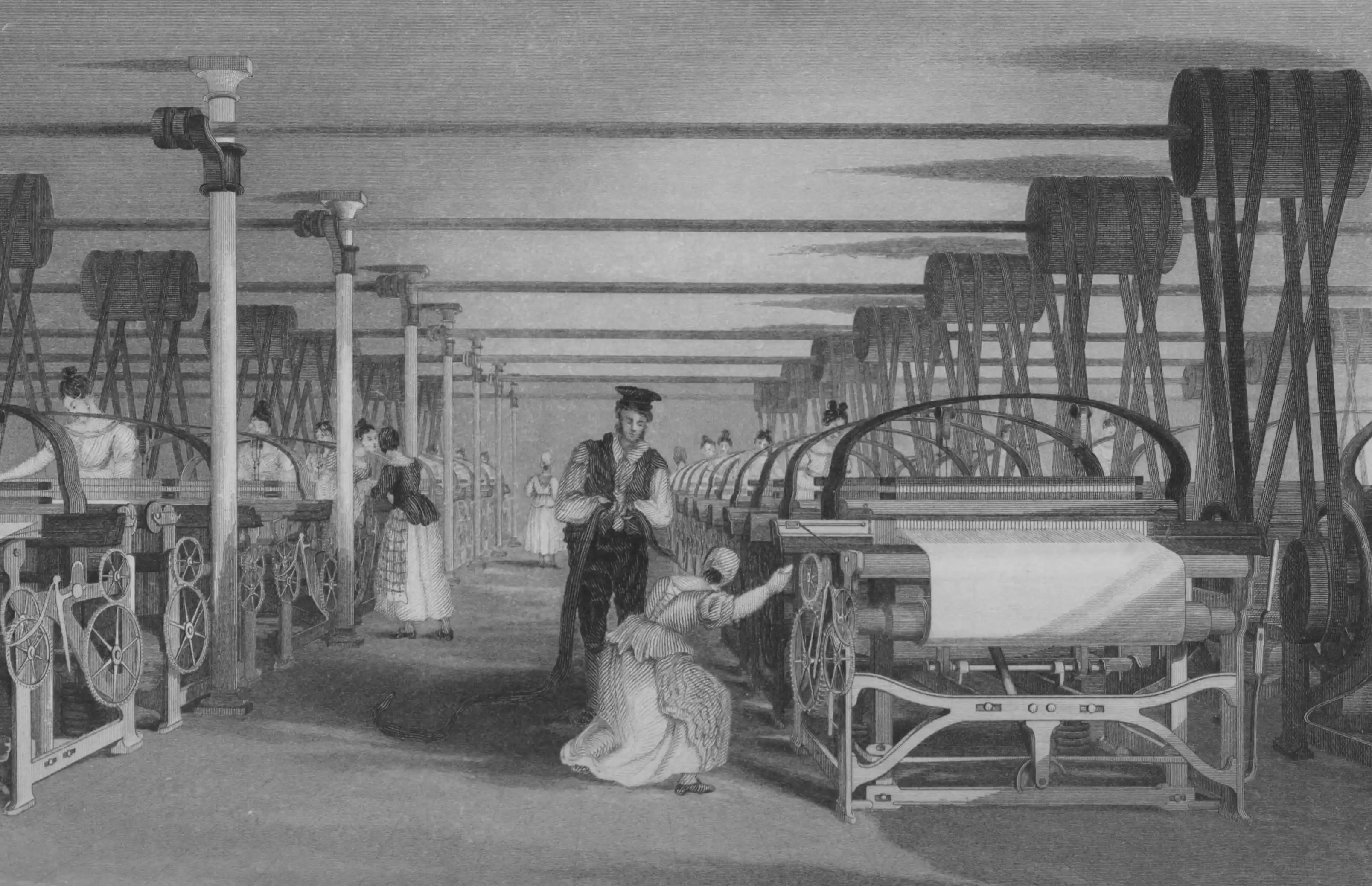
( Power-loom weaving, engraving by J. Tingle after Thomas Allom, 1835 / Wikimedia Commons )

I. The Workshop Is Still Old

Most people's day goes like this: use AI to write an email in the morning, saving ten minutes; then spend two hours in an unnecessary weekly meeting; copy and paste the same set of data between three tools in the afternoon; post on social media at night saying "AI is so great." The ten minutes saved are completely eaten back by the old processes.

Similarly, when the steam engine first appeared, factory owners initially just replaced the waterwheel with the steam engine, leaving everything else unchanged—factories were still built by the river, still multi-story buildings, still with a central drive shaft powering the entire production line. We embed ChatGPT into Slack, add Copilot to Office, place AI chat windows into workflows—we're doing the same thing. The tool is upgraded, but the workshop remains the same.

But replacing the machine is not the same as replacing the workshop. As McLuhan famously said:

We look at the present through a rear-view mirror. We march backwards into the future. Using old processes to accommodate new tools is like early films being merely recorded stage plays. The real breakthrough comes when someone completely frees the steam engine from the river and redesigns the entire production system around the new power source.

Looking at the Industrial Revolution timeline and comparing it to AI, we can roughly locate where we are on the map:
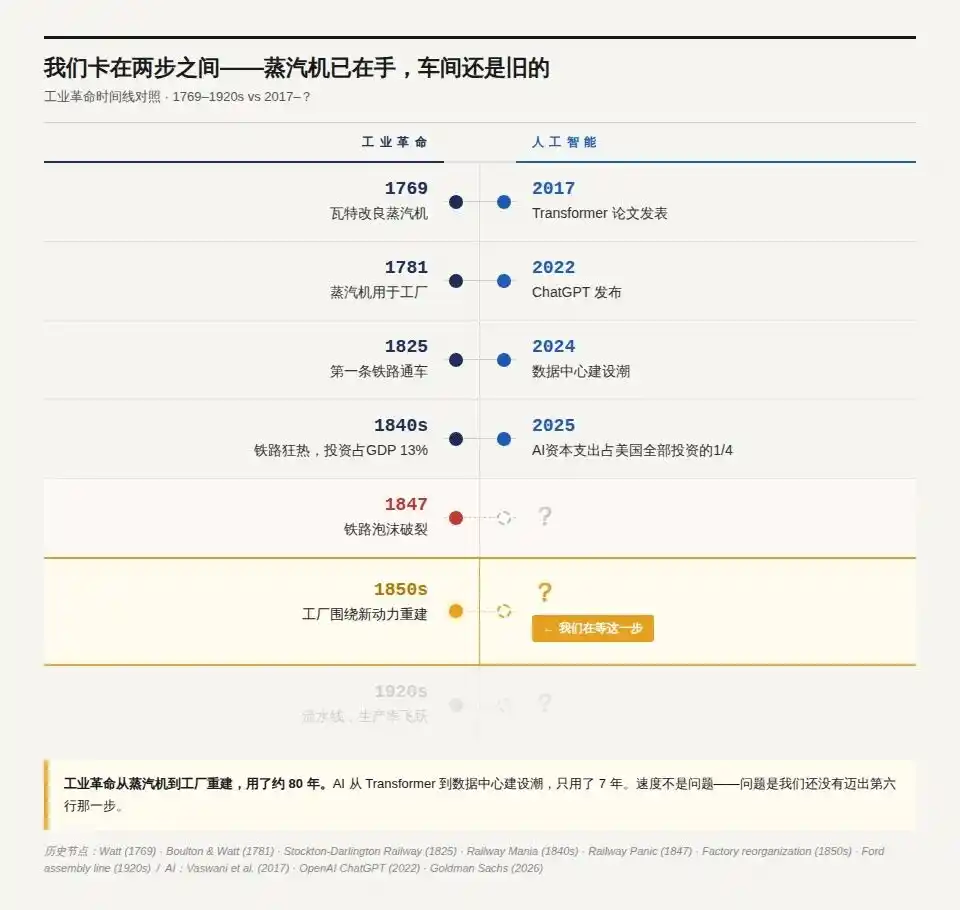
Now the timeline is extremely compressed. The Industrial Revolution took 60 years from the steam engine to the railway mania; AI took only 7 years from Transformer to the data center construction boom.

Speed is not the problem; the problem is where we are stuck—the first four rows are still the stage of installing new machines in old workshops. The steam engine is installed, railways are being laid, but the mode of production remains intact. The sixth row is the real watershed. We are most likely stuck between these two steps.

The steam engine is in our hands, but the workshop is still old.

II. All the Money Is Bet on the Layer Farthest from the Factory

Infrastructure is always overbuilt. It's the investors who go bankrupt, not the infrastructure.

In 1846, the British Parliament passed 263 Railway Acts, approving the construction of 9,500 miles of new railway. At its peak, railway investment accounted for 13% of Britain's GDP. Railway shares could be bought with only a 10% down payment, and the middle class flocked to invest. The bubble burst in 1847. One-third of the approved lines were never built, and countless investors lost everything. Darwin lost 60% on railway stocks, and he was luckier than most.

But the railways remained.

Today's AI infrastructure is following the same path. Goldman Sachs' latest estimate puts global AI infrastructure capital expenditure at $765 billion in 2026, projected to reach $1.6 trillion annually by 2031. The proportion of capital expenditure to operating cash flow for hyperscale cloud providers has risen from about 40% in 2023 to nearly 70% in 2025. AI-related investments already account for about a quarter of all US investment. Aschenbrenner's $13.68 billion is betting on this layer—he's not betting on which application will win, but on the underlying compute power itself.

This capital cycle is isomorphic to real estate development. Building data centers is like building buildings: land is electricity, building materials are GPUs and storage, contractors are data center builders, developers are cloud providers, tenants are AI application companies, and rent is API revenue. The cloud providers' business model is to "rent to cover the loan"—using API revenue to cover data center capital expenditure, waiting for the valuation leap brought by the explosion of AI applications.
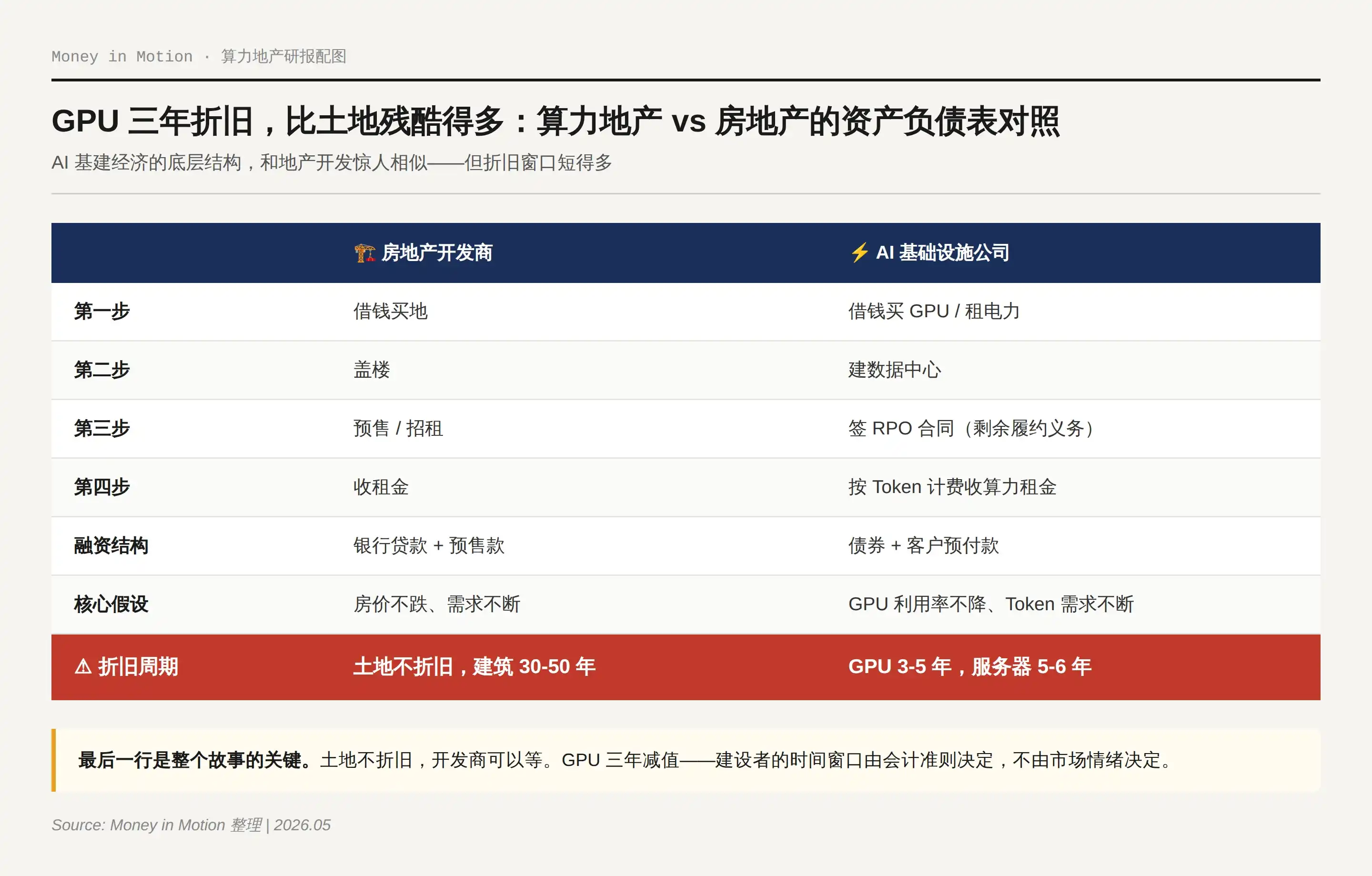
(Compute Power Real Estate: Each generation has its own infrastructure)

The core risk is the same: is the growth rate of API call volume offsetting the decline in API unit price? If rent falls below the loan repayment line—this is a nightmare familiar to real estate developers. The lesson of 2008 was not that too many houses were built, but that the structure of the houses built did not match the structure of real demand. The equivalent risk for AI is: an oversupply of general-purpose compute power, while specialized capabilities that can truly handle high-value scenarios like financial compliance or medical diagnosis remain scarce.

Railways, real estate, AI—infrastructure investments across three eras share the same rule: overbuilding is the norm, material suppliers always lose pricing power, and long-term returns always belong to the owners of "prime locations." Look at the Q1 fund holdings on Wall Street—probably 80% is concentrated in this infrastructure layer: NVIDIA, data centers, cloud infrastructure. But the railway mania teaches us: this is not the full picture of the AI revolution, and it's not even the layer with the highest returns.

What is the prime location for AI? It's unique industry data and deeply embedded workflows. For individuals, the real "prime location" is not the stocks you hold, but your own irreplaceable judgment and industry knowledge—provided you have already rebuilt the way you use them around AI.

The real returns are in the next layer. But between infrastructure and value creation, there is no seamless connection. There is a gap in the middle—historically, this gap has swallowed decades.

III. Who Is Tearing Down the Workshop

Those tearing down the workshop and those "using AI for efficiency" are not doing the same thing.

Notion co-founder Simon used to be a "10x programmer"; now he rarely writes code himself—he simultaneously controls three or four AI coding agents, achieving 30x to 40x efficiency. Notion now has 1,000 employees and over 700 AI agents. The gap isn't the tools; it's that Simon tore down his old workshop, while most people just replaced their waterwheel.

600 million Chinese users have used generative AI tools, a year-on-year increase of 142%—this is the world's largest pool of AI demand. But almost no Chinese company has rebuilt its core workflows around AI. The world's largest demand side, paired with a nearly stagnant supply side in terms of organizational change. This contrast itself is a signal: it's not that the tools are lacking, it's that organizations haven't kept up. The context of knowledge work is scattered across dozens of tools and dozens of minds, outputs are not verifiable, and no one knows how to judge whether a strategic memo is effective.
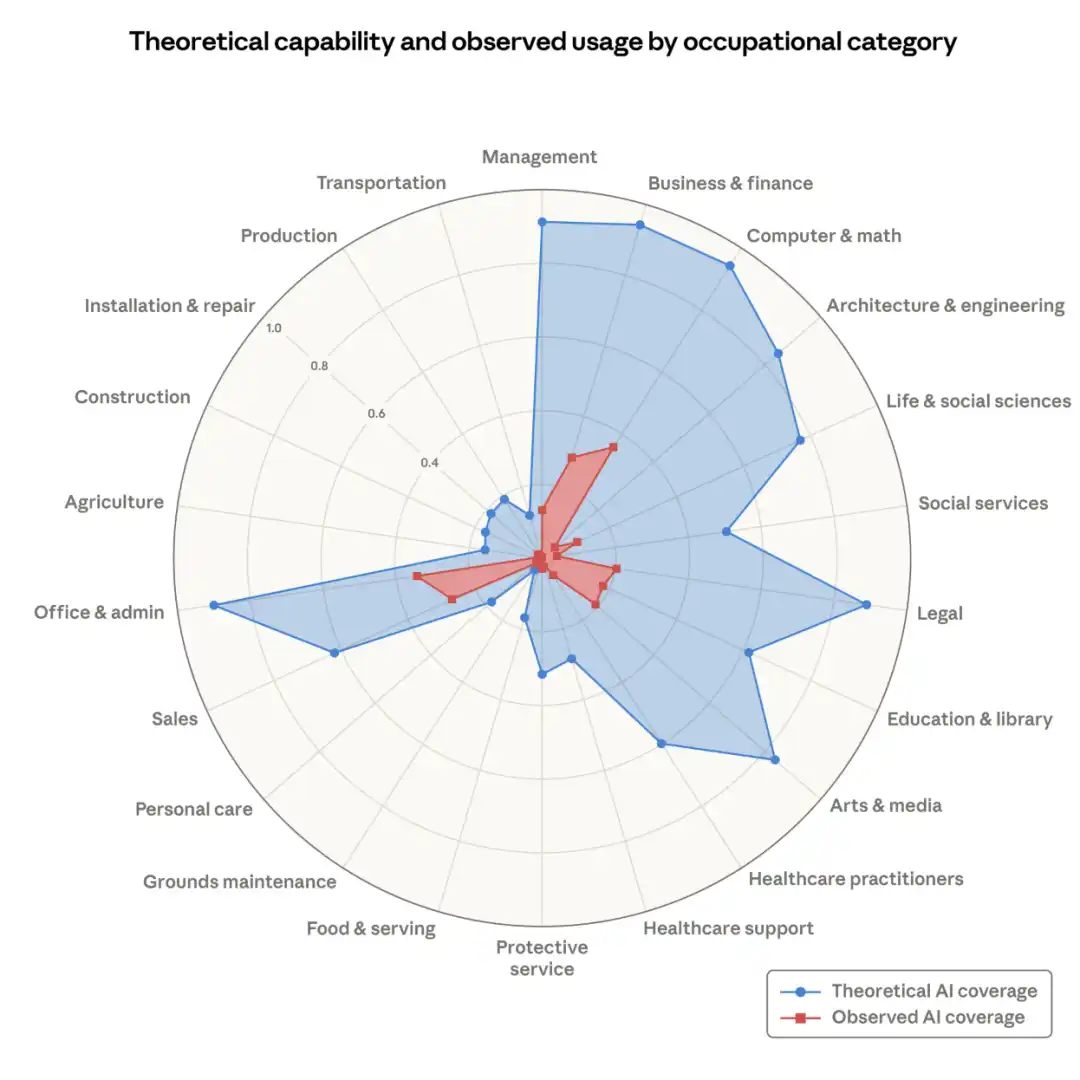
(Labor market impacts of AI: A new measure and early evidence)

Anthropic is already moving on a larger scale. They released an Economic Index, using real usage data to depict which tasks and industries AI is replacing first, then building according to this blueprint: forming a joint venture AI-native enterprise services company with Goldman Sachs, Blackstone, and Hellman & Friedman; establishing a global alliance with KPMG, connecting 276,000 employees to Claude; Accenture forming a business group, training 30,000 people, focusing on finance, life sciences, and healthcare.

The role these consulting firms play is not that of AI users, but AI railway engineers—they don't build steam engines or lay tracks; they help enterprises tear down old factories and rebuild production lines around the new power source. Without this role, most factory owners wouldn't know where to start.

The signals are already flashing. One of the sharpest comes from the job market.

Young people aged 22-25 entering AI-high-exposure professions are 14% less likely to find a job than their peers entering low-exposure professions. Junior positions are already being squeezed.

If I were a new graduate, this number would directly affect my job search. If I were a manager, the next batch of junior positions I hire might not be people.

Organizations are dismantling. What about individuals? My degree, my resume, the industry experience I've accumulated over the years—these are my waterwheels. They once drove my entire production line, but the steam engine has arrived. A degree from a top university is no longer a moat; it just proves I once built a decent factory by the river.

Now the question is, do we have the ability to leave that river?

Anthropic's data shows that users who have used AI tools for more than 6 months have a task success rate 10% higher than new users. Those who started half a year earlier are already leading by 10%, and this gap compounds over time.

But no company has gone bankrupt yet from not using AI, at least my law firm is still advancing full steam ahead around AI. The winners haven't been selected by the market yet. The learning curve is real—early adopters are already accumulating advantages, but most are still at the starting line.

IV. My Next Job Doesn't Have a Name Yet

Will my current job title exist ten years from now? How many of the tools I used daily five years ago are still used today? The answers are likely both negative. But I don't know what the things that replace them are called—because those things don't exist yet.

It's been this way every time in history. New things aren't planned; they grow on their own after old constraints disappear.

Before railways were built, Britain was a collection of isolated local economies. The price of cotton cloth in Manchester and London could differ by 30%. Each city had its own time standard, and no one saw a problem. In the twenty years after railways were built, everything changed. A national unified market appeared for the first time, price differences were smoothed out; standard time was forced by railways, not invented; stationmasters, telegraph operators, travel agents—these jobs didn't exist at all before railways.

No one foresaw department stores when laying railways. No one foresaw standard time when building steam engines.

(Steam, Steel, and AI Infinite Intelligence)

The history of cities tells the same story. Cities hundreds of years ago were human-scale—forty minutes to walk across Florence. Steel frames made skyscrapers possible, railways connected cities to their hinterlands, and elevators, subways, and highways followed. Tokyo, Chongqing, Dallas—these are not bigger versions of Florence; they are entirely new ways of life.

Current knowledge work is also human-scale. Teams of a few dozen people, meetings and emails set the rhythm, becoming unmanageable beyond a few hundred people. We are building Florence with stone and wood. AI makes "Tokyo" possible—organizations composed of thousands of AI agents and people, with workflows running continuously across time zones. Old weekly meetings, quarterly planning, annual reviews may no longer make sense.

Simon no longer writes code—his job has become "managing AI agents." This position didn't exist two years ago. My next job title might not have a name yet. But someone is already building that future we cannot yet name.

V. What Does the New Workshop Look Like

After tearing down the old workshop, what do you build? Y Combinator's answer is: let the company improve itself.

Their internal system now modifies its own code at night. An employee ran a query during the day that failed. A supervising agent read about this failure, deduced the cause, wrote code to fix it, submitted it for review, and deployed it. The same query ran successfully the next day. The whole thing happened while everyone was asleep.

This isn't AI helping people produce 30% more. This is the system running through an entire closed loop on its own, figuring out how to become better.

In an internal talk, YC partner Tom Blomfield called this company form a "recursive self-improving AI loop." His judgment is direct: most companies are still Roman legions—information trickles down layer by layer and aggregates up layer by layer, with people acting as conduits. What AI breaks is not the efficiency of a certain link, but the very premise of this entire hierarchical structure.

His new logic is: burn tokens, not headcount. The bottleneck is shifting from manpower to compute power. The data YC sees shows that companies reaching Demo Day have about 5 times higher revenue per capita than 18 months ago. The role of middle management is being taken over by AI—"coordination" no longer requires humans. Everyone should be an IC, a builder, an operator. Every task has a named owner, not a committee.

There's another prerequisite: the company must be "readable" to AI. Things that aren't recorded are, to AI, as if they never happened. YC now archives all partner emails, records all Slack messages and office hour recordings. One partner used 2,000 hours of recordings accumulated over three months to have AI regenerate a 150-page internal manual—much better than the old version. This manual updates automatically every month, becoming a perpetually fresh "living brain."

Tom left a question:

If you were building your company from scratch today, would you set it up in this form? If your company already has a hierarchical structure, you face a harder question—will the pain of rebuilding be less than the cost of continuing to operate as a Roman legion?

People are not at the center of the workshop; they are on the periphery—responsible for the places AI can't yet reach: on-the-ground judgment, entirely new situations, high-stakes, high-emotion moments. The center of the company is a "corporate brain" pieced together from data, records, and industry knowledge. The software running on it is consumable—if it can be generated, it can be regenerated. What's valuable resides in people's minds—how the business runs, which steps involve judgment; this understanding is the real asset.

What Ivan Zhao describes in "Steam, Steel, and Infinite Minds" is the other side of this direction—an organization of 1,000 employees and over 700 AI agents collaborating, where people are responsible for judgment, and agents are responsible for execution. Aschenbrenner bets on compute infrastructure; Zhao bets on organizational reconstruction. Both paths ultimately point to the same destination: a new mode of production rebuilt around AI.

VI. Conclusion

Between the 1840s and 1850s—the railways were laid, but the factories hadn't been rebuilt.

Where are we? Simon no longer writes code. He tore down his own waterwheel.

The question has never been whether the steam engine is good enough. The question is who will be the first to tear down the old workshop.

I don't intend to predict the future department stores. I only intend to take care of myself—ensuring I stand along the railway line, not guarding a river that is drying up.

What about you?

Preguntas relacionadas

QWhat is the central argument of the article regarding our current phase in the 'AI Industrial Revolution'?

AThe central argument is that we are currently in the 'steam engine' phase of the AI revolution. We have powerful new tools like Large Language Models, but are largely using them to perform old tasks within existing organizational structures and workflows ('the old workshop'). The real revolution hasn't begun yet. It will start not when AI is invented, but when organizations fundamentally dismantle old processes and rebuild their core production methods around AI.

QAccording to the author, what is the key difference between simply 'using AI for efficiency' and truly transforming work?

AThe key difference is between 'replacing the waterwheel' and 'dismantling the old workshop.' Using AI for efficiency means attaching AI chatbots to existing tools (like adding ChatGPT to Slack) to save time on discrete tasks, but leaving the underlying workflows and organizational logic unchanged. True transformation involves redesigning the entire 'factory' around the new 'engine'—reimagining processes, roles, and structures from the ground up with AI as the core driver, as exemplified by individuals like Notion's Simon who manage AI agents instead of writing code.

QWhat historical parallel does the author draw to the massive investment in AI infrastructure (like data centers and GPUs), and what warning does this imply?

AThe author draws a parallel to the British 'Railway Mania' of the 1840s. This implies a warning of a potential investment bubble where capital is overwhelmingly poured into foundational infrastructure (the 'rail lines' and 'real estate' of AI—data centers, chips, cloud capacity), far ahead of proven, high-value applications. The risk is that the 'rent' (API revenue) may not cover the 'mortgage' (capital expenditure) if the growth in usage doesn't outpace price declines, leading to overcapacity in generic compute while specialized, industry-transforming capabilities remain scarce.

QWhat does the author suggest is the 'core location' or most valuable asset for individuals in the AI era, and why?

AFor individuals, the author suggests the true 'core location' is not stock holdings in infrastructure companies, but their own 'irreplaceable judgment and industry knowledge.' This is because AI commoditizes execution and information retrieval. The unique value lies in human capabilities like offline judgment, navigating novel situations, and high-stakes emotional intelligence—areas where AI currently cannot reach. However, this knowledge is only a valuable asset if the individual has already rebuilt their way of working to leverage AI effectively.

QWhat is the 'recursive self-improving AI loop' described in the Y Combinator example, and what does it signify about future organizations?

AThe 'recursive self-improving AI loop' is when an AI system autonomously identifies a failure in its own operations, diagnoses the cause, writes and deploys code to fix it, and verifies the solution—all without human intervention. This signifies a move beyond AI as a productivity tool for humans. It points to future organizations where AI forms a 'company brain' from data and communications, enabling systems to self-optimize. This undermines traditional hierarchical ('Roman legion') structures, as coordination and middle-management tasks are automated. The future organization is 'AI-readable,' with humans focused on high-judgment roles at the periphery.

Lecturas Relacionadas

Bankless Co-founder: Why I Sold All My ETH

Author David Hoffman, founder of Bankless, explains his decision to sell all his ETH, despite being a prominent figure in the Ethereum ecosystem. He clarifies that his move is not a bearish take on Ethereum itself, which he remains highly optimistic about as a network. His core argument is that the "ETH is money" thesis, which he helped popularize, has largely played out. Hoffman argues that ETH has achieved the market valuation it deserves based on Ethereum's current success and competitive position. He details several reasons for this view. First, the path for ETH to become global money required nearly flawless execution and sustained dominance across Ethereum's entire technical and social stack—a coordination challenge he now believes had a narrower window for success than anticipated. Second, market data shows a strong correlation between L1 chain activity/fees and the price of its native asset; Ethereum's fee dominance has been challenged by competitors like Solana. Third, the "strong version" of crypto (decentralized, native crypto economies) that ETH's monetary thesis relied upon has struggled to maintain a positive mainstream narrative and stable adoption beyond a brief period. Finally, Ethereum's architecture as a "giver"—providing secure block space and tokenization capabilities at cost to L2s and applications—means it doesn't capture premium value directly. Its rollup-centric roadmap further directs most profits to L2s and applications ("fat app theory"). In conclusion, Hoffman believes the opportunity for ETH to be revalued significantly upward as money has diminished. He sold not because ETH will fail, but because its monetary thesis has matured, and he seeks to allocate capital to other opportunities he finds more compelling.

链捕手Hace 1 hora(s)

Bankless Co-founder: Why I Sold All My ETH

链捕手Hace 1 hora(s)

From Issuer to Infrastructure Owner: Circle's Arc Strategy and the Fatal Gap in the GENIUS Act

Circle raised $222 million for its proprietary Layer-1 blockchain, Arc, positioning itself not just as a stablecoin issuer but as the owner of the settlement infrastructure USDC relies on. This move, backed by investors like BlackRock and Apollo, highlights a significant structural conflict unaddressed by the GENIUS Act of 2025. While the act focuses on stablecoin reserves and issuer oversight, it remains silent on the market structure implications of an issuer controlling the underlying network—a scenario akin to a currency issuer also owning the payment rails. Traditionally, financial regulations separate issuers from settlement infrastructure to ensure neutrality. With Arc, Circle gains control over transaction ordering, fees, and network rules, potentially favoring USDC over competitors. The article argues that this creates a permanent structural temptation, even if no abuse occurs. The solution lies in applying established market infrastructure principles: mandating neutral transaction ordering, transparent fee schedules, and governance separated from Circle’s commercial interests. The current pre-mainnet phase offers a critical window for regulators to establish these rules before Arc becomes entrenched. Once operational, enforcing changes would be costly and disruptive. The core question remains: should a regulated stablecoin issuer be allowed to own the settlement network its competitors must use? The GENIUS Act doesn’t answer this, but Circle’s Arc strategy makes it urgent.

marsbitHace 1 hora(s)

From Issuer to Infrastructure Owner: Circle's Arc Strategy and the Fatal Gap in the GENIUS Act

marsbitHace 1 hora(s)

What Are the Key Variables Determining the AI Bull Market?

Title: What Determines the AI Bull Market? Key Variables Revealed Despite rising oil prices above $100/barrel, persistent inflation, and fragile Fed rate cut expectations—a traditionally hostile environment for high-valuation tech stocks—the AI sector continues to drive the market to new highs. According to analysts, the current AI boom is in a phase of "rational fervor": while bubbles exist, they are not yet out of control. The crucial shift is the emergence of Agentic AI, which is evolving from an assisting tool (Copilot) to an autonomous execution tool (Autopilot), creating a clearer commercial path from investment to revenue. This shift accelerates Token consumption and inference computing demand while boosting revenue forecasts for leading firms. The market is now rewarding capital expenditure as it transforms from a burden into a competitive moat, supporting hardware chains like GPUs, optical modules, and storage. However, valuations have already priced in growth expectations for 2027-2028. The forward P/E ratio for the "Magnificent Seven" tech giants is about 35x, compared to 25x for the rest of the S&P 500. This premium implies AI adoption must occur 5 to 8 times faster than past technological revolutions—a scenario with little room for error. The sustainability of the AI bull market hinges on three key variables: 1. **Short-term liquidity shocks**: Risks include sustained high oil prices, resurgent inflation, rising interest rates, and potential unwinding of the yen carry trade. The critical question is whether the upward revision speed of Annual Recurring Revenue (ARR) can outpace the rise in interest rates. 2. **Mid-term industry realization**: Can the actual pace of AI adoption and commercialization match the current lofty valuations? Historically, general-purpose technology revolutions follow a non-linear path with periods of acceleration and deceleration. 3. **Long-term structural constraints**: These include energy and power grid limitations, employment displacement and consumer purchasing power, social acceptance and potential backlash, and potential hardware technology breakthroughs that could disrupt current supply chains. While the long-term prospects for AI remain optimistic with potential for significant productivity gains, the stock market's pricing depends not just on the vision but on the actual speed of realization amid these growing constraints. The direction is clear, but the pace of execution will determine whether the bubble remains controlled or spirals out of control.

marsbitHace 1 hora(s)

What Are the Key Variables Determining the AI Bull Market?

marsbitHace 1 hora(s)

Trading

Spot
Futuros

Artículos destacados

Qué es GROK AI

Grok AI: Revolucionando la Tecnología Conversacional en la Era Web3 Introducción En el paisaje de rápida evolución de la inteligencia artificial, Grok AI se destaca como un proyecto notable que une los dominios de la tecnología avanzada y la interacción del usuario. Desarrollado por xAI, una empresa liderada por el renombrado empresario Elon Musk, Grok AI busca redefinir la forma en que interactuamos con la inteligencia artificial. A medida que el movimiento Web3 continúa floreciendo, Grok AI tiene como objetivo aprovechar el poder de la IA conversacional para responder consultas complejas, proporcionando a los usuarios una experiencia que no solo es informativa, sino también entretenida. ¿Qué es Grok AI? Grok AI es un sofisticado chatbot de IA conversacional diseñado para interactuar dinámicamente con los usuarios. A diferencia de muchos sistemas de IA tradicionales, Grok AI abraza una gama más amplia de consultas, incluyendo aquellas que normalmente se consideran inapropiadas o fuera de las respuestas estándar. Los objetivos centrales del proyecto incluyen: Razonamiento Confiable: Grok AI enfatiza el razonamiento de sentido común para proporcionar respuestas lógicas basadas en la comprensión contextual. Supervisión Escalable: La integración de asistencia de herramientas asegura que las interacciones de los usuarios sean monitoreadas y optimizadas para la calidad. Verificación Formal: La seguridad es primordial; Grok AI incorpora métodos de verificación formal para mejorar la confiabilidad de sus resultados. Comprensión de Largo Contexto: El modelo de IA sobresale en retener y recordar un extenso historial de conversaciones, facilitando discusiones significativas y contextualizadas. Robustez Adversarial: Al enfocarse en mejorar sus defensas contra entradas manipuladas o maliciosas, Grok AI busca mantener la integridad de las interacciones de los usuarios. En esencia, Grok AI no es solo un dispositivo de recuperación de información; es un compañero conversacional inmersivo que fomenta un diálogo dinámico. Creador de Grok AI La mente detrás de Grok AI no es otra que Elon Musk, una persona sinónimo de innovación en varios campos, incluyendo la automoción, los viajes espaciales y la tecnología. Bajo el paraguas de xAI, una empresa enfocada en avanzar la tecnología de IA de maneras beneficiosas, la visión de Musk busca remodelar la comprensión de las interacciones de IA. El liderazgo y la ética fundacional están profundamente influenciados por el compromiso de Musk de empujar los límites tecnológicos. Inversores de Grok AI Si bien los detalles específicos sobre los inversores que respaldan a Grok AI son limitados, se reconoce públicamente que xAI, el incubador del proyecto, está fundado y apoyado principalmente por el propio Elon Musk. Las empresas y participaciones anteriores de Musk proporcionan un respaldo robusto, fortaleciendo aún más la credibilidad y el potencial de crecimiento de Grok AI. Sin embargo, hasta ahora, la información sobre fundaciones de inversión adicionales u organizaciones que apoyan a Grok AI no está fácilmente accesible, marcando un área para una posible exploración futura. ¿Cómo Funciona Grok AI? La mecánica operativa de Grok AI es tan innovadora como su marco conceptual. El proyecto integra varias tecnologías de vanguardia que facilitan sus funcionalidades únicas: Infraestructura Robusta: Grok AI está construido utilizando Kubernetes para la orquestación de contenedores, Rust para rendimiento y seguridad, y JAX para computación numérica de alto rendimiento. Este trío asegura que el chatbot opere de manera eficiente, escale efectivamente y sirva a los usuarios de manera oportuna. Acceso a Conocimiento en Tiempo Real: Una de las características distintivas de Grok AI es su capacidad para acceder a datos en tiempo real a través de la plataforma X—anteriormente conocida como Twitter. Esta capacidad otorga a la IA acceso a la información más reciente, permitiéndole proporcionar respuestas y recomendaciones oportunas que otros modelos de IA podrían pasar por alto. Dos Modos de Interacción: Grok AI ofrece a los usuarios una elección entre “Modo Divertido” y “Modo Regular”. El Modo Divertido permite un estilo de interacción más lúdico y humorístico, mientras que el Modo Regular se centra en ofrecer respuestas precisas y exactas. Esta versatilidad asegura una experiencia personalizada que se adapta a diversas preferencias de los usuarios. En esencia, Grok AI une rendimiento con compromiso, creando una experiencia que es tanto enriquecedora como entretenida. Cronología de Grok AI El viaje de Grok AI está marcado por hitos cruciales que reflejan sus etapas de desarrollo y despliegue: Desarrollo Inicial: La fase fundamental de Grok AI tuvo lugar durante aproximadamente dos meses, durante los cuales se realizó el entrenamiento inicial y el ajuste del modelo. Lanzamiento Beta de Grok-2: En un avance significativo, se anunció la beta de Grok-2. Este lanzamiento introdujo dos versiones del chatbot—Grok-2 y Grok-2 mini—cada una equipada con capacidades para chatear, programar y razonar. Acceso Público: Tras su desarrollo beta, Grok AI se volvió disponible para los usuarios de la plataforma X. Aquellos con cuentas verificadas por un número de teléfono y activas durante al menos siete días pueden acceder a una versión limitada, haciendo que la tecnología esté disponible para un público más amplio. Esta cronología encapsula el crecimiento sistemático de Grok AI desde su inicio hasta el compromiso público, enfatizando su compromiso con la mejora continua y la interacción del usuario. Características Clave de Grok AI Grok AI abarca varias características clave que contribuyen a su identidad innovadora: Integración de Conocimiento en Tiempo Real: El acceso a información actual y relevante diferencia a Grok AI de muchos modelos estáticos, permitiendo una experiencia de usuario atractiva y precisa. Estilos de Interacción Versátiles: Al ofrecer modos de interacción distintos, Grok AI se adapta a diversas preferencias de los usuarios, invitando a la creatividad y la personalización en la conversación con la IA. Avanzada Infraestructura Tecnológica: La utilización de Kubernetes, Rust y JAX proporciona al proyecto un marco sólido para asegurar confiabilidad y rendimiento óptimo. Consideración de Discurso Ético: La inclusión de una función generadora de imágenes muestra el espíritu innovador del proyecto. Sin embargo, también plantea consideraciones éticas en torno a los derechos de autor y la representación respetuosa de figuras reconocibles—una discusión en curso dentro de la comunidad de IA. Conclusión Como una entidad pionera en el ámbito de la IA conversacional, Grok AI encapsula el potencial de experiencias transformadoras para los usuarios en la era digital. Desarrollado por xAI y guiado por el enfoque visionario de Elon Musk, Grok AI integra conocimiento en tiempo real con capacidades avanzadas de interacción. Busca empujar los límites de lo que la inteligencia artificial puede lograr mientras mantiene un enfoque en consideraciones éticas y la seguridad del usuario. Grok AI no solo encarna el avance tecnológico, sino que también representa un nuevo paradigma de conversación en el paisaje Web3, prometiendo involucrar a los usuarios con tanto conocimiento hábil como interacción lúdica. A medida que el proyecto continúa evolucionando, se erige como un testimonio de lo que la intersección de la tecnología, la creatividad y la interacción similar a la humana puede lograr.

381 Vistas totalesPublicado en 2024.12.26Actualizado en 2024.12.26

Qué es GROK AI

Qué es ERC AI

Euruka Tech: Una Visión General de $erc ai y sus Ambiciones en Web3 Introducción En el paisaje en rápida evolución de la tecnología blockchain y las aplicaciones descentralizadas, nuevos proyectos emergen con frecuencia, cada uno con objetivos y metodologías únicas. Uno de estos proyectos es Euruka Tech, que opera en el amplio dominio de las criptomonedas y Web3. El enfoque principal de Euruka Tech, particularmente su token $erc ai, es presentar soluciones innovadoras diseñadas para aprovechar las crecientes capacidades de la tecnología descentralizada. Este artículo tiene como objetivo proporcionar una visión general completa de Euruka Tech, una exploración de sus objetivos, funcionalidad, la identidad de su creador, posibles inversores y su importancia dentro del contexto más amplio de Web3. ¿Qué es Euruka Tech, $erc ai? Euruka Tech se caracteriza como un proyecto que aprovecha las herramientas y funcionalidades ofrecidas por el entorno Web3, centrándose en integrar inteligencia artificial dentro de sus operaciones. Aunque los detalles específicos sobre el marco del proyecto son algo elusivos, está diseñado para mejorar la participación del usuario y automatizar procesos en el espacio cripto. El proyecto tiene como objetivo crear un ecosistema descentralizado que no solo facilite transacciones, sino que también incorpore funcionalidades predictivas a través de inteligencia artificial, de ahí la designación de su token, $erc ai. El objetivo es proporcionar una plataforma intuitiva que facilite interacciones más inteligentes y un procesamiento eficiente de transacciones dentro de la creciente esfera de Web3. ¿Quién es el Creador de Euruka Tech, $erc ai? En la actualidad, la información sobre el creador o el equipo fundador detrás de Euruka Tech permanece no especificada y algo opaca. Esta ausencia de datos genera preocupaciones, ya que el conocimiento del trasfondo del equipo es a menudo esencial para establecer credibilidad dentro del sector blockchain. Por lo tanto, hemos categorizado esta información como desconocida hasta que se disponga de detalles concretos en el dominio público. ¿Quiénes son los Inversores de Euruka Tech, $erc ai? De manera similar, la identificación de inversores u organizaciones de respaldo para el proyecto Euruka Tech no se proporciona fácilmente a través de la investigación disponible. Un aspecto que es crucial para los posibles interesados o usuarios que consideren involucrarse con Euruka Tech es la garantía que proviene de asociaciones financieras establecidas o respaldo de firmas de inversión de renombre. Sin divulgaciones sobre afiliaciones de inversión, es difícil sacar conclusiones completas sobre la seguridad financiera o la longevidad del proyecto. De acuerdo con la información encontrada, esta sección también se encuentra en estado de desconocido. ¿Cómo Funciona Euruka Tech, $erc ai? A pesar de la falta de especificaciones técnicas detalladas para Euruka Tech, es esencial considerar sus ambiciones innovadoras. El proyecto busca aprovechar el poder computacional de la inteligencia artificial para automatizar y mejorar la experiencia del usuario dentro del entorno de las criptomonedas. Al integrar IA con tecnología blockchain, Euruka Tech tiene como objetivo proporcionar características como operaciones automatizadas, evaluaciones de riesgo e interfaces de usuario personalizadas. La esencia innovadora de Euruka Tech radica en su objetivo de crear una conexión fluida entre los usuarios y las vastas posibilidades que presentan las redes descentralizadas. A través de la utilización de algoritmos de aprendizaje automático e IA, busca minimizar los desafíos de los usuarios primerizos y optimizar las experiencias transaccionales dentro del marco de Web3. Esta simbiosis entre IA y blockchain subraya la importancia del token $erc ai, que actúa como un puente entre las interfaces de usuario tradicionales y las capacidades avanzadas de las tecnologías descentralizadas. Cronología de Euruka Tech, $erc ai Desafortunadamente, como resultado de la información limitada disponible sobre Euruka Tech, no podemos presentar una cronología detallada de los principales desarrollos o hitos en el viaje del proyecto. Esta cronología, típicamente invaluable para trazar la evolución de un proyecto y entender su trayectoria de crecimiento, no está actualmente disponible. A medida que la información sobre eventos notables, asociaciones o adiciones funcionales se haga evidente, las actualizaciones seguramente mejorarán la visibilidad de Euruka Tech en la esfera cripto. Aclaración sobre Otros Proyectos “Eureka” Es importante señalar que múltiples proyectos y empresas comparten una nomenclatura similar con “Eureka”. La investigación ha identificado iniciativas como un agente de IA de NVIDIA Research, que se centra en enseñar a los robots tareas complejas utilizando métodos generativos, así como Eureka Labs y Eureka AI, que mejoran la experiencia del usuario en educación y análisis de servicio al cliente, respectivamente. Sin embargo, estos proyectos son distintos de Euruka Tech y no deben confundirse con sus objetivos o funcionalidades. Conclusión Euruka Tech, junto con su token $erc ai, representa un jugador prometedor pero actualmente oscuro dentro del paisaje de Web3. Si bien los detalles sobre su creador e inversores permanecen no revelados, la ambición central de combinar inteligencia artificial con tecnología blockchain se presenta como un punto focal de interés. Los enfoques únicos del proyecto para fomentar la participación del usuario a través de la automatización avanzada podrían destacarlo a medida que el ecosistema Web3 progresa. A medida que el mercado cripto continúa evolucionando, los interesados deben mantener un ojo atento a los avances en torno a Euruka Tech, ya que el desarrollo de innovaciones documentadas, asociaciones o una hoja de ruta definida podría presentar oportunidades significativas en el futuro cercano. Tal como está, esperamos más información sustancial que podría revelar el potencial de Euruka Tech y su posición en el competitivo paisaje cripto.

336 Vistas totalesPublicado en 2025.01.02Actualizado en 2025.01.02

Qué es ERC AI

Qué es DUOLINGO AI

DUOLINGO AI: Integrando el Aprendizaje de Idiomas con Web3 e Innovación en IA En una era donde la tecnología redefine la educación, la integración de la inteligencia artificial (IA) y las redes blockchain anuncia una nueva frontera para el aprendizaje de idiomas. Entra DUOLINGO AI y su criptomoneda asociada, $DUOLINGO AI. Este proyecto aspira a fusionar la capacidad educativa de las principales plataformas de aprendizaje de idiomas con los beneficios de la tecnología descentralizada Web3. Este artículo profundiza en los aspectos clave de DUOLINGO AI, explorando sus objetivos, marco tecnológico, desarrollo histórico y potencial futuro, mientras mantiene claridad entre el recurso educativo original y esta iniciativa independiente de criptomoneda. Visión General de DUOLINGO AI En su esencia, DUOLINGO AI busca establecer un entorno descentralizado donde los aprendices puedan ganar recompensas criptográficas por alcanzar hitos educativos en la competencia lingüística. Al aplicar contratos inteligentes, el proyecto tiene como objetivo automatizar los procesos de verificación de habilidades y asignación de tokens, adhiriéndose a los principios de Web3 que enfatizan la transparencia y la propiedad del usuario. El modelo se aparta de los enfoques tradicionales para la adquisición de idiomas al apoyarse en gran medida en una estructura de gobernanza impulsada por la comunidad, permitiendo a los poseedores de tokens sugerir mejoras al contenido del curso y a las distribuciones de recompensas. Algunos de los objetivos notables de DUOLINGO AI incluyen: Aprendizaje Gamificado: El proyecto integra logros en blockchain y tokens no fungibles (NFTs) para representar niveles de competencia lingüística, fomentando la motivación a través de recompensas digitales atractivas. Creación de Contenido Descentralizada: Abre avenidas para que educadores y entusiastas de los idiomas contribuyan con sus cursos, facilitando un modelo de reparto de ingresos que beneficia a todos los contribuyentes. Personalización Impulsada por IA: Al emplear modelos avanzados de aprendizaje automático, DUOLINGO AI personaliza las lecciones para adaptarse al progreso de aprendizaje individual, similar a las características adaptativas que se encuentran en plataformas establecidas. Creadores del Proyecto y Gobernanza A partir de abril de 2025, el equipo detrás de $DUOLINGO AI permanece seudónimo, una práctica frecuente en el paisaje descentralizado de criptomonedas. Esta anonimidad está destinada a promover el crecimiento colectivo y la participación de los interesados en lugar de centrarse en desarrolladores individuales. El contrato inteligente desplegado en la blockchain de Solana anota la dirección de la billetera del desarrollador, lo que significa el compromiso con la transparencia en las transacciones a pesar de que la identidad de los creadores sea desconocida. Según su hoja de ruta, DUOLINGO AI aspira a evolucionar hacia una Organización Autónoma Descentralizada (DAO). Esta estructura de gobernanza permite a los poseedores de tokens votar sobre cuestiones críticas como implementaciones de características y asignaciones del tesoro. Este modelo se alinea con la ética del empoderamiento comunitario que se encuentra en diversas aplicaciones descentralizadas, enfatizando la importancia de la toma de decisiones colectiva. Inversores y Asociaciones Estratégicas Actualmente, no hay inversores institucionales o capitalistas de riesgo identificables públicamente vinculados a $DUOLINGO AI. En cambio, la liquidez del proyecto proviene principalmente de intercambios descentralizados (DEXs), marcando un contraste marcado con las estrategias de financiamiento de las empresas de tecnología educativa tradicionales. Este modelo de base indica un enfoque impulsado por la comunidad, reflejando el compromiso del proyecto con la descentralización. En su libro blanco, DUOLINGO AI menciona la formación de colaboraciones con “plataformas de educación blockchain” no especificadas, destinadas a enriquecer su oferta de cursos. Si bien aún no se han divulgado asociaciones específicas, estos esfuerzos colaborativos sugieren una estrategia para fusionar la innovación blockchain con iniciativas educativas, ampliando el acceso y la participación de los usuarios a través de diversas avenidas de aprendizaje. Arquitectura Tecnológica Integración de IA DUOLINGO AI incorpora dos componentes principales impulsados por IA para mejorar su oferta educativa: Motor de Aprendizaje Adaptativo: Este sofisticado motor aprende de las interacciones de los usuarios, similar a los modelos propietarios de las principales plataformas educativas. Ajusta dinámicamente la dificultad de las lecciones para abordar desafíos específicos de los aprendices, reforzando áreas débiles a través de ejercicios dirigidos. Agentes Conversacionales: Al emplear chatbots impulsados por GPT-4, DUOLINGO AI proporciona una plataforma para que los usuarios participen en conversaciones simuladas, fomentando una experiencia de aprendizaje de idiomas más interactiva y práctica. Infraestructura Blockchain Construido sobre la blockchain de Solana, $DUOLINGO AI utiliza un marco tecnológico integral que incluye: Contratos Inteligentes de Verificación de Habilidades: Esta característica otorga automáticamente tokens a los usuarios que superan con éxito las pruebas de competencia, reforzando la estructura de incentivos para resultados de aprendizaje genuinos. Insignias NFT: Estos tokens digitales significan varios hitos que los aprendices logran, como completar una sección de su curso o dominar habilidades específicas, permitiéndoles intercambiar o mostrar sus logros digitalmente. Gobernanza DAO: Los miembros de la comunidad con tokens pueden participar en la gobernanza votando sobre propuestas clave, facilitando una cultura participativa que fomenta la innovación en las ofertas de cursos y características de la plataforma. Línea de Tiempo Histórica 2022–2023: Conceptualización Los cimientos de DUOLINGO AI comienzan con la creación de un libro blanco, destacando la sinergia entre los avances en IA en el aprendizaje de idiomas y el potencial descentralizado de la tecnología blockchain. 2024: Lanzamiento Beta Un lanzamiento beta limitado introduce ofertas en idiomas populares, recompensando a los primeros usuarios con incentivos en tokens como parte de la estrategia de participación comunitaria del proyecto. 2025: Transición a DAO En abril, se produce un lanzamiento completo de la red principal con la circulación de tokens, lo que provoca discusiones comunitarias sobre posibles expansiones a idiomas asiáticos y otros desarrollos de cursos. Desafíos y Direcciones Futuras Obstáculos Técnicos A pesar de sus ambiciosos objetivos, DUOLINGO AI enfrenta desafíos significativos. La escalabilidad sigue siendo una preocupación constante, particularmente en equilibrar los costos asociados con el procesamiento de IA y mantener una red descentralizada y receptiva. Además, garantizar la creación y moderación de contenido de calidad en medio de una oferta descentralizada plantea complejidades en el mantenimiento de estándares educativos. Oportunidades Estratégicas Mirando hacia adelante, DUOLINGO AI tiene el potencial de aprovechar asociaciones de micro-certificación con instituciones académicas, proporcionando validaciones verificadas en blockchain de habilidades lingüísticas. Además, la expansión entre cadenas podría permitir que el proyecto acceda a bases de usuarios más amplias y a ecosistemas blockchain adicionales, mejorando su interoperabilidad y alcance. Conclusión DUOLINGO AI representa una fusión innovadora de inteligencia artificial y tecnología blockchain, presentando una alternativa centrada en la comunidad a los sistemas tradicionales de aprendizaje de idiomas. Si bien su desarrollo seudónimo y su modelo económico emergente traen ciertos riesgos, el compromiso del proyecto con el aprendizaje gamificado, la educación personalizada y la gobernanza descentralizada ilumina un camino hacia adelante para la tecnología educativa en el ámbito de Web3. A medida que la IA continúa avanzando y el ecosistema blockchain evoluciona, iniciativas como DUOLINGO AI podrían redefinir cómo los usuarios se involucran con la educación lingüística, empoderando comunidades y recompensando la participación a través de mecanismos de aprendizaje innovadores.

377 Vistas totalesPublicado en 2025.04.11Actualizado en 2025.04.11

Qué es DUOLINGO AI

Discusiones

Bienvenido a la comunidad de HTX. Aquí puedes mantenerte informado sobre los últimos desarrollos de la plataforma y acceder a análisis profesionales del mercado. A continuación se presentan las opiniones de los usuarios sobre el precio de AI (AI).

活动图片