The AI Agent Era Accelerates Its Arrival: Questflow Defines a New Paradigm of Financial Intelligence with On-Chain AI Brokerage

链捕手Publicado a 2026-05-11Actualizado a 2026-05-11

Resumen

The AI Agent era is accelerating, with the CB Insights AI 100 list highlighting global investment confidence. The focus has shifted from whether AI works to its speed of deployment and ability to manage complex workflows, with autonomous AI Agents driving this transformation. At the forefront is Questflow, a Singapore-based startup redefining financial intelligence through its on-chain AI brokerage. Unlike tools that merely provide data dashboards, Questflow deploys AI Agents that proactively scan markets, form judgments, and execute trades via a conversational interface—operating 24/7 without requiring manual confirmation for each decision. This embodies the new AI paradigm of agents capable of executing multi-step workflows autonomously. Questflow's mission is to democratize institutional-grade trading intelligence. Historically reserved for the ultra-wealthy, this capability is now accessible starting from just $1 through Questflow's "AI Clone + Copy Trade" model. The platform charges only a 1% execution fee, aligning its incentives directly with users and eliminating traditional management or performance fees. The timing is opportune, aligning with key trends identified by CB Insights: the scalable deployment of AI Agents, accelerated AI adoption in financial services, and the maturation of on-chain infrastructure. With robust liquidity on platforms like Hyperliquid and Polymarket, alongside advancements in AI reasoning and non-custodial wallet security, Questflow is p...

CB Insights, a globally influential technology market intelligence firm, has released its tenth annual AI 100 list, selecting the world's 100 most promising AI startups in 2026. The list covers the full spectrum of AI innovation from infrastructure to industry-specific vertical applications. The selected companies have collectively raised over $10.9 billion, with more than $2 billion raised in 2026 alone, strongly validating global capital's confidence in the AI Agent sector.

CB Insights noted that the core theme this year has shifted from "Can AI work?" to "How quickly can AI be deployed, governed, and scaled into complex workflows." Among these trends, AI Agents capable of autonomously executing multi-step tasks in production environments are emerging as the core driving force behind the new wave of industrial transformation.
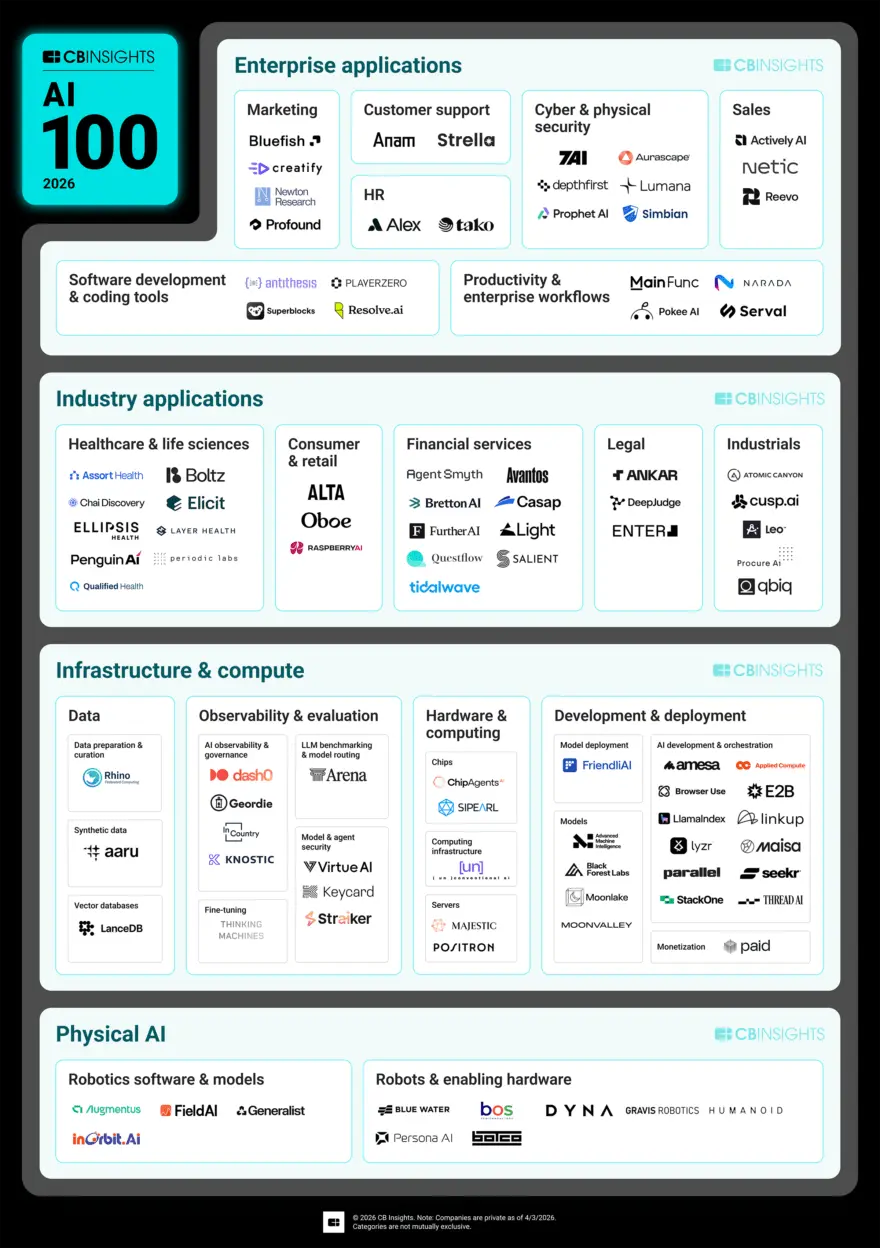
As a deep participant in this wave, Questflow—a Singapore-headquartered startup focused on on-chain AI brokerage—is at the forefront of this transformation with its unique product architecture and business model.

Not Just a Tool, But an AI That Trades For You

While most AI financial tools are still in the "data dashboard" phase, Questflow has already advanced AI Agents to the level of autonomous trading entities. Users don't need to actively search for opportunities; the AI Agents on the platform proactively scan the market, form judgments, and execute trades directly through a conversational interface, operating 24/7 without requiring manual intervention for every decision.

This is precisely the new AI paradigm defined by CB Insights' latest list: Agents capable of independently executing multi-step workflows without requiring step-by-step human confirmation represent the true deployment of AI in production environments. The operation of Questflow's AI Clone simultaneously on the Polymarket prediction market and the Hyperliquid perpetual contract market is the most direct application of this paradigm in the financial field.

Democratizing Financial Intelligence, Breaking Down Wealth Barriers

Questflow's core proposition is concise and powerful: Robinhood got everyone a seat at the table; Questflow gives everyone a brain.

In the past, institutional-grade trading intelligence was a privilege exclusive to wealth—family offices serve clients with over $30 million, private banks even more so, leaving ordinary retail investors to rely on luck. Through its AI Clone + Copy Trade product architecture, Questflow lowers the entry barrier for such capabilities to as little as $1, while maintaining a structure with zero management fees and zero performance fees. Revenue comes from a 1% trade execution fee, aligning interests highly with users and eliminating conflicts.

The Timing Is Right

The three key industry signals emphasized by CB Insights in this year's list—the large-scale deployment of AI Agents, accelerated AI penetration in financial services, and the maturation of on-chain infrastructure—closely align with Questflow's strategic assessment: sufficient on-chain asset liquidity (Hyperliquid monthly trading volume exceeds $30 billion, Polymarket monthly trading volume exceeds $1 billion), enhanced AI reasoning capabilities, and improved security of non-custodial wallet infrastructure. These three forces are converging simultaneously, opening a window of opportunity.

"When millions of people can operate their own quantitative funds, brokers, funds, and exchanges will merge into a single platform," stated the Questflow team. "That's what we are building."


Preguntas relacionadas

QAccording to the article, what is the key theme shift noted by CB Insights regarding AI development in 2026?

AThe core theme has shifted from 'whether AI works' to 'how fast AI can be deployed, governed, and scaled into complex workflows.'

QWhat specific role does Questflow's AI Agent play in the financial markets, distinguishing it from other AI financial tools?

AQuestflow's AI Agent acts as an autonomous trading entity. It proactively scans markets, forms judgments, and directly executes trades through a conversational interface, 24/7 without requiring human intervention for every decision.

QHow does Questflow aim to 'democratize financial intelligence' according to its core proposition?

AIts proposition is: 'Robinhood put everyone at the table, Questflow gives everyone a brain.' It lowers the access barrier to institutional-grade trading intelligence to as low as $1, using an AI Clone + Copy Trade model with zero management fees, aligning its revenue (1% execution fee) with user success.

QWhat are the three converging forces that create a timely opportunity for Questflow's business, as mentioned in the article?

AThe three converging forces are: 1) Sufficient on-chain asset liquidity (e.g., Hyperliquid's monthly volume exceeding $30B), 2) Enhanced AI reasoning capabilities, and 3) Improved security of non-custodial wallet infrastructure.

QWhat is Questflow's ultimate vision for the future structure of financial services, as stated by its team?

AThe team envisions a future where 'brokers, funds, and exchanges merge into a single platform' when millions of people can operate their own quantitative funds.

Lecturas Relacionadas

From Banning Doubao to Embracing Honor: Why Did WeChat Suddenly 'Change Its Face'?

The article explores the sudden shift in WeChat's strategy towards AI assistants from mobile phone manufacturers, transitioning from strict opposition to active collaboration. For over a year, WeChat fiercely resisted attempts by phone AI assistants (like ByteDance's Doubao in late 2025) to control its features via GUI automation ("simulated clicking"), citing security and data control concerns. This stance created a significant barrier for system-level AI integration. Now, Tencent has initiated A2A (Agent-to-Agent) partnerships with major phone brands like Honor, Xiaomi, OPPO, and vivo. This model allows a phone's system AI (e.g., Honor's YOYO) to parse a user's voice command and send a structured request directly to WeChat's own internal AI agent via secure APIs. WeChat then executes the action (e.g., sending a message) and returns the result. The article attributes Tencent's "change of face" to strategic pressure. While leading in social app usage, Tencent trails rivals like ByteDance and Alibaba in standalone AI app popularity. WeChat, with its vast mini-program ecosystem, is Tencent's key asset for an AI comeback. The upcoming WeChat AI agent aims to handle tasks like booking and payments within the app. However, phone system assistants remain the primary AI entry point for most users. The A2A collaboration allows Tencent to extend WeChat's AI reach to this crucial system layer while maintaining control over its core functions and data. For phone manufacturers, embracing A2A is a pragmatic move. The GUI route proved unviable due to WeChat's blocks. A2A offers a compliant path to integrate a vital service, enhancing their AI assistants' usefulness. It allows them to focus on developing their own AI ecosystems for other services while cooperating on WeChat access. The collaboration is framed as a mutual, strategic necessity: Tencent gains a distribution channel, and manufacturers gain a key functionality. The partnership relies on a "dual authorization" mechanism for security, requiring both user and app consent for each action. While questions about long-term data privacy practices remain, experts note A2A is more secure and compliant than GUI automation. Ultimately, this cooperation is seen as a tentative, calculated truce. Tencent's long-term goal is to make WeChat an AI-powered "service OS." Phone manufacturers aim to make their system AI the central user interface. Their paths may converge or clash in the future, but for now, the A2A deal represents the opening chapter in the battle for the AI-era user入口, driven by necessity and strategic calculus on both sides.

marsbitHace 35 min(s)

From Banning Doubao to Embracing Honor: Why Did WeChat Suddenly 'Change Its Face'?

marsbitHace 35 min(s)

On-Chain Figures on the Eve of Kickoff: 1.6 Billion Traded Before the World Cup Even Begins

"On-Chain Numbers on the Eve of the World Cup: $1.6 Billion Traded Before Kick-off" Analysis of on-chain markets before the 2026 FIFA World Cup reveals significant crypto integration into football. The most striking figure is the approximately **$1.6 billion** in total trading volume on the single "World Cup Winner" contract on the Polymarket prediction market platform, accumulated before a single match was played. This represents explosive growth for a sector whose annual volume surged from ~$16B in 2024 to ~$64B in 2025. The ecosystem is maturing beyond speculation. Key developments include: 1) **Infrastructure upgrades** like Polymarket's migration to native, regulated USDC stablecoin for settlements; 2) **Reliable data oracles**, such as Chainlink, being used to resolve real-world match outcomes on-chain; and 3) **Official recognition**, with FIFA appointing its first-ever "Prediction Markets" partner. Over 100 contracts now cover everything from the outright winner to individual match results and even non-sporting risks like venue relocation. This evolution marks a fundamental shift. While crypto firms are absent from FIFA's top-tier sponsor list, the technology has deeply penetrated the tournament's financial and predictive infrastructure through regulated stablecoin settlements, decentralized oracles, and new official partnership categories. The regulatory landscape remains complex and varies by jurisdiction, but on-chain markets for the World Cup are already a multi-billion-dollar reality.

marsbitHace 1 hora(s)

On-Chain Figures on the Eve of Kickoff: 1.6 Billion Traded Before the World Cup Even Begins

marsbitHace 1 hora(s)

From SpaceX's IPO to the Future of Crypto: Which Crypto Sectors Will Host the Trillion-Dollar Narrative?

From the SpaceX IPO, which targets a $750 billion raise at a $1.77 trillion valuation, we can extrapolate capital flow trends relevant to crypto. The focus shifts from speculative narratives to foundational infrastructure and real-world asset (RWA) integration. Key crypto sectors poised to benefit include: 1. **AI Infrastructure**: The narrative is moving from consumer-facing AI applications to underlying, scarce resources like compute power and decentralized GPU networks (e.g., TAO, RENDER, AKT, IO). These protocols are positioning as the essential "picks and shovels" providers for the AI economy. 2. **Real-World Assets (RWA)**: Beyond tokenized treasury bonds, RWA's future lies in on-chain equity and pre-IPO assets like SpaceX. This could democratize access to high-growth assets and reshape global capital flows, benefiting infrastructure projects like ONDO, LINK, and Plume that facilitate issuance, data, and liquidity. 3. **Core Financial Infrastructure**: Stablecoins, payment networks, and DePIN (Decentralized Physical Infrastructure Networks) are critical for settling the future on-chain economy. Their role expands from internal trading tools to foundational layers for global finance, AI systems, and real-world asset networks, leading to potential value reassessment. In summary, the next cycle may prioritize long-term infrastructure value—AI compute, asset tokenization networks, and settlement layers—over short-lived application hype, mirroring the broader market's shift towards funding the foundational systems of the future.

marsbitHace 1 hora(s)

From SpaceX's IPO to the Future of Crypto: Which Crypto Sectors Will Host the Trillion-Dollar Narrative?

marsbitHace 1 hora(s)

Trading

Spot
Futuros

Artículos destacados

Cómo comprar ERA

¡Bienvenido a HTX.com! Hemos hecho que comprar Caldera (ERA) sea simple y conveniente. Sigue nuestra guía paso a paso para iniciar tu viaje de criptos.Paso 1: crea tu cuenta HTXUtiliza tu correo electrónico o número de teléfono para registrarte y obtener una cuenta gratuita en HTX. Experimenta un proceso de registro sin complicaciones y desbloquea todas las funciones.Obtener mi cuentaPaso 2: ve a Comprar cripto y elige tu método de pagoTarjeta de crédito/débito: usa tu Visa o Mastercard para comprar Caldera (ERA) al instante.Saldo: utiliza fondos del saldo de tu cuenta HTX para tradear sin problemas.Terceros: hemos agregado métodos de pago populares como Google Pay y Apple Pay para mejorar la comodidad.P2P: tradear directamente con otros usuarios en HTX.Over-the-Counter (OTC): ofrecemos servicios personalizados y tipos de cambio competitivos para los traders.Paso 3: guarda tu Caldera (ERA)Después de comprar tu Caldera (ERA), guárdalo en tu cuenta HTX. Alternativamente, puedes enviarlo a otro lugar mediante transferencia blockchain o utilizarlo para tradear otras criptomonedas.Paso 4: tradear Caldera (ERA)Tradear fácilmente con Caldera (ERA) en HTX's mercado spot. Simplemente accede a tu cuenta, selecciona tu par de trading, ejecuta tus trades y monitorea en tiempo real. Ofrecemos una experiencia fácil de usar tanto para principiantes como para traders experimentados.

372 Vistas totalesPublicado en 2025.07.17Actualizado en 2026.06.02

Cómo comprar ERA

Discusiones

Bienvenido a la comunidad de HTX. Aquí puedes mantenerte informado sobre los últimos desarrollos de la plataforma y acceder a análisis profesionales del mercado. A continuación se presentan las opiniones de los usuarios sobre el precio de ERA (ERA).

活动图片












