The $150,000 Collective Hallucination: Why Did All Major Institutions Get Bitcoin Wrong in 2025?

marsbitPublicado a 2025-12-15Actualizado a 2025-12-15

Resumen

At the beginning of 2025, major institutions and analysts were overwhelmingly bullish on Bitcoin, with consensus year-end price predictions reaching $170,000 or higher, driven by three core narratives: the post-halving cycle effect, massive expected inflows from spot Bitcoin ETFs, and supportive regulatory policies under the Trump administration. However, by December, Bitcoin had fallen over 33% from its October peak to around $92,000, sharply contradicting these forecasts. The collective misjudgment stemmed from several critical errors. First, the market had already priced in ETF inflows, which later underperformed and even saw significant outflows. Second, historical cycle models failed as macro conditions diverged—unlike previous cycles, 2025 faced a hawkish Fed and high interest rates, undermining Bitcoin’s performance. Third, institutional analysts often had structural biases: many worked for firms with vested interests in promoting bullish narratives, leading to over-optimistic targets that served client interests and media attention rather than reality. Finally, Bitcoin’s misclassified as a inflation hedge like gold when it actually behaves more like a high-beta tech stock, highly sensitive to liquidity conditions. The episode underscores that precise price prediction is inherently flawed in a complex, multi-variable market. When consensus forms around a narrative, it often becomes a trap. The key lesson is the importance of independent thinking, valuing contrarian p...

At the beginning of 2025, the Bitcoin (BTC) market was filled with fervent optimism. Institutions and analysts collectively bet that the price would soar above $150,000 by year-end, even reaching $200,000+ or higher. But reality staged a "contrarian" drama: BTC plummeted over 33% from its October peak of approximately $126,000, entered a "bloodbath" mode in November (a 28% monthly drop), and stabilized around $92,000 on December 10th.

This collective miscalculation warrants a deep review: Why were the predictions so unanimous at the start of the year? Why did almost all major institutions get it wrong?

I. Initial Predictions vs. Current Reality

1.1 The Three Pillars of Market Consensus

At the beginning of 2025, the Bitcoin market was permeated with unprecedented optimism. Almost all major institutions set year-end target prices above $150,000, with some aggressive forecasts pointing directly to $200,000-$250,000. This highly consistent bullish expectation was built on three "certain" logics:

Cyclical Factor: The Halving Curse

Historically, price peaks have often occurred 12-18 months after a halving. After the 2012 halving, the price rose to $1,150 in 13 months; after the 2016 halving, it broke $20,000 in 18 months; after the 2020 halving, it reached $69,000 in 12 months. The market widely believed that the supply-side contraction effect would manifest with a lag, and 2025 was right in this "historic window."

Capital Flow Expectations: The ETF Flood

The approval of spot ETFs was seen as the opening of the "institutional capital floodgates." The market expected cumulative net inflows to exceed $100 billion in the first year, with traditional funds like pensions and sovereign wealth funds making large-scale allocations. Endorsements from Wall Street giants like BlackRock and Fidelity made the "Bitcoin mainstreaming" narrative deeply convincing.

Policy Tailwinds: The Trump Card

The Trump administration's friendly stance towards crypto assets, including discussions on strategic Bitcoin reserve proposals and expectations of SEC personnel changes, was seen as long-term policy support. The market believed regulatory uncertainty would significantly decrease, clearing obstacles for institutional entry.

Based on these three logics, the average year-end target price from major institutions reached $170,000, implying an expected annual gain of over 200%.

1.2 Panorama of Institutional Predictions: Who Was Most Aggressive?

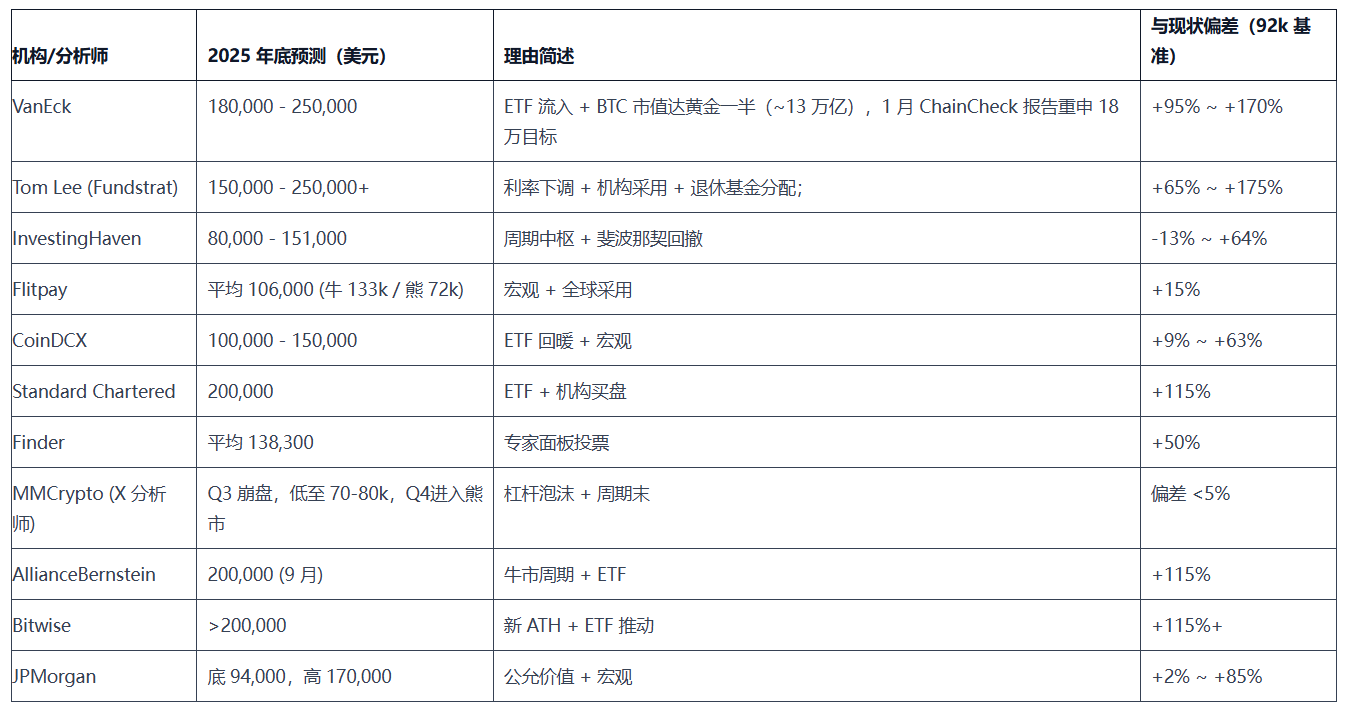
The table below summarizes the initial predictions from 11 major institutions and analysts, contrasting them with the current price ($92,000), making the deviation clear:
Prediction Distribution Characteristics:

  • Aggressive Camp (8 institutions): Target price $150k+, average deviation over 80%, represented by VanEck, Tom Lee, Standard Chartered
  • Moderate Camp (2 institutions): JPMorgan gave a prediction range, Flitpay provided bull/bear scenarios, reserving room for downside
  • Contrarian Camp (1 institution): Only MMCrypto explicitly warned of crash risk, becoming the only accurate predictor

Notably, the most aggressive predictions came from the most well-known institutions (VanEck, Tom Lee), while the accurate prediction came from a relatively niche technical analyst.

II. Roots of Misjudgment: Why Institutional Predictions Failed Collectively

2.1 The Consensus Trap: When "Good News" Loses Marginal Effect

9 institutions unanimously bet on "ETF inflows," forming a highly homogenous prediction logic.

When a factor is fully recognized by the market and reflected in the price, it loses its marginal driving force. By early 2025, the expectation of ETF inflows was completely priced in—every investor knew this "positive," and the price had already reacted in advance. The market needed "better than expected," not "as expected."
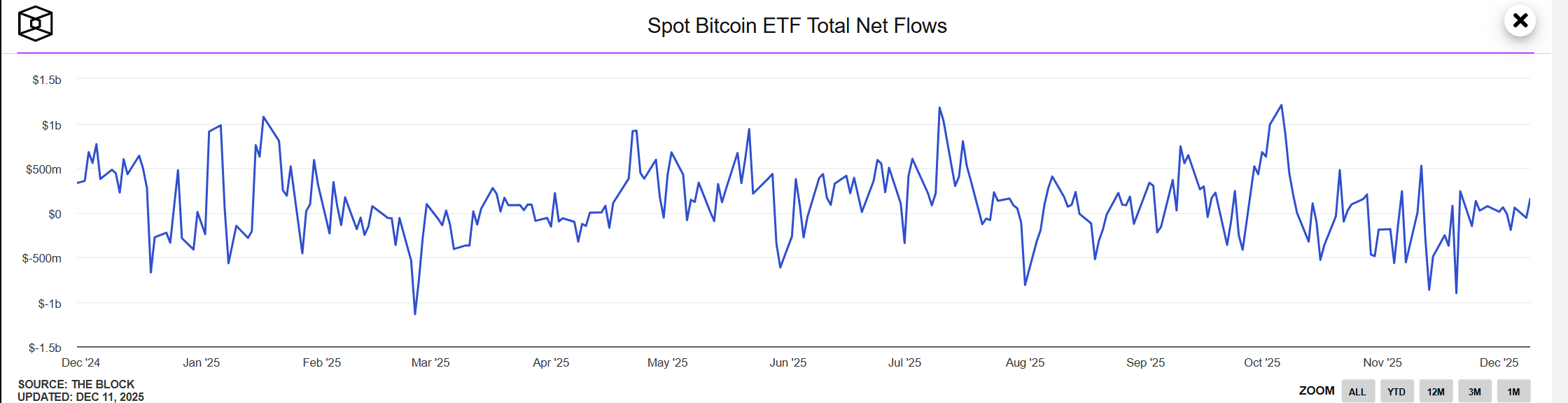
Full-year ETF inflows fell short of expectations, with ETFs seeing net outflows of $3.48-$4.3 billion in November. More critically, institutions overlooked that ETFs are a two-way street—when the market turns, they not only fail to provide support but become a highway for capital flight.

When 90% of analysts are telling the same story, that story has already lost its alpha value.

2.2 Cycle Model Failure: History Doesn't Simply Repeat

Institutions like Tom Lee and VanEck heavily relied on the historical pattern of "price peaks 12-18 months post-halving," believing the cycle would automatically play out.

Radically Changed Environment: The macro environment in 2025 was fundamentally different from past cycles:

  • 2017: Global low interest rates, loose liquidity
  • 2021: Pandemic stimulus, central bank money printing
  • 2025: Aftermath of the most aggressive rate-hiking cycle in 40 years, Fed maintaining a hawkish stance
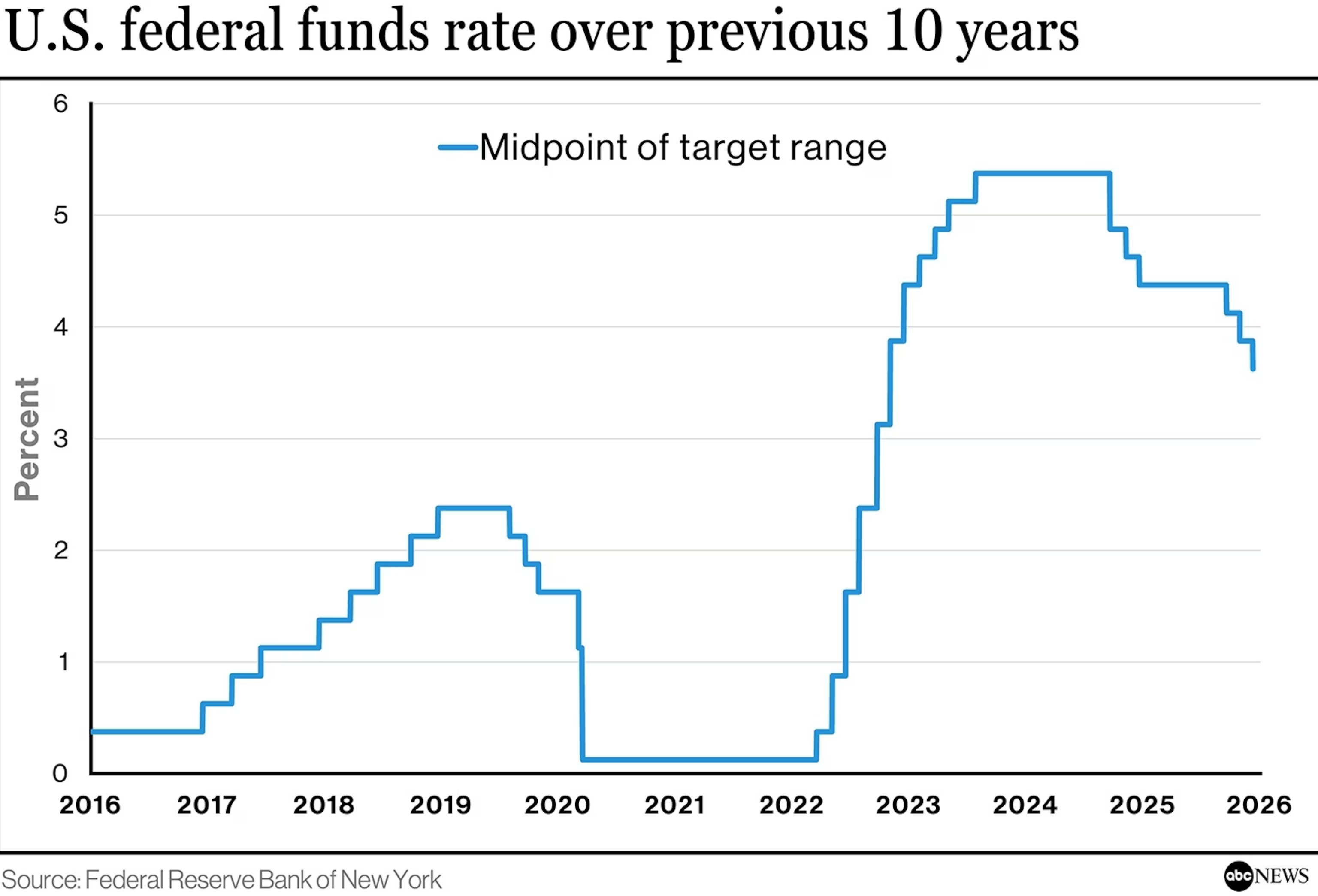
Expectations for Fed rate cuts plummeted from 93% at the start of the year to 38% by November. This kind of abrupt shift in monetary policy had never occurred in historical halving cycles. Institutions treated the "cycle" as a deterministic rule, ignoring that it is essentially a probability distribution and highly dependent on the macro liquidity environment.

When the environmental variables change fundamentally, historical models inevitably fail.

2.3 Conflict of Interest: Structural Bias in Institutions

Top institutions like VanEck, Tom Lee, and Standard Chartered had the largest deviations (+100% or more), while niche players like Changelly and MMCrypto were the most accurate. Institution size often inversely correlates with prediction accuracy.

Root Cause: These institutions are stakeholders themselves:

  • VanEck: Issues Bitcoin ETF products
  • Standard Chartered: Provides crypto asset custody services
  • Fundstrat: Serves clients holding crypto assets
  • Tom Lee: Chairman of Ethereum treasury BMNR

Structural Pressures:

  • Being bearish is biting the hand that feeds. If they published bearish reports, it would be tantamount to telling clients "our products aren't worth buying." This conflict of interest is structural and unavoidable.
  • Clients needed "$150k+" targets to justify holdings. The clients served by these institutions mostly entered the market at mid-bull cycle highs, with cost bases in the $80,000-$100,000 range. They needed analysts to give "$150k+" targets to prove their decisions were correct and to provide psychological support for holding or even adding to positions.
  • Aggressive predictions get more media coverage. Headlines like "Tom Lee Predicts Bitcoin at $250k" obviously get more clicks and shares than conservative predictions. The exposure from aggressive predictions directly translates into institutional brand influence and business traffic.
  • Famous analysts find it hard to reverse their historical stance. Tom Lee gained fame for accurately predicting Bitcoin's rebound in 2023, building a public image as a "bullish standard-bearer." In early 2025, even if he had reservations internally, it would be difficult to publicly reverse his optimistic stance.

2.4 Liquidity Blind Spot: Misjudging Bitcoin's Asset Properties

The market has long been accustomed to analogizing BTC as "digital gold," believing it is a hedge against inflation and currency devaluation. But in reality, Bitcoin behaves more like Nasdaq tech stocks, being extremely sensitive to liquidity: When the Fed maintains a hawkish stance and liquidity tightens, BTC's performance resembles high-beta tech stocks more than safe-haven gold.

The core contradiction lies in the inherent conflict between Bitcoin's asset characteristics and a high-interest-rate environment. When real interest rates remain high, the appeal of zero-yield assets systematically declines. Bitcoin generates no cash flow and pays no interest; its value relies entirely on "someone being willing to buy it at a higher price in the future." In a low-rate era, this wasn't a problem—after all, money in the bank earned little, so why not take a gamble.

But when the risk-free rate reaches 4-5%, the opportunity cost for investors rises significantly, and Bitcoin, a zero-yield asset, lacks fundamental support.

The most fatal misjudgment was that almost all institutions presupposed "the Fed's rate-cutting cycle is about to begin." The market pricing at the start of the year was for 4-6 rate cuts annually, totaling 100-150 basis points. But the data by November gave the complete opposite answer: rekindled inflation risks, collapsed rate cut expectations, the market shifting from expecting "rapid cuts" to pricing in "higher for longer." When this core assumption collapsed, all the optimistic predictions built on "loose liquidity" lost their foundation.

Conclusion

The collective failure of 2025 tells us: Precise prediction is itself a false proposition. Bitcoin is influenced by multiple variables like macro policy, market sentiment, and technical factors; no single model can easily capture this complexity.

Institutional predictions are not worthless—they reveal mainstream market narratives, capital expectations, and sentiment direction. The problem is, when predictions become consensus, consensus becomes a trap.

True investment wisdom lies in: Using institutional reports to understand what the market is thinking, but not letting them decide what you should do. When VanEck, Tom Lee, and others are collectively bullish, the question you need to ask is not "Are they right?" but "What if they are wrong?". Risk management always takes precedence over return prediction.

History repeats, but never simply copies. The halving cycle, ETF narrative, policy expectations—these logics all failed in 2025, not because the logic itself was flawed, but because the environmental variables fundamentally changed. Next time, the catalyst will have a different name, but the essence of market over-optimism will not change.

Remember this lesson: Independent thinking is more important than following authority, contrarian voices are more valuable than mainstream consensus, and risk management is more critical than precise prediction. This is the moat for long-term survival in the crypto market.


Preguntas relacionadas

QWhat were the three main pillars of the consensus that led to the $150,000+ Bitcoin price predictions for 2025?

AThe three main pillars were: 1. The cyclical 'halving effect,' where price peaks historically occurred 12-18 months after a supply reduction event. 2. The expectation of a massive 'ETF inflow' of over $100 billion from institutional investors. 3. The anticipated pro-crypto 'Trump card' policy support, including potential strategic Bitcoin reserves and a more favorable regulatory environment.

QAccording to the article, why did the 'ETF inflow' narrative fail to drive the price up as predicted?

AThe 'ETF inflow' narrative failed because the positive expectation was already fully 'priced in' by the market at the beginning of the year, meaning it lost its marginal effect. Furthermore, ETFs proved to be a two-way street; when the market turned, they became a high-speed exit ramp for capital, with a net outflow of $3.48-$4.3 billion in November.

QHow did the macroeconomic environment in 2025 differ from previous Bitcoin bull cycles, contributing to the failed predictions?

AThe 2025 macro environment was fundamentally different. Unlike the low-interest, high-liquidity conditions of the 2017 and 2021 cycles, 2025 was characterized by the aftermath of the most aggressive Fed hiking cycle in 40 years. The expectation of rapid interest rate cuts collapsed, with the probability of cuts dropping from 93% to 38%, creating a high-interest-rate environment that is detrimental to zero-yield assets like Bitcoin.

QWhat structural biases did large, mainstream institutions have that led to their overly optimistic and inaccurate predictions?

ALarge institutions had significant conflicts of interest. They were often directly involved in the crypto ecosystem (e.g., VanEck issuing a Bitcoin ETF, Standard Chartered offering custody services). This created structural pressure to be bullish, as bearish predictions would harm their own business, justify their clients' existing high-cost holdings, generate more media attention, and force prominent analysts to contradict their established public personas.

QWhat key lesson does the article draw from the collective misjudgment of Bitcoin's price in 2025?

AThe key lesson is that precise prediction is a fallacy. The real wisdom lies in using institutional reports to understand market narratives but not to blindly follow them. When a prediction becomes a consensus, it becomes a trap. Risk management is more critical than profit prediction, and independent thinking and heeding contrarian voices are more valuable than following mainstream consensus.

Lecturas Relacionadas

Stuck Polymarket: The Real Test After Riding the Traffic Boom Has Arrived

Polymarket, a leading prediction market platform, is facing significant technical challenges as its growth outpaces its current infrastructure on Polygon. Users are experiencing laggy transactions, unresponsive orders, and delayed confirmations, severely impacting the trading experience. In response, DeFi Engineering VP Josh Stevens outlined a comprehensive engineering overhaul. The plan includes reducing on-chain data delays, fixing order cancellation issues, rebuilding the central limit order book (CLOB), improving website performance, and developing a unified SDK and API. A major revelation was the ongoing "chain migration," indicating a potential move away from Polygon. The core issue is that Polymarket has evolved from a simple prediction market into a high-frequency trading platform, making Polygon's limitations—such as block space, gas fees, and block time—a ceiling for further growth. The migration is not just a simple chain switch but a fundamental rebuild of its trading system to support more complex products like perpetual contracts (Perps). This announcement has sparked competition among chains like Solana, Sui, and Algorand, all vying to host Polymarket. For Polygon, losing this key application, which contributes significantly to its gas fee revenue, would be a major setback. The real test for Polymarket is no longer attracting users but proving it can provide a stable, reliable trading environment that retains them.

Odaily星球日报Hace 17 min(s)

Stuck Polymarket: The Real Test After Riding the Traffic Boom Has Arrived

Odaily星球日报Hace 17 min(s)

Lowering Expectations for BTC's Next Bull Market

The author, Alex Xu, explains his decision to significantly reduce his Bitcoin holdings (from full to ~30% of his portfolio) during the current bull cycle, citing a lowered long-term outlook for BTC's price appreciation in the next cycle. He outlines six key reasons for this reduced expectation: 1. **Diminished Growth Drivers:** The narrative of exponential user adoption has largely played out with institutional ETF adoption. The next major growth phase—adoption by sovereign national reserves or central banks—seems unlikely in the near future. 2. **Personal Opportunity Cost:** More attractive investment opportunities have emerged in other assets, such as undervalued companies. 3. **Industry-Wide Contraction:** The broader crypto industry is struggling, with most Web3 business models (SocialFi, GameFi, DePIN) failing. This overall萧条 (depression) reduces the fundamental demand and consensus for Bitcoin. 4. **Strain on Major Buyer:** MicroStrategy, a major corporate buyer of BTC, faces rising financing expenses for its debt, which could slow its purchasing rate and create significant marginal pressure on the market. 5. **Increased Competition from Gold:** The emergence of "tokenized gold" has closed the functional gap (portability, divisibility) between physical gold and Bitcoin, offering a strong competitor in the non-sovereign store-of-value space. 6. **Security Budget Concerns:** The block reward halving continues to exacerbate the long-standing issue of funding Bitcoin's network security, with new fee source explorations like Ordinals and L2s largely failing. The author's decision to hold a significant (though reduced) position reflects a cautious, not bearish, outlook. He remains open to increasing his exposure if the fundamental reasons for his skepticism change or if new positive catalysts emerge.

marsbitHace 55 min(s)

Lowering Expectations for BTC's Next Bull Market

marsbitHace 55 min(s)

Can Iran 'Control' the Strait of Hormuz?

Iran has announced a comprehensive plan to assert control over the strategic Strait of Hormuz, a critical global oil shipping chokepoint. The proposed measures include requiring all vessels to obtain Iranian permission for passage, imposing fees for security, environmental protection, and navigation management—preferably paid in Iranian rials—and absolutely banning Israeli ships. Vessels from countries deemed hostile by Iran’s top security bodies may also be barred. Analysts suggest Iran’s motives are multifaceted: increasing pressure on the U.S. and Israel by leveraging control over oil transit to influence global prices and inflation; creating a new revenue stream, potentially exceeding $7.7 billion annually, to counter Western sanctions and support postwar reconstruction; and using transit permissions as bargaining chips in future negotiations, notably with the U.S. However, the plan faces significant practical and diplomatic challenges. Enforcing comprehensive interception and fee collection in the busy waterway, patrolled by international military forces, would be difficult. The U.S. has already countering with a blockade of Iranian ports and threats to intercept any ship paying fees, potentially strangling Iran’s oil exports and fee revenue. Broad international opposition, led by European and Gulf states, and legal controversies further complicate implementation. The proposal may ultimately serve more as a negotiating tactic than a feasible policy, with its execution remaining highly uncertain.

marsbitHace 2 hora(s)

Can Iran 'Control' the Strait of Hormuz?

marsbitHace 2 hora(s)

Trading

Spot
Futuros

Artículos destacados

Qué es BITCOIN

Entendiendo HarryPotterObamaSonic10Inu (ERC-20) y Su Posición en el Espacio Cripto En los últimos años, el mercado de criptomonedas ha sido testigo de un aumento en la popularidad de las monedas meme, capturando el interés no solo de los comerciantes, sino también de aquellos que buscan compromiso comunitario y valor de entretenimiento. Entre estos tokens únicos se encuentra HarryPotterObamaSonic10Inu (ERC-20), un proyecto intrigante que mezcla referencias culturales en el tejido de las criptomonedas. Este artículo profundiza en los aspectos clave de HarryPotterObamaSonic10Inu, explorando sus mecanismos, ethos impulsado por la comunidad y su relación con el paisaje cripto más amplio. ¿Qué es HarryPotterObamaSonic10Inu (ERC-20)? Como su nombre sugiere, HarryPotterObamaSonic10Inu es una moneda meme construida sobre la blockchain de Ethereum, clasificada bajo el estándar ERC-20. A diferencia de las criptomonedas tradicionales que pueden enfatizar la utilidad práctica o el potencial de inversión, este token prospera en el valor de entretenimiento y la fuerza de su comunidad. El proyecto tiene como objetivo fomentar un entorno donde los usuarios comprometidos puedan reunirse, compartir ideas y participar en actividades inspiradas por diversos fenómenos culturales. Una característica notable de HarryPotterObamaSonic10Inu es su cero impuestos en las transacciones. Este atractivo elemento tiene como objetivo incentivar el comercio y la participación comunitaria, sin cargos adicionales que puedan disuadir a los comerciantes de pequeña escala. El suministro total de la moneda está establecido en mil millones de tokens, una cifra que marca su intención de mantener una circulación sustancial dentro de la comunidad. Creador de HarryPotterObamaSonic10Inu (ERC-20) Los orígenes de HarryPotterObamaSonic10Inu están algo envueltos en misterio; los detalles sobre el creador siguen siendo desconocidos. El desarrollo de este token carece de un equipo identificable o de un plan explícito, lo cual no es inusual dentro del sector de monedas meme. En cambio, el proyecto ha surgido de manera orgánica, con su progreso muy dependiente del entusiasmo y la participación de su comunidad. Inversores de HarryPotterObamaSonic10Inu (ERC-20) En cuanto a inversiones externas y respaldo, HarryPotterObamaSonic10Inu también sigue siendo ambiguo. El token no lista ninguna fundación de inversión conocida o apoyo organizacional significativo. En cambio, la savia del proyecto es su comunidad de base, que informa su crecimiento y sostenibilidad a través de la acción colectiva y el compromiso en el espacio cripto. ¿Cómo Funciona HarryPotterObamaSonic10Inu (ERC-20)? Como una moneda meme, HarryPotterObamaSonic10Inu opera principalmente fuera de los marcos tradicionales que a menudo rigen el valor de los activos. Hay varios aspectos distintivos que definen cómo funciona el proyecto: Transacciones Sin Impuestos: Sin tarifas impositivas en las transacciones, los usuarios pueden comprar y vender el token libremente sin preocuparse por costos ocultos. Compromiso Comunitario: El proyecto prospera en la interacción comunitaria, aprovechando plataformas de redes sociales para crear entusiasmo y facilitar la participación. Las discusiones, el intercambio de contenido y el compromiso son elementos cruciales que ayudan a expandir su alcance y fomentar la lealtad entre los seguidores. Sin Utilidad Práctica: Cabe señalar que HarryPotterObamaSonic10Inu no ofrece utilidad concreta dentro del ecosistema financiero. Más bien, se clasifica como un token principalmente para actividades de entretenimiento y comunitarias. Referencia Cultural: El token incorpora astutamente elementos de la cultura popular para atraer interés, conectando con entusiastas de los memes y seguidores de las criptomonedas por igual. HarryPotterObamaSonic10Inu ejemplifica cómo las monedas meme operan de manera diferente a los proyectos de criptomonedas más tradicionales, ingresando al mercado como construcciones sociales innovadoras en lugar de activos utilitarios. Cronología de HarryPotterObamaSonic10Inu (ERC-20) La historia de HarryPotterObamaSonic10Inu está marcada por varios hitos notables: Creación: El token surgió de un meme viral, capturando la imaginación de muchos entusiastas de las criptomonedas. Las fechas específicas de creación no están disponibles, subrayando su ascenso orgánico. Listado en Exchanges: HarryPotterObamaSonic10Inu ha llegado a varios exchanges, permitiendo un acceso y comercio más fácil por parte de la comunidad. Iniciativas de Compromiso Comunitario: Actividades continuas destinadas a mejorar la interacción comunitaria, incluyendo concursos, campañas en redes sociales y generación de contenido por parte de fanáticos y defensores. Planes de Expansión Futuros: La hoja de ruta del proyecto incluye el lanzamiento de una colección de NFT, mercancía y un sitio de comercio electrónico relacionado con sus temas culturales, involucrando aún más a la comunidad e intentando añadir más dimensiones a su ecosistema. Puntos Clave Sobre HarryPotterObamaSonic10Inu (ERC-20) Naturaleza Impulsada por la Comunidad: El proyecto prioriza la participación colectiva y la creatividad, asegurando que la involucración de los usuarios esté a la vanguardia de su desarrollo. Clasificación como Moneda Meme: Representa la epítome de las criptomonedas basadas en el entretenimiento, diferenciándose de los vehículos de inversión tradicionales. Sin Afiliación Directa con Bitcoin: A pesar de la similitud en el nombre del ticker, HarryPotterObamaSonic10Inu es distinto y no tiene relación con Bitcoin u otras criptomonedas establecidas. Enfoque en la Colaboración: HarryPotterObamaSonic10Inu está diseñado para crear un espacio para la colaboración y el intercambio de historias entre sus poseedores, proporcionando una vía para la creatividad y el vínculo comunitario. Perspectivas Futuras: La ambición de expandirse más allá de su premisa inicial hacia NFTs y mercancías describe un camino para que el proyecto potencialmente ingrese a avenidas más tradicionales dentro de la cultura digital. A medida que las monedas meme continúan capturando la imaginación de la comunidad de criptomonedas, HarryPotterObamaSonic10Inu (ERC-20) se destaca debido a sus lazos culturales y su enfoque centrado en la comunidad. Si bien puede no encajar en el molde típico de un token impulsado por la utilidad, su esencia radica en la alegría y la camaradería fomentadas entre sus seguidores, destacando la naturaleza en evolución de las criptomonedas en una era cada vez más digital. A medida que el proyecto continúa desarrollándose, será importante observar cómo las dinámicas comunitarias influyen en su trayectoria en el cambiante paisaje de la tecnología blockchain.

1.3k Vistas totalesPublicado en 2024.04.01Actualizado en 2024.12.03

Qué es BITCOIN

Cómo comprar BTC

¡Bienvenido a HTX.com! Hemos hecho que comprar Bitcoin (BTC) sea simple y conveniente. Sigue nuestra guía paso a paso para iniciar tu viaje de criptos.Paso 1: crea tu cuenta HTXUtiliza tu correo electrónico o número de teléfono para registrarte y obtener una cuenta gratuita en HTX. Experimenta un proceso de registro sin complicaciones y desbloquea todas las funciones.Obtener mi cuentaPaso 2: ve a Comprar cripto y elige tu método de pagoTarjeta de crédito/débito: usa tu Visa o Mastercard para comprar Bitcoin (BTC) al instante.Saldo: utiliza fondos del saldo de tu cuenta HTX para tradear sin problemas.Terceros: hemos agregado métodos de pago populares como Google Pay y Apple Pay para mejorar la comodidad.P2P: tradear directamente con otros usuarios en HTX.Over-the-Counter (OTC): ofrecemos servicios personalizados y tipos de cambio competitivos para los traders.Paso 3: guarda tu Bitcoin (BTC)Después de comprar tu Bitcoin (BTC), guárdalo en tu cuenta HTX. Alternativamente, puedes enviarlo a otro lugar mediante transferencia blockchain o utilizarlo para tradear otras criptomonedas.Paso 4: tradear Bitcoin (BTC)Tradear fácilmente con Bitcoin (BTC) en HTX's mercado spot. Simplemente accede a tu cuenta, selecciona tu par de trading, ejecuta tus trades y monitorea en tiempo real. Ofrecemos una experiencia fácil de usar tanto para principiantes como para traders experimentados.

4.7k Vistas totalesPublicado en 2024.12.12Actualizado en 2025.03.21

Cómo comprar BTC

Qué es $BITCOIN

ORO DIGITAL ($BITCOIN): Un Análisis Integral Introducción al ORO DIGITAL ($BITCOIN) ORO DIGITAL ($BITCOIN) es un proyecto basado en blockchain que opera en la red Solana, cuyo objetivo es combinar las características de los metales preciosos tradicionales con la innovación de las tecnologías descentralizadas. Aunque comparte un nombre con Bitcoin, a menudo referido como “oro digital” debido a su percepción como un refugio de valor, ORO DIGITAL es un token separado diseñado para crear un ecosistema único dentro del paisaje Web3. Su meta es posicionarse como un activo digital alternativo viable, aunque los detalles sobre sus aplicaciones y funcionalidades aún están en desarrollo. ¿Qué es ORO DIGITAL ($BITCOIN)? ORO DIGITAL ($BITCOIN) es un token de criptomoneda diseñado explícitamente para su uso en la blockchain de Solana. A diferencia de Bitcoin, que proporciona un papel de almacenamiento de valor ampliamente reconocido, este token parece centrarse en aplicaciones y características más amplias. Aspectos notables incluyen: Infraestructura Blockchain: El token está construido sobre la blockchain de Solana, conocida por su capacidad para manejar transacciones de alta velocidad y bajo costo. Dinámicas de Suministro: ORO DIGITAL tiene un suministro máximo limitado a 100 cuatrillones de tokens (100P $BITCOIN), aunque los detalles sobre su suministro circulante no se han divulgado actualmente. Utilidad: Si bien las funcionalidades precisas no están delineadas explícitamente, hay indicios de que el token podría ser utilizado para diversas aplicaciones, potencialmente involucrando aplicaciones descentralizadas (dApps) o estrategias de tokenización de activos. ¿Quién es el Creador de ORO DIGITAL ($BITCOIN)? En la actualidad, la identidad de los creadores y el equipo de desarrollo detrás de ORO DIGITAL ($BITCOIN) sigue siendo desconocida. Esta situación es típica entre muchos proyectos innovadores dentro del espacio blockchain, particularmente aquellos alineados con las finanzas descentralizadas y fenómenos de monedas meme. Si bien tal anonimato puede fomentar una cultura impulsada por la comunidad, intensifica las preocupaciones sobre la gobernanza y la responsabilidad. ¿Quiénes son los Inversores de ORO DIGITAL ($BITCOIN)? La información disponible indica que ORO DIGITAL ($BITCOIN) no tiene patrocinadores institucionales conocidos ni inversiones destacadas de capital de riesgo. El proyecto parece operar en un modelo de peer-to-peer centrado en el apoyo y la adopción de la comunidad en lugar de rutas de financiamiento tradicionales. Su actividad y liquidez se sitúan principalmente en intercambios descentralizados (DEX), como PumpSwap, en lugar de plataformas de trading centralizadas establecidas, lo que resalta aún más su enfoque de base. Cómo Funciona ORO DIGITAL ($BITCOIN) Los mecanismos operativos de ORO DIGITAL ($BITCOIN) pueden elaborarse en función de su diseño blockchain y atributos de red: Mecanismo de Consenso: Al aprovechar el único proof-of-history (PoH) de Solana combinado con un modelo de proof-of-stake (PoS), el proyecto asegura una validación de transacciones eficiente que contribuye al alto rendimiento de la red. Tokenómica: Si bien los mecanismos deflacionarios específicos no se han detallado extensamente, el vasto suministro máximo de tokens implica que podría atender microtransacciones o casos de uso nicho que aún están por definirse. Interoperabilidad: Existe el potencial de integración con el ecosistema más amplio de Solana, incluyendo varias plataformas de finanzas descentralizadas (DeFi). Sin embargo, los detalles sobre integraciones específicas permanecen no especificados. Cronología de Eventos Clave Aquí hay una cronología que destaca hitos significativos relacionados con ORO DIGITAL ($BITCOIN): 2023: El despliegue inicial del token ocurre en la blockchain de Solana, marcado por su dirección de contrato. 2024: ORO DIGITAL gana visibilidad al estar disponible para trading en intercambios descentralizados como PumpSwap, permitiendo a los usuarios comerciar contra SOL. 2025: El proyecto presencia actividad de trading esporádica y potencial interés en compromisos liderados por la comunidad, aunque no se han documentado asociaciones notables o avances técnicos hasta el momento. Análisis Crítico Fortalezas Escalabilidad: La infraestructura subyacente de Solana soporta altos volúmenes de transacciones, lo que podría mejorar la utilidad de $BITCOIN en varios escenarios de transacción. Accesibilidad: El potencial bajo precio de trading por token podría atraer a inversores minoristas, facilitando una participación más amplia debido a oportunidades de propiedad fraccionada. Riesgos Falta de Transparencia: La ausencia de patrocinadores, desarrolladores o un proceso de auditoría conocidos públicamente puede generar escepticismo sobre la sostenibilidad y confiabilidad del proyecto. Volatilidad del Mercado: La actividad de trading depende en gran medida del comportamiento especulativo, lo que puede resultar en una volatilidad de precios significativa y en incertidumbre para los inversores. Conclusión ORO DIGITAL ($BITCOIN) surge como un proyecto intrigante pero ambiguo dentro del ecosistema de Solana en rápida evolución. Si bien intenta aprovechar la narrativa del “oro digital”, su alejamiento del papel establecido de Bitcoin como refugio de valor subraya la necesidad de una diferenciación más clara de su utilidad y estructura de gobernanza previstas. La aceptación y adopción futura dependerán probablemente de abordar la actual opacidad y de definir sus estrategias operativas y económicas de manera más explícita. Nota: Este informe abarca información sintetizada disponible hasta octubre de 2023, y pueden haber ocurrido desarrollos más allá del período de investigación.

83 Vistas totalesPublicado en 2025.05.13Actualizado en 2025.05.13

Qué es $BITCOIN

Discusiones

Bienvenido a la comunidad de HTX. Aquí puedes mantenerte informado sobre los últimos desarrollos de la plataforma y acceder a análisis profesionales del mercado. A continuación se presentan las opiniones de los usuarios sobre el precio de BTC (BTC).

活动图片