Texas targets crypto, gambling loopholes amid prediction market concerns

ambcryptoPublicado a 2026-04-01Actualizado a 2026-04-01

Resumen

Prediction markets have gained significant attention, particularly during the U.S. election cycle, but the rise of gambling within these markets has eroded public trust. In response, Texas Lieutenant Governor Dan Patrick is pushing for legislative changes to close gambling loopholes. He aims to prevent the exploitation of federal regulations, such as those of the CFTC, to bypass state gambling prohibitions. The goal is to ensure the integrity of elections and sports in Texas. Additionally, Patrick advocates for assessing the state’s approach to emerging financial technologies, including crypto, while prioritizing consumer protection and addressing issues like crypto ATM scams. The move coincides with a decline in public interest in prediction market gambling, as shown by Google Trends data.

Prediction markets have gained a lot of attention in the past two years. Zooming in, the rise in these markets escalated in Q4 2024 as the U.S. election started to heat up. However, on the flip side, gambling also became an integral part of the prediction markets’ growth cycle.

These began to undermine people’s trust in the prediction market. Hence, to combat this problem and to regain trust, Dan Patrick, Lieutenant Governor of Texas, came up with some legislative changes.

Under the State Affairs Committee category, Patrick underlined plans to close the gambling loopholes. In this push, the governor urged the lawmakers to,

Study the sudden inundation of prediction market gambling and the exploitation of federal law to circumvent Texas gambling prohibitions by allowing users to place bets on the outcome of elections and other events.

The reason behind this crackdown?

Needless to say, this move is intended to protect and reinforce the regulatory oversight of the Commodity Futures Trading Commission (CFTC). Patrick believes that the prediction markets are now exploiting the CFTC regulations just to bypass Texas state gambling prohibitions.

With clear intentions to have fair elections and corruption-free sports in Texas, Patrick added,

Make recommendations to ensure the integrity of Texas elections and Texas sports.

Echoing similar sentiments at the broader level, David Miller, enforcement director of CFTC, in his first public remark after joining, added,

We are aware of the speculation about insider trading. We are watching.

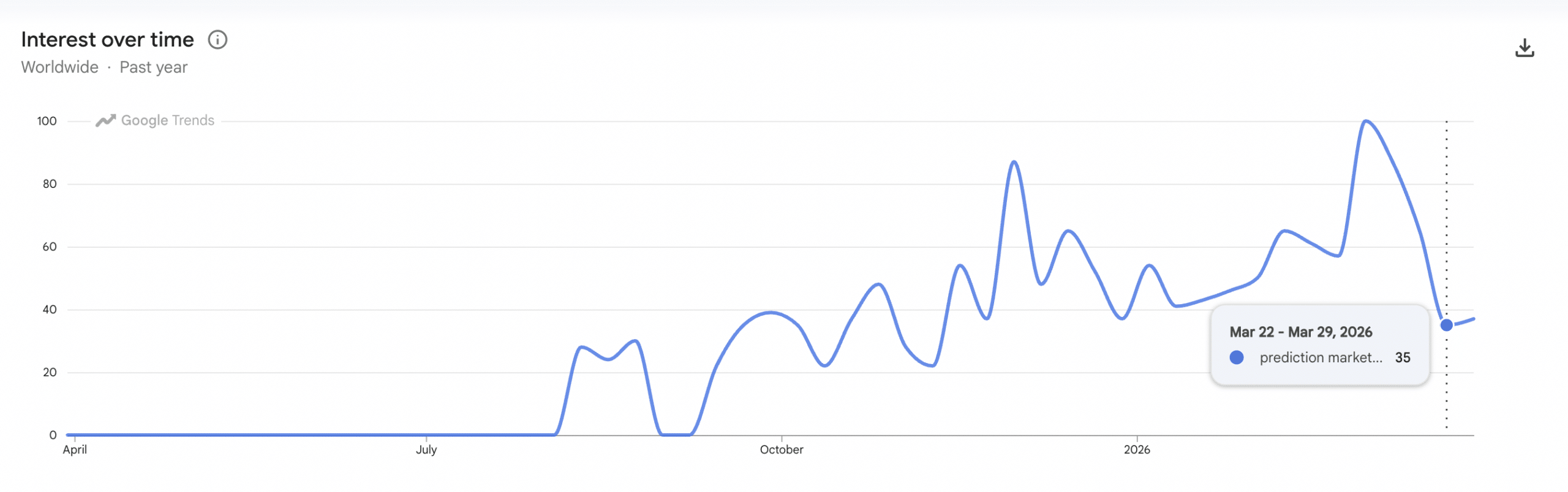
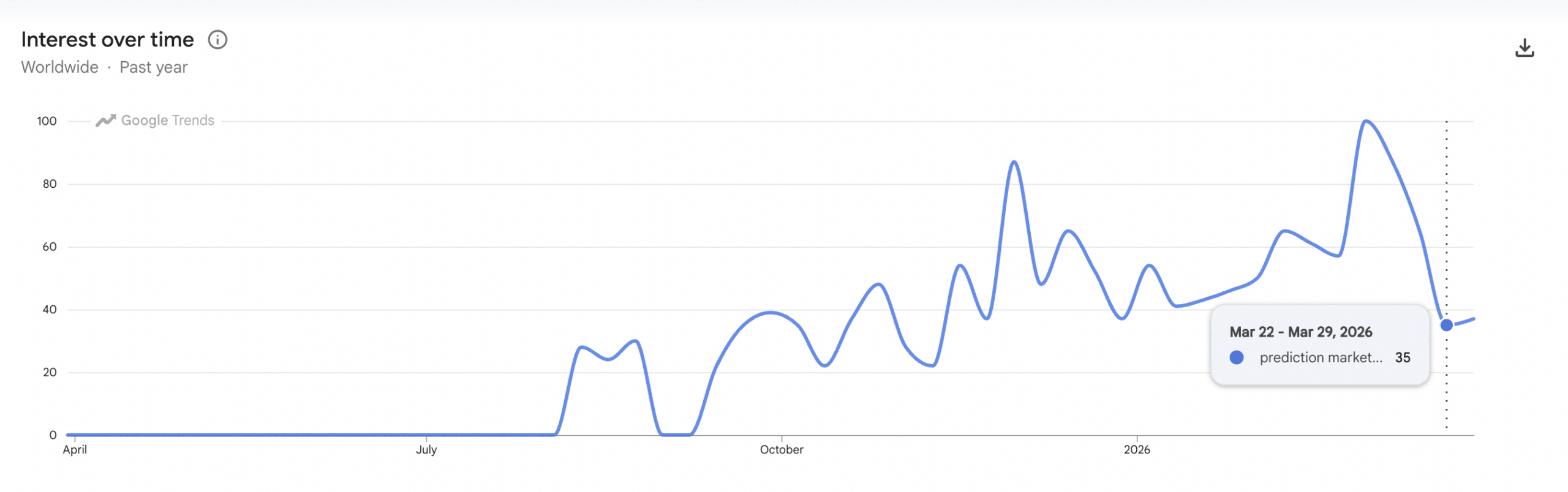
This comes as the Google Trends data saw a drop in the “prediction market gambling” keyword as of writing.
Source: Google Trends

As per the chart, the keyword had peaked to a Google Search score of 100 in early March. However, by the end of Q1 2026, the score stood at 35.

Besides prediction market reforms, Patrick has also come up with a plan to expand the future of crypto in Texas. He urged the lawmakers to:

Assess how the state’s financial regulatory agencies respond to emerging financial technologies and business models, while prioritizing the protection of consumers.

In fact, he also stressed the loopholes of scams surrounding the growing scale of crypto ATMs (virtual currency kiosks).

Lastly, the governor made a point to the lawmakers to look into Senate Bill 21 and how effectively it’s being implemented and whether it’s achieving its goal. For those unaware, Senate Bill 21 of Texas refers to the Texas Strategic Bitcoin Reserve bill implemented on the 20th of June, 2025.

This coincided with Polymarket recently coming up with its updated rulebook across its DeFi platform and CFTC-regulated U.S. exchange.


Final Summary

  • Prediction markets are growing, but with this growth, gambling has taken center stage, raising credibility issues.
  • David Patrick’s push for blockchain technology underlines how individual states are stepping up their crypto game as the U.S.-Iran war continues.


Preguntas relacionadas

QWhat is the main concern that prompted Texas Lieutenant Governor Dan Patrick to propose legislative changes regarding prediction markets?

AThe main concern is that gambling has become an integral part of prediction markets, which began to undermine people's trust in them. This includes the use of crypto to circumvent Texas gambling prohibitions by allowing bets on elections and other events.

QWhich regulatory body's oversight does Dan Patrick aim to reinforce with his proposed crackdown on prediction markets?

ADan Patrick aims to reinforce the regulatory oversight of the Commodity Futures Trading Commission (CFTC).

QBesides prediction market reforms, what other emerging technology did Dan Patrick urge lawmakers to assess in relation to consumer protection?

ADan Patrick urged lawmakers to assess how the state's financial regulatory agencies respond to emerging financial technologies and business models, specifically mentioning the need to prioritize consumer protection in the context of crypto and the growing scale of crypto ATMs.

QWhat specific Texas bill, related to Bitcoin, did Dan Patrick ask lawmakers to review for effective implementation?

ADan Patrick asked lawmakers to look into Senate Bill 21, which is the Texas Strategic Bitcoin Reserve bill implemented on June 20, 2025.

QAccording to the Google Trends data mentioned in the article, what was the search score for 'prediction market gambling' by the end of Q1 2026?

AThe Google Search score for 'prediction market gambling' stood at 35 by the end of Q1 2026, down from a peak of 100 in early March.

Lecturas Relacionadas

Must-Watch Events Next Week|CLARITY Act Could Face Senate Vote; SpaceX, Circle to Report Earnings (8.3-8.9)

**Summary: Key Events and Developments to Watch (August 3-9)** The upcoming week is marked by significant financial disclosures, key legislative deadlines, and notable product updates. **Major Financial Events:** Several companies are scheduled to release their Q2 2026 earnings. American Bitcoin (ABTC) will report on August 3, followed by SpaceX and Hut 8 Mining Corp. on August 4, and Circle on August 5. Notably, a significant portion of SpaceX shares (up to 12% of total shares) will be unlocked on August 6 following their earnings release. **Key Legislative Deadline:** The U.S. Senate faces an August 7 deadline to secure 60 votes for the CLARITY Act, a bipartisan bill aiming to establish a federal regulatory framework for cryptocurrencies. The Senate may hold a full vote on the bill during the week. **Economic Data:** The U.S. July Non-Farm Payrolls report will be released on August 7, providing crucial labor market data. **Technology & Product Updates:** * **Shutdowns:** DeFi portfolio tracker Zapper and wallet app Ctrl Wallet will cease operations on August 3. * **Upgrades:** LayerZero will deprecate its v1 relayers on August 3. XRP Ledger's new version 3.3.0, featuring five new functions, is expected next week. * **AI:** Elon Musk announced that the advanced Grok 4.6 AI model is set for release around August 7. * **Bitcoin:** The BIP-110 forced signaling for a potential Bitcoin network change is scheduled to begin around August 8. **Other Notable Events:** Chinese robotics firm Unitree Tech has set its preliminary price inquiry for its IPO for August 5. South Korean exchange Upbit will delist AQT and AERGO tokens on August 3.

marsbitHace 1 hora(s)

Must-Watch Events Next Week|CLARITY Act Could Face Senate Vote; SpaceX, Circle to Report Earnings (8.3-8.9)

marsbitHace 1 hora(s)

Stocks Are Plummeting More Sharply Than Cryptocurrencies. Where Has the Money Gone?

Stock Markets Plunge Deeper Than Cryptocurrencies: Where Did the Money Go? In late July, Seoul's Kospi index triggered circuit breakers for two consecutive days, plummeting over 40% from its June high. The collapse was led by heavyweight stocks like SK Hynix, whose record profits still disappointed investors, and devastating leveraged ETFs, with one major product losing over 83% of its value. This signaled a global, forced deleveraging targeting the most crowded trades. Interestingly, while stocks exhibited extreme volatility akin to crypto markets, Bitcoin rose nearly 15% in July after a prior steep drop. Analysis shows the money fleeing equities did not flow into Bitcoin. Instead, Bitcoin had already absorbed its sell-off in May-June, when U.S. spot Bitcoin ETFs saw historic outflows. The true safe-haven beneficiary was gold, whose price rose over 20% year-on-year, highlighting a decoupling between Bitcoin and gold as "digital gold." The sell-off was a targeted unwinding of leveraged positions in tech and semiconductors, accelerated by broker-dealer risk management and shifts in the AI narrative, including new competition from Chinese memory chipmakers. The retreat path was clear: from high-valuation tech stocks to cash and U.S. Treasuries, then to gold. For Bitcoin to attract sustained institutional inflows, conditions like eased global liquidity pressure, a "soft-landing" Fed rate cut, and U.S. regulatory clarity via legislation like the stalled CLARITY Act are needed. Currently, Bitcoin is not a safe haven but an already-cleared asset. Its low correlation with tech stocks, however, makes it a potential diversification play for institutional portfolios once the storm passes. The money isn't here yet, but the positioning is underway.

marsbitHace 1 hora(s)

Stocks Are Plummeting More Sharply Than Cryptocurrencies. Where Has the Money Gone?

marsbitHace 1 hora(s)

In Conversation with Ray Dalio: We Are Currently in an AI Bubble, with 1% of My Portfolio in Bitcoin

Ray Dalio, founder of Bridgewater Associates, warns in an interview that the current AI boom shows classic bubble characteristics, which could lead to significant economic downturns as seen in past cycles like 1929 or 2000. He explains that speculative enthusiasm, fueled by debt and overvaluation, often precedes a crash when rising rates or taxation force asset sales, causing widespread losses and recession. Dalio also outlines his "Big Cycle" theory, describing an approximate 80-year pattern where widening wealth gaps, massive government deficits, and shifting geopolitical power (like China's rise) create internal conflict and global instability. He emphasizes that we are in a late-cycle, transitional phase where traditional powers like the US and UK face decline. For personal wealth protection, Dalio advises diversification beyond cash into assets like stocks, bonds, real estate, and particularly gold, which he prefers over Bitcoin. While he holds about 1% of his portfolio in Bitcoin as a non-printable hard asset, he views gold as more secure from technological or governmental threats. Regarding AI's impact, Dalio believes it will disproportionately benefit capital owners, worsening inequality by replacing both physical and cognitive labor. He suggests that human intuition and emotional intelligence, combined with AI, will be key for future workers. On taxation, Dalio argues that wealth taxes are impractical and risk triggering asset sell-offs, reducing productive investment. He points to the UK as a cautionary example of debt, low productivity, and political strife. Geopolitically, Dalio foresees a more regionalized world, with the US showing weakness in prolonged conflicts like with Iran, akin to past imperial declines. The ideal outcome, he suggests, is coexisting powerful blocs (e.g., Americas, China-Asia Pacific) without major war.

marsbitHace 5 hora(s)

In Conversation with Ray Dalio: We Are Currently in an AI Bubble, with 1% of My Portfolio in Bitcoin

marsbitHace 5 hora(s)

Trading

Spot
活动图片




