Tether’s $23B Gold Hoard Rivals Nation States As Smart Money Pivots To $HYPER

bitcoinistPublicado a 2026-02-09Actualizado a 2026-02-09

Resumen

Tether, the issuer of USDT, has accumulated a massive $23 billion in physical gold, placing it among the world's top 30 holders and surpassing many G20 nations. This signals a defensive move against macroeconomic uncertainty. Meanwhile, sophisticated investors are shifting toward high-utility infrastructure projects like Bitcoin Hyper ($HYPER), a Bitcoin Layer 2 solution integrated with Solana Virtual Machine (SVM). It aims to unlock over $1 trillion in dormant Bitcoin capital by enabling fast, low-cost transactions and decentralized applications. With over $31 million raised from large-scale investors, $HYPER is positioned to redefine Bitcoin's utility beyond a store of value.

The definition of a safe haven is shifting under our feet. According to a recent report from investment bank Jefferies, Tether, issuer of the ubiquitous $USDT, has stockpiled a staggering $23B in physical gold. This hasn’t gone unnoticed, with many commenting about the purchase on social media.

That stash places the crypto firm among the top 30 global holders of bullion, eclipsing the official reserves of many G20 nations.

This isn’t just diversification. It’s a signal. Tether holds at least 148 tonnes of the yellow metal, using commodities to back a digital dollar. The irony is rich: the main on-ramp to the crypto ecosystem is hedging against the very fiat currency it represents. This massive accumulation suggests that even the biggest liquidity providers are bracing for prolonged macroeconomic turbulence.

But while Tether plays defense with physical commodities, a more aggressive rotation is brewing elsewhere. Sophisticated investors are moving beyond passive “store of value” plays. They’re hunting for infrastructure that wakes up dormant liquidity.

Gold sits in a vault. It doesn’t yield. Bitcoin, historically, has suffered the same limitation, functioning as digital gold but offering little utility. That narrative, however, is fracturing. As institutional interest hits fever pitch, the market is aggressively repricing protocols that solve Bitcoin’s scalability bottlenecks.

This search for yield on top of the world’s most secure blockchain has channeled significant volume toward Bitcoin Hyper ($HYPER), a project engineering the first bridge between Bitcoin’s security and high-speed execution.

Bitcoin Hyper ($HYPER) Unlocks The Trillion-Dollar Dormant Economy

For over a decade, Bitcoin has faced one persistent critique: it’s secure, but it’s slow. Transactions are pricey (sometimes painfully so), and programmability is virtually non-existent compared to chains like Ethereum or Solana. The result? Over $1T in capital is essentially ‘stuck’ in digital wallets, sidelined from the DeFi economy.

Bitcoin Hyper tackles this inefficiency head-on by deploying the first-ever Bitcoin Layer 2 integrated with the Solana Virtual Machine (SVM).
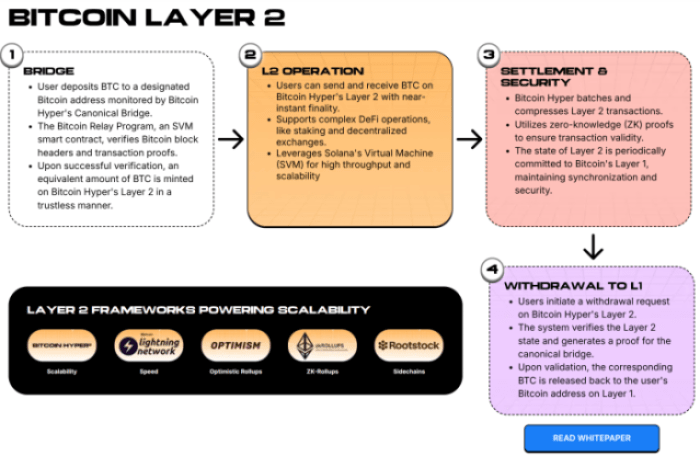
Why does this architecture matter? Because it fundamentally changes the network’s capabilities. By using the SVM for execution while relying on Bitcoin L1 for settlement, $HYPER creates a hybrid environment. Developers can build high-performance dApps using Rust, the standard for high-speed trading systems, while users keep Bitcoin’s immutable security guarantees.

The project uses a decentralized Canonical Bridge for seamless $BTC transfers into the Layer 2 ecosystem. Once bridged, that capital moves with sub-second finality and negligible fees. Suddenly, high-frequency trading, lending markets, and gaming applications, previously impossible on the mainnet, become viable.

For the broader market, this is a pivot point. It’s no longer just about holding an asset that resists inflation (like Gold or $BTC); it’s about owning the rails that power the future financial system.

EXPLORE THE BITCOIN HYPER ($HYPER) ECOSYSTEM

Whales Accumulate $31M As High-Speed Layer 2 Redefines Market Expectations

The market’s appetite for this ‘Bitcoin-on-steroids’ infrastructure shows up clearly in the on-chain flows. While retail investors chase meme coins, smart money seems to be positioning itself in infrastructure plays with tangible utility. Bitcoin Hyper ($HYPER) has already raised an impressive $31M+, signaling strong conviction from early backers.

Whale activity backs this up. Large-scale purchases of $500K, $379.9K, and $274K stand out, not only showing conviction in the project but also the desire to get in early and potentially maximize returns.

With the token currently priced at $0.0136753, these large-scale buys suggest investors see the asset as undervalued relative to its utility. The project’s tokenomics (designed to incentivize the long haul) offer high APY staking rewards immediately after the Token Generation Event (TGE). The structure includes a 7-day vesting period for presale stakers, a classic mechanism to prevent immediate dumping and stabilize price action.

The logic driving these inflows is straightforward. If Bitcoin is the digital equivalent of Tether’s gold stash, then Bitcoin Hyper is the logistical network allowing that gold to be spent, lent, and leveraged at internet speed.

JOIN THE BITCOIN HYPER ($HYPER) PRESALE

The content of this article is for informational purposes only and does not constitute financial advice. Cryptocurrency investments, including presales and Layer 2 tokens, carry inherent risks. Always conduct your own due diligence before making investment decisions.


Preguntas relacionadas

QHow much physical gold has Tether stockpiled, and what does this make them in terms of global holders?

ATether has stockpiled $23 billion in physical gold, which places the crypto firm among the top 30 global holders of bullion.

QWhat is the primary limitation that Bitcoin Hyper ($HYPER) aims to solve for the Bitcoin network?

ABitcoin Hyper aims to solve Bitcoin's scalability bottlenecks, high transaction fees, and lack of programmability to unlock over $1 trillion in dormant capital for the DeFi economy.

QWhat key technology does Bitcoin Hyper use to integrate with Bitcoin's security while enabling high-speed execution?

ABitcoin Hyper deploys the first-ever Bitcoin Layer 2 integrated with the Solana Virtual Machine (SVM), using it for execution while relying on Bitcoin L1 for settlement.

QHow much funding has Bitcoin Hyper ($HYPER) raised from early backers, according to the article?

ABitcoin Hyper has raised over $31 million from early backers, signaling strong conviction in the project.

QAccording to the article, what is the new investment focus shifting towards, beyond passive 'store of value' assets?

AThe investment focus is shifting towards infrastructure that unlocks dormant liquidity, allowing capital to be used for high-performance dApps, lending markets, and other financial applications, rather than just holding inflation-resistant assets.

Lecturas Relacionadas

After Three Consecutive Quarters of Decline, Can the Crypto Market Find a Window for Stabilization in Q3?

The cryptocurrency market has just concluded its worst-performing quarter since 2022, with total capitalization dropping 12.6% to $2.1 trillion. All core metrics indicate capital is leaving the sector, not just rotating within it. Bitcoin fell 14.2% and Ethereum dropped 25.4% in Q2, breaking their previous correlation with US tech stocks. A key driver is the reversal in US spot Bitcoin ETF flows, which saw a net outflow of approximately $4.67 billion in Q2, including a record monthly outflow near $4.5 billion in June. While recent data suggests long-term holders are accumulating again, sustained ETF outflows mean continued selling pressure. Market focus is now singularly on the Federal Reserve. The upcoming July FOMC meeting is seen as the most critical event for Q3. A dovish signal could support Bitcoin reclaiming a $68,000-$84,000 range, while a hawkish stance might establish a new trading band around $50,000-$56,000. Additionally, regulatory uncertainty persists, with the progress of the crucial *CLARITY Act* stalling in the Senate, reducing its perceived 2026 passage probability to 40-45%. Despite the broad downturn, a few sectors showed growth. Prediction markets saw nominal volume surge 48.7% year-over-year to $113.8 billion, and tokenized collectibles transaction volume rose 143% quarterly to $1.4 billion. The Real-World Asset (RWA) tokenization sector also continued steady growth, now representing ~$28.1 billion in on-chain value. The market's foundation for an extreme crash appears limited, with Bitcoin price hovering near its 200-week moving average. However, the trading paradigm has shifted from narrative-driven speculation to decisions based on price action, policy developments, and interest rate expectations, making a broad sentiment-driven rally unlikely in the near term.

marsbitHace 8 hora(s)

After Three Consecutive Quarters of Decline, Can the Crypto Market Find a Window for Stabilization in Q3?

marsbitHace 8 hora(s)

BIT Trading Moment: BTC Still Suppressed by Weekly 200 EMA, Rejection May Restart Decline; Storage and Semiconductors that Surged Last Night Begin Falling in Evening Trading

**Crypto & Stock Market Wrap: Bitcoin Tests Resistance, Stocks Retreat After AI Surge** Bitcoin consolidates around $66,000, facing key resistance near $68,000—an area seen as a major psychological and technical hurdle where previous rallies have failed. Analysts note the cryptocurrency is caught between its 200-week moving average (~$63,333) and 200-week EMA (~$68,328). A clear break above $68k is needed to signal a stronger bullish trend, while a rejection could lead to a retest of $63k support. Market sentiment remains cautious, with low futures open interest pointing to a low-liquidity rebound rather than a full bull market. Bitcoin spot ETFs saw another $203 million inflow. US stock futures pointed lower after a strong Tuesday session led by a massive rebound in semiconductors and memory stocks. The rally was fueled by renewed optimism about AI-driven hardware demand, with Micron, SanDisk, and SK Hynix surging. However, those gains reversed in pre-market trading. Super Micro Computer (SMCI) soared over 20% after hours on strong guidance and a record backlog. Other standouts included Rocket Lab and nuclear energy plays Oklo and X-Energy. Rising oil prices (Brent above $91) and climbing Treasury yields (10-year near 4.64%), however, are reigniting inflation concerns and acting as a headwind for equities. In Asia, markets were mixed. South Korea's KOSPI pared early gains to close slightly higher as semiconductor stocks like SK Hynix gave back initial surges. Japan's Nikkei edged lower as the yen hit a fresh 38-year low against the dollar, raising fears of potential market intervention. Key events to watch include the Samsung Galaxy launch, AMD's AI event, and a slew of major tech earnings from Alphabet, Tesla, and IBM after the close on Wednesday, followed by the ECB meeting and Intel's earnings on Thursday.

marsbitHace 8 hora(s)

BIT Trading Moment: BTC Still Suppressed by Weekly 200 EMA, Rejection May Restart Decline; Storage and Semiconductors that Surged Last Night Begin Falling in Evening Trading

marsbitHace 8 hora(s)

Former CFTC Chairman, Circle President Tarbert: Preaching Long-Termism While Cashing Out $30 Million Himself

Former CFTC Chairman and Circle President Heath Tarbert has consistently advocated for a long-term vision in public, urging patience from investors as Circle’s stock price has fallen significantly from its peak. However, it has been revealed that since Circle’s IPO, Tarbert has continuously sold his CRCL shares through pre-arranged trading plans, cashing out approximately $30 million, without making any public market purchases. This contrast between his public messaging and personal actions has drawn criticism. Tarbert joined Circle in July 2023 as Chief Legal Officer, leveraging his regulatory experience to help guide the company through its IPO and expansion. Despite promoting stablecoins as long-term infrastructure, he established a 10b5-1 trading plan just before Circle went public, leading to substantial stock sales over the following year. In March 2026, he initiated another plan to sell more shares. His career trajectory highlights a pattern of moving between high-level regulatory roles and influential positions in the financial sector. After resigning as CFTC Chairman in early 2021, he joined Citadel Securities as Chief Legal Officer just 27 days later, during a period of intense regulatory scrutiny for the firm. He later joined Circle, aiding its efforts to navigate regulatory challenges for its public listing. While Tarbert's expertise in policy and compliance is valuable to companies like Circle, his actions—advocating long-term confidence while personally divesting—raise questions about the alignment between his public statements and his private financial decisions, leaving investors who followed his advice to bear the market risks.

marsbitHace 9 hora(s)

Former CFTC Chairman, Circle President Tarbert: Preaching Long-Termism While Cashing Out $30 Million Himself

marsbitHace 9 hora(s)

Gate Research Institute: The 'Wall Street-ization' Wave of Crypto Financial Products – Competition or Integration?

The article titled "Gate Research Institute: Are Crypto Financial Products Sparking a 'Wall Street' Wave—Competition or Convergence?" explores the evolving relationship between the crypto ecosystem and traditional finance (TradFi). The piece begins by reflecting on Bitcoin's original 2009 vision of decentralization, disintermediation, and moving away from banks. It then contrasts this with the 2024 landscape, where key crypto assets like Bitcoin are increasingly held through Wall Street products like ETFs issued by giants like BlackRock. The article questions whether this signifies that TradFi is systematically taking over the rights to issue, price, custody, and distribute crypto financial assets. The core argument is that this is not a zero-sum takeover but rather a bidirectional convergence where each side addresses the other's weaknesses. Crypto offers 24/7 global markets, programmable settlement, and open access but lacks compliant channels, institutional-grade custody, deep fiat liquidity, and mainstream distribution. TradFi possesses these but is constrained by legacy systems, limited operating hours, and slow settlement. Two primary convergence paths are highlighted: * **Path A (CEX to TradFi):** Exemplified by Gate, which has progressed from offering tokenized stocks and CFDs to providing direct, real stock trading (US, Hong Kong, South Korea) within its platform, using USDT. * **Path B (TradFi to Crypto):** Exemplified by Robinhood, which has integrated crypto trading, acquired exchanges like Bitstamp, and is moving traditional assets like stocks onto the blockchain via tokenization and its own Layer 2. Both paths are ultimately competing to become the next-generation, unified financial account—a "super account" where users can seamlessly trade cryptocurrencies, stocks, ETFs, RWA (Real World Assets), and tokenized treasury products in one interface. The growth of RWA and tokenized treasuries (e.g., BlackRock's BUIDL) is presented as the asset-layer fusion, providing stable, yield-bearing assets on-chain and acting as a bridge between the two worlds. In conclusion, the "Wall Street-ization" of crypto is framed as a mutual transformation. Decentralized ideals persist in the protocol layer, while at the application layer, a more efficient, global, and accessible unified capital market is emerging from this convergence. The future competition lies not between crypto exchanges and stockbrokers, but between platforms vying to offer the most comprehensive asset coverage, liquidity, and user experience within a single account.

marsbitHace 9 hora(s)

Gate Research Institute: The 'Wall Street-ization' Wave of Crypto Financial Products – Competition or Integration?

marsbitHace 9 hora(s)

Trading

Spot
活动图片




