Tether Urged To Transfer $344M In Frozen USDT To Terror Victims

bitcoinistPublicado a 2026-05-16Actualizado a 2026-05-16

Resumen

A US federal court in Manhattan is being asked to order Tether to transfer $344 million in frozen USDT to victims of Iran-linked terrorist attacks. The plaintiffs, including a Jerusalem family affected by a 1997 Hamas bombing, hold unpaid court judgments against Iran. They target two Tron blockchain wallets, frozen earlier this year by the US Treasury's OFAC as linked to Iran's Islamic Revolutionary Guard Corps. Their lawsuit argues that because Tether, as a centralized issuer, can freeze wallets, it can also be compelled by court order to move the equivalent funds to satisfy the judgments. This case could set a significant legal precedent for centralized stablecoin issuers and is part of a broader legal campaign targeting frozen crypto assets linked to sanctioned entities.

A Jerusalem family that lost relatives in a 1997 Hamas suicide bombing is among the plaintiffs pushing a US federal court to order Tether to hand over hundreds of millions in frozen digital currency.

The case, filed in Manhattan, could set a significant legal precedent for how courts treat centralized stablecoin issuers.

A Decades-Old Debt

The plaintiffs are survivors and family members of victims from Iran-linked terrorist attacks. They hold court judgments against Iran that were awarded years ago — judgments that have never been paid.

Now they are targeting a pile of frozen cryptocurrency as a way to collect what they are owed.

Attorney Charles Gerstein filed the lawsuit Thursday in the US District Court for the Southern District of New York.
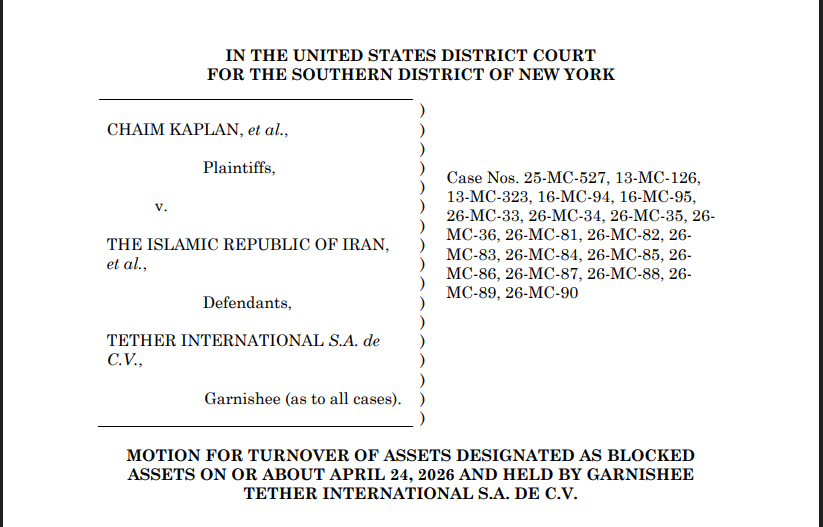
Filing against Tether submitted by Attorney Charles Gerstein.

His clients say they have a legal claim to two Tron blockchain wallet addresses holding roughly 344 million USDT. Those wallets were frozen earlier this year by the US Treasury Department’s Office of Foreign Assets Control, which identified them as linked to Iran’s Islamic Revolutionary Guard Corps.

The plaintiffs are not asking Tether to simply release those specific wallets. According to reports, they want a court order directing Tether to transfer an equivalent amount of USDT to their legal team’s wallet address.
Why Tether Can Be Compelled

Unlike Bitcoin or Ethereum, USDT is controlled by a central company. Tether can freeze wallets, block transactions, and move funds when ordered to do so. That centralized structure is at the heart of Gerstein’s legal argument.

Because a prior order already froze the wallets — something only possible because Tether has direct operational control — he contends the company can also be ordered to move the funds.

BTCUSD trading at $78,115 on the 24-hour chart: TradingView

The ownership question, he argues, is already largely settled: OFAC has already declared the wallets to be IRGC-controlled assets, which clears a path for seizure under US terrorism statutes.

Broader Legal Campaign

This is not Gerstein’s only case of this kind. Based on reports, he has filed similar actions involving North Korea-linked cyber operations against the Arbitrum platform. He is also handling a separate case involving Railgun DAO, a privacy-focused crypto protocol.

The Manhattan filing is part of what appears to be a coordinated legal push to test whether courts can compel crypto platforms with centralized control to act on frozen assets held in sanctioned wallets.

Featured image from CEPA, chart from TradingView

Preguntas relacionadas

QWhat is the plaintiffs' primary demand to Tether in this case?

AThe plaintiffs are asking the US federal court to order Tether to transfer approximately $344 million worth of frozen USDT (an equivalent amount to the funds in two sanctioned wallet addresses) to a wallet address controlled by their legal team.

QWhat is the legal basis for Attorney Charles Gerstein's argument that Tether can be compelled to move the funds?

AThe argument hinges on Tether's centralized control over USDT. Gerstein contends that because Tether can and has frozen the specific wallets (as ordered by OFAC), demonstrating direct operational control, the company can similarly be ordered by a court to move the funds.

QWhat entity froze the Tron blockchain wallets containing the 344 million USDT, and why were they frozen?

AThe wallets were frozen earlier this year by the US Treasury Department's Office of Foreign Assets Control (OFAC), which identified them as assets linked to Iran's Islamic Revolutionary Guard Corps (IRGC).

QWho are the plaintiffs in this lawsuit against Tether?

AThe plaintiffs are survivors and family members of victims from Iran-linked terrorist attacks, including a Jerusalem family that lost relatives in a 1997 Hamas suicide bombing. They hold unpaid court judgments against Iran.

QWhat potential legal significance does this case hold beyond the immediate dispute?

AThe case could set a significant legal precedent for how US courts treat centralized stablecoin issuers, testing whether courts can compel such platforms to act on frozen assets held in wallets linked to sanctioned entities under terrorism statutes.

Lecturas Relacionadas

ChatGPT Might Be Disappearing Soon

OpenAI announced at its "Intelligence at Work" event that its coding assistant, Codex, will be fully integrated into the ChatGPT app within weeks. This move marks a strategic shift from a conversational AI (Chat) towards a unified "agentic" platform capable of execution. Codex, originally launched to compete with Anthropic's Claude Code, has grown rapidly to 5 million weekly active users, with 20% being non-developers like analysts and designers. Its enterprise revenue now constitutes 40% of OpenAI's total. The integration is the first step in creating a super-app combining ChatGPT (interface), Codex (execution engine), and the Atlas browser (web access). OpenAI also unveiled new Codex features: specialized Agent plugins for six professional roles, an "Annotations" tool for direct document editing, and a "Sites" function to turn work into shareable web apps. Internally, this reflects a power shift; the Codex team now leads core product strategy. While the ChatGPT brand remains for its vast user base, the platform's future is focused on autonomous agents that perform tasks, not just chat. The article notes that competition with Claude Code pushed OpenAI's development, with Codex competing on cost-effectiveness and accessibility rather than raw coding quality. It concludes that the essence of "ChatGPT" is evolving from a chatbot into an AI agent platform, with the name potentially becoming a legacy symbol of its original function.

marsbitHace 8 min(s)

ChatGPT Might Be Disappearing Soon

marsbitHace 8 min(s)

WWDC26 Ultimate Preview: The All-New Siri is the Main Course, iOS 27 is Another Year of Refinements

Apple has confirmed WWDC26 will begin on June 8, with the keynote at 10 AM PT (1 AM Beijing Time, June 9). This year's focus is expected to shift significantly from routine OS updates to Apple's progress in AI, particularly a major overhaul of Siri. Reports indicate the highlight will be a new Siri, reportedly powered by Google's Gemini technology. This upgraded assistant is expected to appear as a lightweight bubble from the Dynamic Island and be accessible via a unified "Search or Ask" system-wide entry point. It aims to deeply integrate with iOS 27, iPadOS 27, and macOS 27, accessing personal data like messages, photos, and documents, with a potential standalone Siri app also in development. For iOS 27, leaks suggest incremental improvements rather than major redesigns. Key updates may include a redesigned, more customizable Camera app, enhanced photo editing tools within the Photos app, and potential early system optimizations for a future foldable iPhone. The update is also rumored to prioritize bug fixes, stability, and performance optimization. iPadOS 27 is anticipated to focus on improving productivity features like window management, file systems, and external display support to better utilize the iPad's hardware. macOS 27 is seen as a core platform for Apple Intelligence, likely receiving an optimized Siri, new AI features, and continued refinement of the "Liquid Glass" design language. Notably, macOS 27 may finally drop support for Intel-based Macs. The overarching theme for WWDC26 is whether Apple can effectively integrate AI across its ecosystem. The success of the new Siri and Apple Intelligence will be judged on their ability to move beyond standalone features and become a cohesive, context-aware system layer that understands user workflows across iPhone, iPad, Mac, and other devices, while maintaining Apple's emphasis on privacy and stability. The conference represents Apple's critical attempt to catch up and redefine the AI assistant experience after a perceived slow start in the generative AI era.

marsbitHace 33 min(s)

WWDC26 Ultimate Preview: The All-New Siri is the Main Course, iOS 27 is Another Year of Refinements

marsbitHace 33 min(s)

Trading

Spot
Futuros
活动图片





