Tether Launches Bitcoin Mining OS, Fueling $HYPER’s $31.2M Presale

bitcoinistPublicado a 2026-02-03Actualizado a 2026-02-03

Resumen

Tether, the major stablecoin issuer, is expanding its influence in Bitcoin infrastructure by launching MOS, a proprietary mining operating system that integrates IoT technology to optimize energy efficiency. This move signals a strong institutional commitment to Bitcoin's foundational growth. However, Bitcoin's inherent limitations in transaction speed and scalability for DeFi applications remain a challenge. Addressing this, Bitcoin Hyper ($HYPER) is gaining attention as a Bitcoin Layer 2 solution that combines Bitcoin's security with the high-speed performance of the Solana Virtual Machine (SVM). It enables fast, low-cost transactions and smart contracts in Rust, making Bitcoin more usable for DeFi. The project's presale has raised over $31.2 million, indicating significant investor interest, particularly from larger entities, ahead of its Token Generation Event (TGE). The tokenomics include immediate staking post-TGE with a 7-day vesting period to reduce sell pressure. This development represents a growing trend to enhance Bitcoin's utility alongside infrastructure improvements.

Tether isn’t just a stablecoin issuer anymore. It’s rapidly becoming a dominant force in Bitcoin infrastructure.

The company’s recent launch of MOS, its proprietary mining operating system, marks a massive shift in how institutional capital interacts with the network.
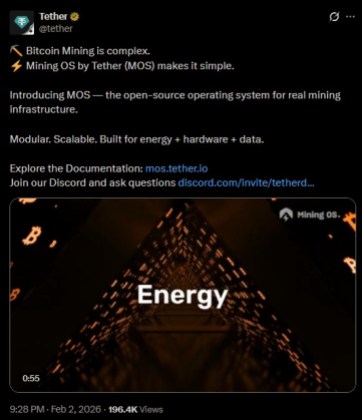
By fusing Internet of Things (IoT) technology with mining hardware, Tether is optimizing energy efficiency in a way that screams long-term commitment. It’s not just about holding $BTC; it’s about building the rails.

That validates the ‘Bitcoin as infrastructure’ thesis. When the world’s largest stablecoin issuer, sitting on over $100B in liquidity, pivots to mining logistics, it de-risks the network for everyone else. But while Tether tackles hardware inefficiencies, a glaring gap remains on the software side: Bitcoin simply can’t handle complex, high-speed transactions natively.

Consequently, focus is shifting toward solutions that can unlock Bitcoin’s $1T+ capital for decentralized finance (DeFi). The liquidity is there. The rails? Too slow. This search for scalability has pushed massive capital toward Layer 2 protocols.

Right now, smart money is circling Bitcoin Hyper ($HYPER), a project merging Bitcoin’s security with the Solana Virtual Machine’s (SVM) speed to bridge institutional security with retail velocity.

You can buy $HYPER here.

Bitcoin Hyper Bridges the Gap Between Security and SVM Speed

Bitcoin’s core limitation has always been the ‘trilemma’ trade-off: it sacrifices speed for absolute decentralization. While reliable for settlement, frankly, it’s functionally useless for modern DeFi applications that require sub-second finality.

Bitcoin Hyper ($HYPER) tackles this by integrating the Solana Virtual Machine (SVM) directly as a Layer 2 execution environment.

This isn’t just narrative fluff, it’s a technical leap. By using the SVM, Bitcoin Hyper lets developers write smart contracts in Rust (the language powering Solana’s ecosystem) while anchoring the final state to Bitcoin’s Layer 1. This modular approach separates execution from settlement.
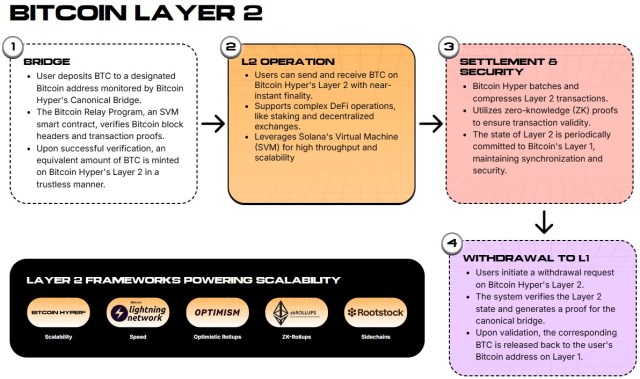
Transactions happen in real-time on the SVM layer, delivering the snappy, low-cost experience users expect, while security remains tied to Bitcoin.

For developers, this removes the friction of learning archaic scripting languages like Bitcoin Script. For users, it means interacting with Bitcoin DeFi without exorbitant fees or 10-minute waits. The protocol includes a Decentralized Canonical Bridge to keep value transfers trust-minimized.

That infrastructure is crucial for high-frequency trading and gaming dApps, stuff that was previously impossible on the Bitcoin network.

Explore the Bitcoin Hyper ecosystem.

Whale Accumulation Signals Confidence as Presale Clears $31M

The appetite for high-performance Bitcoin Layer 2s is real. Just look at the capital flows surrounding the Bitcoin Hyper presale. Official data shows the project has raised over $31.2M, a figure that underscores demand despite market chop. With tokens priced at $0.013675, the valuation offers an early-stage entry point compared to established competitors like Stacks.

Sophisticated actors appear to be positioning themselves ahead of the Token Generation Event (TGE). The implication? Larger entities are betting the “SVM on Bitcoin” narrative will outperform standard EVM-based Layer 2s.

The tokenomics look designed for the long haul. Bitcoin Hyper offers immediate staking after TGE (though APY rates are still under wraps). There’s a catch: a 7-day vesting period for presale stakers. But that’s likely a feature, not a bug, intended to mitigate immediate sell pressure.

As Tether industrializes Bitcoin mining, projects like Bitcoin Hyper are industrializing Bitcoin utility, creating a dual engine for the network’s next growth phase.

Check out the Bitcoin Hyper presale.

Disclaimer: This article is for informational purposes only and does not constitute financial advice. Cryptocurrency investments, including presales and Layer 2 tokens, carry high risks. Always perform your own due diligence before investing.


Preguntas relacionadas

QWhat is the main focus of Tether's new initiative mentioned in the article?

ATether is expanding beyond stablecoin issuance by launching its proprietary Bitcoin mining operating system (MOS), focusing on optimizing energy efficiency and becoming a dominant force in Bitcoin infrastructure.

QHow does Bitcoin Hyper ($HYPER) aim to solve Bitcoin's scalability issue?

ABitcoin Hyper integrates the Solana Virtual Machine (SVM) as a Layer 2 execution environment, enabling high-speed, low-cost transactions while anchoring security to Bitcoin's Layer 1, thus addressing Bitcoin's limitations for DeFi applications.

QWhat technical advantage does Bitcoin Hyper offer to developers?

AIt allows developers to write smart contracts in Rust (the language used in Solana's ecosystem) instead of Bitcoin Script, reducing friction and enabling the creation of high-frequency trading and gaming dApps on Bitcoin.

QHow much capital has the Bitcoin Hyper presale raised, and what does it indicate?

AThe Bitcoin Hyper presale has raised over $31.2 million, indicating strong demand and confidence in the 'SVM on Bitcoin' narrative, with whale accumulation signaling institutional interest.

QWhat is one key feature of Bitcoin Hyper's tokenomics designed for long-term stability?

AThe tokenomics include immediate staking after the Token Generation Event (TGE) with a 7-day vesting period for presale stakers to mitigate immediate sell pressure and encourage long-term holding.

Lecturas Relacionadas

a16z: AI's 'Amnesia', Can Continuous Learning Cure It?

The article "a16z: AI's 'Amnesia' – Can Continual Learning Cure It?" explores the limitations of current large language models (LLMs), which, like the protagonist in the film *Memento*, are trapped in a perpetual present—unable to form new memories after training. While methods like in-context learning (ICL), retrieval-augmented generation (RAG), and external scaffolding (e.g., chat history, prompts) provide temporary solutions, they fail to enable true internalization of new knowledge. The authors argue that compression—the core of learning during training—is halted at deployment, preventing models from generalizing, discovering novel solutions (e.g., mathematical proofs), or handling adversarial scenarios. The piece introduces *continual learning* as a critical research direction to address this, categorizing approaches into three paths: 1. **Context**: Scaling external memory via longer context windows, multi-agent systems, and smarter retrieval. 2. **Modules**: Using pluggable adapters or external memory layers for specialization without full retraining. 3. **Weights**: Enabling parameter updates through sparse training, test-time training, meta-learning, distillation, and reinforcement learning from feedback. Challenges include catastrophic forgetting, safety risks, and auditability, but overcoming these could unlock models that learn iteratively from experience. The conclusion emphasizes that while context-based methods are effective, true breakthroughs require models to compress new information into weights post-deployment, moving from mere retrieval to genuine learning.

marsbitHace 2 hora(s)

a16z: AI's 'Amnesia', Can Continuous Learning Cure It?

marsbitHace 2 hora(s)

Can a Hair Dryer Earn $34,000? Deciphering the Reflexivity Paradox in Prediction Markets

An individual manipulated a weather sensor at Paris Charles de Gaulle Airport with a portable heat source, causing a Polymarket weather market to settle at 22°C and earning $34,000. This incident highlights a fundamental issue in prediction markets: when a market aims to reflect reality, it also incentivizes participants to influence that reality. Prediction markets operate on two layers: platform rules (what outcome counts as a win) and data sources (what actually happened). While most focus on rules, the real vulnerability lies in the data source. If reality is recorded through a specific source, influencing that source directly affects market settlement. The article categorizes markets by their vulnerability: 1. **Single-point physical data sources** (e.g., weather stations): Easily manipulated through physical interference. 2. **Insider information markets** (e.g., MrBeast video details): Insiders like team members use non-public information to trade. Kalshi fined a剪辑师 $20,000 for insider trading. 3. **Actor-manipulated markets** (e.g., Andrew Tate’s tweet counts): The subject of the market can control the outcome. Evidence suggests Tate’sociated accounts coordinated to profit. 4. **Individual-action markets** (e.g., WNBA disruptions): A single person can execute an event to profit from their pre-placed bets. Kalshi and Polymarket handle these issues differently. Kalshi enforces strict KYC, publicly penalizes insider trading, and reports to regulators. Polymarket, with its anonymous wallet-based system, has historically been more permissive, arguing that insider information improves market accuracy. However, it cooperated with authorities in the "Van Dyke case," where a user traded on classified government information. The core paradox is reflexivity: prediction markets are designed to discover truth, but their financial incentives can distort reality. The more valuable a prediction becomes, the more likely participants are to influence the event itself. The market ceases to be a mirror of reality and instead shapes it.

marsbitHace 3 hora(s)

Can a Hair Dryer Earn $34,000? Deciphering the Reflexivity Paradox in Prediction Markets

marsbitHace 3 hora(s)

Trading

Spot
Futuros
活动图片