Tether-backed Northern Data sold mining firm to Tether execs: FT

cointelegraphPublicado a 2025-12-22Actualizado a 2025-12-22

Resumen

Northern Data, a Tether-backed data center operator, sold its Bitcoin mining business, Peak Mining, for up to $200 million to three companies run by Tether executives, including its co-founder and CEO. The sale occurred just before Rumble, a video-sharing platform in which Tether holds a major stake, agreed to acquire Northern Data. This is the second attempt to sell the mining unit to a Tether-linked entity. Northern Data is under investigation in Europe for suspected tax fraud and has a complex financial relationship with Tether, including a €610 million loan. The sale highlights Tether's expanding interests beyond stablecoins into mining, AI, and other ventures.

The Tether-backed data centre operator Northern Data reportedly sold its Bitcoin mining business, Peak Mining, to three companies run by Tether executives.

Northern Data was sold for up to $200 million to Highland Group Mining, Appalachian Energy, and an Alberta-based company, run by Giancarlo Devasini, Tether co-founder and chair, and its CEO, Paolo Ardoino, the Financial Times reported on Friday.

Filings reportedly show that Highland Group’s directors are Devasini and Ardoino, and the sole director of the Alberta company is Devasini, while it remains unclear who runs Delaware-based Appalachian Energy.

Northern Data initially announced the Peak Mining divestment in November, but did not identify the buyers, as it was not required by German regulators.

The deal also happened just before video-sharing platform Rumble, in which Tether holds nearly a 50% stake, agreed to acquire Northern Data.
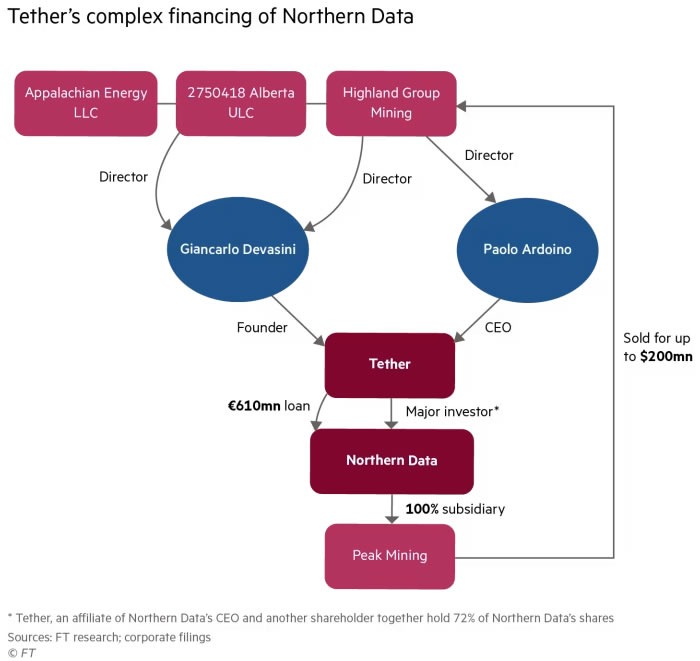
Tether’s complex web of financial ties. Source: The Financial Times

Web of complex financial ties

It is also the second attempt to sell Peak Mining to a Devasini-controlled company. The first deal announced in August was with Elektron Energy for $235 million, but it fell through amid whistleblower allegations.

Northern Data faces investigation by European prosecutors for suspected tax fraud, and its offices were raided in September.

Related: Tether deepens AI bet, backs Italian firm’s humanoid robots

Tether has also agreed on a $100 million advertising deal with Rumble and plans to buy $150 million worth of GPU services from it as it delves deeper into Bitcoin mining.

Northern Data also currently has a 610 million euro ($715 million) loan from Tether.

The stablecoin issuer will receive half of the loan balance in Rumble stock as part of the acquisition, with the rest paid in the form of a new loan from Tether to Rumble, secured against Northern Data assets, the FT reported.

Tether branching out from stablecoins

Tether remains the world’s dominant player in the stablecoin sector with a 60% market share and $187 billion in circulating supply of USDT.

In addition to Bitcoin mining, AI, and video-sharing platforms, it is also eyeing sports teams.

On December 12, Tether launched a $1.1 billion bid to acquire the Italian professional soccer club, Juventus Football Club, but it was rejected by the club’s owners.

Magazine: Big questions: Would Bitcoin survive a 10-year power outage?

Preguntas relacionadas

QWhat is the name of the Bitcoin mining business sold by Northern Data, and to whom was it sold?

ANorthern Data sold its Bitcoin mining business, Peak Mining, to three companies run by Tether executives: Highland Group Mining, Appalachian Energy, and an Alberta-based company.

QWho are the key Tether executives involved in the purchase of Peak Mining, according to the Financial Times report?

AThe key Tether executives involved are Giancarlo Devasini, Tether's co-founder and chair, and its CEO, Paolo Ardoino. Devasini is a director of Highland Group and the sole director of the Alberta company.

QWhat significant event happened just before Rumble agreed to acquire Northern Data?

AJust before Rumble agreed to acquire Northern Data, the deal to sell Peak Mining to the Tether executives' companies took place.

QBesides stablecoins, what other industries is Tether investing in, as mentioned in the article?

ATether is investing in Bitcoin mining, artificial intelligence (AI), video-sharing platforms (through its stake in Rumble), and has also made a bid to acquire the Italian soccer club Juventus.

QWhat is the nature of the financial relationship between Tether and Northern Data beyond the recent sale?

ANorthern Data currently has a 610 million euro ($715 million) loan from Tether. As part of Rumble's acquisition of Northern Data, Tether will receive half of this loan balance in Rumble stock, with the rest paid as a new loan from Tether to Rumble, secured against Northern Data's assets.

Lecturas Relacionadas

Anthropic Starts Poaching Scientists? $27K Weekly Onsite Stipend to Fix Claude's Expert-Level Errors

Anthropic has launched a new STEM Fellow program, offering $3,800 per week for a three-month, in-person residency in San Francisco. The role targets experts from science, technology, engineering, and mathematics (STEM) fields—machine learning experience is helpful but not required. Instead, Anthropic values scientific judgment and a willingness to learn quickly. Fellows will work with Claude models and internal tools under the guidance of an Anthropic researcher. Example projects include a materials scientist identifying errors in Claude’s reasoning or a climate scientist integrating atmospheric modeling software with Claude. The goal is to have experts "tell Claude where it's wrong" and improve its scientific capabilities. This initiative is part of Anthropic’s broader strategy to strengthen its scientific ecosystem, following earlier programs like the AI Safety Fellows and AI for Science programs. The company acknowledges that current AI models, while powerful, still produce high-confidence errors and lack end-to-end research autonomy. The program aims to embed domain expertise directly into model development, turning scientists into "high-level reviewers" for AI. Anthropic CEO Dario Amodei has previously emphasized AI’s potential to accelerate scientific breakthroughs, particularly in biology and healthcare. The company believes that the next phase of AI competition will depend not on scaling parameters, but on integrating human expertise to refine model accuracy and reliability.

marsbitHace 47 min(s)

Anthropic Starts Poaching Scientists? $27K Weekly Onsite Stipend to Fix Claude's Expert-Level Errors

marsbitHace 47 min(s)

On the Eve of X Money's Launch, Musk Dismantles the Referee First

"X Money Launches After Dismantling Regulator: Musk's 9-Day Power Play" In February 2025, a team from the "Department of Government Efficiency" (DOGE), led by Elon Musk, entered the Consumer Financial Protection Bureau (CFPB) headquarters. Shortly after, the CFPB was effectively dismantled—its funding frozen, activities suspended, and nearly 90% of staff laid off. This move came just nine days after X announced a partnership with Visa and as X Money prepared to launch. The article contrasts this with the decade-long regulatory battles faced by companies like Coinbase and PayPal. Coinbase spent over $75 million in political contributions and endured a major SEC lawsuit to operate legally. PayPal complied with strict state and federal rules for its stablecoin PYUSD, including 100% reserve requirements and monthly audits. However, Musk’s approach was different. After the CFPB introduced a rule placing large digital payment apps under federal oversight, Musk tweeted "Delete CFPB." Within months, the rule was revoked by Congress. Meanwhile, DOGE operatives gained "god-tier" access to CFPB databases, potentially obtaining sensitive competitive information from rivals like Apple, Google, and PayPal. The article also highlights a "suspicious exemption clause" in the GENIUS Act, which allows private companies like X to issue stablecoins with fewer restrictions. Senator Elizabeth Warren questioned whether Musk, who was a senior presidential advisor during the Act’s drafting, influenced this clause. X Money offers a 6% APY on deposits, despite FDIC warnings that stablecoin users are not insured. As X Money launches to 600 million monthly users, the article questions the fairness of a system where Musk can bypass regulations that others spent years and millions to comply with. The dismantling of the CFPB and the alleged regulatory advantages raise concerns about the future of equitable rule-making in the U.S. financial system.

marsbitHace 56 min(s)

On the Eve of X Money's Launch, Musk Dismantles the Referee First

marsbitHace 56 min(s)

Trading

Spot
Futuros
活动图片