Terraform’s $40B Collapse Back in Spotlight as Jane Street Faces Insider Trading Lawsuit

bitcoinistPublicado a 2026-02-24Actualizado a 2026-02-24

Resumen

Terraform Labs' $40 billion collapse is back in the spotlight as Jane Street faces an insider trading lawsuit. The complaint, filed by Terraform's bankruptcy administrator, alleges the trading giant used confidential information to avoid losses and hasten the ecosystem's downfall in May 2022. It claims Jane Street obtained non-public details through a former Terraform intern and executed trades minutes after Terraform secretly removed 150 million UST from a liquidity pool, before the information was public. Jane Street denies the allegations, blaming Terraform's management for the collapse. The case could set a precedent for oversight of institutional trading and information asymmetry in crypto markets.

Nearly four years after one of crypto’s most destructive failures erased tens of billions of dollars in value, the collapse of Terraform Labs has returned to the courtroom.

A new lawsuit filed in a U.S. federal court accuses trading giant Jane Street of insider trading tied to the 2022 downfall of the Terra ecosystem, a case that could reshape how institutional trading activity in digital asset markets is scrutinized.

The complaint was filed by the court-appointed administrator overseeing Terraform Labs’ bankruptcy, alleging the firm used confidential information to trade ahead of key market events, avoid losses, and hasten the collapse of its algorithmic stablecoin system.
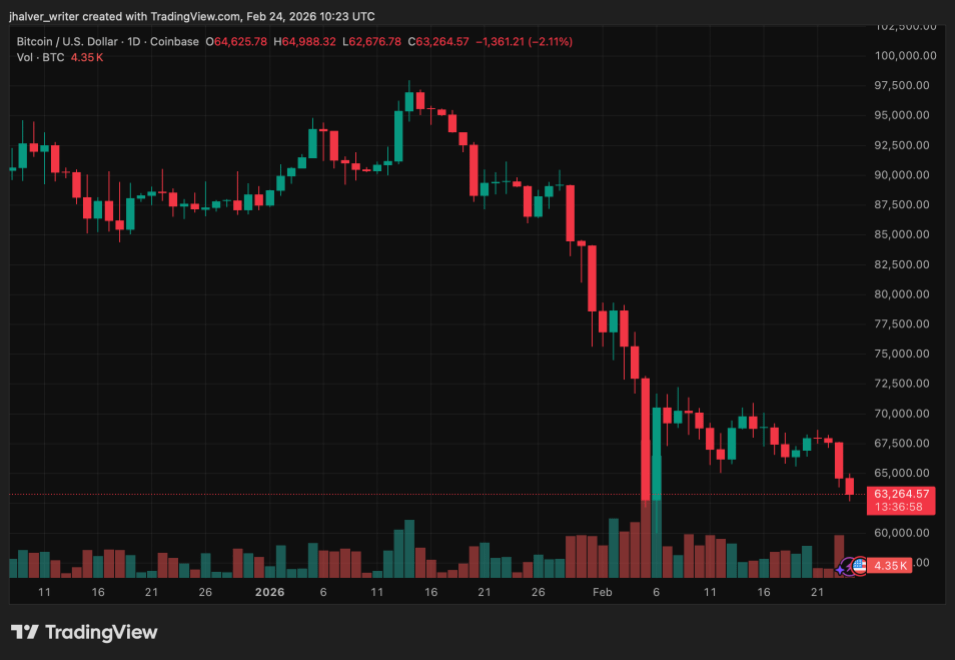
BTC's price trends to the downside on the daily chart. Source: BTCUSD on Tradingview 

Allegations of Insider Trading During Terra’s Final Days

According to the lawsuit, Jane Street obtained material non-public information through contacts within Terraform. The filing claims that a former Terraform intern working at the trading firm helped establish private communication channels that allegedly became a source of sensitive operational details.

Central to the case is a series of transactions on May 7, 2022, days before TerraUSD lost its dollar peg. Terraform quietly removed 150 million TerraUSD from Curve’s 3pool liquidity pool, a move that had not yet been disclosed publicly. Less than ten minutes later, a wallet linked to Jane Street allegedly withdrew 85 million TerraUSD from the same pool.

The administrator argues that this timing allowed the firm to unwind large exposures and position trades before panic spread across the market. The lawsuit claims these actions intensified liquidity stress and contributed to the rapid loss of confidence that followed.

Jane Street has strongly denied the accusations, describing the lawsuit as baseless and arguing that Terraform’s own management, not outside traders, was responsible for investor losses.

Revisiting the $40 Billion Crypto Meltdown

Terraform’s collapse remains one of the defining crises in cryptocurrency history. When TerraUSD lost its peg in May 2022, its sister token Luna entered a death spiral that wiped out roughly $40 billion in market value within days.

The fallout triggered widespread liquidations and contributed to broader industry instability, later exposing weaknesses across several crypto firms.

Terraform filed for bankruptcy in 2024, while Kwon later pleaded guilty to criminal charges and received a prison sentence. The current lawsuit follows earlier legal action against another trading firm, signaling an ongoing effort to recover funds for creditors.

Broader Implications for Crypto Market Oversight

The case spotlights growing concerns about information asymmetry in markets often promoted as decentralized. Regulators have increasingly focused on trading practices, market manipulation, and the role of large liquidity providers in digital assets.

If the allegations are proven, the lawsuit could set an important precedent for how proprietary trading firms interact with crypto projects and handle non-public information. Even if unsuccessful, the legal battle reopens unresolved questions about accountability during major crypto failures.

Cover image from ChatGPT, BTCUSD on Tradingview

Preguntas relacionadas

QWhat is the new lawsuit against Jane Street about, and how is it connected to the Terraform Labs collapse?

AThe lawsuit accuses Jane Street of insider trading tied to the 2022 collapse of the Terra ecosystem. It alleges the firm used confidential, non-public information obtained through contacts within Terraform Labs to trade ahead of key market events, avoid losses, and hasten the downfall of its algorithmic stablecoin system.

QWhat specific event on May 7, 2022, is central to the insider trading allegations against Jane Street?

AThe lawsuit centers on Terraform Labs quietly removing 150 million TerraUSD from Curve’s 3pool liquidity pool, a move not yet public. Less than ten minutes later, a wallet linked to Jane Street allegedly withdrew 85 million TerraUSD from the same pool, allowing the firm to unwind exposures before panic spread.

QHow did Jane Street respond to the allegations in the lawsuit?

AJane Street has strongly denied the accusations, describing the lawsuit as baseless. The firm argues that Terraform’s own management, not outside traders, was responsible for the investor losses.

QWhat were the broader consequences of the Terraform Labs collapse in May 2022?

AThe collapse erased roughly $40 billion in market value within days as TerraUSD lost its peg and its sister token Luna entered a death spiral. The fallout triggered widespread liquidations, contributed to broader industry instability, and exposed weaknesses in several crypto firms.

QWhat potential broader implications for the crypto market does this lawsuit highlight?

AThe case spotlights concerns about information asymmetry in decentralized markets. It could set a precedent for how proprietary trading firms interact with crypto projects and handle non-public information, raising questions about accountability and market oversight during major crypto failures.

Lecturas Relacionadas

SharpLink CEO: How to Understand Ethereum Developers Just Exceeded 1 Million?

SharpLink CEO reflects on the milestone of Ethereum surpassing 1 million historical developers, emphasizing that this figure represents the largest pool of technical talent ever assembled around an open, permissionless blockchain network. While approximately 232,000 developers remain active, the key question for the crypto industry is not which chain is fastest, but where the best builders choose to build long-term. Ethereum's advantage lies in a decade-long accumulation of infrastructure, standards, tools, liquidity, and a cohesive culture, making it the default operating system for programmable finance. This developer base is tackling complex challenges: the Glamsterdam upgrade aims to enhance scalability while preserving core principles; synchronous composability seeks to unify Rollup ecosystems; and significant efforts are underway for post-quantum security. Ethereum's deeper network effects stem from composability and shared standards (like the EVM and Solidity), creating a flywheel of more developers, tools, and liquidity. Three reinforcing strengths cement Ethereum's lead: credible neutrality (secured by ~900k validators), a modular architecture with interconnected Rollups, and a culture that attracts top researchers. The ecosystem is consolidating as the trusted coordination layer for internet-native finance, favored by large institutions valuing security and liquidity. The future of Ethereum is being built by this global community of founders and architects.

链捕手Hace 6 min(s)

SharpLink CEO: How to Understand Ethereum Developers Just Exceeded 1 Million?

链捕手Hace 6 min(s)

A Clod of Chinese Soil Chokes Two Japanese Giants

"Chinese Soil Chokes Japanese Giants" The production of a key electronic specialty gas, tungsten hexafluoride (WF6), vital for manufacturing AI chips, was halted by two leading Japanese producers—Kanto Denka and Central Glass. Their shutdown was not due to a technological failure but a sudden, critical shortage of a raw material they had long taken for granted: ultra-high-purity (6N-grade) tungsten powder, which is almost entirely sourced from China. Following a quiet Chinese export announcement in January 2026, tungsten powder shipments to Japan dropped to zero for months. Despite frantic efforts, Japanese companies found no viable alternative; imported powder was three times more expensive and lacked the required purity. Their existing stockpiles were exhausted by mid-2026. WF6 is essential for depositing tungsten into the microscopic contact holes of High Bandwidth Memory (HBM) chips, which are crucial for advanced processors like those from Nvidia. While Japanese firms had mastered producing ultra-pure WF6 gas, their entire supply chain relied on China's 6N tungsten powder—a dependency now revealed as a fatal vulnerability. China's dominance in this "soil" results from decades of painstaking R&D by companies like Xiamen Tungsten and China Tungsten & Hightech. They overcame immense technical hurdles, such as separating chemically similar molybdenum from tungsten, to achieve mass production of the world's purest tungsten powder. With their primary suppliers gone, Kanto Denka and Central Glass announced a permanent halt to WF6 production starting July 1, 2026. This immediately created a supply crisis for major semiconductor manufacturers like Samsung and SK Hynix, forcing them to urgently seek and certify new Chinese suppliers for WF6 itself. The reversal marks a dramatic shift: China has moved from exporting low-value raw materials to controlling the high-purity foundation of a critical global tech supply chain, upending a long-established industrial hierarchy.

marsbitHace 37 min(s)

A Clod of Chinese Soil Chokes Two Japanese Giants

marsbitHace 37 min(s)

Without Tencent, What's Left for Suiyuan?

The article centers on the crucial question posed in the title: what is Seyond Technology really worth if its dominant customer, Tencent, were to stop purchasing its AI chips? As the last of China's "Four AI Chip Dragons" to secure approval for a public listing, Seyond's IPO filing reveals a profound and controversial dependency. In 2025, 74.9% to over 80% of its revenue came from Tencent. The piece argues that this extreme customer concentration is not merely a vulnerability but a strategic outcome of China's AI industry evolution. It contrasts Seyond's path with its peers (Moore Thread, Biren Technology, and MetaX), noting that while others raced to market with ambitious stories, Seyond focused first on securing and delivering for a major client. Its explosive revenue growth—with Q1 2026 up 1474.85% year-on-year—is driven by concentrated orders from Tencent, which itself faces massive, escalating AI compute demands for products like its Yuanbao and Hunyuan models. The relationship is framed as a deliberate, symbiotic cultivation of a supply chain. As both a major shareholder (20.26%) and primary client, Tencent is actively fostering Seyond to build a controllable, stable alternative to NVIDIA, similar to how global tech giants historically nurtured key suppliers. The high switching costs—involving software stacks and deployed systems—create a deep "ecological moat" for Seyond within Tencent's ecosystem. The analysis positions the AI chip landscape in three tiers: NVIDIA as the global leader, Huawei's Ascend as the state-backed player, and commercial firms like Seyond competing for market orders. Seyond is increasingly seen as "Tencent's compute foundation," with its product roadmap closely aligned with the tech giant's needs. The conclusion is that the industry's metric for success is shifting from fundraising and technical specs to real orders, delivery capability, and ecosystem binding. Seyond's value, therefore, lies not just in its chips but in holding a massive, multi-year procurement order from China's largest internet company—a tangible asset arguably more telling than any technical whitepaper in the current climate. The core insight is that for domestic chips, the ultimate challenge isn't just catching up technologically with NVIDIA, but earning the trust, scenarios, and recurring orders from a major anchor client.

marsbitHace 1 hora(s)

Without Tencent, What's Left for Suiyuan?

marsbitHace 1 hora(s)

Trading

Spot
Futuros

Artículos destacados

Cómo comprar ONE

¡Bienvenido a HTX.com! Hemos hecho que comprar Harmony (ONE) sea simple y conveniente. Sigue nuestra guía paso a paso para iniciar tu viaje de criptos.Paso 1: crea tu cuenta HTXUtiliza tu correo electrónico o número de teléfono para registrarte y obtener una cuenta gratuita en HTX. Experimenta un proceso de registro sin complicaciones y desbloquea todas las funciones.Obtener mi cuentaPaso 2: ve a Comprar cripto y elige tu método de pagoTarjeta de crédito/débito: usa tu Visa o Mastercard para comprar Harmony (ONE) al instante.Saldo: utiliza fondos del saldo de tu cuenta HTX para tradear sin problemas.Terceros: hemos agregado métodos de pago populares como Google Pay y Apple Pay para mejorar la comodidad.P2P: tradear directamente con otros usuarios en HTX.Over-the-Counter (OTC): ofrecemos servicios personalizados y tipos de cambio competitivos para los traders.Paso 3: guarda tu Harmony (ONE)Después de comprar tu Harmony (ONE), guárdalo en tu cuenta HTX. Alternativamente, puedes enviarlo a otro lugar mediante transferencia blockchain o utilizarlo para tradear otras criptomonedas.Paso 4: tradear Harmony (ONE)Tradear fácilmente con Harmony (ONE) en HTX's mercado spot. Simplemente accede a tu cuenta, selecciona tu par de trading, ejecuta tus trades y monitorea en tiempo real. Ofrecemos una experiencia fácil de usar tanto para principiantes como para traders experimentados.

291 Vistas totalesPublicado en 2024.12.12Actualizado en 2026.06.02

Cómo comprar ONE

Discusiones

Bienvenido a la comunidad de HTX. Aquí puedes mantenerte informado sobre los últimos desarrollos de la plataforma y acceder a análisis profesionales del mercado. A continuación se presentan las opiniones de los usuarios sobre el precio de ONE (ONE).

活动图片