Terraform’s $40B Collapse Back in Spotlight as Jane Street Faces Insider Trading Lawsuit

bitcoinistPublicado a 2026-02-24Actualizado a 2026-02-24

Resumen

Terraform Labs' $40 billion collapse is back in the spotlight as Jane Street faces an insider trading lawsuit. The complaint, filed by Terraform's bankruptcy administrator, alleges the trading giant used confidential information to avoid losses and hasten the ecosystem's downfall in May 2022. It claims Jane Street obtained non-public details through a former Terraform intern and executed trades minutes after Terraform secretly removed 150 million UST from a liquidity pool, before the information was public. Jane Street denies the allegations, blaming Terraform's management for the collapse. The case could set a precedent for oversight of institutional trading and information asymmetry in crypto markets.

Nearly four years after one of crypto’s most destructive failures erased tens of billions of dollars in value, the collapse of Terraform Labs has returned to the courtroom.

A new lawsuit filed in a U.S. federal court accuses trading giant Jane Street of insider trading tied to the 2022 downfall of the Terra ecosystem, a case that could reshape how institutional trading activity in digital asset markets is scrutinized.

The complaint was filed by the court-appointed administrator overseeing Terraform Labs’ bankruptcy, alleging the firm used confidential information to trade ahead of key market events, avoid losses, and hasten the collapse of its algorithmic stablecoin system.
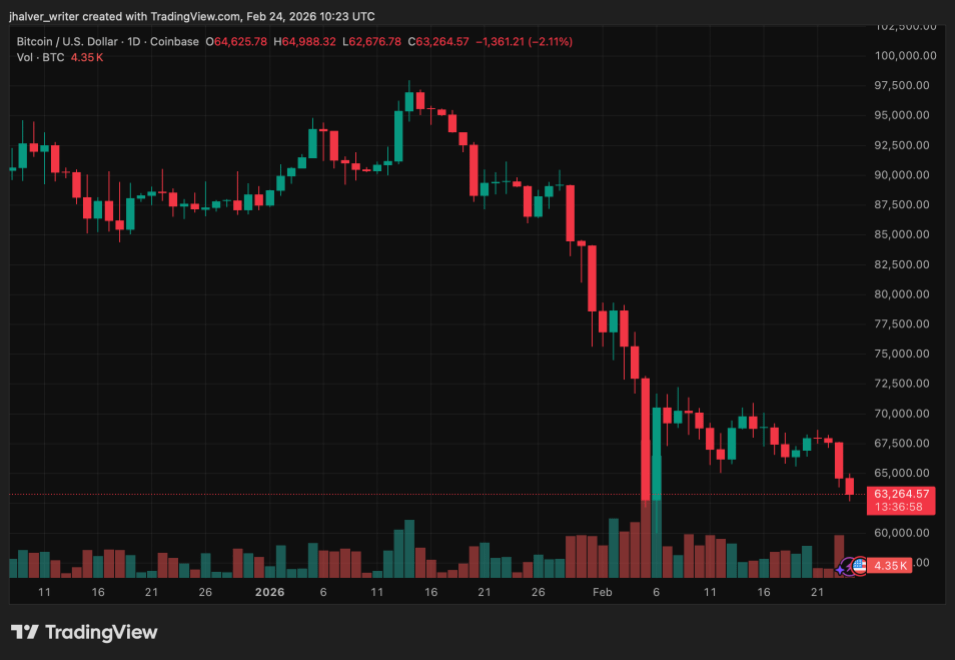
BTC's price trends to the downside on the daily chart. Source: BTCUSD on Tradingview 

Allegations of Insider Trading During Terra’s Final Days

According to the lawsuit, Jane Street obtained material non-public information through contacts within Terraform. The filing claims that a former Terraform intern working at the trading firm helped establish private communication channels that allegedly became a source of sensitive operational details.

Central to the case is a series of transactions on May 7, 2022, days before TerraUSD lost its dollar peg. Terraform quietly removed 150 million TerraUSD from Curve’s 3pool liquidity pool, a move that had not yet been disclosed publicly. Less than ten minutes later, a wallet linked to Jane Street allegedly withdrew 85 million TerraUSD from the same pool.

The administrator argues that this timing allowed the firm to unwind large exposures and position trades before panic spread across the market. The lawsuit claims these actions intensified liquidity stress and contributed to the rapid loss of confidence that followed.

Jane Street has strongly denied the accusations, describing the lawsuit as baseless and arguing that Terraform’s own management, not outside traders, was responsible for investor losses.

Revisiting the $40 Billion Crypto Meltdown

Terraform’s collapse remains one of the defining crises in cryptocurrency history. When TerraUSD lost its peg in May 2022, its sister token Luna entered a death spiral that wiped out roughly $40 billion in market value within days.

The fallout triggered widespread liquidations and contributed to broader industry instability, later exposing weaknesses across several crypto firms.

Terraform filed for bankruptcy in 2024, while Kwon later pleaded guilty to criminal charges and received a prison sentence. The current lawsuit follows earlier legal action against another trading firm, signaling an ongoing effort to recover funds for creditors.

Broader Implications for Crypto Market Oversight

The case spotlights growing concerns about information asymmetry in markets often promoted as decentralized. Regulators have increasingly focused on trading practices, market manipulation, and the role of large liquidity providers in digital assets.

If the allegations are proven, the lawsuit could set an important precedent for how proprietary trading firms interact with crypto projects and handle non-public information. Even if unsuccessful, the legal battle reopens unresolved questions about accountability during major crypto failures.

Cover image from ChatGPT, BTCUSD on Tradingview

Preguntas relacionadas

QWhat is the new lawsuit against Jane Street about, and how is it connected to the Terraform Labs collapse?

AThe lawsuit accuses Jane Street of insider trading tied to the 2022 collapse of the Terra ecosystem. It alleges the firm used confidential, non-public information obtained through contacts within Terraform Labs to trade ahead of key market events, avoid losses, and hasten the downfall of its algorithmic stablecoin system.

QWhat specific event on May 7, 2022, is central to the insider trading allegations against Jane Street?

AThe lawsuit centers on Terraform Labs quietly removing 150 million TerraUSD from Curve’s 3pool liquidity pool, a move not yet public. Less than ten minutes later, a wallet linked to Jane Street allegedly withdrew 85 million TerraUSD from the same pool, allowing the firm to unwind exposures before panic spread.

QHow did Jane Street respond to the allegations in the lawsuit?

AJane Street has strongly denied the accusations, describing the lawsuit as baseless. The firm argues that Terraform’s own management, not outside traders, was responsible for the investor losses.

QWhat were the broader consequences of the Terraform Labs collapse in May 2022?

AThe collapse erased roughly $40 billion in market value within days as TerraUSD lost its peg and its sister token Luna entered a death spiral. The fallout triggered widespread liquidations, contributed to broader industry instability, and exposed weaknesses in several crypto firms.

QWhat potential broader implications for the crypto market does this lawsuit highlight?

AThe case spotlights concerns about information asymmetry in decentralized markets. It could set a precedent for how proprietary trading firms interact with crypto projects and handle non-public information, raising questions about accountability and market oversight during major crypto failures.

Lecturas Relacionadas

Huawei Cloud Rejects Token Price War, Zhou Yuefeng Seeks a New Winning Formula for AI Cloud

At the 2026 Huawei Cloud INSPIRE Creator Conference, CEO Zhou Yuefeng outlined Huawei Cloud's distinct strategy in the competitive AI cloud market. Instead of engaging in price wars based on token volume or Maas revenue—a common focus for rivals like Alibaba Cloud and ByteDance's Volcano Engine—Huawei Cloud is shifting the competition towards real-world productivity gains. Zhou highlighted three core differentiators: a fully domestic computing stack (Ascend, Kunpeng), a focus on government and enterprise clients rather than consumer internet, and a deep commitment to open-source ecosystems. To this end, Huawei Cloud launched a suite of new products under the "Agentic Infra" paradigm, including the AICS Lingqu computing cluster, AMS memory storage, and the ModelArts Next platform. These aim to solve enterprise challenges in deploying AI agents, such as latency, memory, scheduling, and security. The strategy further involves creating specialized industry zones ("AI Dream Factories") for sectors like healthcare and embodied intelligence. For example, a smart medical zone developed with Shanghai Ruijin Hospital aims to democratize expert-level diagnostic capabilities. In essence, Huawei Cloud is positioning itself not as a commodity token provider, but as the foundational infrastructure for industrial AI, leveraging its domestic supply chain and hybrid cloud solutions to serve sectors where productivity, not just scale, is the ultimate measure of value.

marsbitHace 20 min(s)

Huawei Cloud Rejects Token Price War, Zhou Yuefeng Seeks a New Winning Formula for AI Cloud

marsbitHace 20 min(s)

70% of the Public Opposes AI, Americans Hope the U.S. Loses the AI War

70% of Americans believe AI development is moving too fast, with growing public resistance evolving from online criticism to real-world protests and violence. This widespread anti-AI sentiment stems from fears of job losses, rising utility costs, environmental damage, threats to democracy, and financial instability. Key incidents illustrate the backlash: Google's former CEO Eric Schmidt was loudly booed at a graduation for promoting AI; AI company ads are vandalized; protests and even violent attacks target AI firms and data centers. Polls show deep public pessimism and strong local opposition to data center construction, often surpassing resistance to nuclear power plants. The core grievances are economic and practical: AI is seen as automating jobs, concentrating wealth, and increasing household electricity and water bills due to massive data center resource demands. Environmentalists also oppose AI's high energy use and carbon emissions. This opposition has turned AI into a major political issue in the US. While the Trump administration prioritizes AI innovation for global competition, bipartisan pushback is growing. Democrats and factions within the MAGA movement are forming temporary alliances to support stricter regulations and local bans on new data centers, pressuring the administration to choose between its tech industry backers and its voter base. The situation highlights a profound national divide over AI's future.

marsbitHace 53 min(s)

70% of the Public Opposes AI, Americans Hope the U.S. Loses the AI War

marsbitHace 53 min(s)

Agents Take Over Traffic Distribution Power: What Are Tencent, ByteDance, and Alibaba Competing For?

In the race to dominate the AI era's entry point, China's tech giants—Tencent, ByteDance, and Alibaba—are aggressively deploying AI Agents to control the future of traffic distribution. Alibaba is pursuing a dual-track "closed loop + openness" strategy. Its Qianwen app is evolving into a super-Agent integrated across its ecosystem (Taobao, Alipay, etc.) to handle complex tasks like travel planning. Concurrently, it is opening its platform to external brands (Luckin Coffee, KFC) and has launched a B2B Agent platform, "Wukong," targeting enterprise automation. Its other flagship, Quark, aims to be an "AI super search box" for information and tasks. ByteDance is executing an omnipresent "sprawl strategy." Its Doubao app boasts over 300 million monthly active users and is evolving into a default AI entry point for daily life, with plans for paid versions and e-commerce integration. Its core weapon is the Kouzi platform, a visual "AI assembly factory" for developers to build custom Agents. ByteDance is also pushing hardware integration, collaborating on AI phones and developing smart glasses to embed Doubao everywhere. Tencent is playing its long-held "ultimate card" by quietly embedding an AI Agent directly into WeChat. This Agent, accessible via a swipe, can understand user commands and automatically execute tasks by calling upon WeChat's millions of mini-programs (e.g., finding and ordering coffee). This leverages WeChat's unparalleled 1.4-billion-user ecosystem to position the app as an AI-powered "service operating system," a move that could dramatically reshape the competitive landscape. The core battleground is shifting from competing for "user screen time" to competing to be the "default execution layer" for user intent. The business model is evolving from an "attention economy" to an "intent economy," where the Agent that can most efficiently fulfill a user's need gains control over service access and token flow. This represents a fundamental change in how users connect with digital services, making the fight for the Agent入口 (entry point) a pivotal moment for redefining industry leadership in the AI age.

marsbitHace 2 hora(s)

Agents Take Over Traffic Distribution Power: What Are Tencent, ByteDance, and Alibaba Competing For?

marsbitHace 2 hora(s)

Trading

Spot
Futuros

Artículos destacados

Cómo comprar ONE

¡Bienvenido a HTX.com! Hemos hecho que comprar Harmony (ONE) sea simple y conveniente. Sigue nuestra guía paso a paso para iniciar tu viaje de criptos.Paso 1: crea tu cuenta HTXUtiliza tu correo electrónico o número de teléfono para registrarte y obtener una cuenta gratuita en HTX. Experimenta un proceso de registro sin complicaciones y desbloquea todas las funciones.Obtener mi cuentaPaso 2: ve a Comprar cripto y elige tu método de pagoTarjeta de crédito/débito: usa tu Visa o Mastercard para comprar Harmony (ONE) al instante.Saldo: utiliza fondos del saldo de tu cuenta HTX para tradear sin problemas.Terceros: hemos agregado métodos de pago populares como Google Pay y Apple Pay para mejorar la comodidad.P2P: tradear directamente con otros usuarios en HTX.Over-the-Counter (OTC): ofrecemos servicios personalizados y tipos de cambio competitivos para los traders.Paso 3: guarda tu Harmony (ONE)Después de comprar tu Harmony (ONE), guárdalo en tu cuenta HTX. Alternativamente, puedes enviarlo a otro lugar mediante transferencia blockchain o utilizarlo para tradear otras criptomonedas.Paso 4: tradear Harmony (ONE)Tradear fácilmente con Harmony (ONE) en HTX's mercado spot. Simplemente accede a tu cuenta, selecciona tu par de trading, ejecuta tus trades y monitorea en tiempo real. Ofrecemos una experiencia fácil de usar tanto para principiantes como para traders experimentados.

278 Vistas totalesPublicado en 2024.12.12Actualizado en 2026.06.02

Cómo comprar ONE

Discusiones

Bienvenido a la comunidad de HTX. Aquí puedes mantenerte informado sobre los últimos desarrollos de la plataforma y acceder a análisis profesionales del mercado. A continuación se presentan las opiniones de los usuarios sobre el precio de ONE (ONE).

活动图片