Telegram’s Lighter integration fuels HYPE – Breakout toward $42 IF…

ambcryptoPublicado a 2026-04-07Actualizado a 2026-04-07

Resumen

Telegram's integration with Lighter brought attention to Hyperliquid (HYPE), but a significant whale moved against the trend by selling 12.2K HYPE ($449.1K) and placing an additional 10.4K HYPE sell order ($386K), while withdrawing $1.26M in USDC. This activity, following the whale's exit from large long positions, created a divergence between the bullish narrative and capital flow. HYPE maintained a bullish flag pattern, trading between support at $35.37 and resistance at $38. While the structure remained intact with buyers stepping in at lower levels, failure to break $38 indicated hesitation. A breakout toward $42.10 was possible if resistance was overcome. The RSI showed weakening buying pressure, stabilizing near 49.18. Short liquidations dominated recent activity ($26.58K vs. $4.14K long liquidations), supporting upward pressure and short squeezes. However, the funding rate, though positive at 0.0008%, was declining, signaling reduced conviction among longs. This aligned with whale distribution, suggesting weakened confidence. The overall setup remained constructive but faced headwinds near resistance, leaving a breakout uncertain.

Telegram’s Lighter integration drew attention to Hyperliquid. However, a large whale moved in the opposite direction immediately.
Source: Onchain Lens

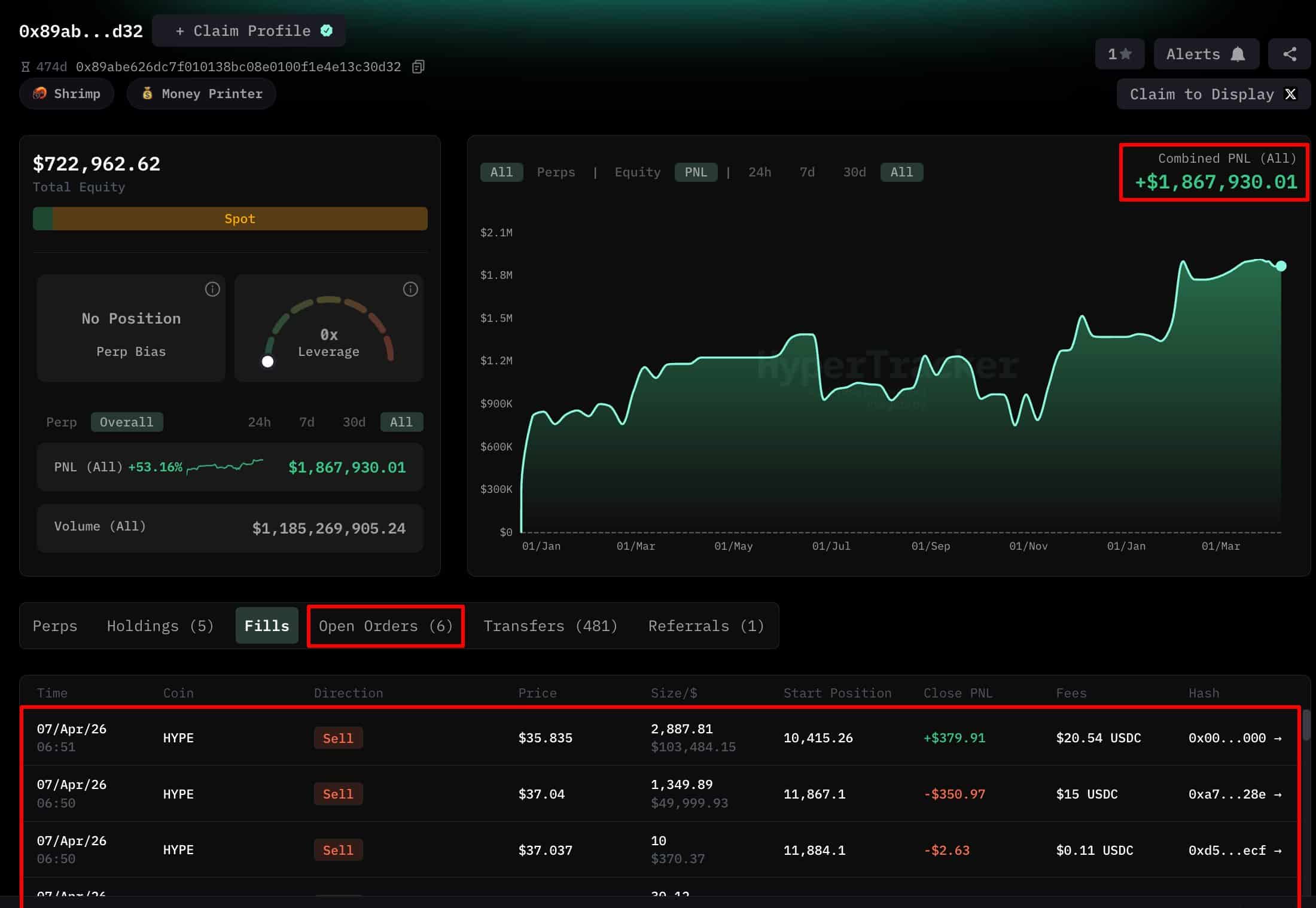
The whale dumped 12.2K HYPE worth $449.1K and placed another 10.4K HYPE sell order worth $386K. He also withdrew $1.26M in USDC, reducing exposure.

That move followed his exit from multi-million dollar HYPE longs after the 3rd of April. His $1.72M+ lifetime PnL suggested calculated positioning.

However, this created a divergence between the bullish narrative and capital flow. That shift raised concerns about distribution in strength.

Bullish flag holds as HYPE compresses

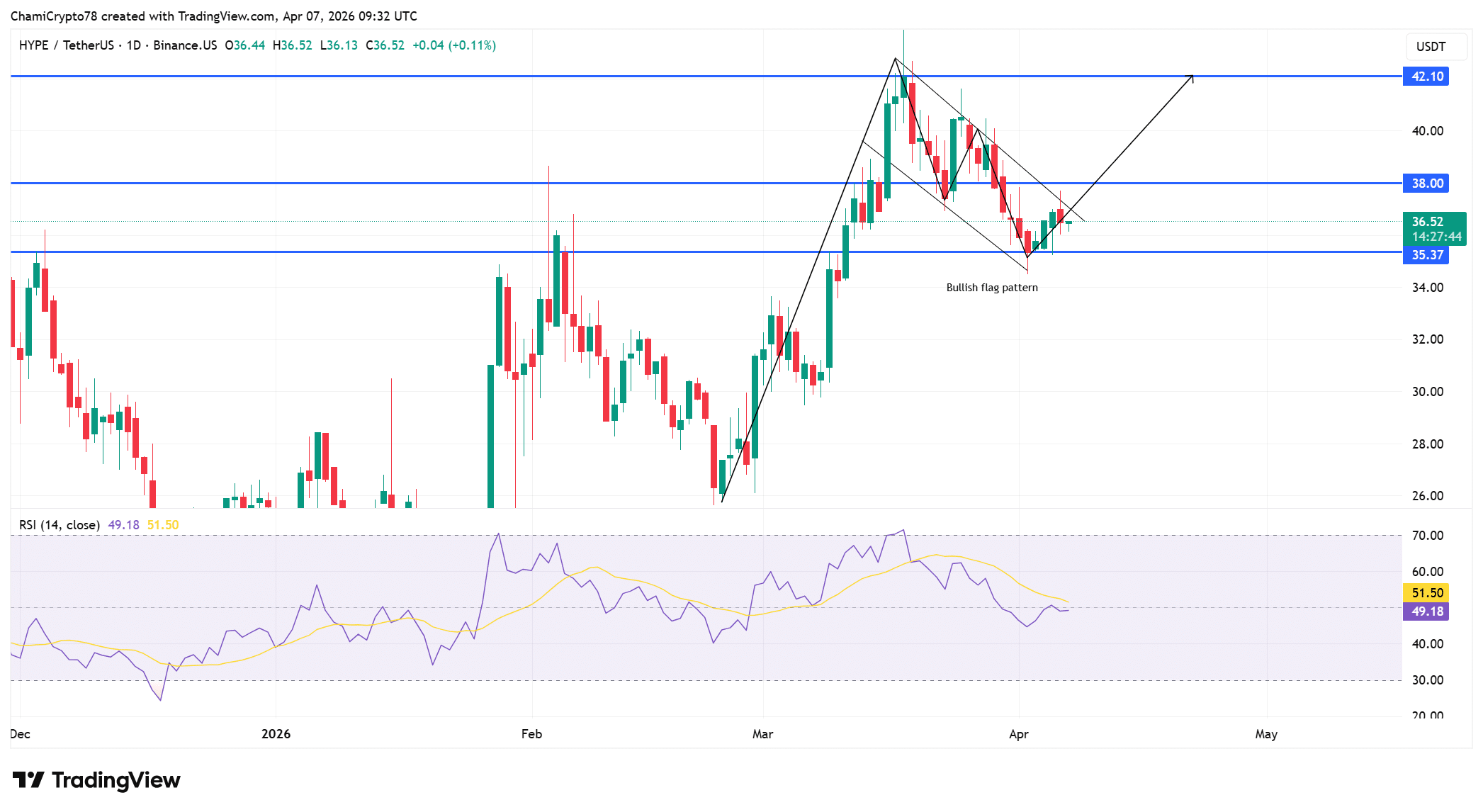
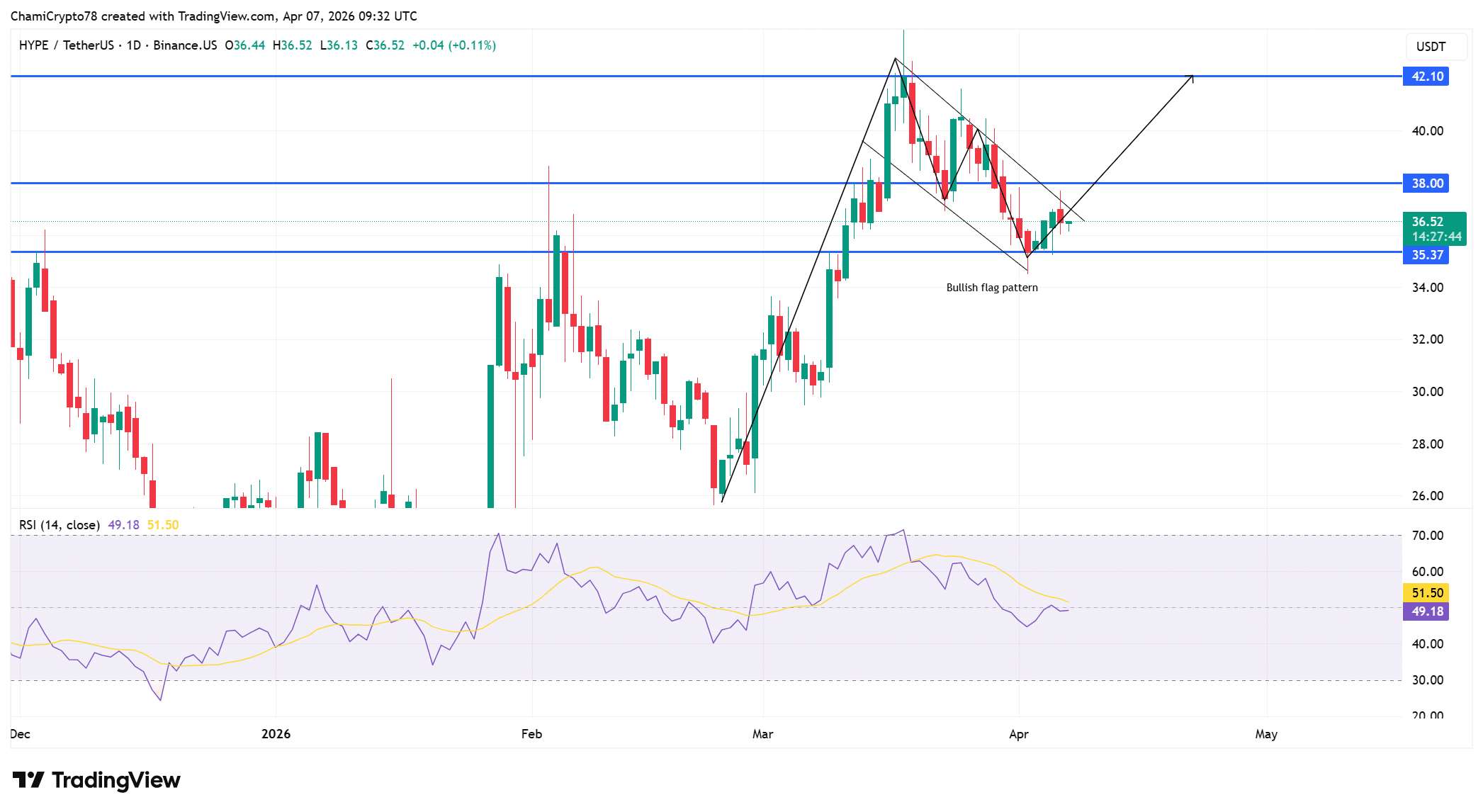
HYPE maintained a bullish flag after rallying toward $42.10. Price pulled back into a descending channel, forming the structure.

The asset traded between $35.37 support and $38 resistance, showing controlled consolidation. Each lower-bound retest attracted buyers, preserving structure.

However, Hyperliquid [HYPE] failed to reclaim $38 decisively, signaling hesitation near resistance. This left the market waiting for a breakout.

A move toward $42.10 remained likely if resistance broke.

RSI stabilized near 49.18, with its moving average near 51.50. The indicator cooled after nearing overbought levels around 70.

Lower highs on RSI suggested weakening buying pressure.
Source: TradingView

HYPE short liquidations dominate recent activity

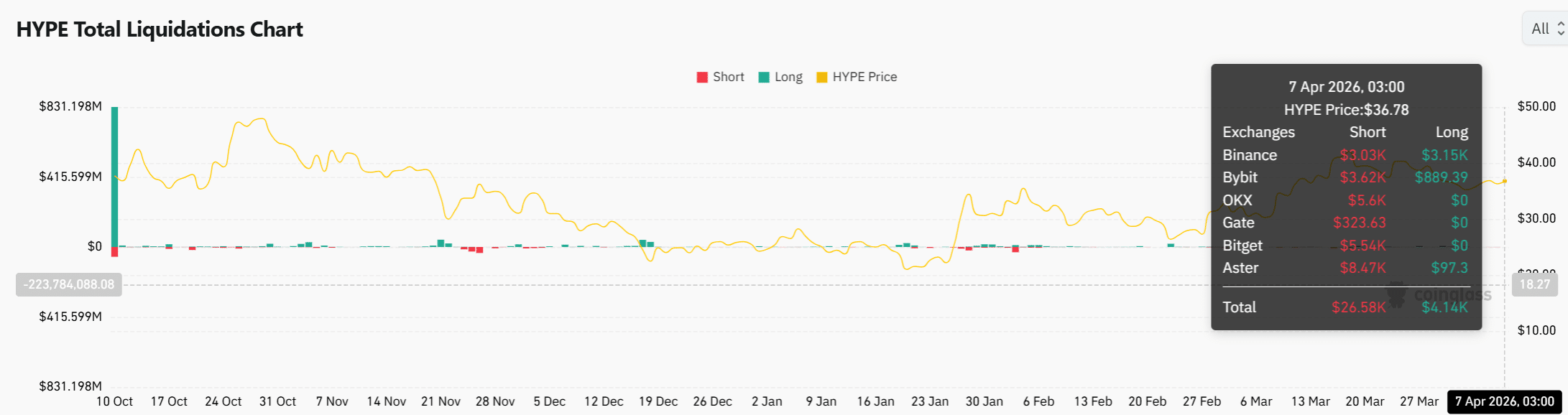
The Liquidation chart had shown that short liquidations had outweighed long liquidations, reinforcing upward pressure in the market.

Recent figures had recorded $26.58K in short liquidations compared to $4.14K in long liquidations.

This imbalance had indicated that bearish positions had been forced out as the price held above key levels.

As a result, the market had experienced localized short squeezes, which had supported price stability within the flag.

However, the absence of large liquidation spikes had suggested controlled volatility rather than aggressive expansion.

Liquidity had continued to build around the $35.37 support and $38 resistance zones, leaving the market positioned for a decisive move.
Source: CoinGlass

Funding stays positive but weakens

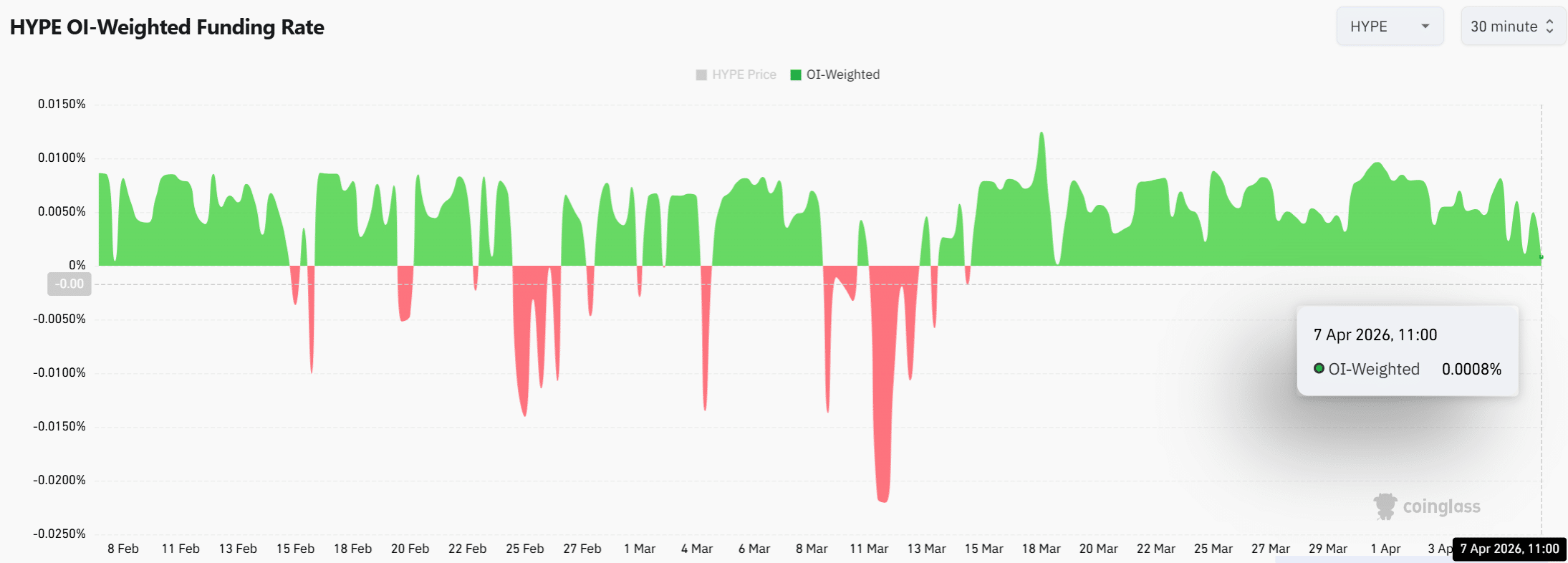
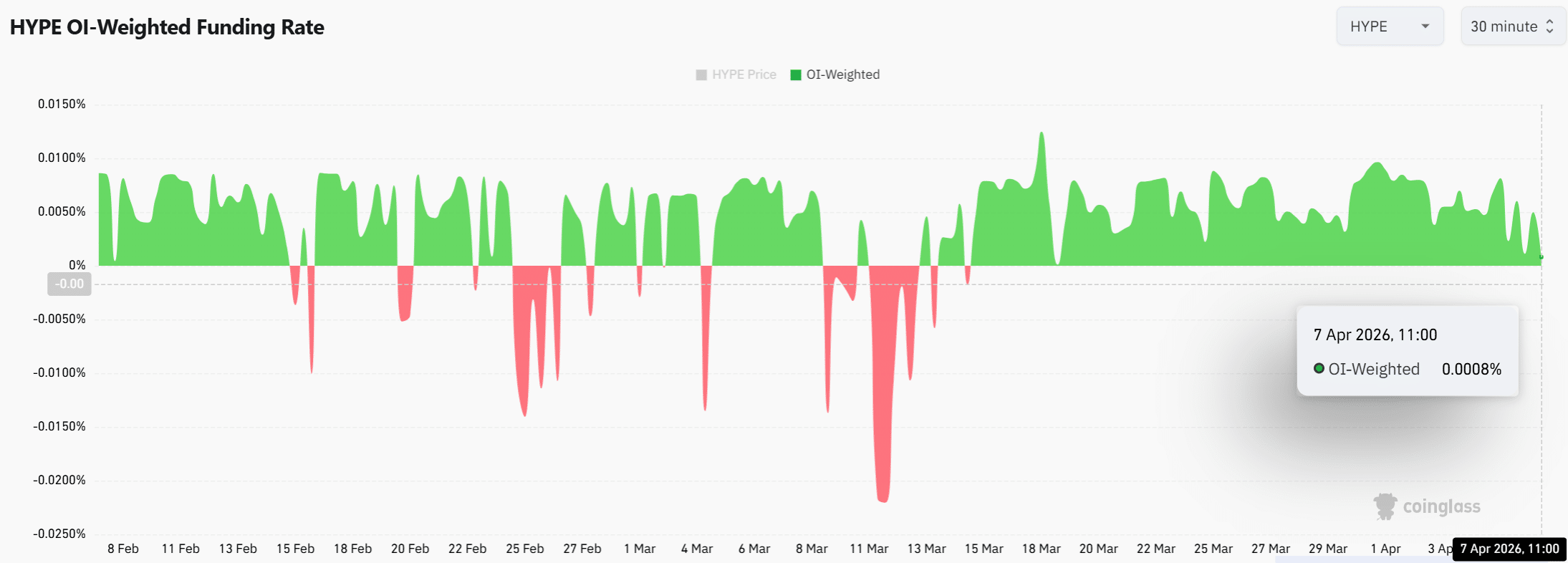
The OI-Weighted Funding Rate remained positive at 0.0008% on the 7th of April, confirming long dominance.

However, Funding Rates trended downward, signaling weakening conviction among longs.

Traders showed less willingness to pay premiums, reflecting caution near resistance.

That decline contrasted with a bullish price structure and short liquidations. It also aligned with whale-selling activity.

This suggested confidence had not fully backed further upside.
Source: CoinGlass

Can HYPE sustain a breakout?

HYPE had retained a bullish structure, supported by short liquidations and stable price action. However, declining funding rates and whale distribution had introduced clear hesitation.

The setup had remained constructive, yet conviction had weakened near resistance.

A breakout had remained possible, though underlying signals had suggested that upside strength might face immediate pressure.


Final Summary

  • HYPE held a bullish flag between $35.37 support and $38 resistance, showing controlled consolidation rather than a breakdown.
  • Repeated rejection near $38 indicated hesitation, with buyers unable to confirm a breakout yet.

Preguntas relacionadas

QWhat was the impact of Telegram's Lighter integration on Hyperliquid (HYPE)?

ATelegram's Lighter integration drew significant attention to Hyperliquid (HYPE), creating a bullish narrative for the asset.

QWhat significant trading activity did a large whale perform that contradicted the bullish sentiment?

AA large whale dumped 12.2K HYPE worth $449.1K, placed a 10.4K HYPE sell order worth $386K, and withdrew $1.26M in USDC, reducing their exposure and moving in the opposite direction of the bullish trend.

QWhat is the key price range HYPE was trading within, and what does it signify?

AHYPE was trading between the $35.37 support level and the $38 resistance level, which signifies a period of controlled consolidation within a bullish flag pattern.

QWhat did the liquidation data reveal about market pressure for HYPE?

AThe liquidation data showed that short liquidations ($26.58K) significantly outweighed long liquidations ($4.14K), indicating upward pressure as bearish positions were being forced out, supporting price stability.

QWhat was the trend of the Funding Rate, and what does it suggest about trader sentiment?

AThe OI-Weighted Funding Rate remained positive but was trending downward, signaling that while long positions were still dominant, conviction among longs was weakening and traders were showing caution near the resistance level.

Lecturas Relacionadas

Why Do You Always Lose Money on Polymarket? Because You're Betting on News, While the Pros Read the Rules

Why do you always lose money on Polymarket? Because you bet on news, while the pros study the rules. This article explains how top traders ("che tou") profit by meticulously analyzing market rules, not just predicting events. Polymarket, a prediction market platform, often sees disputes over event outcomes due to ambiguous rule wording. For instance, a market asking "Who will be the leader of Venezuela by the end of 2026?" was misinterpreted by many who bet on Delcy Rodríguez, assuming she held power. However, the rules specified "officially holds" as the formally appointed, sworn-in individual. Since Nicolás Maduro was still recognized as president officially, he won the market—even being in prison. To resolve such disputes, Polymarket uses a decentralized arbitration system via UMA protocol. The process involves: 1. Proposal: Anyone can propose a market outcome by staking 750 USDC, earning 5 USDC if unchallenged. 2. Dispute: A 2-hour window allows challenges with a 750 USDC stake; successful challengers earn 250 USDC. 3. Discussion: A 48-hour period on UMA Discord for evidence and debate. 4. Voting: UMA token holders vote in two 24-hour phases (blind then public). Outcomes require >65% consensus and 5M tokens voted; otherwise, four re-votes occur before Polymarket intervention. 5. Settlement: Results are final and automatic. Unlike traditional courts, Polymarket’s system lacks separation between arbitrators and stakeholders—voters often hold market positions, creating conflicts of interest. This leads to herd mentality in discussions and non-transparent outcomes without explanatory rulings, preventing precedent formation. Thus, success on Polymarket hinges on deep rule interpretation, not just event prediction, exploiting gaps between reality and contractual wording.

marsbitHace 2 hora(s)

Why Do You Always Lose Money on Polymarket? Because You're Betting on News, While the Pros Read the Rules

marsbitHace 2 hora(s)

DeepSeek Funding: Liang Wenfeng's 'Realist' Pivot

DeepSeek, a leading Chinese AI company, has initiated its first external funding round, aiming to raise at least $300 million at a valuation of no less than $10 billion. This move marks a significant shift from its founder Liang Wenfeng’s previous idealistic stance of rejecting external capital to maintain independence. Despite strong financial backing from its parent company, quantitative trading firm幻方量化 (Huanfang Quant), which provided an estimated $700 million in revenue in 2025 alone, DeepSeek faces mounting challenges. Key issues include a 15-month gap in major model updates, delays in its flagship V4 release, and the loss of several core researchers to competitors offering significantly higher compensation. The company is also undergoing a strategic pivot by migrating its infrastructure from NVIDIA’s CUDA to Huawei’s Ascend platform, a move aligned with China’s push for technological self-reliance amid U.S. export controls. However, DeepSeek lags behind rivals like智谱AI and MiniMax—both now publicly listed—in areas such as product ecosystem, multimodal capabilities, and commercialization. The funding round, though relatively small in scale, is seen as a way to establish a market-validated valuation anchor, making employee stock options more competitive and facilitating talent retention. It also signals DeepSeek’s transition from a pure research-oriented organization to a commercially-driven player in the global AI ecosystem.

marsbitHace 2 hora(s)

DeepSeek Funding: Liang Wenfeng's 'Realist' Pivot

marsbitHace 2 hora(s)

Trading

Spot
Futuros

Artículos destacados

Cómo comprar TON

¡Bienvenido a HTX.com! Hemos hecho que comprar The Open Network (TON) sea simple y conveniente. Sigue nuestra guía paso a paso para iniciar tu viaje de criptos.Paso 1: crea tu cuenta HTXUtiliza tu correo electrónico o número de teléfono para registrarte y obtener una cuenta gratuita en HTX. Experimenta un proceso de registro sin complicaciones y desbloquea todas las funciones.Obtener mi cuentaPaso 2: ve a Comprar cripto y elige tu método de pagoTarjeta de crédito/débito: usa tu Visa o Mastercard para comprar The Open Network (TON) al instante.Saldo: utiliza fondos del saldo de tu cuenta HTX para tradear sin problemas.Terceros: hemos agregado métodos de pago populares como Google Pay y Apple Pay para mejorar la comodidad.P2P: tradear directamente con otros usuarios en HTX.Over-the-Counter (OTC): ofrecemos servicios personalizados y tipos de cambio competitivos para los traders.Paso 3: guarda tu The Open Network (TON)Después de comprar tu The Open Network (TON), guárdalo en tu cuenta HTX. Alternativamente, puedes enviarlo a otro lugar mediante transferencia blockchain o utilizarlo para tradear otras criptomonedas.Paso 4: tradear The Open Network (TON)Tradear fácilmente con The Open Network (TON) en HTX's mercado spot. Simplemente accede a tu cuenta, selecciona tu par de trading, ejecuta tus trades y monitorea en tiempo real. Ofrecemos una experiencia fácil de usar tanto para principiantes como para traders experimentados.

422 Vistas totalesPublicado en 2024.12.10Actualizado en 2025.03.21

Cómo comprar TON

Discusiones

Bienvenido a la comunidad de HTX. Aquí puedes mantenerte informado sobre los últimos desarrollos de la plataforma y acceder a análisis profesionales del mercado. A continuación se presentan las opiniones de los usuarios sobre el precio de TON (TON).

活动图片