Telegram's 'Crypto Accounting': Surging Revenue Behind Net Losses and the $450 Million Token Sale Controversy

marsbitPublicado a 2026-01-10Actualizado a 2026-01-10

Resumen

Telegram's recent unaudited financials reveal a paradox: while its H1 2025 revenue surged 65% year-over-year to $870 million, it reported a net loss of $222 million. This was primarily due to a sharp devaluation of its TON token holdings, which fell over 73% during the crypto market downturn. Revenue growth was driven by an 88% increase in premium subscriptions ($223 million), a 5% rise in ads ($125 million), and nearly $300 million from its exclusive partnership with the TON blockchain. However, the company’s significant crypto assets led to major accounting losses. Telegram also sold over $450 million worth of TON tokens, sparking community concerns about potential "dumping." Officials clarified that these sales—mainly to long-term investors like TONStrategy (TONX)—came with four-year vesting periods to avoid immediate sell pressure. Founder Pavel Durov emphasized that the move aimed to decentralize TON ownership and fund development, not just cash out. As Telegram eyes a potential IPO by 2026–2027, its deep ties to TON present both a growth engine and a volatility risk. The company recently raised $1.7 billion in convertible notes from investors like BlackRock, but its IPO plans face regulatory and legal hurdles, including ongoing investigations involving Durov in France.

Author: Zen, PANews

Telegram has recently been in the spotlight again due to financial information circulating among investors: revenue is rising, but net profit is turning downward. The key variable here is not a slowdown in user growth, but the decline in TON's price, which has transmitted volatility from the asset side into the income statement.

The sale of over $450 million worth of TON tokens has led the outside world to re-examine its interest relationship and boundaries with the TON ecosystem.

Due to Low TON Prices, Telegram Sees Surging Revenue but Still Reports Net Loss

According to an FT report, in the first half of 2025, Telegram achieved a significant leap in revenue. Unaudited financial reports show that the company's revenue reached $870 million in the first half of the year, a year-on-year increase of 65%, significantly exceeding the $525 million in the first half of 2024; it achieved nearly $400 million in operating profit.

In terms of revenue structure, Telegram's advertising revenue grew by 5% to $125 million; premium subscription revenue surged by 88% to $223 million, nearly double the same period last year. Compared to these two items, the key factor in Telegram's revenue growth mainly comes from the exclusive agreement signed with the TON blockchain—TON became the exclusive blockchain infrastructure for Telegram's mini-app ecosystem and brought Telegram nearly $300 million in related revenue.
Therefore, overall, Telegram continued its strong growth momentum from the mini-game boom ignited in 2024 in the first half of last year—in 2024, Telegram achieved its first annual profit, with profits as high as $540 million, and annual revenue reached $1.4 billion, far exceeding the $343 million in 2023.

Of the $1.4 billion revenue in 2024, about half came from its so-called "partnerships and ecosystem," roughly $250 million from advertising, and $292 million from its premium subscription service. Clearly, Telegram's growth is partly due to the surge in the number of paying users, but even more so due to the收益 brought by its cryptocurrency-related collaborations.

However, the high volatility of cryptocurrencies has also brought risks to Telegram. Even though it achieved nearly $400 million in operating profit in the first half of 2025, Telegram still reported a net loss of $222 million. Informed sources stated that this was because the company had to revalue its held Ton token assets. Due to the持续低迷 of altcoins in 2025, the price of Ton tokens持续下跌 throughout 2025, falling by over 73% at its lowest point.

Selling $450 Million: Cashing Out or Upholding Decentralization理念

Accustomed to the long-term低迷 of altcoin prices and the floating losses of many DAT-listed companies, retail investors were not too surprised by Telegram's losses due to the depreciation of virtual assets. What surprised and displeased the community more was the FT report stating that Telegram had sold off a large amount, with its TON token sales exceeding $450 million. This figure exceeds 10% of the token's current circulating market value.

Thus, the持续走低 of TON's price, combined with Telegram's disposal of its huge token holdings, has sparked质疑 and controversy among some TON community members and investors regarding its "selling tokens to cash out" and背刺 Ton investors.

According to the public explanation by Manuel Stotz, Chairman of the Board of TON treasury company TONStrategy (Nasdaq: TONX), all TON tokens sold by Telegram are subject to a four-year vesting period. This means these tokens cannot be circulated on the secondary market in the short term and will not cause immediate selling pressure.

Furthermore, Stotz stated that the main buyers Telegram connected with were long-term investment entities like the TONX company led by Stotz himself. Their purchase of these tokens is for long-term holding and staking. TONX, led by Stotz, as a US-listed专项 investment company for the TON ecosystem, primarily acquired Telegram's筹码 for long-term strategic purposes, not for speculative flipping.

Stotz also emphasized that Telegram's net holdings of Ton tokens did not decrease significantly after the transaction and may have even increased. This is because Telegram exchanged part of its existing holdings for vested token distributions and can持续获得 new TON income from业务 like advertising revenue sharing.综合计算, its holdings remain high.

Telegram's long-term business model of acquiring TON tokens had previously raised concerns among some community members—the company holding too high a proportion of tokens is not conducive to TON's decentralization. Telegram founder Pavel Durov took this concern very seriously and stated as early as 2024 that the team would control Telegram's TON holdings to no more than 10%. If holdings exceed this standard, the excess will be sold to long-term investors to achieve wider token distribution, while also raising development funds for Telegram.
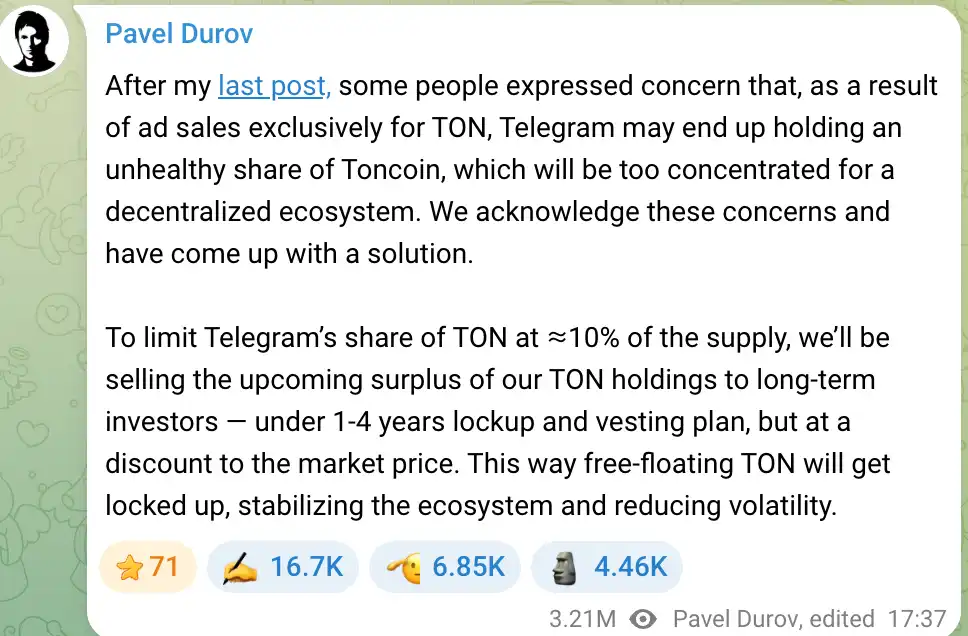
Durov emphasized that these sales would be conducted at a slight discount to the market price and would be subject to lock-up and vesting periods to avoid short-term selling pressure and ensure the stability of the TON ecosystem. This plan aims to prevent TON from being concentrated in Telegram's hands, which could raise concerns about price manipulation, and to维护 the project's decentralization宗旨. Therefore, Telegram's token selling行为 is more like a part of asset structure adjustment and liquidity management, rather than simply cashing out at high prices for arbitrage.

It is worth noting that while the持续走低 of TON's price in 2025 certainly brought impairment pressure on Telegram's financial reports, in the long run, Telegram's deep binding with TON has also created a situation of shared prosperity and loss.

Telegram has gained new revenue sources and product highlights through deep participation in the TON ecosystem, but it must also bear the financial impact of crypto market volatility. This "double-edged sword" effect is also a factor that investors must consider when evaluating its value as Telegram contemplates an IPO.

Telegram's IPO Prospects

With improving financial performance and business diversification, Telegram's上市前景 has become a focus of market attention. The company has raised over $1 billion since 2021 through multiple rounds of bond issuance; in 2025, it issued another $1.7 billion in convertible bonds, attracting participation from internationally renowned institutions like BlackRock and Abu Dhabi's Mubadala.

These financing measures not only provide Telegram with capital but are also seen as preparations for an IPO. However, Telegram's path to listing is not smooth; its debt arrangements, regulatory environment, and founder factors will all influence the IPO process.

Telegram currently has two main bonds outstanding: one is a bond with a coupon of 7% maturing in March 2026, and the other is a convertible bond with a coupon of 9% maturing in 2030. In the second $1.7 billion bond, approximately $955 million was used to replace old bonds, and $745 million was new capital for the company.

The special feature of the convertible bond is that it has an IPO conversion clause: if the company goes public before 2030, investors can redeem/convert the bonds at approximately 80% of the IPO price, equivalent to a 20% discount. In other words, these investors are betting that Telegram can successfully IPO and achieve a considerable valuation premium.

Currently, through the 2025 debt restructuring, Telegram has提前 redeemed or repaid the vast majority of the bonds maturing in 2026. Durov publicly stated that the old debt from 2021 has been largely settled and does not constitute a current risk. Addressing the impact of the frozen $500 million Russian bonds on Telegram, he responded that Telegram does not rely on Russian capital, and there were no Russian investors in the recently issued $1.7 billion bond.

Therefore, Telegram's main debt now is the convertible bond maturing in 2030, leaving a relatively宽裕的上市窗口. However, many investors still expect Telegram to seek an上市 around 2026-2027,实现债转股 and open up new financing channels. If this window is missed, the company may face long-term debt interest pressure in the future and may lose a good opportunity to transition to equity financing.

When investors measure Telegram's上市价值, they also focus on its profit prospects and抽成模式. Telegram currently has about 1 billion monthly active users and an estimated 450 million daily active users. This huge user base gives it commercial imagination space. Although its growth has been迅猛 in recent years, Telegram still needs to prove that its business model can achieve sustainable profitability.

The good news is that Telegram currently has absolute control over its own ecosystem. Durov recently emphasized that he remains the company's sole shareholder, and creditors are not involved in corporate governance.

Therefore, Telegram has the potential to sacrifice some short-term profits for long-term user stickiness and ecological prosperity without being constrained by short-sighted shareholders. This "delayed gratification" strategy is in line with Durov's consistent product philosophy and will also be the core of the growth story told to investors during the IPO path.

However, it must be emphasized that an IPO does not depend solely on financial and debt structure. FT pointed out that Telegram's potential上市计划 is currently still affected by judicial proceedings in France against Durov, and the related uncertainty makes it difficult to clarify the上市时间表. Telegram has also acknowledged in its communication with investors that this investigation may pose an obstacle.

Recommended Reading:

RootData 2025 Web3 Industry Annual Report

Xiao Hong: From Small-Town Youth to Manus CEO, The Long-Termism of a Bitcoin Believer

Binance's Power Shift: The Dilemma of a 300 Million User Empire

Has the Project Buyback红利 Really Come to an End?

Criptos en tendencia

Preguntas relacionadas

QWhy did Telegram report a net loss of $222 million in the first half of 2025 despite strong revenue growth?

ATelegram reported a net loss primarily because it had to revalue its holdings of TON tokens due to a significant price decline. The value of TON tokens fell by over 73% at their lowest point in 2025, leading to substantial impairment losses on its financial statements.

QHow much TON tokens did Telegram sell, and what was the purpose behind this sale?

ATelegram sold over $450 million worth of TON tokens. The sales were part of a strategy to prevent over-concentration of tokens, adhering to founder Pavel Durov's commitment to keep Telegram's holdings below 10% of the total supply to maintain decentralization. The tokens were sold at a discount with a four-year vesting period to long-term investors to avoid immediate market pressure.

QWhat are the main revenue sources for Telegram as highlighted in the article?

ATelegram's main revenue sources include advertising, premium subscriptions, and partnerships with the TON blockchain. In the first half of 2025, advertising contributed $125 million, premium subscriptions brought in $223 million, and the TON partnership generated nearly $300 million.

QWhat is the significance of Telegram's convertible bonds and their IPO conversion terms?

ATelegram issued $1.7 billion in convertible bonds with a 9% coupon maturing in 2030. These bonds include an IPO conversion clause that allows investors to redeem or convert their bonds at approximately 80% of the IPO price if Telegram goes public before 2030, effectively giving them a 20% discount. This structure incentivizes investors to support Telegram's IPO plans.

QWhat potential obstacles does Telegram face regarding its planned public listing?

ATelegram's IPO plans face obstacles primarily from ongoing legal proceedings in France involving founder Pavel Durov. The company has acknowledged that this investigation could pose a significant challenge to its上市 timeline, adding uncertainty to its public listing efforts.

Lecturas Relacionadas

DRAM ETF Issuer: Samsung, SK Hynix, Micron All Surpass $1 Trillion, the AI Era of Memory Chips Has Only Just Begun

Authors: Dave Mazza, Thomas DiFazio | Source: Deep Tide TechFlow The article, written by Roundhill Investments (issuer of the DRAM ETF), responds to Morningstar's caution about investing in memory chip stocks. Morningstar warns of the sector's history of boom-bust cycles, a lack of economic moats, and potential momentum-driven overvaluation. Roundhill argues the current situation is structurally different due to AI. Key points in Roundhill's rebuttal include: * **Changed Demand & Supply Dynamics:** AI infrastructure, not consumer electronics, is now the primary growth driver for memory demand. New, strict long-term supply agreements with hyperscalers reflect the high capital intensity of advanced manufacturing. * **Existence of a Moat:** High-Bandwidth Memory (HBM), essential for AI, has extremely high manufacturing barriers. The market is dominated by Samsung, SK Hynix, and Micron, with new entrants blocked by technological complexity and long lead times for equipment like ASML's EUV machines. * **Strong Fundamental Outlook:** Analyst consensus projects the three companies will rank among the world's most profitable by 2027, with combined profits of $704 billion on over $1 trillion in revenue. Their operating margins have already reached record highs. * **Valuation Re-rating:** Despite significant stock price gains, memory stocks trade at attractive valuations (e.g., a median NTM P/E of 8.37x for the DRAM ETF) relative to projected explosive EPS growth. Roundhill suggests historical valuation frameworks may no longer apply given the new profitability paradigm. Conclusion: Roundhill contends the rally is justified by fundamentals, marking a structural shift for the memory industry into a new era of sustained, AI-driven demand against constrained supply, rather than a repeat of past cycles.

marsbitHace 13 min(s)

DRAM ETF Issuer: Samsung, SK Hynix, Micron All Surpass $1 Trillion, the AI Era of Memory Chips Has Only Just Begun

marsbitHace 13 min(s)

EF's Epic Reorganization: 20% Layoffs, Budget Halved, Is Ethereum Gearing Up for a Leaner Future?

The Ethereum Foundation (EF) has announced a major organizational restructuring, involving a 20% staff reduction (approx. 54 employees) and a division into functional clusters like Protocol, Access, User, Community, and Institutional layers. Co-founder Vitalik Buterin further revealed plans to cut the EF's budget by around 40% over the coming years, aiming to reduce its annual spending rate from about 15% to roughly 5% by 2030, transitioning to an endowment-driven model. This overhaul is seen as a long-overdue correction to the EF's ambiguous role. As Ethereum grew, the foundation faced persistent criticism over ETH sales, perceived lack of execution, and unclear strategy, often becoming a focal point for community frustration amid ETH's price stagnation. The reform aims to redefine the EF's boundaries, narrowing its focus to core protocol research, public goods funding, and ecosystem coordination, while offloading more applied development work to the broader market. Concurrently, ecosystem forces like the newly formed Ethlabs (founded by ex-EF researchers) and other independent groups are stepping in to fill the space, signaling a shift from a centralized model to a more distributed, collaborative ecosystem structure. The move was notably praised by Solana co-founder toly, who viewed a "leaner" EF as potentially more decisive and agile.

Odaily星球日报Hace 54 min(s)

EF's Epic Reorganization: 20% Layoffs, Budget Halved, Is Ethereum Gearing Up for a Leaner Future?

Odaily星球日报Hace 54 min(s)

Dragonfly Partner Haseeb: The Fastest-Growing Companies of the Future May All Get Stuck at 149 Employees

Dragonfly partner Haseeb explores the distorted economics of AI model pricing, drawing parallels to tax policy. He notes that startups and small teams (under 150 users) enjoy heavily subsidized, fixed-price AI subscriptions (like Claude Code), where the marginal cost of an additional token is effectively zero. This creates a powerful incentive for them to maximize token usage ("token-maxxing") and innovate aggressively with AI automation. In contrast, large enterprises (over 150 users) are forced onto "Enterprise" plans, paying per-token API fees with high (~75%) markups. This acts like a steep "tax" on AI-powered labor, disincentivizing marginal automation and experimental use, and encouraging them to retain more human workers. Haseeb argues this pricing creates a "150-person cliff," a regulatory notch similar to labor laws in France that discourage firms from growing past 50 employees. He predicts the fastest-growing future companies may deliberately cap their headcount at 149 to avoid the punitive enterprise pricing. This would foster an "AI-first" management philosophy obsessed with automation and outsourcing to stay lean. While not intentionally designed, this bifurcated pricing could become one of the most influential de facto tax policies, shaping how AI replaces labor—not through mass layoffs at big firms, but through agile, AI-native startups outcompeting them.

marsbitHace 1 hora(s)

Dragonfly Partner Haseeb: The Fastest-Growing Companies of the Future May All Get Stuck at 149 Employees

marsbitHace 1 hora(s)

How xBubble Breaks Through in the VC-Heavily-Backed OPC Economy

xBubble: Addressing the Structural Gap in the VC-Backed OPC Economy The concept of OPC (One Person Company) is evolving from a buzzword to a significant AI-driven market. While AI coding tools like Replit and Lovable have validated demand from non-technical users wanting to build applications, a key gap remains: the leap from creating a demo to running a stable, evolving business. These tools still require users to manage the development process, including technical judgments for integrations, modifications, and deployments—a major hurdle for OPCs. xBubble, by DAPPOS, tackles this by shifting from "Prompt-to-Code" to "SOP-to-Business." Instead of generating code from instructions, its core is a system of pre-organized SOPs (Standard Operating Procedures) that translate business goals—like "sell World Cup merchandise"—into complete, executable workflows. This includes generating cohesive assets, pages, payment systems, and backend logic. The platform is augmented by a network of third-party service providers who handle infrastructure (hosting, domains, payment setup), acting like "on-site service engineers." Users can pay for these services directly with xBubble credits, simplifying onboarding. This ecosystem aims to deliver not just an app, but a complete, modifiable business launch path. xBubble targets a clear OPC segment: small commercial nodes (e.g., creators, merchants) with existing products, customers, or channels, but for whom a full tech team is unjustifiable. Its potential lies in SOPs accumulating expertise from real cases, improving reliability and reducing delivery costs over time. Additionally, its native support for crypto payments caters to global or digital-native OPCs. In summary, as AI democratizes software creation, xBubble's opportunity is to prove that "SOP-to-Business" provides more immediate value for launching a real, operational business than a powerful but unstructured AI coding tool.

链捕手Hace 1 hora(s)

How xBubble Breaks Through in the VC-Heavily-Backed OPC Economy

链捕手Hace 1 hora(s)

Trading

Spot
Futuros

Artículos destacados

Qué es $S$

Entendiendo SPERO: Una Visión General Completa Introducción a SPERO A medida que el panorama de la innovación continúa evolucionando, la aparición de tecnologías web3 y proyectos de criptomonedas juega un papel fundamental en la configuración del futuro digital. Un proyecto que ha atraído la atención en este campo dinámico es SPERO, denotado como SPERO,$$s$. Este artículo tiene como objetivo reunir y presentar información detallada sobre SPERO, para ayudar a entusiastas e inversores a comprender sus fundamentos, objetivos e innovaciones dentro de los dominios web3 y cripto. ¿Qué es SPERO,$$s$? SPERO,$$s$ es un proyecto único dentro del espacio cripto que busca aprovechar los principios de descentralización y tecnología blockchain para crear un ecosistema que promueva la participación, la utilidad y la inclusión financiera. El proyecto está diseñado para facilitar interacciones de igual a igual de nuevas maneras, proporcionando a los usuarios soluciones y servicios financieros innovadores. En su esencia, SPERO,$$s$ tiene como objetivo empoderar a los individuos al proporcionar herramientas y plataformas que mejoren la experiencia del usuario en el espacio de las criptomonedas. Esto incluye habilitar métodos de transacción más flexibles, fomentar iniciativas impulsadas por la comunidad y crear caminos para oportunidades financieras a través de aplicaciones descentralizadas (dApps). La visión subyacente de SPERO,$$s$ gira en torno a la inclusividad, buscando cerrar brechas dentro de las finanzas tradicionales mientras aprovecha los beneficios de la tecnología blockchain. ¿Quién es el Creador de SPERO,$$s$? La identidad del creador de SPERO,$$s$ sigue siendo algo oscura, ya que hay recursos públicos limitados que proporcionan información de fondo detallada sobre su(s) fundador(es). Esta falta de transparencia puede derivarse del compromiso del proyecto con la descentralización, una ética que muchos proyectos web3 comparten, priorizando las contribuciones colectivas sobre el reconocimiento individual. Al centrar las discusiones en torno a la comunidad y sus objetivos colectivos, SPERO,$$s$ encarna la esencia del empoderamiento sin señalar a individuos específicos. Como tal, comprender la ética y la misión de SPERO sigue siendo más importante que identificar a un creador singular. ¿Quiénes son los Inversores de SPERO,$$s$? SPERO,$$s$ cuenta con el apoyo de una diversa gama de inversores que van desde capitalistas de riesgo hasta inversores ángeles dedicados a fomentar la innovación en el sector cripto. El enfoque de estos inversores generalmente se alinea con la misión de SPERO, priorizando proyectos que prometen avances tecnológicos sociales, inclusión financiera y gobernanza descentralizada. Estas fundaciones de inversores suelen estar interesadas en proyectos que no solo ofrecen productos innovadores, sino que también contribuyen positivamente a la comunidad blockchain y sus ecosistemas. El respaldo de estos inversores refuerza a SPERO,$$s$ como un contendiente notable en el dominio de proyectos cripto que evoluciona rápidamente. ¿Cómo Funciona SPERO,$$s$? SPERO,$$s$ emplea un marco multifacético que lo distingue de los proyectos de criptomonedas convencionales. Aquí hay algunas de las características clave que subrayan su singularidad e innovación: Gobernanza Descentralizada: SPERO,$$s$ integra modelos de gobernanza descentralizada, empoderando a los usuarios para participar activamente en los procesos de toma de decisiones sobre el futuro del proyecto. Este enfoque fomenta un sentido de propiedad y responsabilidad entre los miembros de la comunidad. Utilidad del Token: SPERO,$$s$ utiliza su propio token de criptomoneda, diseñado para servir diversas funciones dentro del ecosistema. Estos tokens permiten transacciones, recompensas y la facilitación de servicios ofrecidos en la plataforma, mejorando la participación y la utilidad general. Arquitectura en Capas: La arquitectura técnica de SPERO,$$s$ apoya la modularidad y escalabilidad, permitiendo la integración fluida de características y aplicaciones adicionales a medida que el proyecto evoluciona. Esta adaptabilidad es fundamental para mantener la relevancia en el cambiante paisaje cripto. Participación de la Comunidad: El proyecto enfatiza iniciativas impulsadas por la comunidad, empleando mecanismos que incentivan la colaboración y la retroalimentación. Al nutrir una comunidad sólida, SPERO,$$s$ puede abordar mejor las necesidades de los usuarios y adaptarse a las tendencias del mercado. Enfoque en la Inclusión: Al ofrecer tarifas de transacción bajas e interfaces amigables para el usuario, SPERO,$$s$ busca atraer a una base de usuarios diversa, incluyendo a individuos que anteriormente pueden no haber participado en el espacio cripto. Este compromiso con la inclusión se alinea con su misión general de empoderamiento a través de la accesibilidad. Cronología de SPERO,$$s$ Entender la historia de un proyecto proporciona información crucial sobre su trayectoria de desarrollo y hitos. A continuación se presenta una cronología sugerida que mapea eventos significativos en la evolución de SPERO,$$s$: Fase de Conceptualización e Ideación: Las ideas iniciales que forman la base de SPERO,$$s$ fueron concebidas, alineándose estrechamente con los principios de descentralización y enfoque comunitario dentro de la industria blockchain. Lanzamiento del Whitepaper del Proyecto: Tras la fase conceptual, se lanzó un whitepaper completo que detalla la visión, los objetivos y la infraestructura tecnológica de SPERO,$$s$ para generar interés y retroalimentación de la comunidad. Construcción de Comunidad y Primeras Interacciones: Se realizaron esfuerzos de divulgación activa para construir una comunidad de primeros adoptantes y posibles inversores, facilitando discusiones en torno a los objetivos del proyecto y obteniendo apoyo. Evento de Generación de Tokens: SPERO,$$s$ llevó a cabo un evento de generación de tokens (TGE) para distribuir sus tokens nativos a los primeros seguidores y establecer liquidez inicial dentro del ecosistema. Lanzamiento de la dApp Inicial: La primera aplicación descentralizada (dApp) asociada con SPERO,$$s$ se puso en marcha, permitiendo a los usuarios interactuar con las funcionalidades centrales de la plataforma. Desarrollo Continuo y Alianzas: Actualizaciones y mejoras continuas a las ofertas del proyecto, incluyendo alianzas estratégicas con otros actores en el espacio blockchain, han moldeado a SPERO,$$s$ en un jugador competitivo y en evolución en el mercado cripto. Conclusión SPERO,$$s$ se erige como un testimonio del potencial de web3 y las criptomonedas para revolucionar los sistemas financieros y empoderar a los individuos. Con un compromiso con la gobernanza descentralizada, la participación comunitaria y funcionalidades diseñadas de manera innovadora, allana el camino hacia un paisaje financiero más inclusivo. Como con cualquier inversión en el espacio cripto que evoluciona rápidamente, se anima a los posibles inversores y usuarios a investigar a fondo y participar de manera reflexiva con los desarrollos en curso dentro de SPERO,$$s$. El proyecto muestra el espíritu innovador de la industria cripto, invitando a una mayor exploración de sus innumerables posibilidades. Mientras el viaje de SPERO,$$s$ aún se desarrolla, sus principios fundamentales pueden, de hecho, influir en el futuro de cómo interactuamos con la tecnología, las finanzas y entre nosotros en ecosistemas digitales interconectados.

87 Vistas totalesPublicado en 2024.12.17Actualizado en 2024.12.17

Qué es $S$

Qué es AGENT S

Agent S: El Futuro de la Interacción Autónoma en Web3 Introducción En el paisaje en constante evolución de Web3 y las criptomonedas, las innovaciones están redefiniendo constantemente cómo los individuos interactúan con las plataformas digitales. Uno de estos proyectos pioneros, Agent S, promete revolucionar la interacción humano-computadora a través de su marco agente abierto. Al allanar el camino para interacciones autónomas, Agent S busca simplificar tareas complejas, ofreciendo aplicaciones transformadoras en inteligencia artificial (IA). Esta exploración detallada profundizará en las complejidades del proyecto, sus características únicas y las implicaciones para el dominio de las criptomonedas. ¿Qué es Agent S? Agent S se presenta como un marco agente abierto innovador, diseñado específicamente para abordar tres desafíos fundamentales en la automatización de tareas informáticas: Adquisición de Conocimiento Específico del Dominio: El marco aprende inteligentemente de diversas fuentes de conocimiento externas y experiencias internas. Este enfoque dual le permite construir un rico repositorio de conocimiento específico del dominio, mejorando su rendimiento en la ejecución de tareas. Planificación a Largo Plazo de Tareas: Agent S emplea planificación jerárquica aumentada por la experiencia, un enfoque estratégico que facilita la descomposición y ejecución eficiente de tareas complejas. Esta característica mejora significativamente su capacidad para gestionar múltiples subtareas de manera eficiente y efectiva. Manejo de Interfaces Dinámicas y No Uniformes: El proyecto introduce la Interfaz Agente-Computadora (ACI), una solución innovadora que mejora la interacción entre agentes y usuarios. Utilizando Modelos de Lenguaje Multimodal de Gran Escala (MLLMs), Agent S puede navegar y manipular diversas interfaces gráficas de usuario sin problemas. A través de estas características pioneras, Agent S proporciona un marco robusto que aborda las complejidades involucradas en la automatización de la interacción humana con las máquinas, preparando el terreno para una multitud de aplicaciones en IA y más allá. ¿Quién es el Creador de Agent S? Si bien el concepto de Agent S es fundamentalmente innovador, la información específica sobre su creador sigue siendo elusiva. El creador es actualmente desconocido, lo que resalta ya sea la etapa incipiente del proyecto o la elección estratégica de mantener a los miembros fundadores en el anonimato. Independientemente de la anonimidad, el enfoque sigue siendo en las capacidades y el potencial del marco. ¿Quiénes son los Inversores de Agent S? Dado que Agent S es relativamente nuevo en el ecosistema criptográfico, la información detallada sobre sus inversores y patrocinadores financieros no está documentada explícitamente. La falta de información disponible públicamente sobre las bases de inversión u organizaciones que apoyan el proyecto plantea preguntas sobre su estructura de financiamiento y hoja de ruta de desarrollo. Comprender el respaldo es crucial para evaluar la sostenibilidad del proyecto y su posible impacto en el mercado. ¿Cómo Funciona Agent S? En el núcleo de Agent S se encuentra una tecnología de vanguardia que le permite funcionar de manera efectiva en diversos entornos. Su modelo operativo se basa en varias características clave: Interacción Humano-Computadora Similar a la Humana: El marco ofrece planificación avanzada de IA, esforzándose por hacer que las interacciones con las computadoras sean más intuitivas. Al imitar el comportamiento humano en la ejecución de tareas, promete elevar las experiencias de los usuarios. Memoria Narrativa: Empleada para aprovechar experiencias de alto nivel, Agent S utiliza memoria narrativa para hacer un seguimiento de las historias de tareas, mejorando así sus procesos de toma de decisiones. Memoria Episódica: Esta característica proporciona a los usuarios una guía paso a paso, permitiendo que el marco ofrezca apoyo contextual a medida que se desarrollan las tareas. Soporte para OpenACI: Con la capacidad de ejecutarse localmente, Agent S permite a los usuarios mantener el control sobre sus interacciones y flujos de trabajo, alineándose con la ética descentralizada de Web3. Fácil Integración con APIs Externas: Su versatilidad y compatibilidad con varias plataformas de IA aseguran que Agent S pueda encajar sin problemas en ecosistemas tecnológicos existentes, convirtiéndolo en una opción atractiva para desarrolladores y organizaciones. Estas funcionalidades contribuyen colectivamente a la posición única de Agent S dentro del espacio cripto, ya que automatiza tareas complejas y de múltiples pasos con una intervención humana mínima. A medida que el proyecto evoluciona, sus posibles aplicaciones en Web3 podrían redefinir cómo se desarrollan las interacciones digitales. Cronología de Agent S El desarrollo y los hitos de Agent S pueden encapsularse en una cronología que resalta sus eventos significativos: 27 de septiembre de 2024: El concepto de Agent S fue lanzado en un documento de investigación integral titulado “Un Marco Agente Abierto que Usa Computadoras Como un Humano”, mostrando las bases del proyecto. 10 de octubre de 2024: El documento de investigación fue puesto a disposición del público en arXiv, ofreciendo una exploración profunda del marco y su evaluación de rendimiento basada en el benchmark OSWorld. 12 de octubre de 2024: Se lanzó una presentación en video, proporcionando una visión visual de las capacidades y características de Agent S, involucrando aún más a posibles usuarios e inversores. Estos marcadores en la cronología no solo ilustran el progreso de Agent S, sino que también indican su compromiso con la transparencia y la participación comunitaria. Puntos Clave Sobre Agent S A medida que el marco Agent S continúa evolucionando, varios atributos clave destacan, subrayando su naturaleza innovadora y potencial: Marco Innovador: Diseñado para proporcionar un uso intuitivo de las computadoras similar a la interacción humana, Agent S aporta un enfoque novedoso a la automatización de tareas. Interacción Autónoma: La capacidad de interactuar de manera autónoma con las computadoras a través de GUI significa un salto hacia soluciones informáticas más inteligentes y eficientes. Automatización de Tareas Complejas: Con su metodología robusta, puede automatizar tareas complejas y de múltiples pasos, haciendo que los procesos sean más rápidos y menos propensos a errores. Mejora Continua: Los mecanismos de aprendizaje permiten a Agent S mejorar a partir de experiencias pasadas, mejorando continuamente su rendimiento y eficacia. Versatilidad: Su adaptabilidad en diferentes entornos operativos como OSWorld y WindowsAgentArena asegura que pueda servir a una amplia gama de aplicaciones. A medida que Agent S se posiciona en el paisaje de Web3 y criptomonedas, su potencial para mejorar las capacidades de interacción y automatizar procesos significa un avance significativo en las tecnologías de IA. A través de su marco innovador, Agent S ejemplifica el futuro de las interacciones digitales, prometiendo una experiencia más fluida y eficiente para los usuarios en diversas industrias. Conclusión Agent S representa un audaz avance en la unión de la IA y Web3, con la capacidad de redefinir cómo interactuamos con la tecnología. Aunque aún se encuentra en sus primeras etapas, las posibilidades para su aplicación son vastas y atractivas. A través de su marco integral que aborda desafíos críticos, Agent S busca llevar las interacciones autónomas al primer plano de la experiencia digital. A medida que nos adentramos más en los reinos de las criptomonedas y la descentralización, proyectos como Agent S sin duda desempeñarán un papel crucial en la configuración del futuro de la tecnología y la colaboración humano-computadora.

497 Vistas totalesPublicado en 2025.01.14Actualizado en 2025.01.14

Qué es AGENT S

Cómo comprar S

¡Bienvenido a HTX.com! Hemos hecho que comprar Sonic (S) sea simple y conveniente. Sigue nuestra guía paso a paso para iniciar tu viaje de criptos.Paso 1: crea tu cuenta HTXUtiliza tu correo electrónico o número de teléfono para registrarte y obtener una cuenta gratuita en HTX. Experimenta un proceso de registro sin complicaciones y desbloquea todas las funciones.Obtener mi cuentaPaso 2: ve a Comprar cripto y elige tu método de pagoTarjeta de crédito/débito: usa tu Visa o Mastercard para comprar Sonic (S) al instante.Saldo: utiliza fondos del saldo de tu cuenta HTX para tradear sin problemas.Terceros: hemos agregado métodos de pago populares como Google Pay y Apple Pay para mejorar la comodidad.P2P: tradear directamente con otros usuarios en HTX.Over-the-Counter (OTC): ofrecemos servicios personalizados y tipos de cambio competitivos para los traders.Paso 3: guarda tu Sonic (S)Después de comprar tu Sonic (S), guárdalo en tu cuenta HTX. Alternativamente, puedes enviarlo a otro lugar mediante transferencia blockchain o utilizarlo para tradear otras criptomonedas.Paso 4: tradear Sonic (S)Tradear fácilmente con Sonic (S) en HTX's mercado spot. Simplemente accede a tu cuenta, selecciona tu par de trading, ejecuta tus trades y monitorea en tiempo real. Ofrecemos una experiencia fácil de usar tanto para principiantes como para traders experimentados.

1.0k Vistas totalesPublicado en 2025.01.15Actualizado en 2026.06.02

Cómo comprar S

Discusiones

Bienvenido a la comunidad de HTX. Aquí puedes mantenerte informado sobre los últimos desarrollos de la plataforma y acceder a análisis profesionales del mercado. A continuación se presentan las opiniones de los usuarios sobre el precio de S (S).

活动图片