# Upgrade Related Articles

HTX News Center provides the latest articles and in-depth analysis on "Upgrade", covering market trends, project updates, tech developments, and regulatory policies in the crypto industry.

New Huo Tech Livio: Ethereum Fusaka Upgrade Value Underestimated

New Huo Tech's Livio argues that the Ethereum Fusaka upgrade, completed on December 3, is significantly undervalued by the market. Occurring during a period of extreme pessimism and a major crypto market correction, the upgrade went largely unnoticed but represents a critical strategic improvement to Ethereum’s economic model and ecosystem performance. Fusaka systematically tackles two core bottlenecks: high costs and poor user experience. It achieves a "cost revolution" by dramatically reducing Layer-2 (L2) transaction fees—potentially as low as $0.001 per transaction—without overburdening the Layer-1 (L1) mainnet. This enables economically viable high-frequency applications like on-chain gaming, social dApps, AI agent settlements, and RWA (Real World Asset) trading. The upgrade also delivers a user experience leap by natively supporting Passkey authentication, allowing users to sign transactions using biometrics like fingerprints or FaceID instead of managing complex seed phrases. This shift makes using crypto wallets as seamless as conventional apps, lowering the barrier to entry for mainstream adoption. Most importantly, Fusaka fundamentally overhauls Ethereum’s tokenomics. It establishes a structured "taxation" system where L2s must pay fees to the L1 for security and data capacity. These fees are burned, creating a stable, endogenous "buyback" mechanism for ETH. As L2 activity grows, this is projected to result in an additional 3,000–10,000 ETH burned annually, shifting Ethereum from an inflationary to a deflationary or slightly inflationary model. This ties ETH's value directly to network usage, strengthening its role as the risk hub and settlement layer for the entire L2 economy. With Fusaka, Ethereum’s scaling roadmap is affirmed, with potential L2 TPS reaching 10,000 and eventually 100,000+. The upgrade is a pivotal step towards mass Web3 commercialization, and its strategic long-term value is currently underestimated by the market.

marsbitHace 2 días 04:45

New Huo Tech Livio: Ethereum Fusaka Upgrade Value Underestimated

marsbitHace 2 días 04:45

x402 V2 Released: What Are the Core Highlights?

The x402 protocol, initially developed by Coinbase, has now released its V2 upgrade. The core idea remains leveraging the HTTP 402 status code to embed payment logic directly into web requests. Since its launch, x402 has processed over 100 million payments across various use cases, such as API calls and AI agents purchasing compute resources. V2 introduces several major improvements. It supports wallet-based identity (e.g., Sign-In-With-X via CAIP-122) and reusable sessions, allowing users and autonomous agents to avoid repeated on-chain payments after initial authentication, significantly reducing latency and cost for high-frequency interactions. A unified payment interface now supports multiple chains (including Base and Solana) by default and integrates traditional payment rails like ACH and credit cards through Facilitators. Dynamic payTo routing enables complex pricing models and multi-tenant setups. The architecture is now modular and plugin-based, making it easier for developers to extend support for new chains or payment methods without altering core SDK code. Configuration is simplified, with automatic optimization based on developer preferences. A new discovery mechanism allows services to publish structured metadata, which Facilitators can automatically index, ensuring pricing and endpoint information stays current without manual updates. For end-users, V2 enables seamless, near-invisible payments with a "micro-subscription" feel. Developers benefit from reduced integration effort, dynamic pricing capabilities, and more flexible business logic. AI agents can autonomously transact using endowed wallets, making independent economic decisions. Overall, x402 V2 evolves from a pay-per-use tool into a versatile economic layer for the internet, though widespread adoption, modular risks, and regulatory challenges remain.

marsbitHace 13 hora(s)

x402 V2 Released: What Are the Core Highlights?

marsbitHace 13 hora(s)

ETC Olympia Development Part 1: Implementing ECIP-1111 and ECIP-1112

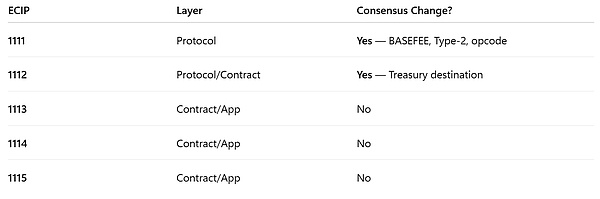
ETC Olympia Development Series Part 1: Implementing ECIP-1111 and ECIP-1112 This article introduces the first part of the Ethereum Classic Olympia development series, focusing on the implementation of ECIP-1111 and ECIP-1112. These two proposals are the only components within the broader Olympia framework that modify consensus behavior. ECIP-1111 modernizes the fee market by introducing an EIP-1559-style mechanism with a base fee and optional priority tip (miner tip). A key difference from Ethereum is that the base fee is not burned but is instead redirected to a treasury address defined by ECIP-1112. It also adds support for Type-2 transactions and the BASEFEE opcode (0x48), ensuring compatibility with modern EVM tooling and wallets. Crucially, it does not change miner rewards, monetary policy, or existing transaction types. ECIP-1112 defines an immutable, deterministic treasury smart contract that will receive the redirected base fees. This vault is designed to be receive-only upon activation, meaning it can accumulate value but cannot distribute funds until a separate, subsequent governance layer (defined in other ECIPs) is deployed and activated on the contract layer. The article emphasizes the modular architecture of Olympia. While the suite includes five ECIPs (1111-1115), only these two affect consensus. This separation ensures that the core protocol remains minimal and auditable, while future governance and funding mechanisms can evolve independently at the contract level without requiring further hard forks. The implementation is currently in the draft stage per the ECIP-1000 process. Any decision to move forward with mainnet activation will require extensive testing on the Mordor testnet and full community review.

金色财经Hace 8 hora(s)

ETC Olympia Development Part 1: Implementing ECIP-1111 and ECIP-1112

金色财经Hace 8 hora(s)

活动图片