Actually, ETH Scaling is a Major Boon for L2s
Vitalik Buterin's recent comments on Ethereum scaling have been misinterpreted. He did not declare Layer 2s (L2s) a failure but rather signaled a strategic shift: Ethereum is moving from a "rollup-centric" scaling model, where L2s were seen as simple replicas of the base layer, to one where the L1 itself undergoes aggressive scaling. L2s remain crucial, but their primary value proposition has evolved to be customization, not just cheap transactions.
Two key developments drove this change. First, Ethereum's base layer is scaling faster than anticipated. After years of cautious progress to preserve decentralization, an ambitious new roadmap aims to drastically increase L1 throughput through a series of upgrades, including a higher gas limit, faster block times, parallel transaction processing, and a fundamental transition to a native zero-knowledge (zkEVM) architecture. This allows Ethereum to scale while maintaining its superior decentralization.
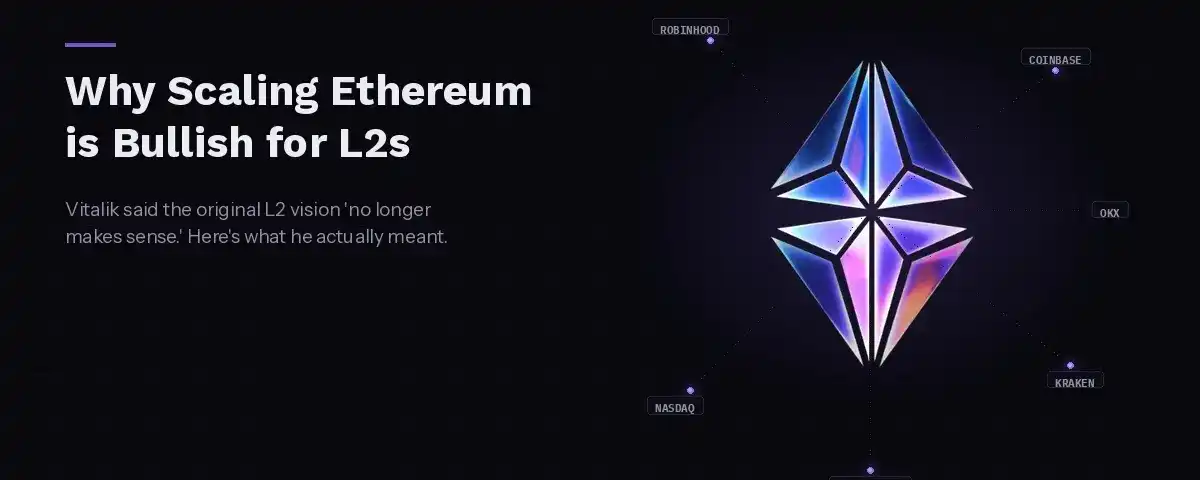
Second, L2s have found product-market fit with institutions. Companies like Robinhood, Coinbase, and Kraken are building their own L2s because they need Ethereum's security and access to its liquidity, but also require control for regulatory compliance, custom fee structures, and operational flexibility. This creates a spectrum of L2s, from highly decentralized ones to more controlled, institutionally-focused chains—a reality Vitalik acknowledges is valid as long as marketing is honest.
Crucially, scaling the L1 does not compete with L2s; it makes them better. A more powerful L1 means cheaper data availability and settlement costs for L2s, faster withdrawals, and quicker finality. The main unresolved challenge is liquidity fragmentation between L2s, which the Ethereum Foundation is prioritizing with new interoperability solutions for 2026.
The narrative that Ethereum is abandoning L2s is incorrect. The ecosystem is maturing into a system with a radically scaling L1 at its core, surrounded by a flourishing ecosystem of specialized L2s.
marsbit03/15 03:20