Artículos Relacionados con Risk Management

El Centro de Noticias de HTX ofrece los artículos más recientes y un análisis profundo sobre "Risk Management", cubriendo tendencias del mercado, actualizaciones de proyectos, desarrollos tecnológicos y políticas regulatorias en la industria de cripto.

Blockchain Capital Partner: The Structure of On-Chain Two-Tier Capital Is Still in the Early Stages of Value Discovery

Spencer Bogart, a general partner at Blockchain Capital, argues that the on-chain economy possesses unique features like programmability, composability, and global distribution, fostering an open and fast-paced innovation ecosystem. However, these very features create challenges for large, fiduciarily-responsible institutional capital, which requires robust risk assessment frameworks often difficult in a permissionless and adversarial environment. The proposed solution is the emergence of a two-tiered capital structure. The first, permissionless layer remains the crucible for innovation, where protocols are built, tested, and hardened with real capital. The second, "institutional" layer consists of chains (L1s, L2s, etc.) that, while based on similar code, incorporate risk-management features like the ability to pause or freeze transactions in extreme scenarios, making them suitable for large-scale institutional deployment. The synergy between these layers is key. Protocols proven resilient in the open, permissionless environment can then scale to the institutional layer, accessing deeper capital pools. This creates a lifecycle: build and launch permissionlessly, test and prove robustness publicly, then expand to an institutional-grade chain for scaled adoption. This architecture allows the open, experimental side to continue driving innovation with crypto-native capital, while the institutional layer provides the liquidity, stability, and trust required for mainstream adoption. The major challenge identified is the "cold start" problem: aligning where institutional capital prefers to go with where the most proven applications and network effects currently reside. How this dynamic resolves—whether through protocol migration, new protocol builds, or institutional adaptation—will be crucial to watch. Overall, this evolving structure aims to combine the strengths of open innovation and institutional depth within a shared on-chain ecosystem.

链捕手Hace 10 hora(s)

Blockchain Capital Partner: The Structure of On-Chain Two-Tier Capital Is Still in the Early Stages of Value Discovery

链捕手Hace 10 hora(s)

Who is Selling, Who is Holding, Who is Still Buying? The Divergence of U.S. Old Money's Crypto ETF Holdings

"American Institutional Crypto ETF Holdings Show Divergence in Q1 2026. Amidst a quarter of market pullback, major institutional 13F filings reveal distinct strategies towards crypto ETFs. Key sell-offs/trimming: Harvard Management cut its iShares Bitcoin Trust (IBIT) holdings by ~43% and fully exited its iShares Ethereum Trust (ETHA) position, reallocating some funds toward AI/tech stocks. Goldman Sachs reduced its overall crypto ETF exposure, notably clearing its XRP and Solana ETF holdings while adding to selected crypto-related equities like Circle and Galaxy Digital. Hedge funds Millennium Management and Capula Management also significantly reduced or fully exited major Bitcoin and Ethereum ETF positions. Holders maintaining positions: Brown University kept its IBIT stake unchanged, demonstrating a long-term allocation approach. Dartmouth College maintained its core Bitcoin ETF holding while shifting some Ethereum exposure to a staking ETF and initiating a position in a Bitwise Solana Staking ETF. Strategic buyers increasing exposure: Sovereign wealth fund Mubadala increased its IBIT holdings by ~16%. JPMorgan significantly boosted its IBIT stake by 174%, while Wells Fargo raised its Ethereum ETF allocations. Market maker Jane Street rebalanced, cutting Bitcoin ETF holdings but adding ~$82 million in Ethereum ETF exposure. The filings indicate institutions are actively sorting crypto assets by perceived risk and liquidity, with Bitcoin often treated as a 'core' holding, Ethereum facing mixed treatment, and altcoins like Solana and XRP being the first to be cut or used for tactical 'elastic' allocations by some. It's crucial to note that 13F data is a lagging snapshot (as of March 31) and doesn't reveal entry costs or potential off-balance-sheet hedging strategies."

marsbitHace 13 hora(s)

Who is Selling, Who is Holding, Who is Still Buying? The Divergence of U.S. Old Money's Crypto ETF Holdings

marsbitHace 13 hora(s)

147 Trillion vs 70 Billion: The Rise of On-Chain 'Risk Managers' and the Potential Dawn of a New Era in DeFi Asset Management

"147 Trillion vs 70 Billion: The Rise of On-Chain 'Risk Managers' and the Potential Dawn of a New Era in DeFi Asset Management" Key Points: The role of professional asset managers is emerging in DeFi, ending the era where protocols and governance dictated everything. While early DeFi protocols like Aave and Compound bundled risk management within their code, innovations like Morpho have separated infrastructure from risk judgment. This allows specialized "Risk Managers" to operate independent lending vaults, acting as on-chain asset managers. The market, though early with ~$7B in assets under management (AUM), is rapidly consolidating around top performers like SteakhouseFi (RWA focus), SentoraHQ (AI-driven models), and Gauntlet (crisis management). This modular structure mirrors TradFi's division of labor: distributors (e.g., exchanges) source capital, Risk Managers design strategies and set standards, and underlying protocols handle custody and execution. For traditional asset managers, this familiar structure presents clear entry paths: 1) **Distribution**: Partnering with Risk Managers as a backend service. 2) **Supply**: Bringing real-world assets (RWA) on-chain as collateral. 3) **Operation**: Becoming a Risk Manager themselves (e.g., Bitwise). The core competency required is shifting from coding to traditional risk underwriting and financial expertise—areas where established institutions hold a natural advantage. While the current DeFi market (~$80B) is minuscule compared to global asset management (~$147T), it represents a significant growth runway. The teams that build the trusted standards and rails for risk-managed capital now are poised to define the market's future as institutional capital seeks secure on-ramps.

marsbitAyer 01:24

147 Trillion vs 70 Billion: The Rise of On-Chain 'Risk Managers' and the Potential Dawn of a New Era in DeFi Asset Management

marsbitAyer 01:24

Stanley Druckenmiller: From Soros' Comrade-in-Arms to the Godfather of Macro Investing—System, Disciples, and Latest Thoughts

Stanley Druckenmiller is a pivotal figure in global macro investing, renowned for his partnership with George Soros, his legendary fund Duquesne Capital, and a decades-long track record of near-30% annualized returns without a single annual loss. His methodology uniquely blends value, growth, macro, and trend investing. A key early experience was as a bank stock analyst, grounding him in both company fundamentals and macro forces. His most famous trade, shorting the British Pound in 1992, exemplified his approach: identifying unsustainable structural contradictions and concentrating capital on high-probability, high-payoff opportunities. The "Duquesne System" is built on four pillars: macro-directional analysis, concentrated bets on best ideas, rapid error correction, and acute awareness of liquidity. His famous phrase "Invest, then investigate" reflects a dynamic approach of entering a position based on a strong initial thesis and then adjusting based on market feedback. This differs fundamentally from Warren Buffett's focus on long-term intrinsic business value; Druckenmiller focuses on marginal changes, cycles, and capital allocation at inflection points. His influence extends through protégés like Scott Bessent (market execution) and Kevin Warsh (policy insight), representing the dual market-and-institutional understanding he embodies. He closed his flagship fund in 2010 at its peak, prioritizing flexibility and performance over asset-gathering. Recent moves highlight his core logic: reducing AI exposure as expectations became crowded while investing in copper, recognizing the underlying infrastructure and resource demands of the AI boom. He remains concerned about long-term US dollar purchasing power due to fiscal deficits and monetary policy. His core skill is judging risk/reward payoff, not just prediction accuracy. For ordinary investors, key lessons are to focus on marginal changes, align position size with conviction and risk, and seek second-order opportunities beneath surface-level narratives. Ultimately, Druckenmiller is a strategist who combines macro insight with price discipline, decisive action with rigorous risk management, succeeding by identifying major market mispricings, acting before full consensus, and exiting swiftly when proven wrong.

marsbitHace 2 días 02:08

Stanley Druckenmiller: From Soros' Comrade-in-Arms to the Godfather of Macro Investing—System, Disciples, and Latest Thoughts

marsbitHace 2 días 02:08

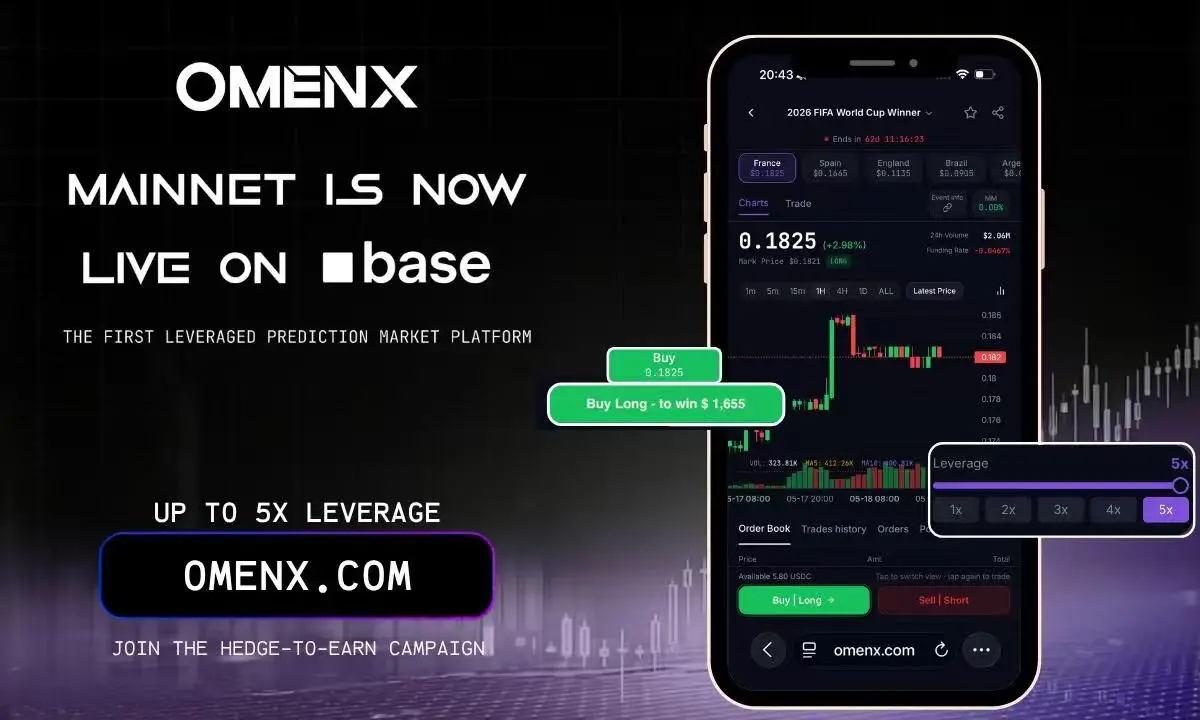
Base Native Leveraged Prediction Market OmenX Officially Launches on Mainnet

Base-native leveraged prediction market platform OmenX has officially launched on mainnet. It currently supports up to 5x leverage, with plans to increase to 10x based on platform liquidity and market conditions. Unlike traditional prediction markets where users fully collateralize YES/NO positions and wait for settlement, OmenX aims to create a trading platform-like experience. Users can open leveraged positions on event outcomes, and actively trade, adjust, or hedge these positions before the event concludes for greater capital efficiency. Alongside the mainnet launch, OmenX introduced a "Hedge-to-Earn" campaign targeting existing users of other prediction markets (initially Polymarket). This initiative allows users to claim incentives or hedging benefits on OmenX based on their existing positions, aiming to introduce them to leveraged trading and active risk management. OmenX positions itself as a derivatives trading platform for prediction market assets. The team believes that as platforms like Polymarket mainstream prediction markets, event outcomes are becoming a new tradable asset class. The next phase of demand will focus on leverage, liquidity, and advanced trading tools. Post-launch, OmenX plans to expand supported market types, optimize liquidity, and develop APIs and additional trading tools. The team is also in discussions with investors and partners to secure resources for further development.

链捕手05/19 13:35

Base Native Leveraged Prediction Market OmenX Officially Launches on Mainnet

链捕手05/19 13:35

Behind Galaxy Digital and SharpLink's $125 Million DeFi Fund: Why Are Institutional Funds Embracing DeFi Again?

In May 2026, Galaxy Digital and SharpLink announced a $125 million Institutional Onchain Yield Fund, marking a significant pivot as institutional capital begins systematically integrating corporate ETH treasuries into DeFi. This move signals a shift from passive crypto holdings to active on-chain asset management. SharpLink is evolving into an "ETH Treasury Company," focusing on managing ETH's capital efficiency beyond simple staking, akin to a digital-age internet bond. Galaxy's role is to embed Wall Street-grade risk controls—managing exposure, volatility, and compliance—into DeFi, positioning itself as an "Onchain Asset Manager." This renewed institutional interest stems from DeFi's maturation into a "real yield" era with sustainable cash flows from stablecoin lending, on-chain treasuries, restaking, and RWA pools. Stablecoins have institutionalized into an on-chain dollar system, while restaking (e.g., EigenLayer) is reshaping ETH into a productive yield-bearing asset, forming an "internet benchmark rate." The collaboration reflects an upgrade to ETH's narrative: from a speculative asset to productive on-chain collateral and financial infrastructure. However, institutionalization amplifies systemic risks like liquidity crises and cross-protocol contagion, akin to traditional finance's pitfalls. Ultimately, this fund represents a foundational step toward building a native internet financial system—with stablecoins as digital dollars, ETH as reserve capital, and DeFi as banking—indicating that on-chain markets may become integral to the global financial architecture.

marsbit05/13 00:10

Behind Galaxy Digital and SharpLink's $125 Million DeFi Fund: Why Are Institutional Funds Embracing DeFi Again?

marsbit05/13 00:10

After Half a Year as a Token Broker, She Has Fallen into Every Pitfall of the Relay Station Business

Sukie, who operated an AI API "middle station" service for six months, recently open-sourced her entire setup process. Her story reveals the harsh realities of this once-lucrative but now hyper-competitive market. The core challenge is cost. Legitimate, compliant API accounts are expensive. To compete, many players resort to cheaper, high-risk sources like stolen accounts. The market has seen prices plummet from 70-80% of official rates down to 30-50%, a level unsustainable for compliant operators. Sukie believes a 70-80% price point is the minimum for healthy margins using legitimate methods. A major mistake was targeting the Chinese market while incurring USD costs. She found Chinese developers extremely price-sensitive compared to Western clients, leading to thin margins compounded by currency and payment hurdles. Operational burdens are heavy: maintaining a pool of hundreds of accounts against rising platform bans, handling detailed technical support, and managing cross-border payments and invoices for different client types. Marketing channels like X (Twitter) and referrals work best, while platforms like Douyin (TikTok) and Xianyu have poor ROI due to low intent or pricing mismatches. The landscape shifted dramatically with high-profile entrants like Justin Sun, Fu Sheng, and the Trump family. For them, the middle station is a loss leader to attract users to their primary businesses—crypto ecosystems, corporate narratives, or token promotions. This makes competing on price alone impossible for independent operators. Sukie open-sourced her methodology both as marketing and to demystify the industry. By eliminating the "black box" technical premium, she hopes to shift competition from cutthroat pricing towards service quality, stability, and compliance. Her advice: this is not a viable full-time venture for newcomers. The compliant path can't compete with grey-area discounters or ecosystem-backed giants. If already involved, focus on niche B2B, academic, or overseas markets. The middle station business, she concludes, is an entry ticket, not a destination, in the broader AI landscape.

marsbit05/09 04:48

After Half a Year as a Token Broker, She Has Fallen into Every Pitfall of the Relay Station Business

marsbit05/09 04:48

In-Depth Reconstruction of the $285 Million Drift Hack: How Should DeFi Governance Move Beyond "Amateur Hour"?

On April 1, 2026, Drift Protocol, the largest perpetual futures DEX on Solana, suffered a catastrophic hack resulting in a loss of $285 million. The attack, attributed to a sophisticated social engineering campaign rather than a technical exploit, unfolded over several months. Hackers first infiltrated Drift’s internal circles by posing as a legitimate market maker, building trust over time. They then exploited Solana’s "Durable Nonce" feature to trick core team members into blindly signing transactions that granted administrative control. A critical vulnerability was introduced when Drift migrated to a 2/5 multisig structure without a timelock, allowing instant execution of privileged transactions with just two signatures. The attackers finally triggered the attack by adding a fake token (CVT) to the whitelist, manipulating its oracle price, and using it as collateral to drain the protocol’s treasury. The incident highlights fundamental flaws in DeFi governance, including overreliance on multisig mechanisms that lack intent verification and are vulnerable to social engineering. It underscores the misalignment between retail-grade security tools and institutional-scale treasury management. The hack signals the need for a security paradigm shift in DeFi, including adoption of Hardware Security Modules (HSMs) for key management, intent-based policy engines for transaction validation, and professional third-party custody solutions to ensure institutional-grade safety.

marsbit04/13 12:00

In-Depth Reconstruction of the $285 Million Drift Hack: How Should DeFi Governance Move Beyond "Amateur Hour"?

marsbit04/13 12:00

活动图片