# DeFi Related Articles

HTX News Center provides the latest articles and in-depth analysis on "DeFi", covering market trends, project updates, tech developments, and regulatory policies in the crypto industry.

Stablecoins at a Crossroads: Clear Regulations Drive Adoption, Systemic Risks Remain

Stablecoins are at a critical juncture, with regulatory clarity driving their rapid evolution from crypto trading tools to mainstream payment and settlement infrastructure. The U.S. GENIUS Act and the EU’s MiCA framework have established federal and regional standards for issuance, reserves, and auditing, accelerating their adoption. Market capitalization has surpassed $300 billion, with USD-pegged stablecoins dominating, though euro and other fiat-backed alternatives are growing. Use cases are expanding significantly, with enterprises adopting stablecoins for cross-border payments, payroll, and treasury management due to their 24/7 availability and low transaction costs. They are increasingly integrated into traditional finance as settlement and custody solutions. However, systemic risks remain. USD-pegged stablecoins face potential de-pegging risks, insufficient reserve transparency, and high centralization, which could trigger liquidity crises. Large holdings of sovereign bonds or fixed-income assets may also impact bond markets and monetary policy. The IMF has warned about financial stability risks and dollarization concerns. For stablecoins to mature into reliable, compliant, and interoperable digital infrastructure—rather than just survive—they require transparent issuance mechanisms, robust regulatory coordination, and effective systemic risk controls.

cointelegraph_中文Hace 19 hora(s)

Stablecoins at a Crossroads: Clear Regulations Drive Adoption, Systemic Risks Remain

cointelegraph_中文Hace 19 hora(s)

Polymarket Revival: The Mainstreaming of Crypto Prediction Markets and Future Prospects

Polymarket, a crypto-based prediction market platform, has made a significant comeback in 2025 by re-entering the U.S. market through regulatory-compliant means, including the acquisition of regulated trading and清算 entities. This resurgence is further supported by institutional capital investment and integration with mainstream platforms like the MetaMask wallet, allowing users to trade directly without leaving their wallets. Mainstream financial data platforms have also begun displaying prediction market data, increasing market visibility. Once viewed primarily as a gambling or speculative platform, Polymarket is increasingly recognized as a mechanism for information pricing in financial markets. Widespread participation from both retail and institutional users has made its probability assessments of future events more representative and liquid. Prediction market data is now being incorporated by traditional financial media and data platforms, highlighting its growing potential. However, challenges remain. Prediction markets are not always accurate, with studies showing limited predictive reliability in certain contexts. Questions about platform neutrality and business models have emerged, such as the employment of internal market makers, which could undermine trust. Information asymmetry and insider risks are inherent, potentially disadvantaging ordinary users when some participants access information early. Regulatory, tax, and disclosure requirements also present ongoing uncertainties. The revival and transformation of Polymarket signify a broader shift of prediction markets from niche experiments toward mainstream financial infrastructure. By converting public expectations into tradable probabilities, these markets may complement traditional analysis and polling, providing real-time, decentralized signals in areas like macroeconomics, policy, technology, and geopolitics. As traditional financial institutions invest in compliance and structured products, DeFi is evolving beyond an alternative asset pool to resemble traditional financial infrastructure. Prediction market applications are expanding beyond crypto to potentially include stocks, macroeconomic indicators, sports events, and tech product launches, tightening the link between crypto and the real world. If platforms like Polymarket continue on a path of compliance, stable operation, and integration with mainstream financial services, they could become next-generation market infrastructures—event-driven financial tools alongside stocks, bonds, and options. Key factors for development include platform neutrality, prediction accuracy, regulatory environment, participant diversity, and the maturity of related financial products. In summary, Polymarket’s comeback represents a move of prediction markets from the fringe into the core of financial systems, reflecting deeper changes in how information is priced and how financial infrastructure is rebuilt. This shift brings not only new trading methods but also potential changes in how investors perceive and engage with future events and asset valuation.

cointelegraph_中文Hace 18 hora(s)

Polymarket Revival: The Mainstreaming of Crypto Prediction Markets and Future Prospects

cointelegraph_中文Hace 18 hora(s)

Altcoin: The ETF Boom Explodes – XRP, SOL, LTC, HBAR, DOGE, LINK, and the Emergence of New Opportunities

While the spotlight has been on Solana (SOL) ETFs, which have attracted approximately $682 million in inflows, XRP ETFs have quietly surpassed them with $874 million, despite launching later. Simultaneously, a new wave of altcoin ETFs for LTC, HBAR, DOGE, and LINK has entered the market, each recording modest but stable inflows since their debut. Seven separate Solana ETFs have generated $618.62 million in net inflows, holding $915.08 million in assets under management, representing about 1.15% of Solana's market cap. In contrast, four XRP ETFs have attracted $874.28 million, with Canary's XRPC leading at $357 million. The newly launched altcoin ETFs for LINK, HBAR, LTC, and DOGE have collectively seen $133.46 million in net inflows. Grayscale's GLNK attracted $40.90 million, Canary's LTCC (Litecoin) drew $7.67 million, and its HBR (HBAR) ETF recorded $82.04 million. Two DOGE ETFs brought in $2.85 million. This expansion signals a new market phase of diverse choices and intense competition. However, these new altcoin ETFs remain far behind the established Bitcoin and Ethereum ETFs in terms of total capital. Amid this ETF boom, Bitcoin Hyper (HYPER) is emerging as a potential altcoin outside the traditional ETF scope. It's a Bitcoin Layer-2 project built on the Solana Virtual Machine (SVM), combining Solana's speed with Bitcoin's security. Having raised nearly $29 million in its presale, it offers a fixed supply of 21 billion tokens and 40% staking APY, positioning itself to unlock Bitcoin's potential in DeFi.

bitcoinistHace 18 hora(s)

Altcoin: The ETF Boom Explodes – XRP, SOL, LTC, HBAR, DOGE, LINK, and the Emergence of New Opportunities

bitcoinistHace 18 hora(s)

Solana Lending Internal Conflict: The Power Struggle Behind Foundation Mediation

Over the weekend, a public dispute erupted between Solana's two leading lending protocols, Jupiter Lend and Kamino. The conflict originated from Jupiter's earlier marketing claims that its lending product featured "risk isolation," implying that different lending pools would not be exposed to cross-contagion in the event of an asset failure. However, after Jupiter Lend launched, the market observed that its design did not align with the conventional understanding of risk isolation. The protocol allows for the rehypothecation (re-use) of collateral across pools to improve capital efficiency, which critics argue creates potential channels for risk contagion. Kamino's co-founder, Marius Ciubotariu, publicly accused Jupiter of misleading users with false advertising and subsequently blocked a migration tool from Kamino to Jupiter Lend. The core of the debate lies in differing interpretations of "risk isolation." Jupiter and its supporters argue their model offers a balanced approach with independent pool configurations, while Kamino and its allies insist that any form of rehypothecation negates true risk isolation and constitutes a failure in disclosure. The dispute drew reactions from key ecosystem players. Multicoin Capital, an investor in Kamino, strongly criticized Jupiter, accusing the team of either incompetence or intentional deception. In contrast, the Solana Foundation President, Lily Liu, called for unity, urging the two projects to focus on growing the overall market share against competitors like Ethereum rather than engaging in internal conflict. The clash is seen as an inevitable result of intensifying competition in a shrinking market. Jupiter Lend has been rapidly capturing market share from the formerly dominant Kamino since its launch. In a tighter, post-market-crash environment where safety is a paramount concern, Kamino seized on a perceived vulnerability in Jupiter's product design to launch a competitive attack. The incident highlights the fierce battle for dominance in Solana's DeFi lending sector.

比推Hace 13 hora(s)

Solana Lending Internal Conflict: The Power Struggle Behind Foundation Mediation

比推Hace 13 hora(s)

Crypto Winter is Near. Is Bitcoin Headed for a Deep Correction?

The cryptocurrency market is experiencing heightened anxiety, with high volatility and talks of a "crypto winter" fueling fears of a deep Bitcoin correction. While some investors are moving to stablecoins, others are looking at infrastructure projects built on Bitcoin. Despite being the foundational asset, Bitcoin's limitations—slow transactions, high fees, and lack of flexible smart contracts—hinder its use in DeFi and mass applications. This has increased interest in Layer 2 solutions. Infrastructure altcoins that aim to transform Bitcoin into a base for financial applications are gaining attention. Projects focusing on modular blockchains, virtual machines, and liquidity bridges are being viewed as potential leaders in the next cycle. Among them is Bitcoin Hyper and its token $HYPER, which positions itself as the first Bitcoin Layer 2 integrating the Solana Virtual Machine (SVM). This project aims to combine Bitcoin's security with Solana's high throughput, offering low latency and minimal fees. Bitcoin Hyper's architecture uses Bitcoin for finality and an SVM layer for real-time transactions and smart contracts. It claims to exceed Solana's performance with sub-cent fees, enabling DeFi, NFT platforms, and gaming applications using wrapped Bitcoin. The project has raised $29 million in its early sale, with on-chain data showing significant "smart money" interest. The $HYPER token features staking with high APY and governance rights. Bitcoin Hyper's goal is to address Bitcoin's core limitations, potentially making it a key infrastructure play that benefits from future Bitcoin growth.

bitcoinistHace 12 hora(s)

Crypto Winter is Near. Is Bitcoin Headed for a Deep Correction?

bitcoinistHace 12 hora(s)

Bitcoin's Dormant Capital Has Finally Awakened

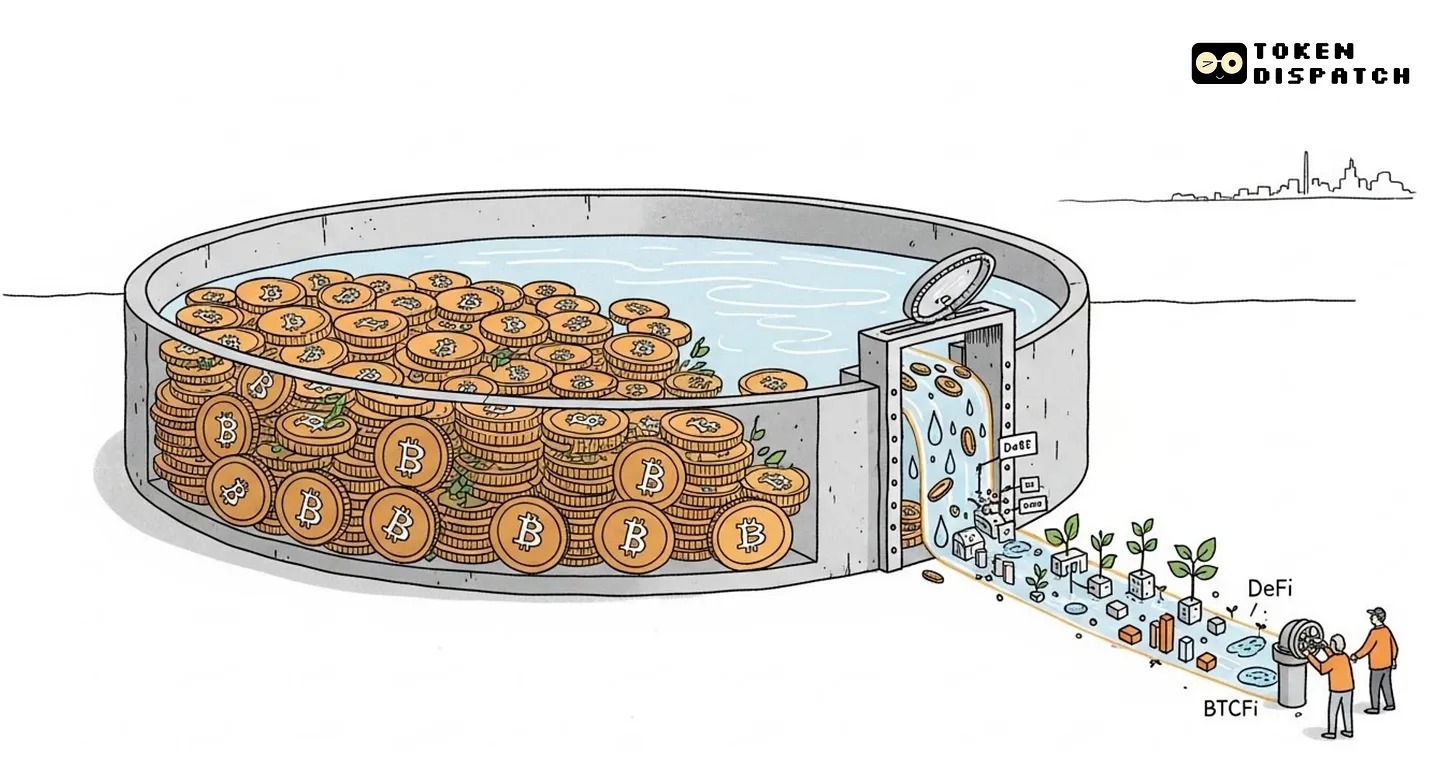
Bitcoin, the largest and most secure cryptocurrency, has historically been underutilized, with over 60% of its supply dormant for more than a year and less than 1% engaged in DeFi. While other ecosystems like Ethereum and Solana evolved with smart contracts and vibrant economies, Bitcoin’s largely remained a passive asset due to its security-first architecture, limited scripting capabilities, slow upgrade processes, and cultural conservatism. Previous workarounds—wrapped BTC, federated systems, cross-chain bridges, and sidechains—introduced trust assumptions, custodial risks, and security vulnerabilities, failing to align with Bitcoin’s trust-minimized ethos. Recent breakthroughs are changing this. Innovations like BitVM enable Bitcoin to verify off-chain computations without executing them, allowing for Bitcoin-backed rollups, trust-minimized bridges, and programmable vaults. Upgrades like Taproot have expanded Bitcoin’s capabilities, enabling native assets (e.g., Taproot Assets for stablecoins) and more complex cryptographic structures. New models also allow Bitcoin to earn yield natively—through staking, restaking, and Lightning Network-based liquidity provision—without leaving self-custody. This emerging BTCFi ecosystem comprises infrastructure for secure execution environments, verifiable bridges, yield markets, and Bitcoin-native assets, all without compromising Bitcoin’s core security or self-custody principles. This marks the first time Bitcoin has a financial ecosystem capable of supporting its trillion-dollar market cap, potentially unlocking vast dormant capital and integrating it into a productive, decentralized economy.

深潮Hace 4 hora(s)

Bitcoin's Dormant Capital Has Finally Awakened

深潮Hace 4 hora(s)

We've Hoarded Trillions in Bitcoin, But Never Use It? That's Changing Now

A significant portion of Bitcoin's trillion-dollar market cap remains dormant, with 61% of coins not moving in over a year and only 0.8% used in DeFi. While other ecosystems like Ethereum and L2s thrive with active use cases, Bitcoin has largely functioned as a passive store of value due to architectural and cultural constraints—prioritizing security over programmability, resisting upgrades, and lacking native interoperability. Previous solutions like wrapped BTC, federated systems, and bridges attempted to unlock Bitcoin’s liquidity but introduced new risks like custodial trust, security vulnerabilities, and reliance on external validators, contradicting Bitcoin’s trust-minimized ethos. However, this is changing with recent breakthroughs. Innovations like BitVM enable Bitcoin to verify external computations without executing them, allowing for Bitcoin-secured rollups and trust-minimized bridges. Upgrades like Taproot facilitate native assets and programmable vaults. New systems now support Bitcoin staking, restaking, and Lightning Network-based yield without requiring custodial wrapping or bridging. This emerging BTCFi ecosystem—comprising infrastructure, asset, and protocol layers—finally allows Bitcoin to participate in a functional economy while preserving its security model and self-custody principles. This could unlock a portion of the dormant capital, significantly impacting the broader crypto landscape.

marsbitHace 3 hora(s)

We've Hoarded Trillions in Bitcoin, But Never Use It? That's Changing Now

marsbitHace 3 hora(s)

活动图片