‘TACO’ Is Outdated, Wall Street Embraces ‘NACHO’ Trading

marsbitPublicado a 2026-05-09Actualizado a 2026-05-09

Resumen

The Wall Street trading meme "TACO" (Trump Always Chickens Out) is being replaced by "NACHO" (Not A Chance Hormuz Opens), signaling a major shift in market expectations. TACO bets anticipated de-escalation from political figures, but this pattern broke on March 23rd when a Trump social media post claiming progress with Iran was denied by Tehran, causing a sharp but temporary market reversal. Since then, markets have adopted a NACHO mindset, betting the Strait of Hormuz will remain closed for an extended period. This view is reflected in three key markets. First, war risk insurance premiums for vessels transiting the strait have skyrocketed. Second, the oil futures curve shows a steep backwardation, with near-term prices far exceeding long-dated contracts, indicating expectations for a prolonged but not permanent supply crunch. Third, Federal Reserve rate cut expectations for 2026 have been priced out to zero due to persistent oil-price inflation. While the S&P 500 continues hitting record highs, the market internally reflects NACHO's impact. The energy sector ETF (XLE) has vastly outperformed the transportation sector ETF (IYT), as high oil prices directly benefit producers but squeeze transport and logistics companies' margins. The NACHO trade has a concrete deadline. Analysts warn global commercial oil inventories could reach critical "operational pressure" levels by early June. If the strait remains closed into September, OECD stocks may fall below the operational floor...

On Wall Street, ‘TACO trading’ is out of style, and everyone is now discussing a new trading pattern—‘NACHO’.

Since the U.S.-Israel airstrike on Iran on February 28th, the Strait of Hormuz has remained closed. Oil prices are now up over 50% from pre-war levels, and the market's expectation for Federal Reserve rate cuts in 2026 has been compressed from 2 cuts pre-war to the current 0 cuts. Yet, during the same period, the S&P 500 has hit record highs, rallying for six consecutive weeks—its longest winning streak since 2024.

Wall Street has given this seemingly contradictory market state a name: NACHO, short for ‘Not A Chance Hormuz Opens’. It's the opposite of TACO (Trump Always Chickens Out). TACO bets on ‘people backing down’—that Trump would retreat at critical moments. NACHO bets on ‘things getting stuck’—that this time, the Strait of Hormuz cannot be reopened with just one Truth Social post.

eToro market analyst Zavier Wong described this shift: ‘For most of the crisis, every ceasefire headline caused oil prices to plunge sharply. Traders kept betting on a solution that never arrived. NACHO means the market acknowledges that high oil prices are not a one-time shock; they are the current market environment itself.’

Two Diverging Lines in Early April

March 23rd was the tipping point where the TACO pattern failed. That morning, Trump announced on Truth Social that he had held ‘very good constructive talks’ with Iran and ordered the Pentagon to halt strikes on Iranian energy facilities for five days. S&P 500 futures rebounded nearly 4% from lows within minutes, instantly adding $1.7 trillion in market value. Brent crude fell from $109 intraday to $92.

Then, Iranian officials denied the talks took place. According to Iranian state media, a ‘senior security official’ called it a market manipulation tactic, stating no dialogue ever occurred. The gains were halved within two hours, with the S&P closing only +1.15% and Brent rebounding to $99.94.

That was the first time in 14 months that Trump's ‘backing down’ no longer moved the market effectively. The reason isn't complicated: backing down in the TACO pattern was one-sided, deliverable with a single post. The retreat on March 23rd required Iran's cooperation. When the counterparty didn't cooperate, the retreat turned into a lie.
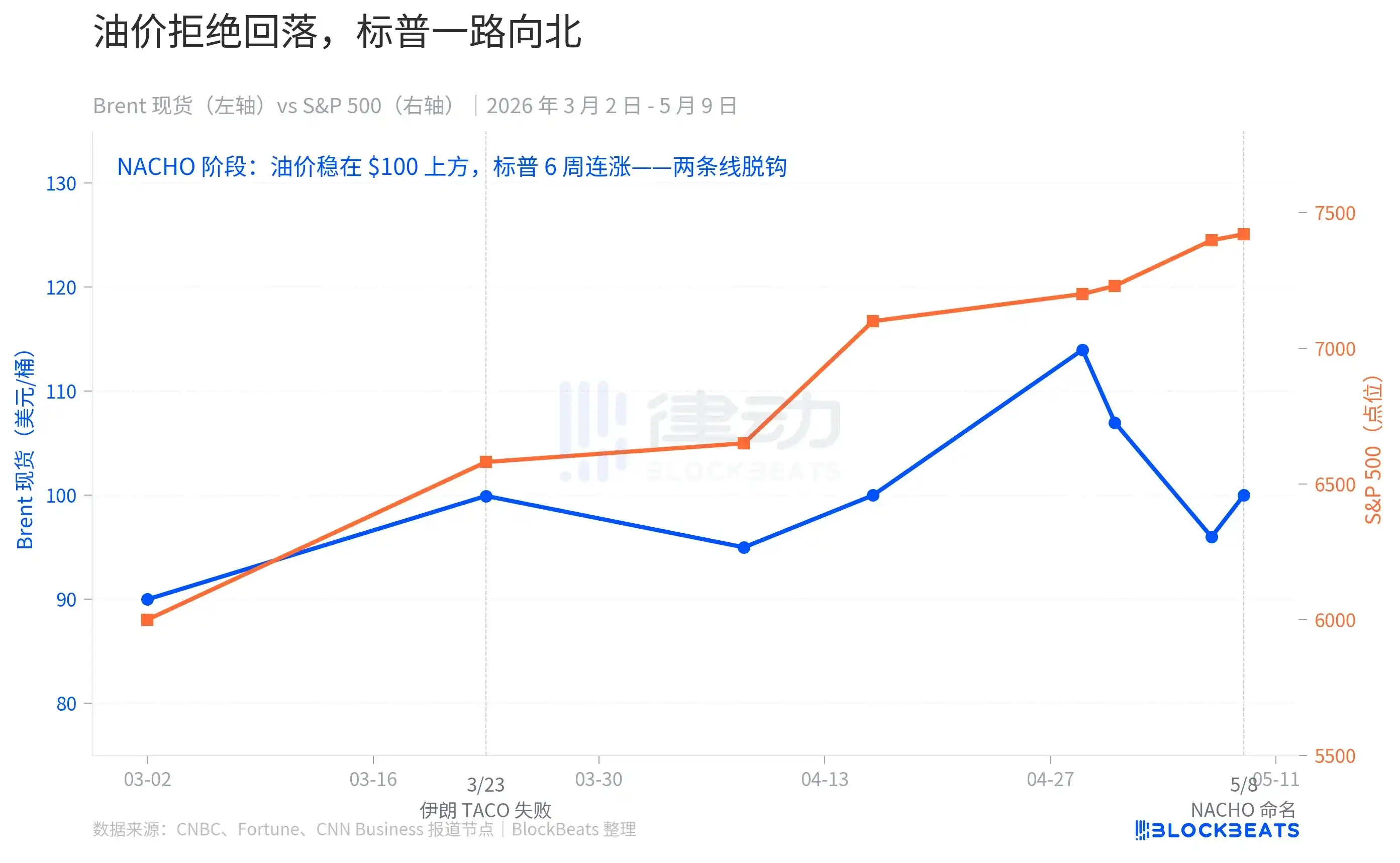
From that day on, market behavior fundamentally changed. Brent crude never fell back to the pre-war level of $67 in the following six weeks, with its May average price still maintained at $109.57. In between, there were U.S.-Iran ceasefire agreements on April 7th and 8th, a brief return of oil prices to ‘initial war levels’ on April 17th, and news on May 7th that the U.S. and Iran were close to a deal. None of these ‘ceasefire headlines’ brought oil prices back to the baseline.

But the S&P headed north. It rose 10% in April alone, its strongest month since November 2020, setting 7 intraday all-time highs during the period. On May 1st, it broke 7,230 points intraday, closing at 7,398 points on May 7th.

The two lines completely decoupled in early April. In the TACO era, they moved together: threats came, oil and the S&P fell; backing down came, oil and the S&P rebounded. In the NACHO era, they speak two different languages: oil prices say ‘Hormuz is shut for good,’ while the S&P says ‘it's none of my business.’

Three Markets, Three Reactions

NACHO is not just talk; it's the same bet placed with real money across three separate derivative markets.

The first layer is insurance. According to historical data from the Strauss Center, war risk insurance rates for the Strait of Hormuz once soared to 3.5% of hull value during the 2003 U.S. invasion of Iraq, reaching 7.5% at the peak of the ‘Tanker War’ in the 1984 Iran-Iraq War after the attack on the Yanbu Pride tanker. The baseline before this crisis was 0.125% to 0.25%. By early May, this rate had entered the 1% range, with some policies surging to 3%–8%.

Converted to the insurance cost for a single Very Large Crude Carrier (VLCC) per transit, the fee has jumped from about $250,000 pre-war to the current $800,000 to $8 million. An insurer's job is to price risk. The practical implication of this layer is: if insurers simply won't provide coverage, shipowners won't risk uninsured transit. The ‘physical reopening’ and ‘de facto navigation’ of the Strait are two different things.
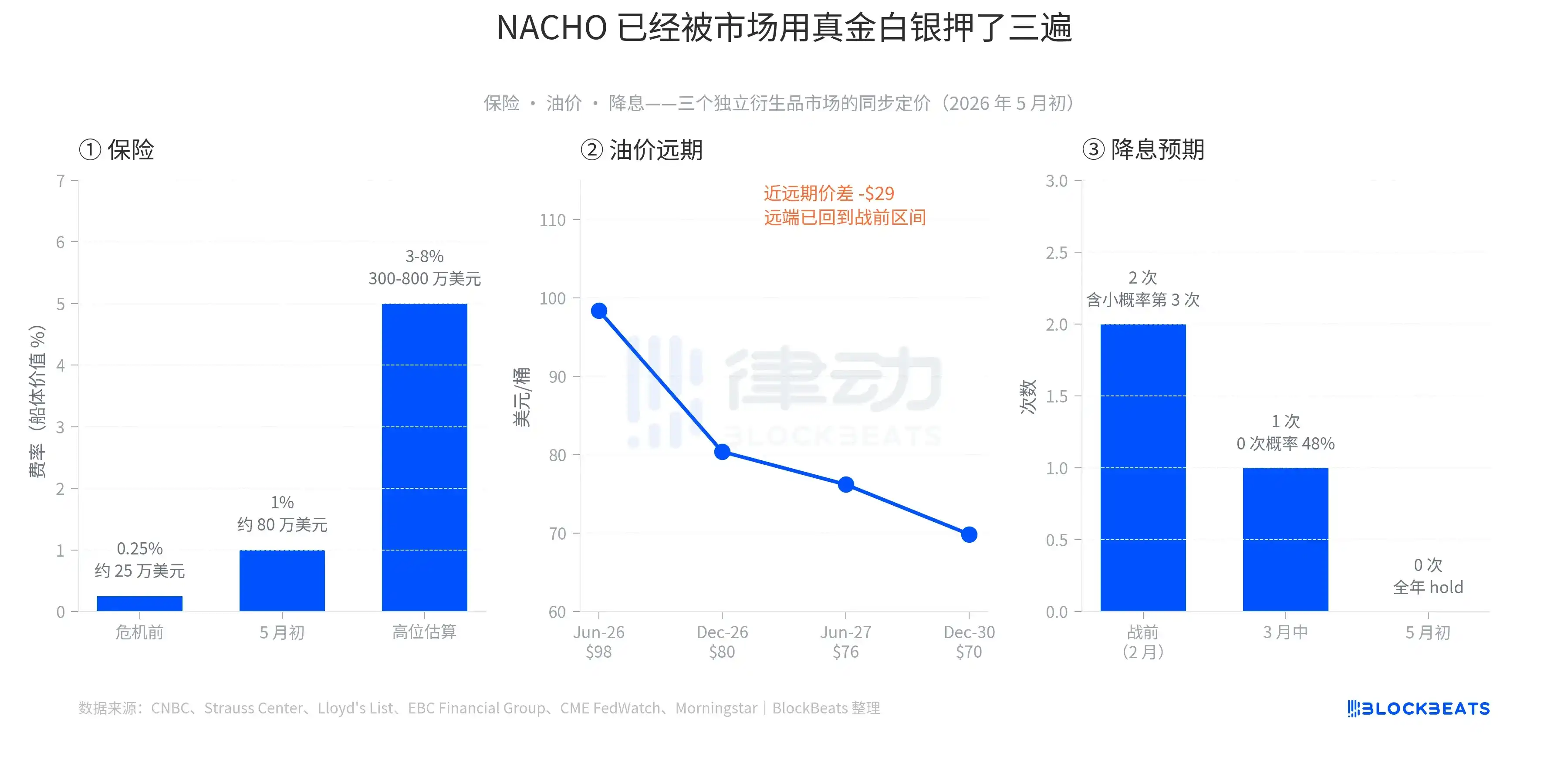
The second layer is oil prices. Early May data shows the Brent Jun-26 contract at $98.41, Dec-26 at $80.39, Jun-27 at $76.20, Dec-30 at $69.85. The spread between the front month and Dec-30 is about $28.5, one of the steepest backwardation (near-term price higher than long-term) structures in the past five years. This curve tells a very specific story: the market believes spot supply is tight but will eventually ease, with long-term prices returning to the pre-war $60–$70 range. In other words, high oil prices are not the final state but a bounded window. However, this window is long enough that traders won't bet on it ending suddenly.

The third layer is rate cuts. In early February 2026, the market expected the Fed to cut rates twice that year, with a small chance of a third cut. By mid-March, as oil prices surged, this was compressed to 1 cut, with a 48% probability of 0 cuts. On April 29th, the Fed held rates at 3.50%–3.75%. By May 6th, the CME FedWatch tool showed a 70% probability of another hold at the June meeting. For the entirety of 2026, the market had already priced in 0 rate cuts. Hedge fund legend Paul Tudor Jones even said in a May 7th CNBC interview, ‘Not even Volcker could get the Fed to cut rates now.’

All three layers have left their mark in the derivative markets—it's not just narrative; it's real money.

A Differentiated Market

The second, less obvious detail of NACHO is that it has already created differentiated pricing within the broader market.

As of the May 7th close, the Energy Sector ETF (XLE, State Street's Energy Select Sector Fund) was up 31.63% year-to-date, the only major sector in positive territory for 2026. Over the same period, the S&P 500 rose about 24%. The Transportation Sector ETF (IYT, iShares U.S. Transportation ETF) gained only 8.79% year-to-date, underperforming the broader market by over 15 percentage points.
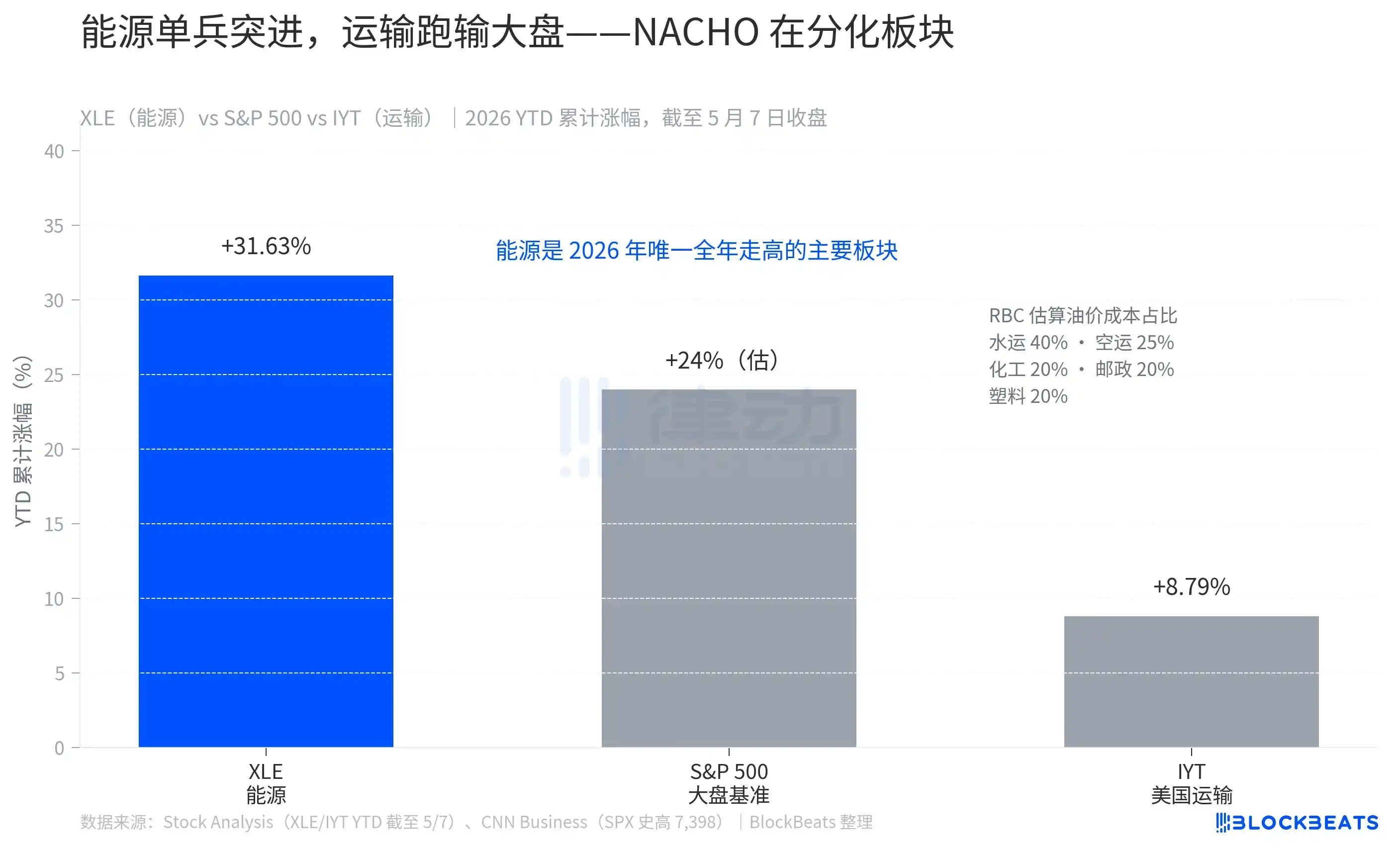
This gap is not random. According to RBC Capital Markets estimates, fuel costs constitute 40% of operating costs for the water transport industry, 25% for air transport, and 20% each for chemicals, postal/courier services, and rubber/plastics. If fuel is a major item on your cost sheet, NACHO hits you directly in the face.

XLE's 31.63% gain is not a short-term bounce; it's the result of 8 weeks of sustained outperformance. IYT's 8.79% gain isn't weakness; it's rising with the broader market while having its returns split by oil prices. The market has clearly told readers how NACHO calculates the odds—just look at how much the transportation ETF is underperforming the market.

But NACHO is not an indefinite bet; it has a very specific deadline: June 1st.

According to estimates from JPMorgan's commodity research team, global commercial crude oil inventories were around 8.4 billion barrels at the beginning of 2026, but only about 800 million barrels of that was ‘practically usable.’ The rest consisted of pipeline fill, tank bottom inventories, minimum terminal storage—the parts necessary to keep the system running daily. Since the crisis began, 280 million barrels have been drawn down, leaving roughly 520 million barrels of usable inventory. JPMorgan's exact words were, ‘Commercial inventories are expected to approach operational stress levels by early June.’

‘Operational stress level’ is a concrete physical concept. JPMorgan explains, ‘The system doesn't collapse because oil disappears; it collapses because the flow network no longer has sufficient working inventory.’ Once this line is breached, the only choices for companies and governments are to either squeeze the minimum inventory needed to maintain operations (which damages the infrastructure itself) or wait for new supply. If Hormuz remains closed until September, OECD commercial inventories could fall to the so-called ‘operational floor.’ According to a Fortune report, European jet fuel inventories are projected to fall below the 23-day supply threshold in June—a key industry warning line.
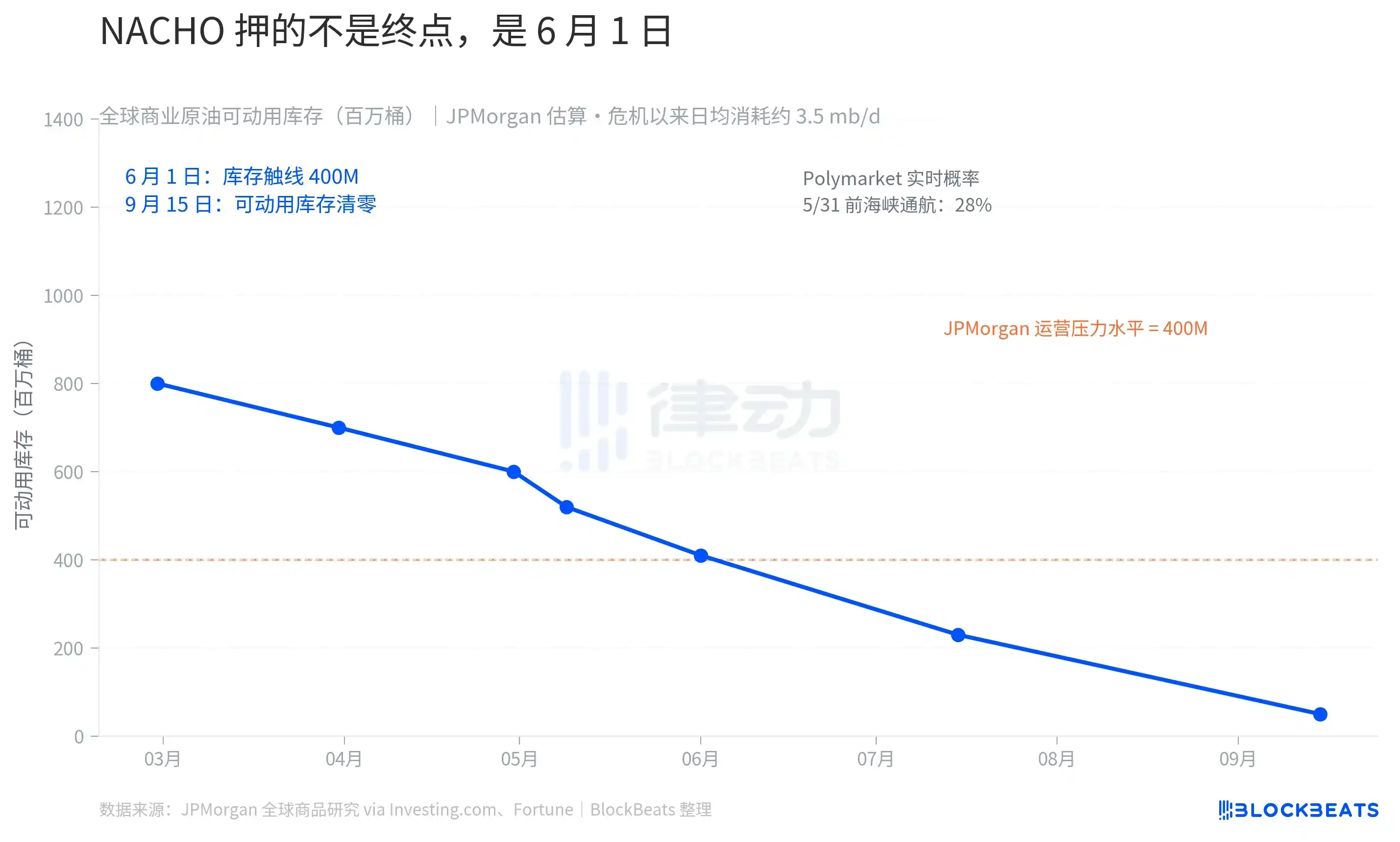
Prediction market odds are synchronized with the physical clock. According to Polymarket data from May 9th, the probability of ‘the Strait of Hormuz resuming normal traffic before May 31st’ is 28%, with only a 2% probability before May 15th. Active positions worth $9.92 million on that market are betting that NACHO won't fail at least within May.

The market is no longer trading Trump's next Truth Social post; it's trading the early-June inventory data for the Strait of Hormuz.


Preguntas relacionadas

QWhat does the acronym NACHO stand for, and what market view does it represent?

ANACHO stands for 'Not A Chance Hormuz Opens'. It represents a market view that the situation in the Strait of Hormuz is a prolonged, intractable crisis ('things will get stuck'), and the strait has no chance of reopening anytime soon, as opposed to betting on a political de-escalation.

QWhat event marked the failure of the TACO trading narrative and the shift towards NACHO?

AThe turning point was on March 23. Trump announced on Truth Social a 'very good constructive dialogue' with Iran and ordered a 5-day pause on strikes. The market initially rallied (TACO style), but when Iran officially denied any dialogue occurred, the gains were halved. This was the first time in 14 months that Trump 'backing down' failed to sustainably move the market, proving that a one-sided retreat was ineffective when the opponent doesn't cooperate.

QHow has the NACHO view manifested in the oil futures market structure?

AThe NACHO view is reflected in a steeply inverted (backwardated) oil futures curve. For example, near-month contracts (Jun-26) trade around $98, while Dec-30 contracts trade around $70. This large ~$28 spread signals the market believes current supply is tight and will remain so for a significant window, but the high prices are not permanent, and the situation is expected to eventually normalize in the long term.

QWhat is the significance of the performance gap between the Energy (XLE) and Transportation (IYT) sector ETFs in the context of NACHO?

AThe performance gap (XLE up ~31% vs. IYT up only ~8.8%) demonstrates the market's differentiated pricing under NACHO. High oil prices directly benefit energy producers (XLE) but act as a major cost headwind for transportation and other fuel-intensive industries (IYT). This divergence shows the market is not just betting on a general crisis, but is precisely calculating which sectors win and lose from sustained high oil prices.

QWhat is the key physical/economic deadline mentioned in the article that gives the NACHO trade a specific timeframe?

AThe key deadline is around June 1st. According to JPMorgan estimates, global commercial crude inventories are projected to approach 'operational pressure levels' by early June. Once this critical line is crossed, the physical oil distribution network risks seizing up. Markets are thus betting the NACHO situation (strait closure) will hold at least until this inventory buffer is nearly exhausted, shifting focus from political headlines to hard inventory data.

Lecturas Relacionadas

Warsh's First Day in Office, Markets Deliver a 'Wake-up Call': Rate Hike Expected This Year

On his first day in office, newly inaugurated Federal Reserve Chairman Warsh received a stark market warning, with expectations now fully pricing in a 25-basis-point interest rate hike this year. The shift was triggered by hawkish remarks from Fed Governor Waller, who stated that inflation is now the key policy "driver" and that the odds of a hike or cut are evenly split. This sent short-term Treasury yields higher. Waller signaled a significant pivot in his stance, citing disappointing inflation and labor data. He suggested removing "easing bias" language from Fed statements and did not rule out future rate increases if inflation fails to recede, though he noted immediate action isn't warranted without signs of unanchored inflation expectations. Chairman Warsh faces immediate pressure at his first FOMC meeting in June. With the preferred inflation gauge at a three-year high, analysts warn that failing to hike could be interpreted as an implicit easing of policy. The geopolitical situation in the Middle East is adding to existing price pressures. The market's expectation for a hike contrasts sharply with earlier forecasts for multiple cuts. While long-term Treasury yields have been contained by lower energy prices recently, analysts note they remain under structural upward pressure. Warsh's swearing-in at the White House highlights political scrutiny over Fed independence. However, the market has made it clear that inflation is the most urgent challenge, leaving the new chairman little time to settle in.

marsbitHace 6 hora(s)

Warsh's First Day in Office, Markets Deliver a 'Wake-up Call': Rate Hike Expected This Year

marsbitHace 6 hora(s)

Has Microsoft Lost Its Way in the AI Race, and Can Copilot Bring It Back on Track?

Microsoft, once seen as an early AI frontrunner due to its investment in OpenAI, is navigating a strategic shift amid increased competition. Its initial reliance on OpenAI’s GPT models has been complicated by OpenAI’s growing ambitions as a direct competitor, rapid advancements from rivals like Claude and Gemini, and the disruptive rise of AI agents, which challenge its traditional SaaS business model. These factors contributed to stock declines and slower-than-expected adoption of its flagship Copilot products. In response, CEO Satya Nadella has taken a hands-on role in product development, signaling the urgency of change. Microsoft is pivoting from a model-centric strategy to a "model-agnostic" enterprise platform approach. It aims to become the foundational layer connecting various AI models—from OpenAI, Anthropic, or its own new "Superintelligence" team—with enterprise workflows, data, security, and cloud services. Recent organizational changes merged consumer and enterprise Copilot teams to accelerate innovation, exemplified by new products like Copilot Tasks and Copilot Cowork. However, this transformation comes at a high cost. Microsoft faces massive capital expenditures, potentially reaching ~$190 billion by 2026, to support AI infrastructure. While its platform strategy shows early signs of traction with growing Azure AI revenue, it must balance startup-like agility with the reliability expected by enterprise clients. The core challenge is no longer being the sole AI winner but defending its position as the essential enterprise software entry point amidst rapid technological commoditization and the shift towards always-on AI agents.

marsbitHace 7 hora(s)

Has Microsoft Lost Its Way in the AI Race, and Can Copilot Bring It Back on Track?

marsbitHace 7 hora(s)

Why Haven't Forex Stablecoins Taken Off?

Why FX Stablecoins Never Took Off: A Path Forward via Synthetic FX Despite the explosive growth of stablecoin-powered digital banking, which has seen ~$6B in VC investment and a 24x surge in crypto card spending in under a year, a major limitation persists: these banks are essentially dollar-only accounts. This leaves 95-99% of global accounts, which are denominated in non-USD currencies, underserved. Attempts to create native foreign currency (FX) stablecoins (like EURC) have largely failed, with total FX stablecoin TVL at ~$600M compared to $400B for USD stablecoins—a 700x gap. These FX tokens face critical challenges: fragile pegs due to low liquidity, limited exchange/FinTech acceptance, poor on/off-ramps, complex regional compliance, and a chicken-and-egg adoption problem. The article argues that the solution lies not in competing with entrenched USD stablecoin networks (USDT/USDC), but in adopting a synthetic FX model inspired by traditional finance. Specifically, it advocates for Mark-to-Market Non-Deliverable Forwards (NDFs)—cash-settled FX derivatives that allow users to maintain underlying USD stablecoin holdings while having their account balance and P&L denominated in a foreign currency. This approach offers key advantages: strong oracle-based pegs, retention of deep USD stablecoin liquidity and yield, superior on/off-ramps, scalability to any currency with a reliable feed, and capital efficiency. It mirrors how modern institutional FX markets operate. Primary use cases for on-chain NDFs include: 1. **Digital Banks/Wallets:** Enabling multi-currency accounts for international users without leaving the USD stablecoin ecosystem, boosting deposits and retention. 2. **FX Carry Trade Vaults:** Offering access to sovereign interest rate differentials (e.g., earning yield on BRL) in a more stable and scalable format than crypto-native products like Ethena. 3. **Global Enterprise Payments:** Allowing merchants to receive payments in local currency equivalents while settling in USD stablecoins, similar to services offered by Stripe for fiat. The conclusion is that synthetic FX, not native FX stablecoins, is the viable path to integrating foreign exchange into the growing stablecoin digital banking landscape, potentially unlocking the next phase of institutional DeFi and multi-trillion-dollar global adoption.

链捕手Hace 8 hora(s)

Why Haven't Forex Stablecoins Taken Off?

链捕手Hace 8 hora(s)

Trading

Spot
Futuros
活动图片




