Survival Guide for Crypto KOLs

marsbitPublicado a 2026-06-18Actualizado a 2026-06-18

Resumen

The article titled "A Survival Guide for Crypto KOLs" discusses the recent ban on "InfoFi" or "post-to-earn" applications (e.g., Kaito, Cookie) on X (formerly Twitter), which effectively ended the era of easy monetization through engagement farming. It attributes this move to X's desire to reclaim platform control over user attention and ad inventory, noting that the incentive structure had degraded content quality and user experience. The piece outlines both the benefits—like a cleaner feed and a focus on genuine content—and the drawbacks, including immediate economic losses for creators and exposed platform risk. It then provides an updated guide for crypto content creators, emphasizing a shift from quantity to quality. Key recommendations include: 1) Doubling down on high-signal, original content (e.g., deep-dive threads, data-driven analysis). 2) Diversifying platforms (e.g., Substack, YouTube) to mitigate dependency on X. 3) Pursuing direct monetization through brand deals, newsletters, and paid communities. 4) Aligning with professional crypto marketing agencies for distribution. 5) Prioritizing reputation, offline networking, and evergreen content. The conclusion frames the ban as a painful but necessary reset for Crypto Twitter, pushing the ecosystem towards more sustainable and professional content creation models where genuine creators can thrive with less noise.

Source: @Eli5defi

Compiled and Edited by: BitpushNews

(Note: The article was compiled from January 16, 2026. Some data may have changed.)

If you woke up today and found your timeline unusually quiet (or chaotic, depending on that mysterious algorithm), it’s not your imagination.

The "InfoFi" ban is officially in effect. X (formerly Twitter) has revoked API access for the "post-to-earn" apps we all knew (and some loved to hate), including Kaito, Cookie, Wallchain, Xet, and others.

Well, "easy mode" is over. The harvest period has ended.

We need to talk about Goodhart's Law: "When a measure becomes a target, it ceases to be a good measure." We turned "replies" into a target, and in doing so, we turned the timeline into a Turing test where everyone failed.

But now what?

Why Did the Bubble Burst?

Let's be honest: the "attention economy" is suffering from hyperinflation. Apps like Kaito, Cookie, and Wallchain attempted to financialize attention.

In theory, it incentivized activity. In practice, it created a perverse incentive structure where "engagement" became decoupled from "value."

We weren't building communities; we were conducting a distributed, human-powered DDoS attack on the notification bar.

X finally realized that if they let third-party apps consume X users' dopamine, they would lose control over ad inventory and, more importantly, over genuine interaction and content on X. This is a battle for platform sovereignty.
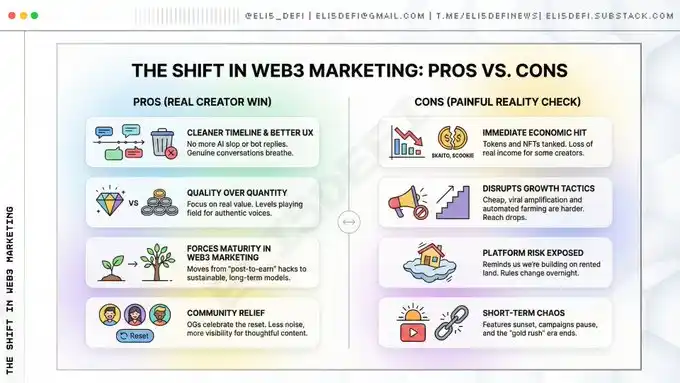
The Upside (Why This is Good for Real Creators)

  • A cleaner timeline and better UX: No more endless AI-generated junk, "gm" farms, or bot replies clogging every post's replies. Real conversations can breathe again.
  • Quality over quantity: Projects and creators who relied on paid spam now have to focus on real value. This levels the playing field for authentic voices (less noise = higher visibility for thoughtful content).
  • Forcing Web3 marketing to mature: The "post-to-earn" model was a short-term hack that made quick money but burned communities and damaged long-term trust. This pushes us towards more sustainable models.
  • Community relief: Many OGs and seasoned users are celebrating (ZachXBT called it a "fact-based decision," and even some creators see it as a reset for Crypto Twitter).

The Downside (The Painful Reality)

  • Immediate economic hit: Tokens like $KAITO, $COOKIE, and related NFTs plummeted 15-20%+ overnight. Many creators (especially in emerging markets) lost a tangible source of income as leaderboard rewards or campaigns stopped abruptly with no compensation in sight.
  • Disrupting growth strategies: Web3 projects loved using InfoFi for cheap, viral marketing. Without automated farming, promotion just got harder. Crypto topic reach might drop further.
  • Platform risk exposure: X can change the rules overnight (again). It's a reminder we're building on rented land. One policy update, and your entire strategy crumbles.
  • Short-term chaos: Projects are shutting down features, campaigns are on pause, and some creators are mourning the "gold rush" era that paid their rent for daily posting.

What We Need to Do from Now On

X's InfoFi ban has stirred the pot, but it's paving the way for a more structured, professional path for Web3 content creation. I see it as a nudge towards genuine project/agency partnerships and tight-knit creator communities.

Many creators are already pivoting in this direction, agencies are gearing up to fill the gap, building curated networks, and creator collectives are emerging as new hubs for deals and collaboration.
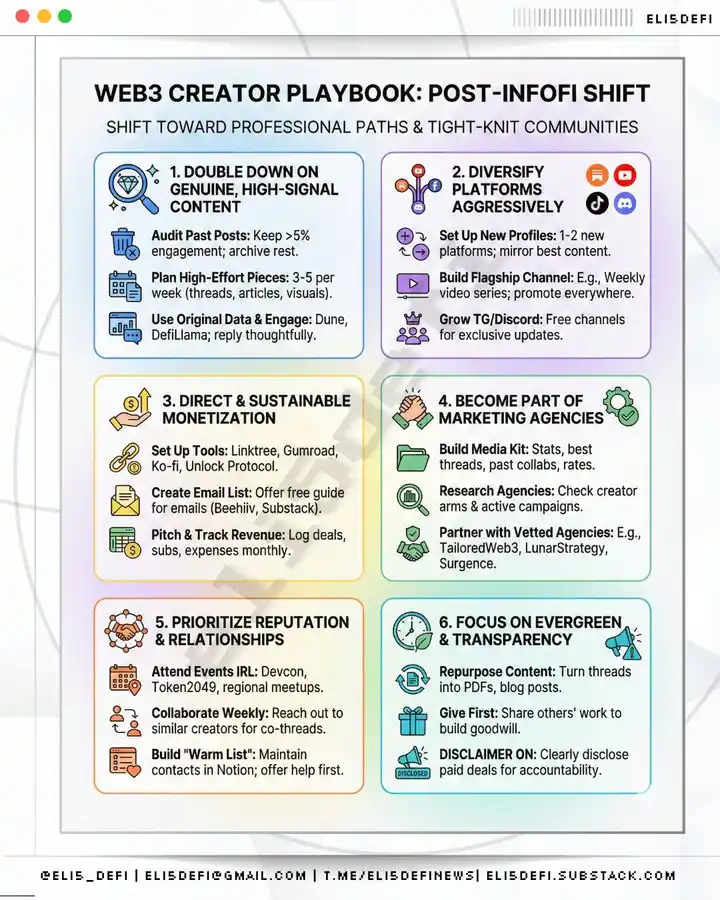
Here is the complete, updated playbook, with detailed steps for each point:

1. Double Down on High-Quality, High-Signal Content

Focus on deep analysis, threads, visual content, and genuine insights (this is what got me here in the first place). If the content is human-made and valuable, X will still reward quality interactions.

Detailed Steps:

  • Audit your last 30 days of posts: Keep only those with engagement rates >5% or meaningful replies; delete or archive the rest.
  • Plan 3-5 premium posts per week: (e.g., 10-tweet threads / long-form posts / articles with charts, simple analogies, or breakdowns).
  • Use data tools: Use @Dune, @DefiLlama, @getmoni_io, @nansen_ai, etc., for original insights, not machine-generated AI summaries.
  • Engage with replies: Thoughtfully respond to every high-quality comment within 24 hours to build genuine dialogue.
  • Subscribe to quality research: Subscribe to outlets like @fourpillarsFP, @shoalresearch, @oak_res_EN, @delphi_digital, etc. Full list here: [https://x.com/i/lists/1956904918348190144)
  • Track performance: Use X Analytics to see which format (threads vs. polls vs. video) generates the most bookmarks/shares.

2. Diversify Platforms

Detailed Steps:

  • Set up 1-2 new platforms: (e.g., Substack + YouTube); sync your best X content there.
  • Cross-post strategically: When sharing a post on X, include a link back to X.
  • Build a flagship channel: For example, start a weekly YouTube/TikTok series (like "DeFi in 5 Minutes") and promote it everywhere.
  • Grow Telegram/Discord: Create a free channel/group for exclusive updates and to connect with your audience.

3. Pivot to Direct, Sustainable Monetization

Open up DMs for genuine brand/marketing deals (this is where many projects will turn). Build your own audience flywheel: an email list, a personal site, or a paid community.

Detailed Steps:

  • Set up tools: Create a Linktree and use Beehiiv or Substack to build an email list. You can try offering a freebie (like a "DeFi Starter Guide" PDF) as an opt-in. Find what works for you.
  • Pitch yourself or offer free exposure: Reach out to projects proactively.
  • Track revenue: Use a simple spreadsheet to log deals, subscriptions, and payouts monthly.

4. Join Marketing Agencies

The ban killed permissionless reward spam, so brands/projects will rely more on trusted agencies for distribution. Top crypto/Web3 marketing agencies have already built out or expanded creator arms. Even Kaito seems to be heading down this path with Kaito Studio.

Some top agencies I've worked with (in no particular order):

@TailoredWeb3, @radarblock, @GREEND0TS, @PinkBrains_io, @apcollective, @funhouse_la, @yaptradeDAO, @JELabs2024, @growgami, @LunarStrategy, @surgence_io

Detailed Steps:

  • Build your media kit: Aggregate data (follower count, avg. engagement rate, niche focus), 3-5 best threads, past collaborations, and rates.
  • Research agencies: Visit their websites, check their creator recruitment announcements, see if they have ongoing campaigns, and pitch yourself.

5. Prioritize Reputation and Relationships

Attend in-person events, collaborate with like-minded creators, and create evergreen value that compounds (not daily spam).

Detailed Steps:

  • Attend 1-2 events per quarter: Aim for conferences like Devcon, Token2049, or regional meetups (check Eventbrite or CryptoEvents).
  • Collaborate weekly: Reach out to 3 creators of similar size for joint threads, guest spots, or shoutouts.
  • Build a "warm list": Maintain a Notion doc with 50+ contacts (creators, founders, community managers) and note how you help each other.
  • Focus on evergreen content: Repurpose top threads into Notion pages, PDFs, or permanent blog posts.
  • Be altruistic first: Offer free value (e.g., tagging helpful people, sharing their work) to build goodwill.
  • Disclosure ON: If you take a paid deal, ensure you clearly disclose it. This ensures accountability and keeps your audience fully informed.

Conclusion

The crypto space moves fast. There may be new, similar InfoFi-like models on friendlier platforms in the future. But the lesson is clear: never bet your farm on a centralized platform's incentive mechanics.

It's painful in the short term, but long term? This might be the best thing to happen to Crypto Twitter. Less noise, more signal, and the real creators will win.


Preguntas relacionadas

QWhat was the main reason behind X's decision to revoke API access for 'post-to-earn' applications like Kaito and Cookie?

AX revoked API access to regain platform sovereignty. These third-party apps were consuming user attention and interaction data, which undermined X's control over its advertising inventory and the quality of genuine engagement on its platform.

QAccording to the article, what is one significant long-term benefit of the InfoFi ban for genuine content creators?

AOne significant long-term benefit is a fairer competitive environment. By eliminating automated engagement farming and low-quality spam, the ban allows for higher-quality, thoughtful content from genuine creators to gain better visibility.

QWhat immediate economic impact did the InfoFi ban have on creators and related tokens?

AThe ban caused an immediate economic shock. Tokens like $KAITO and $COOKIE, along with related NFTs, crashed by 15-20% overnight. Many creators, especially in emerging markets, lost a direct source of income from leaderboard rewards and campaigns.

QWhat are two specific strategies the article suggests for creators to diversify their presence beyond X (formerly Twitter)?

ATwo strategies are: 1) Setting up 1-2 new platforms like Substack or YouTube and syncing best content there. 2) Building a flagship channel, such as launching a weekly YouTube/TikTok series and promoting it across all platforms.

QHow does the article suggest creators should approach monetization after the ban on 'post-to-earn' models?

ACreators should shift to direct and sustainable monetization. This includes being open to direct brand/marketing deals, building their own audience flywheel (e.g., email lists, personal websites, paid communities), and clearly disclosing any paid promotions for accountability.

Lecturas Relacionadas

Base Under Pressure

**Title: The Pressure Mounts for Base** Base, the Ethereum Layer 2 scaling solution backed by Coinbase, is facing significant pressure and public scrutiny from its leadership following the launch of Robinhood Chain. Base co-founder Jesse Pollak recently acknowledged strategic missteps, admitting that the chain's past focus on social and creator tokens (e.g., through Farcaster, Zora) failed to deliver sustainable adoption. He has refocused on core infrastructure, handing leadership of the Base App back to Coinbase's Cobie. While Base remains a top L2 contender alongside OP Mainnet and Arbitrum, and boasts the highest TVL (nearly $12B), its weaknesses are being highlighted by the new competitor. Key criticisms include its slow progress on decentralization. Base has faced issues with its single sequencer causing block production halts, and L2BEAT is reportedly considering downgrading its decentralization rating from Stage 1 to Stage 0. This contrasts sharply with the rapid initial success of Robinhood Chain, whose DEX quickly entered the top five by volume. The leadership styles of the parent companies are also being compared: Robinhood's CEO actively engages with new projects, while a recent incident where Coinbase's Brian Armstrong briefly changed his profile picture—sparking and then crashing a related meme token—drew community ire and mockery. Pollak stated Base is working with Coinbase on tokenized stocks backed 1:1 by real equity, differentiating it from Robinhood's derivatives model. However, the article argues that Base's most urgent task is to address its long-standing technical and trust issues. With more traditional finance players likely to emulate Robinhood's path, Base must use this competitive pressure to solidify its position as long-term financial infrastructure.

Foresight NewsHace 7 min(s)

Base Under Pressure

Foresight NewsHace 7 min(s)

White House Concession Removes Ethical Hurdle, Clarity Act Races Against Final Window Before Recess?

On July 21st, industry sources reported that the Trump administration has agreed to include an ethics provision in the "Clarity Act" (Digital Asset Market Clarity Act of 2025). This concession addresses the long-standing conflict-of-interest concerns regarding government officials and the crypto industry, potentially removing the final major obstacle to the bill's progress. Additionally, Patrick Witt, the executive director of the White House's Digital Asset Advisory Committee, confirmed he will remain in his role to help finalize the bill, alleviating previous concerns about his potential departure. The Clarity Act aims to establish a unified federal regulatory framework for the U.S. digital asset market. Its core objective is to resolve regulatory ambiguity by defining different types of digital assets (digital commodities, investment contract assets, and permitted payment stablecoins) and clarifying the respective oversight roles of the SEC and CFTC. This would end the long-running jurisdictional dispute between the two agencies and provide clearer compliance paths for the industry. With the ethics issue moving toward resolution, the most urgent challenge now is time. The U.S. Congress is set to begin its August recess in mid-August, leaving only a few working weeks to finalize the text and advance the bill through the Senate. Industry advocates, like the Blockchain Association's Kristin Smith, stress that this is a critical moment. If negotiations conclude successfully in the coming weeks, the Clarity Act could pass a key hurdle before the recess; otherwise, it may face significant delays. If enacted, the Clarity Act could mark a historic turning point in crypto regulation. By providing a clearer and more predictable legal framework, it aims to reduce uncertainty for businesses, developers, and traditional financial institutions looking to enter the digital asset space, potentially setting a global benchmark for market structure regulation.

Odaily星球日报Hace 12 min(s)

White House Concession Removes Ethical Hurdle, Clarity Act Races Against Final Window Before Recess?

Odaily星球日报Hace 12 min(s)

AI Era, Industrial Revolution, and Future Civilization Interview — Zhang Dingwen: The Future Does Not Belong to Chasers

"AI Era, Industrial Revolution and Future Civilization: An Interview with Zhang Dingwen – The Future Does Not Belong to Those Who Chase" In this interview, entrepreneur Zhang Dingwen reflects on his entrepreneurial journey and philosophy, moving beyond discussions of financing or success to emphasize understanding the "era" itself. He argues that true entrepreneurs should not chase short-term trends ("winds"), but position themselves in the direction of long-term technological and societal evolution. Zhang shares key lessons from his early days, including the realization that user value does not automatically translate to commercial value. For him, the core of entrepreneurship is not building a company but constantly upgrading one's own "cognition" – the ability to interpret information, ask the right questions, and understand the underlying "causes" behind business outcomes, not just the effects. His thinking has evolved from a focus on creating good products to a strategic focus on building "entrances" – platforms that naturally connect users to digital services. He sees smart wearables, like watches, not merely as hardware but as potential future gateways combining technological, financial, social, and even fashion attributes to create sustained user relationships and ecosystems. Ultimately, Zhang's vision transcends individual products or companies. He discusses business competition in three stages: product, platform, and finally, "civilization" – where the greatest companies influence how society operates by defining new rules and ways of life. He believes the mission of a truly great enterprise is to solve problems of its time, build enduring trust, and contribute lasting value, leaving behind not just wealth but a positive impact on how the world works. The future, he concludes, belongs not to the fastest, but to those with the correct long-term direction and a commitment to continuous learning and evolution.

marsbitHace 23 min(s)

AI Era, Industrial Revolution, and Future Civilization Interview — Zhang Dingwen: The Future Does Not Belong to Chasers

marsbitHace 23 min(s)

Cryptocurrency & Stock Market Barometer丨Strategy Cash Reserves Increase to $3.23 Billion, Halting BTC Purchases; Vanguard and Other Asset Managers Increase Holdings in Strategy Stock (July 21)

Market Overview & Warnings: The article warns of high volatility in South Korean stocks and continued dependence on U.S. stocks on geopolitics. Chinese A-shares remain under pressure. It advises against using leverage in current equity markets. For crypto-linked stocks, most have limited growth except Robinhood, with caution advised. U.S. Stock Market: Bearish bets on U.S. stocks, particularly targeting AI-related companies, have reached record highs since 2010, signaling deep skepticism about the sustainability of the AI-driven rally. Tech and chip stocks led a market decline, with the Philadelphia Semiconductor Index potentially entering a bear market. Increased expectations for Federal Reserve interest rate hikes and geopolitical tensions contributed to the negative sentiment. Bitcoin Treasury Company Updates: * Strategy: Increased its cash reserves to $3.23 billion and paused Bitcoin purchases. Several major asset managers, including Vanguard Group and Capital Group, increased their holdings of Strategy (MSTR) stock. * Global corporate Bitcoin buying slowed significantly to just $1.33 million last week. * Other notable activity: Strive purchased 21 BTC; ORANGE JUICE raised $40 million for Bitcoin acquisitions; Bitcoin Japan Corp. raised $60 million, allocating $4.08 million for its first BTC purchase. Other Crypto Treasury Holdings: * Ethereum: BitMine increased its ETH holdings to 5.78 million, nearing its 5% of supply goal. Its total crypto assets, cash, and securities are valued at $11.5 billion. * Solana: No significant corporate treasury activity reported. * Altcoins: HypeStrat made no adjustments to its treasury; its mNAV ratio fell to a long-term low. (Note: This summary is for informational purposes only and does not constitute investment advice.)

marsbitHace 24 min(s)

Cryptocurrency & Stock Market Barometer丨Strategy Cash Reserves Increase to $3.23 Billion, Halting BTC Purchases; Vanguard and Other Asset Managers Increase Holdings in Strategy Stock (July 21)

marsbitHace 24 min(s)

Trading

Spot
活动图片