Supply Skyrockets by 3 Trillion, Veteran Blockchain Harmony Dealt Another Fatal Blow

marsbitPublicado a 2026-08-12Actualizado a 2026-08-12

Resumen

**Title: Supply Surges by 3 Trillion, Dealing Another Blow to Veteran Blockchain Harmony** A significant security breach has struck the Harmony blockchain, involving the illegal minting of approximately 3 trillion ONE tokens (valued around $23.4 billion), which constitutes about 26% of its total supply. The attack exploited critical logic errors in Harmony's cross-shard receipt verification and signature validation systems, allowing the attacker to forge receipts and bypass security checks. Initial reports indicated around 4 billion tokens were minted, but this figure was later revised drastically upwards as more data became available. A substantial portion of the newly minted tokens was quickly transferred to cryptocurrency exchanges, leading to a sharp price drop of nearly 38% for ONE. Harmony's official response included identifying related wallet addresses, urging exchanges to freeze associated funds, releasing a software patch (v2026.1.1) to prevent further minting, and temporarily halting its cross-chain bridge service. The team is also evaluating the option of a network rollback. This incident marks the third major security or technical issue directly affecting Harmony's token supply in recent years, following a $100 million bridge hack in 2022 and a staking bug in late 2023. Once a notable Layer 1 chain, Harmony's market capitalization has dwindled to around $12 million, with its Total Value Locked (TVL) collapsing from a peak over $1.4 billion to under $170,000. ...

Author: Ma He, Foresight News

Hack attacks are becoming the "number one killer" of crypto protocols.

On August 12, X user Juiceberg posted on X stating that on-chain data indicated the Harmony protocol had suffered an exploit, where an attacker illicitly minted approximately 4 billion ONE tokens (worth around $3+ million) through empty blocks, accounting for 26% of its total supply. About 2.8 billion of these tokens were rapidly transferred to exchanges during the price plunge. Concurrently, Harmony's total supply endpoint failed to reflect this token issuance, leading to a discrepancy between the actual on-chain supply and publicly available data. The attacker currently holds about 115 million tokens on-chain (approximately 2.9% of the minted amount), with the vast majority already in exchange accounts, either sold or held in deposit wallets.

Following the announcement, the price of ONE plummeted from $0.00118 to a low of $0.00056, currently recovering to $0.00078, marking a nearly 38% decline in 24 hours.
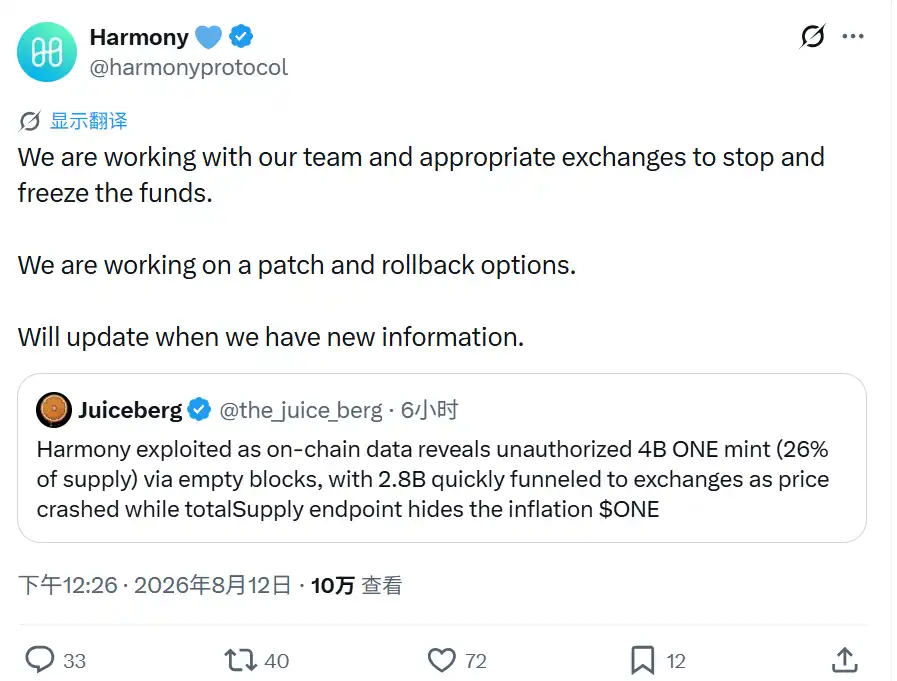
Harmony officials subsequently responded with a repost on X, stating they are collaborating with their team and multiple related exchanges to block and freeze the funds in question; they are also advancing software patch development and evaluating network rollback options.

Later, the officials further disclosed four related wallet addresses, explicitly requesting all exchanges to block and freeze funds traceable to these addresses:

  • one1uap8dx2z0qsjxqthm5flgcxkeepsz3gsrghnfn
  • one17u300a40ll5wphd8kj5hktryhdjq3ml9f4phy4
  • one1a5hur07z5vtvzhr35zkw8tfqedemkz8t88xgd7
  • one1h56hkxmua0uzfv07fu04cudvtrl35u96pq47vy

Around 2:00 PM, the officials announced the suspension of the bridge.harmony.one cross-chain bridge service due to the security incident and requested all validator nodes to immediately upgrade to the latest patch version v2026.1.1. The official explanation stated that this patch can prevent further illicit minting, with subsequent updates to be released to handle the already minted tokens. Relevant release records are visible on GitHub.

This marks the third major security or technical issue directly related to token supply for Harmony in recent years. In June 2022, its Horizon cross-chain bridge was attacked, resulting in the loss of approximately $100 million in assets, an event later attributed by the U.S. Federal Bureau of Investigation to a North Korea-linked hacking group. In December 2023, a bug in the staking system led to the erroneous minting of about 146.3 million ONE tokens, involving 74 addresses, with a single address receiving over 51 million; some tokens were subsequently transferred to exchanges. At that time, officials urgently released a patch and took follow-up measures.

In terms of market scale, although this event caused significant supply dilution and drastic price fluctuations, the absolute loss scale is limited. Prior to the incident, Harmony's market capitalization had fallen to around $17 million; post-incident, it further dropped to the $12 million range, evaporating approximately $5 million in market value. In 2022, Harmony's total TVL once peaked at over $1.4 billion. The latest data from DefiLlama shows its TVL is now less than $170,000.

According to CertiK Alert monitoring, as of around 4:00 PM, the number of ONE tokens abnormally minted on the Harmony network has exceeded 3 trillion (worth approximately $2.34 billion), involving six abnormal blocks.

Initially, the attacker exploited the total supply interface to conceal the issuance data, and different blocks were being packed continuously, so the initial reported 4 billion increase was far from the real figure.
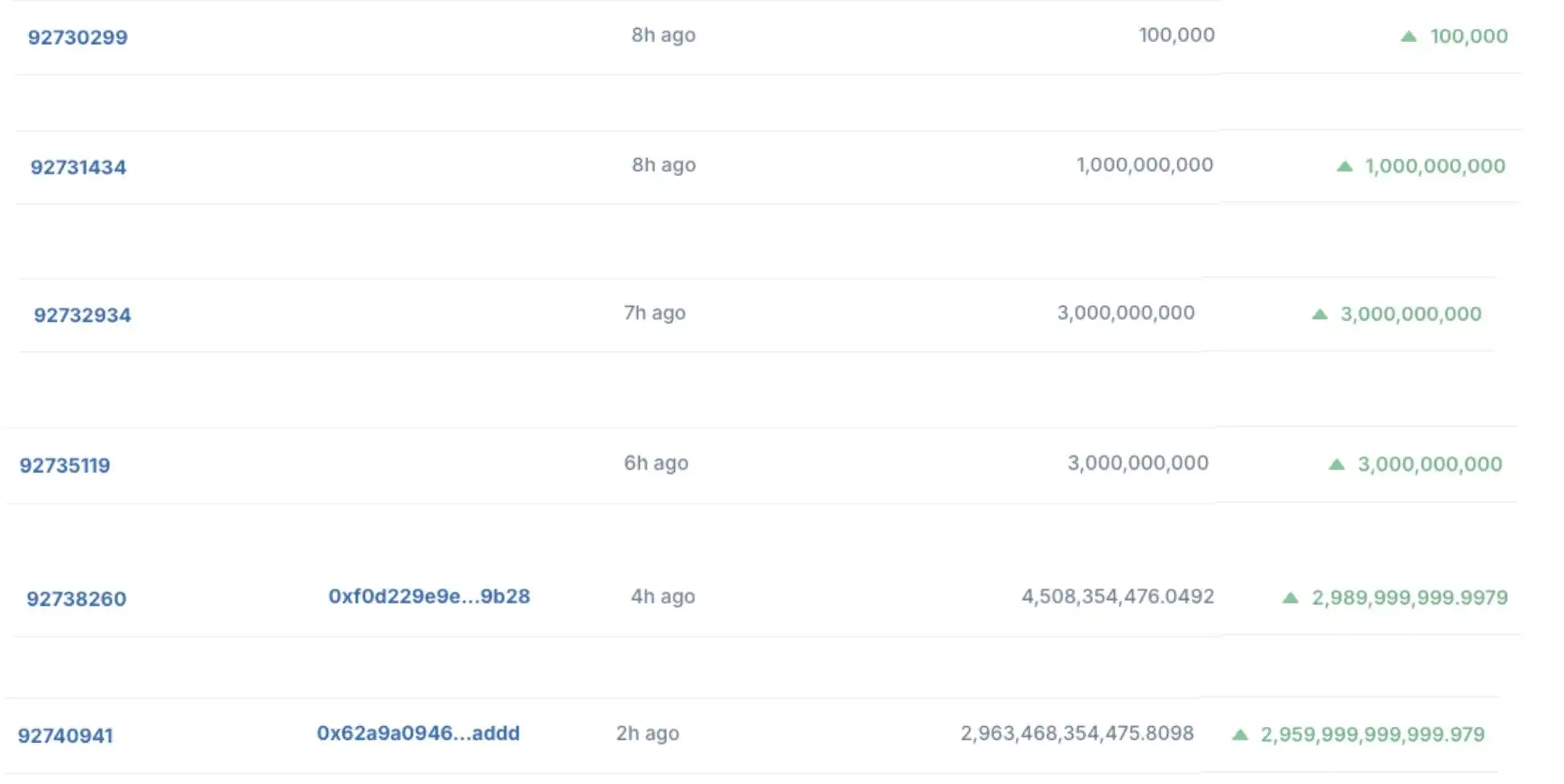
The X account BlockWatchdog analyzed the incident, stating that the attacker exploited a severe logic error in Harmony's cross-shard receipt verification and signature checking, fabricating approximately 3 trillion coins in one go.
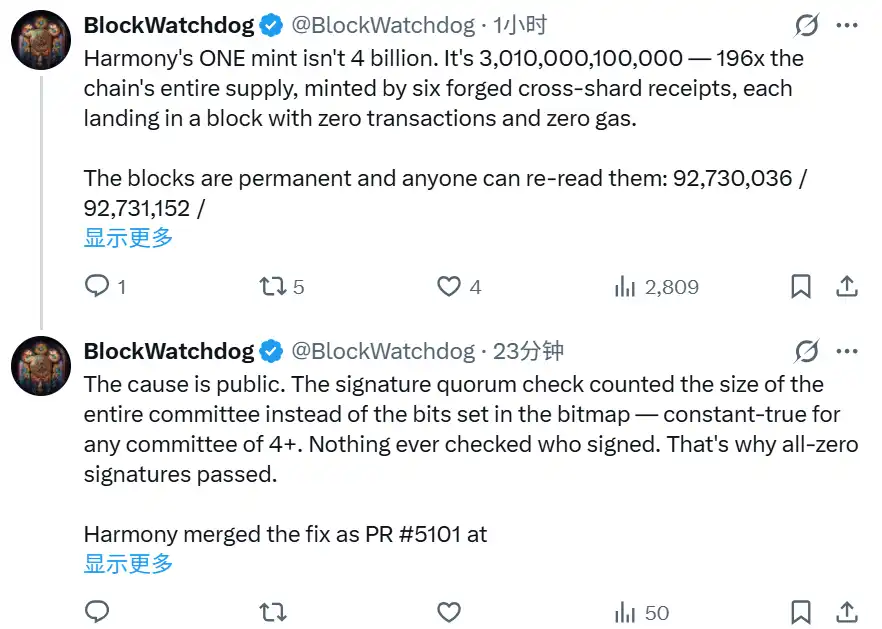
Harmony is a sharded chain; transferring coins between different shards requires a "receipt" for proof. The hacker forged this receipt, and the receipt stated:

It originated from a very old epoch (epoch 100, currently over 3000)

Signatures were all empty (zero signatures)

It was transferred from a dead address (0x00...dEaD)

Normally, the system should reject it outright. However, the system had two vulnerabilities: First, the signature check was flawed. When the system checked "if enough people signed," it only looked at "how many people are in the committee," not "how many actually signed." Result: As long as the committee had ≥4 members, even all empty signatures would pass. It's like a door lock is broken; anyone can push it open. Second, there was a flaw in the anti-replay protection. The system's check for "has this receipt been used before" relied on a field that the attacker could fill for old epochs. Thus, the attacker could repeatedly use the same fake receipt or bypass the check.

With these two vulnerabilities combined, the attacker was able to mint trillions of coins at once.

As of press time, the officials have not yet confirmed whether a network rollback will ultimately be executed. A rollback would mean restoring the chain state to a point before the attack, theoretically mitigating some effects of the illicit minting. However, once a large number of tokens have entered centralized exchanges and transactions are completed, the actual effectiveness would be significantly limited. Whether exchanges effectively freeze related funds, the adoption progress of the patch among validator nodes, and the subsequent handling plan for the already minted tokens will be the core variables of short-term market focus.

As an early Layer 1 public chain focusing on high performance and low fees, Harmony once held a certain position in the DeFi and cross-chain narratives. Consecutive security incidents coupled with long-term market cap shrinkage have significantly reduced its attention in the current crypto market.

This incident once again exposes the vulnerability of small-cap public chains in consensus and supply mechanisms, reminding market participants to more cautiously examine the historical security records and actual on-chain activity of similar projects during evaluation.


Preguntas relacionadas

QWhat was the core technical vulnerability exploited in the Harmony attack according to the article?

AThe attackers exploited a severe logic error involving cross-shard receipt verification and signature checking. The system incorrectly validated receipts with zero signatures if the committee size was greater than or equal to 4, and a replay protection flaw allowed the same forged receipt to be used repeatedly from an old epoch.

QWhat were the immediate actions taken by the Harmony team in response to the security breach?

AHarmony's team collaborated with exchanges to block and freeze funds linked to the attacker's wallets, paused the main cross-chain bridge service, and required all validator nodes to upgrade to a new software patch (v2026.1.1) to prevent further illegal minting.

QHow did the initial reported figure of 4 billion illegally minted ONE tokens change later in the event?

AThe initial report of 4 billion minted tokens was far from the final tally. According to later monitoring by CertiK Alert, the total number of ONE tokens abnormally minted exceeded 3 trillion, with an estimated value of about $2.34 billion.

QWhat is the historical context of major issues related to Harmony's token supply mentioned in the article?

AThis was Harmony's third major security/technical issue related to token supply. In June 2022, its Horizon bridge was hacked for ~$100 million. In December 2023, a staking system bug led to the erroneous minting of approximately 146.3 million ONE tokens.

QAccording to the article, what is one potential but limited remedy mentioned for the attack, and what factors constrain its effectiveness?

AA network rollback to a state before the attack is mentioned as a potential remedy. However, its effectiveness is significantly limited if a large number of the illegally minted tokens have already been deposited into centralized exchanges and traded.

Lecturas Relacionadas

Interview with Dr. Han, Founder of Gate: Fewer User Trades Can Also Be a Better Business

Interview with Dr. Han, founder and CEO of Gate, discussing the launch of Gate Money, a new platform integrating fiat, digital assets, stocks, gold, banking, and payment services. Dr. Han argues that a future where users hold assets and use them for daily spending, rather than frequent trading, represents a better business model. While trading remains Gate's primary revenue source currently, he envisions payment and daily financial services becoming larger as the platform attracts a broader, non-trader user base. Gate Money aims to serve two key groups: those underserved by traditional banking (e.g., for international remittances) and users in mature markets seeking a faster, lower-cost alternative. The app simplifies the interface for these everyday users, contrasting with the complex trader-focused design. Dr. Han details the challenges of expanding into traditional finance, including securing necessary licenses and partnerships with brokers, custodians, and clearinghouses. He also discusses revenue sources for different assets (cash, crypto, stocks) within the platform and addresses transparency and trust-building measures like reserve proofs. Reflecting on his technical background, Dr. Han emphasizes balancing innovation with product refinement. He sees AI agents playing a significant future role in transactions and asset management, with Gate focusing on the user's fund management and allocation side. The interview concludes by noting this shift marks a new chapter for both Gate and Dr. Han himself, as they move beyond a pure exchange model towards broader financial services.

marsbitHace 9 min(s)

Interview with Dr. Han, Founder of Gate: Fewer User Trades Can Also Be a Better Business

marsbitHace 9 min(s)

Castle Labs Report: Solana Builds a Full-Stack On-Chain Economy, From Consumer Apps to the RWA Flywheel

Castle Labs Report: Solana is building a full-stack on-chain economy, driven by a flywheel from consumer applications to RWA. Over the past 30 days, Solana generated $193.1M in application-layer revenue, far ahead of competitors, with consumer apps like launchpads, trading terminals, and wallets contributing ~80%. Contrary to criticism that this revenue is speculative and fleeting, data shows a resilient weekly income floor between $13.5M and $42.6M. Top applications from Q4 2025 largely retained their dominance, with new entrants like StonkFun gaining significant share, demonstrating sustainable demand. Beyond consumer apps, Solana's DeFi ecosystem is rapidly evolving. Lending protocols like Jupiter Lend and Kamino are integrating yield-bearing stablecoins and principal tokens to drive leverage loops. Perpetual DEX volume reached $42B, ranking fourth among chains. Stablecoin supply grew to $16.3B, with new entrants diversifying beyond USDC. Most notably, Solana's Real World Asset (RWA) sector exploded by over 600% in the past year, from $700M to $4.3B, now constituting 26% of Ethereum's RWA size. Tokenized stocks, treasury products, and credit assets are being actively used as collateral in lending markets, with over $650M generating on-chain yield. This integration of productive, yield-bearing RWAs is fueling a new credit expansion flywheel within Solana's financial stack. In summary, Solana has established a robust, high-revenue consumer application base and is successfully channeling that momentum into a mature, diversified DeFi and RWA economy, moving towards a self-reinforcing, full-stack on-chain ecosystem.

marsbitHace 48 min(s)

Castle Labs Report: Solana Builds a Full-Stack On-Chain Economy, From Consumer Apps to the RWA Flywheel

marsbitHace 48 min(s)

S&P 500 Today: A Historical High, The Bottom of a Bull Market

The S&P 500 is near its all-time high, yet presents a paradox: a "bull market within a bear market." While the index is up 23% since its March 30th low, its performance is concentrated; 70% of those gains come from just 10 stocks, primarily large-cap tech names like Nvidia, Apple, and Microsoft. Conversely, 84% of S&P 500 components are in a bear market, trading at least 10% below their highs. This concentration is seen as a potential opportunity. Key drivers like AI are fueling unprecedented corporate earnings growth (52% in Q2 2026). Despite significant price increases, many leading tech stocks now trade at valuations (e.g., forward P/E ratios) comparable to or even below the broader S&P 500, implying a "discount" due to macro headwinds. These include the ongoing Iran war, soaring energy prices, high inflation (~4%), and a shifting Fed policy from expected cuts to hikes. The thesis is that resolving these macro pressures—like an end to the Iran conflict—could trigger a powerful rally. Lower energy prices would ease inflation, potentially allowing a more dovish Fed, eliminate the current valuation discount on tech leaders, and broaden market participation. Combined with persistent investor demand for inflation-hedging assets after 67 months of above-target CPI, this sets the stage for the S&P 500 to surge significantly in 2027, moving from a narrow, resilient bull market to a much broader one.

marsbitHace 49 min(s)

S&P 500 Today: A Historical High, The Bottom of a Bull Market

marsbitHace 49 min(s)

Trading

Spot
活动图片