Sui Reveals What Caused Three Mainnet Halts After Major Network Upgrade

bitcoinistPublicado a 2026-06-02Actualizado a 2026-06-02

Resumen

The Sui mainnet experienced three outages on May 28 and 29 following its 1.72 network upgrade. The first two halts, on Thursday and Friday morning, were caused by a bug in the new hybrid gas charging logic for address balances. A transaction cancellation due to insufficient funds could later trigger an underflow during the gas settlement process. A temporary patch was applied, but a masked error caused a repeat halt Friday morning. The third outage Friday afternoon was a separate issue triggered by a scheduled epoch change. A bug prevented validators from properly persisting the failed status of a randomness generation protocol, stalling the transition. All issues have been resolved with no risk to user funds, and network activity has resumed. The Sui Foundation cited lessons around improving epoch resilience and the critical nature of gas charging logic.

Sui’s mainnet suffered three separate outages across May 28 and May 29 after the network’s 1.72 release exposed edge cases in gas charging and validator restart logic, according to a postmortem from the Sui Foundation. The foundation said the issues have since been resolved, network activity has resumed, and “no user funds were at risk.”

The incidents began on Thursday, May 28, when Sui’s mainnet halted at around 7 a.m. PT and remained down until roughly 1:30 p.m. PT. A second outage followed on Friday morning, starting at about 5 a.m. PT and ending around 8:30 a.m. PT. The third halt began Friday afternoon at approximately 1:30 p.m. PT and was resolved around 7:20 p.m. PT.

According to the foundation, the first two outages stemmed from crash bugs involving the interaction between gas charging logic and Sui’s 1.72 upgrade, which introduced address balances. The third outage was separate, triggered during a scheduled epoch change after validator restarts exposed a latent bug in how randomness state was preserved.

“During the outages, no user funds were at risk, and the network did not revert any committed transactions when it resumed,” the Sui Foundation said. “As of now, validators have fully addressed the known issues caused by both the original gas-charging bug and the randomness-state bug, and network activity has resumed.”

Sui Gas Charging Bug Triggered Initial Halts

The first problem centered on Sui’s new address balance feature, which allows users to store funds and pay for gas without relying solely on coin objects. Transactions on Sui can pay gas through address balances, coin objects, or a hybrid structure combining both.

The edge case emerged in that hybrid gas path. When a transaction attempted to spend from an address balance that could not cover competing transactions, the scheduler correctly cancelled it with an InsufficientFundsForWithdraw error. But later, during gas smashing — the process of combining input coins into a single gas-paying coin — the same reservation could still attempt to debit funds again.

In the foundation’s explanation, the crash did not occur directly during gas smashing but during settlement, when balance deltas were reconciled by a system transaction. A negative delta applied to a zero balance caused an underflow.

The immediate fix was conceptually straightforward: avoid gas smashing when a transaction is cancelled with InsufficientFundsForWithdraw. Validators adopted that fix on Thursday, bringing the network back online. But the foundation acknowledged that the patch was an interim measure, chosen to restore the network while engineers developed a more complete solution.

“Changing gas logic is a delicate operation,” the foundation wrote. “As explained above, there are complicated interactions between address balances and coins. Other than fixing bugs, gas logic changes must preserve all previous behavior or use appropriate version gating.”

That interim patch contained a known weakness. If a transaction had multiple cancellation reasons, another error could mask the InsufficientFundsForWithdraw condition. When that happened Friday morning, the original underflow path could still be reached, causing a second halt.

Epoch Change Exposed Randomness-State Bug

The third outage came after the network had resumed normal operation Friday morning. At the next scheduled epoch change, validators failed to complete the transition because of a bug tied to Sui’s distributed key generation protocol, or DKG, which bootstraps randomness for transactions that depend on on-chain randomness.

During the earlier restart cycle, participation was not high enough for the next epoch’s DKG process, so randomness was disabled as designed. The problem was that the failure verdict was not written to disk. As validators restarted again, they came back up without remembering that DKG had failed.

“With validators no longer remembering DKG had failed, neither could happen, the paused queue grew, and end-of-epoch logic — which must drain that queue before closing — was left waiting on DKG that would never come,” the foundation said.

The fix had two parts: persisting DKG status across restarts and adding a mechanism that allowed validators to close the stuck epoch at a coordinated point. That mechanism was used once to close the affected epoch, after which the network moved into the next epoch and randomness was restored.

The postmortem framed the outages as a broader engineering lesson for Sui. The foundation said end-of-epoch resilience needs further investment, particularly around graceful degradation and operational force-close mechanisms. It also said gas charging deserves the same level of rigor as the Move VM or Mysticeti consensus, given its interaction with settlement, conservation checks, and scheduling.

At press time, SUI traded at $0.8798.
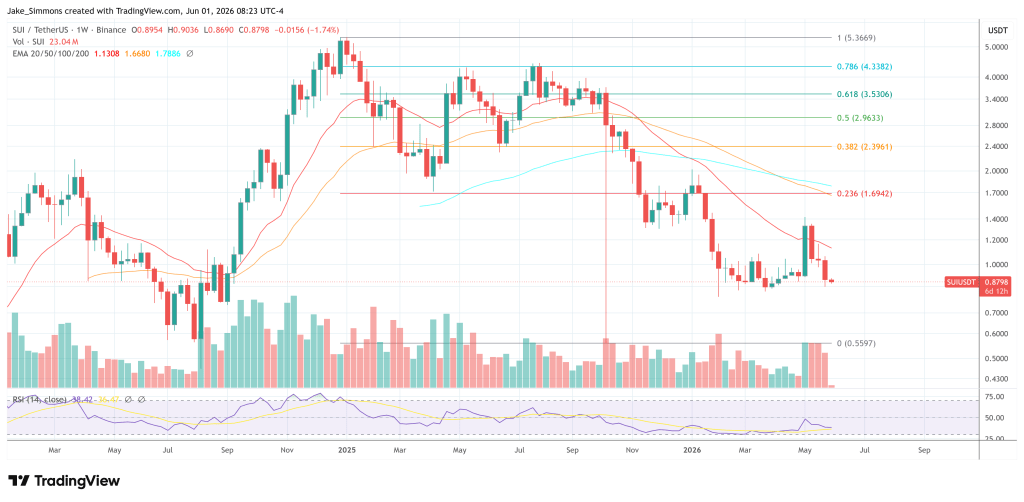
Sui remains below the 20-week EMA, 1-week chart | Source: SUIUSDT on TradingView.com

Preguntas relacionadas

QWhat were the root causes of the three mainnet halts experienced by Sui?

AThe first two outages were caused by crash bugs involving the interaction between the new address balance feature in the 1.72 upgrade and gas charging logic. The third outage was caused by a latent bug related to how randomness state was preserved during validator restarts, which was exposed during a scheduled epoch change.

QAccording to the postmortem, were any user funds at risk during the network outages?

ANo. The Sui Foundation stated that during the outages, no user funds were at risk, and the network did not revert any committed transactions when it resumed.

QWhat specific condition triggered the gas-charging bug that led to the first two halts?

AThe bug was triggered in a hybrid gas payment scenario. When a transaction attempted to spend from an address balance that could not cover competing transactions, it was cancelled. Later, during the 'gas smashing' process, the system incorrectly tried to debit funds from the same cancelled reservation again, leading to an underflow error during settlement.

QWhat was the key issue with the Distributed Key Generation (DKG) protocol that caused the third outage?

ADuring validator restarts, the failure verdict of a DKG process (which was disabled due to low participation) was not written to disk. When validators restarted again, they had no memory of the DKG failure. This caused the end-of-epoch logic to wait indefinitely for a DKG process that would never complete, stalling the epoch transition.

QWhat broader engineering lessons did the Sui Foundation highlight from these incidents?

AThe foundation highlighted two main areas for improvement: 1) Enhancing end-of-epoch resilience with better graceful degradation and operational force-close mechanisms. 2) Applying the same level of engineering rigor to gas charging logic as is applied to the Move VM or consensus, due to its complex interactions with settlement, conservation checks, and scheduling.

Lecturas Relacionadas

From 'Old Dogs' to 'New Darlings': How AI is Revaluing Old Infrastructure, from Dell to Nokia

"Old Dogs" Become AI's New Darlings: Revaluing Legacy Infrastructure The AI investment narrative is shifting. Beyond the spotlight on core chipmakers like Nvidia, a new wave of interest is rising for legacy tech companies—Dell, HPE, Nokia, Cisco, Corning, Western Digital—once labeled as slow-growth, outdated stories. This resurgence stems from AI's evolution from model development to real-world deployment, creating massive demand for physical infrastructure. As AI moves into data center construction and enterprise adoption, the focus turns to who can actually build and deliver complex systems. These established players hold decades of experience in supply chains, integration, networking, and enterprise delivery—assets now critical for scaling AI. The revaluation can be grouped into three key infrastructure areas: 1. **Servers & Integration (e.g., Dell, HPE):** They are becoming essential system integrators, transforming GPUs into full-scale AI servers with networking, power, and cooling, then delivering them to clients. Strong recent earnings and AI-specific revenue/order growth for Dell and HPE underscore this shift. 2. **Networking & Connectivity (e.g., Corning, Nokia, Cisco):** As AI clusters grow, high-speed data transfer becomes paramount. Corning benefits from fiber demand for data center links, Nokia is exploring AI-integrated wireless networks (AI-RAN), and Cisco sees surging orders for data center switches—all critical for efficient AI operations. 3. **Storage (e.g., Western Digital, Seagate):** The AI data explosion requires vast capacity. Beyond high-speed memory (HBM), there's growing need for high-capacity HDDs to store training data, logs, video, and cold/archival data cost-effectively. This revaluation, however, is not a blanket endorsement. True reassessment requires concrete proof: AI-driven orders and revenue growth, upward revisions to company guidance, and sustainable improvements in profit quality, not just top-line sales. In essence, AI is not turning all old tech firms into high-growth stocks; it is selectively re-pricing the "old assets" of companies that are mission-critical for building the new AI infrastructure, transforming their legacy capabilities into renewed growth engines.

marsbitHace 6 min(s)

From 'Old Dogs' to 'New Darlings': How AI is Revaluing Old Infrastructure, from Dell to Nokia

marsbitHace 6 min(s)

Probability in the Price: How World Cup Odds Are Calculated

**The Probability in the Price: How World Cup Odds Are Calculated** Two major systems released their "championship probabilities" before the 2026 World Cup, and they disagreed on the favorite. Prediction market aggregators listed France at around **17%**, while the Opta supercomputer gave European champion Spain **16.1%**. These numbers look similar, but their production methods are fundamentally different. The market's **17%** is the **price** that clears after hundreds of millions of dollars in trading across platforms like Polymarket and Kalshi, where contracts trade between 0 and 100 cents, directly representing implied probability. This liquidity is provided by crypto-native market makers like Wintermute, though the market still has "the liquidity profile of an early-stage" asset class. In contrast, Opta's **16.1%** is a **simulated frequency**. Its model uses team data (including betting market odds as an input) to estimate match probabilities, then runs **10,000 full tournament simulations**, counting how often each team wins. Which is more accurate? There is **no rigorous, cross-tournament academic study** directly comparing their track records. However, a persistent **longshot bias**—where low-probability outcomes are systematically overvalued—observed in traditional betting for nearly a century, has also been found in modern crypto prediction markets. Research shows low-price contracts on Kalshi/Polymer less likely to pay out than their implied odds suggest. Unlike traditional bookmakers, prediction markets operate on **public blockchain ledgers**, making every transaction auditable and enabling such research. However, price formation is also influenced by **regulatory uncertainty**, as seen in recent US state-level bans and legal battles over jurisdiction. In summary, the "probability" you see is either a **market-clearing price** subject to behavioral biases and liquidity constraints, or a **model-simulated frequency** that partially incorporates market data. The question of which method is more reliable remains open, highlighting the importance of asking: **How was this number produced?**

marsbitHace 35 min(s)

Probability in the Price: How World Cup Odds Are Calculated

marsbitHace 35 min(s)

Trading

Spot
Futuros

Artículos destacados

Cómo comprar SUI

¡Bienvenido a HTX.com! Hemos hecho que comprar SUI Network (SUI) sea simple y conveniente. Sigue nuestra guía paso a paso para iniciar tu viaje de criptos.Paso 1: crea tu cuenta HTXUtiliza tu correo electrónico o número de teléfono para registrarte y obtener una cuenta gratuita en HTX. Experimenta un proceso de registro sin complicaciones y desbloquea todas las funciones.Obtener mi cuentaPaso 2: ve a Comprar cripto y elige tu método de pagoTarjeta de crédito/débito: usa tu Visa o Mastercard para comprar SUI Network (SUI) al instante.Saldo: utiliza fondos del saldo de tu cuenta HTX para tradear sin problemas.Terceros: hemos agregado métodos de pago populares como Google Pay y Apple Pay para mejorar la comodidad.P2P: tradear directamente con otros usuarios en HTX.Over-the-Counter (OTC): ofrecemos servicios personalizados y tipos de cambio competitivos para los traders.Paso 3: guarda tu SUI Network (SUI)Después de comprar tu SUI Network (SUI), guárdalo en tu cuenta HTX. Alternativamente, puedes enviarlo a otro lugar mediante transferencia blockchain o utilizarlo para tradear otras criptomonedas.Paso 4: tradear SUI Network (SUI)Tradear fácilmente con SUI Network (SUI) en HTX's mercado spot. Simplemente accede a tu cuenta, selecciona tu par de trading, ejecuta tus trades y monitorea en tiempo real. Ofrecemos una experiencia fácil de usar tanto para principiantes como para traders experimentados.

483 Vistas totalesPublicado en 2024.12.12Actualizado en 2026.06.02

Cómo comprar SUI

Discusiones

Bienvenido a la comunidad de HTX. Aquí puedes mantenerte informado sobre los últimos desarrollos de la plataforma y acceder a análisis profesionales del mercado. A continuación se presentan las opiniones de los usuarios sobre el precio de SUI (SUI).

活动图片