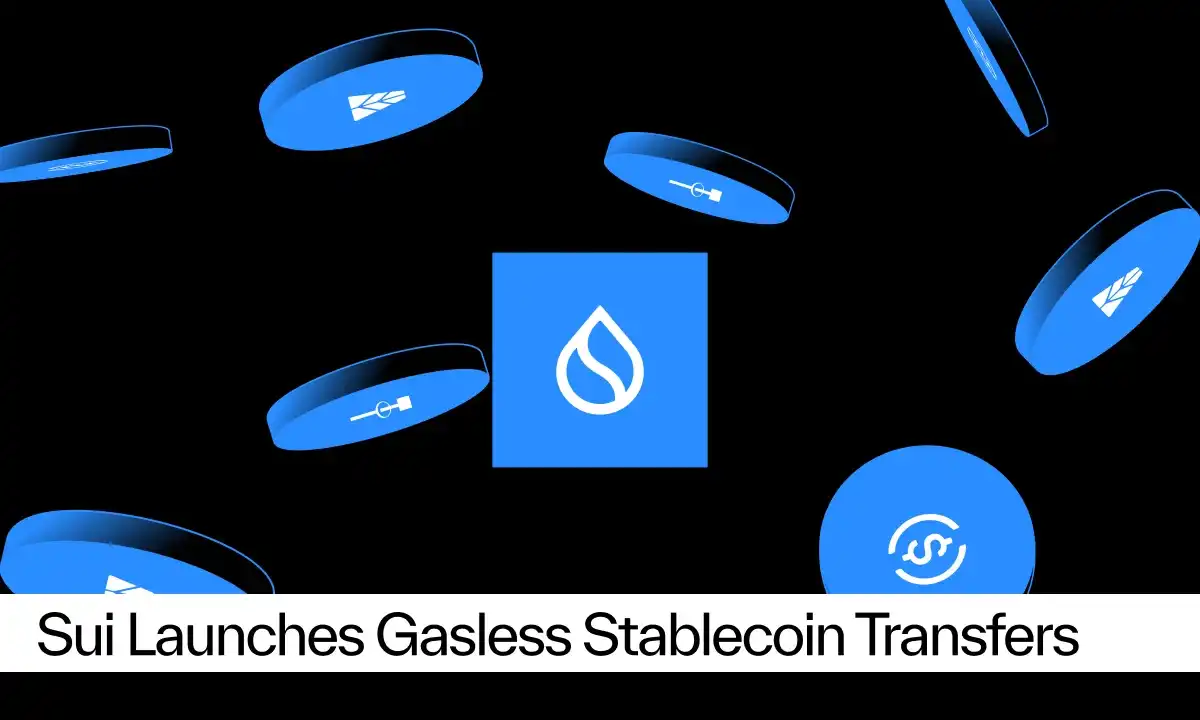
Sui Launches Gasless Stablecoin Transfers, Supported by Fireblocks

marsbitPublicado a 2026-05-21Actualizado a 2026-05-21

Resumen

Sui has officially launched "Gasless Stablecoin Transfers," a new protocol-level feature enabling users and enterprises to send supported stablecoins on Sui without paying gas fees or needing a separate SUI token balance. As the feature rolls out, stablecoin transfer fees on Sui are now effectively $0. Major stablecoins like USDsui, suiUSDe, AUSD, FDUSD, USDB, USDC, and USDY are already supported. This aims to simplify payments and remove a key barrier to mass adoption: requiring users to hold another token for gas. The enterprise platform Fireblocks, securing over $14 trillion in digital asset transactions, has integrated the feature in advance, enhancing institutional accessibility. Other wallets and custodians are also set to support zero-gas transactions. Sui co-founder Adeniyi Abiodun stated this brings Sui closer to being a global payment rail. Fireblocks' Ran Goldi noted it removes a major friction point for businesses building on-chain payments. This is a permanent structural change to Sui's mainnet, not a subsidy. It positions Sui as low-cost infrastructure for enterprises, traders, and AI agents. Sui's stablecoin transfer volume has surpassed $1 trillion since August 2025, with its architecture supporting high-frequency payments. Recent growth includes three SUI Exchange-Traded Products (ETPs) launching in 2026 and the expansion of major stablecoin projects like USDsui and SuiUSDe on the network. Zero-gas stablecoin transfers are now being gradually deployed o...

On May 20, Sui officially announced the launch of "Gasless Stablecoin Transfers".

This is a brand-new protocol-level feature that enables users and enterprises to send supported stablecoins on Sui without paying gas fees or managing a separate SUI token balance.

As this feature begins a gradual roll-out to validators, the transaction fee for stablecoin transfers on the Sui network has now officially been reduced to $0.

Currently, multiple major stablecoins are supported, including USDsui, suiUSDe, AUSD, FDUSD, USDB, USDC, and USDY. This feature aims to simplify the payment process and eliminate one of the biggest friction points in the mass adoption of stablecoins: users needing to hold another token for gas to complete a transaction.

As an enterprise-grade platform securing over $14 trillion in digital asset transactions, Fireblocks has already completed integration ahead of the official launch, as part of Sui's payment ecosystem expansion. Furthermore, numerous institutional custodians and retail-facing wallets will support gasless transactions at launch, allowing users to send specific stablecoins without holding or spending SUI.

Sui's upcoming native support for gasless stablecoin transfers allows users to send supported stablecoins without needing to hold or consume SUI.

Adeniyi Abiodun, Co-founder and CPO of Mysten Labs, stated: "Stablecoins are becoming a major part of global finance, but the infrastructure around them remains unnecessarily complex. From the very beginning, we believed that people shouldn't be charged to move their own money. With the launch of Gasless Stablecoin Transfers, we are one step closer to making Sui a global payment rail for enterprises, AI agents, and everyday consumers alike."

Fireblocks' support further enhances the accessibility of Sui's payment infrastructure for institutions, enabling businesses and financial service providers to securely access and manage on-chain stablecoin activities through trusted digital asset infrastructure.

Ran Goldi, SVP of Payments & Network at Fireblocks, stated: "The future of payments will run on stablecoin rails, but the institutional-grade experience still needs to catch up. Sui is making all the right moves. Gasless Stablecoin Transfers removes one of the biggest friction points for businesses building on-chain payment flows and customer experiences."

Gasless Stablecoin Transfers represent a structural change in how both single and bulk peer-to-peer stablecoin transfers operate on the Sui mainnet. This is not a subsidy, an officially sponsored program, or a temporary marketing campaign. In a competitive market where margins are everything, this upgrade makes Sui the default stablecoin infrastructure for businesses wanting to reduce complexity and operational costs, for traders tired of transaction failures and fee friction, and for AI agents that automatically select the "lowest cost path" to execute payments.

Since August 2025, Sui's total stablecoin transfer volume has exceeded $1 trillion, while its stablecoin ecosystem continues to expand rapidly across institutional, retail, and developer use cases. Sui's horizontally scalable architecture and object-centric model enable the network to support high-frequency payment activities with predictable performance and low operational costs, making it ideal for new payment applications, the agent economy, and enterprise-grade financial systems.

These new protocol mechanisms achieve this goal by significantly reducing processing costs, and Gasless Stablecoin Transfers further eliminate the issues associated with gas pre-funding and volatile treasury management. The end result is simpler infrastructure for institutions and an operational and cost model that truly works for the agent economy and autonomous systems. Free transfers mean gas fees will never exceed the payment amount itself, making micropayments of any size a reality.

The recent momentum in the Sui ecosystem further reflects the rapidly growing market demand for scalable financial infrastructure and stablecoin payments. Already in 2026, three SUI Exchange Traded Products (ETPs) from 21Shares, Grayscale, and Canary Capital have launched globally, further expanding institutional access to the Sui ecosystem. Meanwhile, significant stablecoin projects, including Bridge's Sui Dollar (USDsui) and Ethena's eSui Dollar (SuiUSDe), continue to expand Sui's digital dollar ecosystem, reinforcing its position as internet-scale financial infrastructure.

Gasless Stablecoin Transfers have now begun a gradual roll-out on the Sui mainnet. To learn more about payments on Sui, please visit Sui Payments.

About Sui

Sui is a next-generation Layer 1 blockchain positioned as "making money flow as freely as messages," built for scalable finance and global payments. Created by the core team behind Meta's stablecoin project and built on an object-centric model, Sui makes assets, permissions, and user data programmable and ownable. Sui provides Builders with everything they need to build high-performance payment and financial applications, including instant agentic payments. Learn more: http://sui.io .

About Fireblocks

Digital asset infrastructure company Fireblocks helps institutions of all sizes build, manage, and scale their businesses on the blockchain. Through the industry's most scalable and secure infrastructure platform, Fireblocks offers capabilities for stablecoin payments, settlement, custody, tokenization, trading, financial operations, and compliance reporting. Its services span institutional finance, consumer digital experiences, banks, payment service providers, stablecoin issuers, exchanges, and custodians. Thousands of institutions, including Worldpay, BNY, Galaxy, and Revolut, use Fireblocks to secure over $14 trillion in digital asset transactions across 150+ blockchains. Learn more: http://fireblocks.com .


Preguntas relacionadas

QWhat is the main new feature announced for the Sui blockchain?

ASui announced the launch of 'Gasless Stablecoin Transfers,' a new protocol-level feature that enables users and businesses to send supported stablecoins on Sui without paying gas fees or needing to manage a separate SUI token balance.

QWhich major digital asset infrastructure platform has integrated the new Sui feature before its launch?

AFireblocks, the enterprise-grade platform that secures over $14 trillion in digital asset transactions, has integrated the 'Gasless Stablecoin Transfers' feature prior to its official launch.

QAccording to the Sui co-founder, what role are stablecoins playing and what problem does the new feature address?

AAdeniyi Abiodun, Co-Founder and CPO of Mysten Labs, stated that stablecoins are becoming an important part of global finance, but their infrastructure still has unnecessary complexity. The new feature addresses this by allowing people to transfer their money without being charged, moving Sui closer to becoming a global payments rail.

QHow does the 'Gasless Stablecoin Transfers' feature benefit institutional users specifically?

AThe feature eliminates one of the biggest friction points for institutions building on-chain payment flows and customer experiences. It provides simpler infrastructure and a true operational and cost model suitable for the agent economy and autonomous systems by removing the need for gas pre-funding and volatile treasury management.

QWhat is one key statistic mentioned that highlights the growth of stablecoin activity on Sui?

ASince August 2025, the total volume of stablecoin transfers on Sui has exceeded $1 trillion, demonstrating significant growth and adoption in its stablecoin ecosystem across institutional, retail, and developer use cases.

Lecturas Relacionadas

HYPE Spot ETF Continuously Accumulates 1% in 14 Days: Is the $75 New High Just the Starting Point?

Hyperliquid (HYPE) has surged to a new all-time high of $75 amid strong institutional and ETF-driven buying pressure. The article highlights several key bullish factors. First, the HYPE spot ETFs from 21Shares and Bitwise have seen 14 consecutive days of net inflows, totaling over $136 million and absorbing nearly 1% of HYPE's market cap—a faster initial pace than BTC or ETH ETFs. This ETF demand provides a solid price floor. Second, the protocol's own Assistance Fund (AF) mechanism, which uses 99% of fees to buy back and burn HYPE, has already removed over $1.1 billion worth of tokens, creating a dual support system alongside ETF inflows. This combined buying power is expected to counter potential selling pressure from upcoming team token unlocks. Institutionally, venture firm a16z is now considered one of the largest external holders of HYPE, with multiple addresses accumulating millions of tokens. Galaxy Digital is also actively buying. Analysts and firms like Bitwise and Grayscale are framing HYPE not as a mere meme coin but as a "second-generation" crypto with real value capture and infrastructure potential. Furthermore, Hyperliquid Strategies (PURR), a publicly traded company holding a large HYPE treasury, is set to join the Russell 3000 Index, potentially unlocking further passive investment flows. The ongoing feud between prominent backers like Arthur Hayes (pro-HYPE) and Kyle Samani (pro-SOL) underscores the intense market debate, with Hayes famously betting HYPE will outperform all top-ten crypto assets this year.

Odaily星球日报Hace 12 min(s)

HYPE Spot ETF Continuously Accumulates 1% in 14 Days: Is the $75 New High Just the Starting Point?

Odaily星球日报Hace 12 min(s)

ETH Bull and Bear Views Compilation: Can Ethereum's Value Flow Back to ETH?

Titled "ETH Bull and Bear Views: Can Ethereum's Value Flow Back to ETH?", this article synthesizes the current heated debate around Ethereum's native token, ETH, following Bankless co-founder David Hoffman's decision to sell his entire ETH holdings. The **bullish case**, represented by figures like Tom Lee (BitMine CEO) and Raoul Pal, argues that ETH's core thesis remains intact. They contend Ethereum is the essential, secure, and neutral foundational layer for future finance—encompassing stablecoins, RWA, DeFi, L2s, and Agentic AI. Bulls bet on ETH's long-term revaluation as institutional adoption of on-chain finance grows, with significant buying activity from entities like BitMine and Consensys cited as evidence. Conversely, the **bearish perspective**, led by Hoffman and analysts like Markus Thielen, questions ETH's value capture mechanism. They acknowledge Ethereum's network success but argue that the value created by L2s, DeFi, and applications does not sufficiently accrue to the ETH token itself. Bears point to ETH's prolonged underperformance versus the broader crypto market, lack of traditional cash flows, weakening "ultrasound money" narrative, and apparent institutional retreat (e.g., Harvard Management Company exiting its ETH ETF position) as key concerns. The debate highlights a pivotal shift: ETH is no longer just a community belief asset. The central question is whether ETH can transition from being a "**used infrastructure**" to a "**continuously bought and held core asset**" as more value enters the Ethereum ecosystem. The market is now critically examining the direct link between network growth and ETH's value.

marsbitHace 58 min(s)

ETH Bull and Bear Views Compilation: Can Ethereum's Value Flow Back to ETH?

marsbitHace 58 min(s)

Crypto is dead, Perps are forever

The crypto industry is shifting from a focus on creating native assets (like altcoins and protocol tokens) to becoming a "global asset pipeline." Native cryptocurrencies, except for Bitcoin, are seen as failing in their value storage and utility promises, with demand driven largely by speculation. Attention and liquidity are now moving toward real-world assets (RWAs) like U.S. stocks, bonds, gold, and oil traded on-chain via perpetual contracts (Perps). Stablecoins like USDT and USDC set the precedent, proving blockchain's core strength is efficient global settlement and transfer, not inventing new monetary systems. Meanwhile, assets like Ethereum and many DeFi tokens struggle as their narratives weaken against tangible traditional assets and the rapid real-world progress of AI. Perpetual contracts have emerged as a pivotal innovation. They simplify trading by offering pure price exposure to any asset, bypassing complexities of ownership, custody, and traditional market hours. Projects like Hyperliquid gained traction by combining CEX-like efficiency with on-chain transparency, capitalizing on post-FTX distrust, macroeconomic volatility, and the surge in demand for 24/7 stock trading. In conclusion, while the era of speculative native "crypto assets" may be over, perpetual contracts persist as the industry's most potent financial instrument—transforming all assets into globally accessible, constantly tradable instruments centered on price speculation.

marsbitHace 1 hora(s)

Crypto is dead, Perps are forever

marsbitHace 1 hora(s)

Trading

Spot
Futuros

Artículos destacados

Cómo comprar SUI

¡Bienvenido a HTX.com! Hemos hecho que comprar SUI Network (SUI) sea simple y conveniente. Sigue nuestra guía paso a paso para iniciar tu viaje de criptos.Paso 1: crea tu cuenta HTXUtiliza tu correo electrónico o número de teléfono para registrarte y obtener una cuenta gratuita en HTX. Experimenta un proceso de registro sin complicaciones y desbloquea todas las funciones.Obtener mi cuentaPaso 2: ve a Comprar cripto y elige tu método de pagoTarjeta de crédito/débito: usa tu Visa o Mastercard para comprar SUI Network (SUI) al instante.Saldo: utiliza fondos del saldo de tu cuenta HTX para tradear sin problemas.Terceros: hemos agregado métodos de pago populares como Google Pay y Apple Pay para mejorar la comodidad.P2P: tradear directamente con otros usuarios en HTX.Over-the-Counter (OTC): ofrecemos servicios personalizados y tipos de cambio competitivos para los traders.Paso 3: guarda tu SUI Network (SUI)Después de comprar tu SUI Network (SUI), guárdalo en tu cuenta HTX. Alternativamente, puedes enviarlo a otro lugar mediante transferencia blockchain o utilizarlo para tradear otras criptomonedas.Paso 4: tradear SUI Network (SUI)Tradear fácilmente con SUI Network (SUI) en HTX's mercado spot. Simplemente accede a tu cuenta, selecciona tu par de trading, ejecuta tus trades y monitorea en tiempo real. Ofrecemos una experiencia fácil de usar tanto para principiantes como para traders experimentados.

482 Vistas totalesPublicado en 2024.12.12Actualizado en 2026.06.02

Cómo comprar SUI

Discusiones

Bienvenido a la comunidad de HTX. Aquí puedes mantenerte informado sobre los últimos desarrollos de la plataforma y acceder a análisis profesionales del mercado. A continuación se presentan las opiniones de los usuarios sobre el precio de SUI (SUI).

活动图片