SUI Faces Daily $15 Million Token Unlock, While BEAT Leads $81 Million Token Release Wave This Week

cryptonews.ruPublicado a 2026-07-29Actualizado a 2026-07-29

Resumen

The article discusses significant token unlocks planned for this week in the crypto market. According to Cryptorank, seven assets, including $SUI and $BEAT, are set for major releases. Analyst account Top7 estimates a $74.9 million one-time unlock for $BEAT on August 1, constituting about 2.12% of its circulating supply. $EIGEN and $KITE will also unlock on the same day for $7.65M and $6.08M respectively, with $BTW and $ZAMA following on August 2 for a combined $13.24M. In contrast to these large, concentrated unlocks, the $SUI token follows a different, continuous daily vesting mechanism, distributing approximately $15.4 million worth of tokens weekly into circulation among community reserves, early contributors, and the Mysten Labs treasury. This gradual release is seen as less likely to cause immediate selling pressure compared to one-time events. As of July 29, $SUI trades at $0.69 with a market cap of around $2.78 billion. The piece explains that large unlocks are important for traders as they increase the pool of tokens available for sale, potentially creating downward price pressure if supply outpaces demand. This effect is considered strongest for "cliff" unlocks like $BEAT's. Despite being a regular feature on unlock trackers due to its volume and vesting schedule, $SUI's ecosystem has shown independent growth, including a reported influx of $65 billion in stablecoin volume following a recent fee reduction. A key test will be whether $SUI's price holds steady from ...

Token unlocking occurs when previously restricted circulation cryptocurrencies, typically reserved for the project team, early investors, or an ecosystem fund, become available for trading on the open market. In a Cryptorank review, $SUI was named one of seven assets with significant unlocks scheduled for this week, alongside $BEAT, $BTW, ENA from Ethena, $EIGEN from EigenLayer, $ZAMA from Zama, and $KITE from Kite AI.
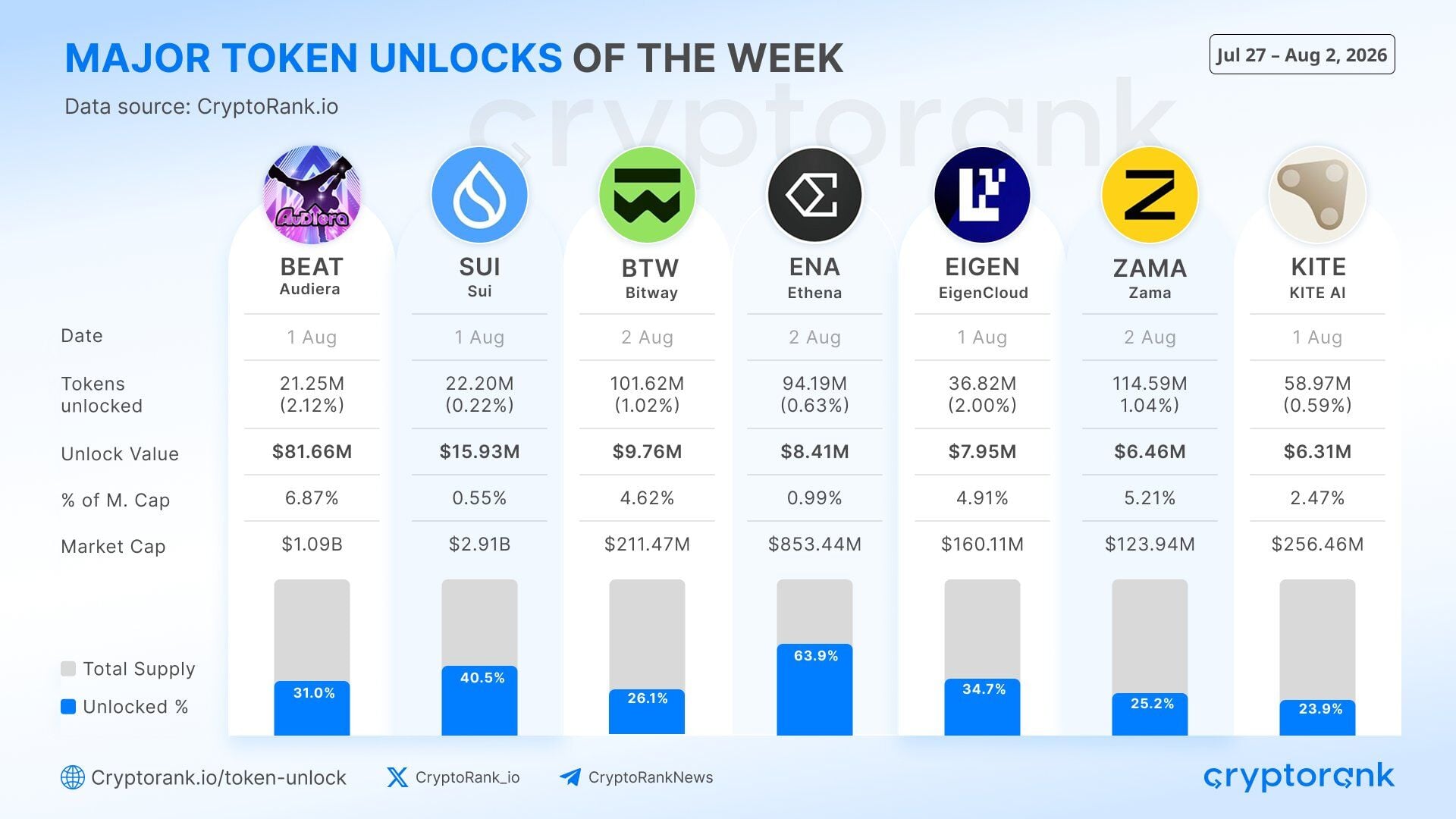
A separate tracker maintained by the crypto analytics account Top7 estimates the $BEAT release volume at $74.9 million, scheduled for a one-time unlock on August 1, representing approximately 2.12% of the total circulating token supply. The $EIGEN and $KITE token unlocks follow on the same day, valued at $7.65 million and $6.08 million respectively, while $BTW and $ZAMA follow on August 2 with a combined value of $13.24 million.

The $SUI Unlock Mechanism Works Differently

Unlike the one-time event for $BEAT, $SUI does not release tokens in a single batch. More precisely, the Sui network, developed by Mysten Labs, distributes the new supply on a constant daily basis to categories such as the Community Reserve, early contributors, and the Mysten Labs treasury.

This structure introduces approximately $15.4 million worth of $SUI into circulation over the week, rather than concentrating the impact on a single trading day.

The maximum supply of $SUI is capped at 10 billion tokens, with about 4.05 billion, or roughly 40%, already in circulation. As of July 29, the token is trading at $0.69, giving it a market capitalization of approximately $2.78 billion.

On August 1 alone, approximately 13.72 million $SUI will be unlocked, distributed among three stakeholder groups: 4 million will go to the Community Reserve, 7.65 million to early contributors, and 2.07 million to the Mysten Labs treasury.

Why Unlocks Affect Markets

Large unlocks are significant for traders as they increase the pool of tokens that can be sold simultaneously. When new supply hits exchanges faster than demand absorbs it, prices can experience downward pressure, especially for tokens where the unlocking holders include venture investors or early team members looking to realize profits.

Analysts tracking vesting schedules argue this effect is strongest with "cliff" unlocks, such as with $BEAT, where a significant portion of supply is released at once, as opposed to gradual daily releases like those for $SUI.

This aspect alone has made $SUI a regular feature on unlock watchlists, not necessarily signaling acute selling pressure. The token has appeared in weekly unlock listings throughout 2026, given its volume and continuous vesting mechanism, even as the Sui ecosystem has shown growth in other areas independent of this.

Earlier this year, Mysten Labs reduced transaction fees on the Sui network, and as reported by Bitcoin.com News, this move helped attract $65 billion worth of stablecoin volume to the network, indicating that trader attention to this asset extends far beyond its unlock schedule.

The next signal to watch is whether the price of $SUI holds steady between August 1 and 2, even as five other tokens simultaneously absorb concentrated releases—this test could determine how traders price in future weeks of unlocks on the Sui network.

end-content

Preguntas relacionadas

QWhat is token unlocking in the context of crypto markets, and why is it significant?

AToken unlocking refers to the release of previously restricted or locked cryptocurrencies—typically reserved for project teams, early investors, or ecosystem funds—into the open market for trading. It is significant because it increases the supply of tokens available for sale. If new supply enters exchanges faster than demand can absorb it, prices can face downward pressure, especially when large, concentrated unlocks occur.

QAccording to the article, how is SUI's token unlock mechanism different from that of BEAT?

ASUI's token unlock mechanism differs from BEAT's in its distribution schedule. SUI does not release tokens in a single, lump-sum event. Instead, the Sui network, developed by Mysten Labs, distributes new supply on a continuous, daily basis to categories like community reserves, early contributors, and the Mysten Labs treasury. This spreads approximately $15.4 million worth of SUI into circulation over a week. In contrast, BEAT is scheduled for a one-time, lump-sum unlock of roughly $74.9 million on August 1.

QWhich token is expected to have the largest value unlock on August 1 according to the tracker mentioned in the article?

AAccording to the tracker from crypto analytics account Top7 mentioned in the article, the token expected to have the largest value unlock on August 1 is $BEAT, with an estimated value of $74.9 million.

QWhat are the three stakeholder groups that will receive unlocked SUI tokens on August 1, and what are the respective amounts?

AOn August 1, three stakeholder groups will receive unlocked SUI tokens: 4 million SUI will go to the community reserve, 7.65 million SUI to early contributors, and 2.07 million SUI to the Mysten Labs treasury.

QWhy do analysts suggest that 'cliff' unlocks (like BEAT's) have a stronger market impact than gradual daily unlocks (like SUI's)?

AAnalysts suggest that 'cliff' unlocks have a stronger immediate market impact than gradual daily unlocks because they release a significant portion of the token supply all at once. This sudden influx of new, sellable tokens can quickly outpace market demand, creating more pronounced downward pressure on prices. Gradual daily releases, like SUI's, distribute the selling pressure over time, which can be more easily absorbed by the market.

Lecturas Relacionadas

Trezor Customer Data Leak: Coins Are Safe, But Phishing Is Inevitable

Trezor, a hardware cryptocurrency wallet manufacturer, reported a data breach at its logistics partner, ShipMonk, affecting around 13,689 customers. The incident, confirmed on August 13, 2026, involved unauthorized access to ShipMonk's systems, which stored order information from May 10 to August 8, 2026. Trezor's own systems and user crypto assets were not compromised. The leaked data varies: for 11,742 customers, full names, email addresses, phone numbers, and delivery addresses were exposed. For 1,947 others, only name, city, and email were leaked. The breach was limited to customers in the US, UK, Sweden, Colombia, Brazil, Italy, and Portugal. Trezor warns affected users of an increased risk of phishing attacks, where malicious actors may use the stolen contact details to impersonate Trezor, banks, or exchanges to steal wallet recovery phrases. All impacted customers have been notified via email. In response, Trezor announced a planned "Anonymous Delivery" feature for the EU (September 2026) and the US (end of 2026), aiming to anonymize logistics data. ShipMonk has not yet issued a public statement on its official website. The analysis highlights this as a recurring industry pattern where third-party logistics vendors become weak links in the supply chain, storing data longer than necessary. Similar incidents, like the 2020 Ledger breach, led to prolonged phishing campaigns. A key question remains whether hardware wallets can ever fully decouple from external logistics risks.

cryptonews.ruHace 8 min(s)

Trezor Customer Data Leak: Coins Are Safe, But Phishing Is Inevitable

cryptonews.ruHace 8 min(s)

Token Buyback Volumes Continue to Rise, But Price Lows Keep Falling

The volume of token buybacks continues to grow, but the minimum price level is constantly declining, according to an internal memo by Bitwise CIO Matt Hogan. He argues that most crypto tokens, except Bitcoin, are undervalued as investors are unaware of the revenue now being returned to holders. He highlights the example of Hyperliquid, which has bought back and burned $1.3 billion worth of its $HYPE token. Hogan posits that tokens are beginning to trade based on revenue, similar to stocks and bonds, marking the end of an era where scaling networks provided little token utility. He links token valuation to strengthening protocol revenue, noting that Hyperliquid has earned over $800 million in the past year and spends nearly all fees on $HYPE buybacks. Following this model, protocols like Uniswap and Aave have implemented fee mechanisms to buy back and burn their own tokens. The trend has also affected base chains like Solana and Aptos, which have proposed or enacted higher fee burns. However, the memo acknowledges that reducing token supply has not reliably boosted prices. A Cryptopolitan report found many tokens with regular buybacks still underperformed the market. Even Hyperliquid's upward trend broke, and Pump.fun conducted significant buybacks near token lows. Hogan cautions that token buybacks differ from stock buybacks due to the lack of contractual claims on profits or assets, as governance rules can always be rewritten.

cryptonews.ruHace 59 min(s)

Token Buyback Volumes Continue to Rise, But Price Lows Keep Falling

cryptonews.ruHace 59 min(s)

Trading

Spot
活动图片