SUBBD Token’s Massive Projected Impact on the Content Creation Market in 2026

bitcoinistPublicado a 2026-02-10Actualizado a 2026-02-10

Resumen

The SUBBD Token ($SUBBD) is projected to significantly impact the $191 billion content creation market by 2026 by addressing inefficiencies in the current creator economy. It aims to replace high-fee centralized platforms with a decentralized, AI-integrated Web3 alternative. The platform consolidates tools like AI Personal Assistants, Voice Cloning, and automated interactions into a single interface, solving tool fragmentation issues. It enables multiple monetization methods, including PPV, NFT sales, and AI-exclusive content, while allowing community-led governance through token-based voting. The presale has raised $1.47 million, with tokens priced at $0.057495. A fixed 20% APY staking reward in the first year incentivizes long-term holding and reduces sell pressure. By combining AI-driven automation with decentralized infrastructure, SUBBD Token positions itself as a comprehensive ecosystem for creators seeking sovereignty and reduced operational overhead.

Trusted Editorial content, reviewed by leading industry experts and seasoned editors. Ad Disclosure

Quick Facts:

  • ➡️ SUBBD Token targets the inefficiencies of the $191B creator economy, aiming to replace high-fee legacy platforms with a decentralized, AI-integrated alternative by 2026.
  • ➡️ The project consolidates essential tools, such as AI Personal Assistants, Voice Cloning, and automated interactions, into a single Web3 interface, solving the problem of tool fragmentation.
  • ➡️ With $1.47M raised and a current price of $0.057495, the project demonstrates significant early interest and financial backing.
  • ➡️ A fixed 20% APY staking reward for the first year creates a robust mechanism for reducing sell pressure while rewarding long-term ecosystem participants.

The digital economy is heading toward a singular, undeniable friction point: the unsustainable rent-seeking of centralized platforms.

As analysts forecast the state of the industry three years out, the consensus surrounding SUBBD Token’s massive projected impact on the content creation market in 2026 is rooted in a fundamental shift from aggregation to autonomy.

Right now, the creator economy is valued at roughly $191B, yet the infrastructure supporting it remains archaic, characterized by opaque algorithms and fee structures that strip creators of up to 70% of their earnings.

This structural inefficiency creates a vacuum for decentralized alternatives. In 2026, market intelligence suggests that Artificial Intelligence won’t merely be a tool for content generation but the primary interface for monetization and community management.

The divergence is clear. On one side, legacy platforms are increasing take rates to satisfy shareholders; on the other, Web3 protocols are using Generative AI to automate workflows and slash overhead.

This collision of AI ubiquity and decentralized finance (DeFi) sets the stage for specialized utility tokens to capture significant market share. Investors and creators aren’t looking for simple payment rails anymore; they want comprehensive ecosystems that solve the ‘fragmentation headache’ of managing subscriptions, AI tools, and payouts across disparate apps.

It’s within this high-stakes environment that SUBBD Token ($SUBBD) has emerged, positioning itself not just as a currency, but as the operational backbone for the next generation of digital interaction.

Read more about $SUBBD here.

Disrupting The $191B Economy Through AI-Driven Autonomy

The projected impact of SUBBD Token ($SUBBD) hinges on its ability to dismantle the current fee logic of the $85 billion content creation industry. Standard platforms operate as walled gardens. SUBBD flips the script, introducing a model where value accrues directly to the user through Ethereum-based EVM-compatible smart contracts.

This isn’t just about lower transaction costs; it’s about using proprietary AI to remove the administrative burden that currently stifles creator growth.

The platform’s technical architecture integrates an AI Personal Assistant and advanced Voice Cloning technology directly into the user experience. For a creator, this means the ability to deploy AI-driven influencers or automate fan interactions without relying on third-party software that demands additional subscriptions.
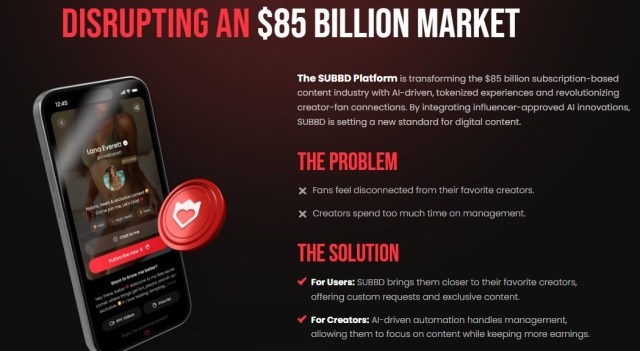
By consolidating these tools, chatbots, object recognition, and content generation, into a single Web3 environment, SUBBD addresses the fragmentation plaguing the sector.

Plus, the introduction of token-gated access fundamentally changes the relationship between creator and consumer. Instead of arbitrary bans or demonetization based on shifting corporate policies, governance is handled through token-based voting. This ensures that the community dictates feature rollouts and content themes.

The data points to a clear trend: creators are migrating toward platforms that offer sovereignty. SUBBD’s provision of multiple monetization routes, including PPV, NFT sales, and AI-exclusive content, suggests a strategic alignment with where the market is heading in 2026.

Explore the SUBBD Token presale here.

Presale Momentum And The Case For 20% APY Staking Rewards

While the technological utility provides the long-term thesis, the immediate market reaction is visible in the project’s capital accumulation.

According to official data, the SUBBD Token presale has already raised $1.47M, a figure that indicates strong early conviction from retail and sophisticated investors alike. With tokens currently priced at $0.057495, the market is pricing in the potential for this asset to bridge the gap between speculative crypto assets and tangible software-as-a-service (SaaS) utility.
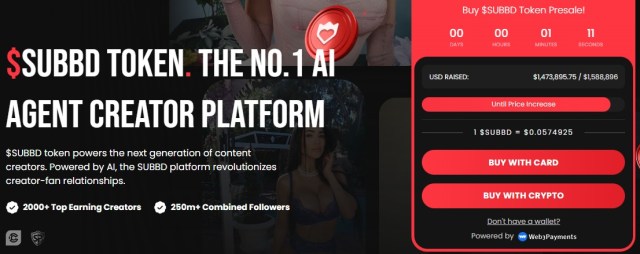
The tokenomics structure (often a weak point in new projects) looks designed to mitigate the volatility typically associated with early-stage utility tokens.

The protocol offers a fixed 20% APY for staking during the first year. This mechanism serves a dual purpose: it incentivizes long-term holding to reduce circulating supply pressure and aligns user interests with platform growth.

Beyond simple yield, staking unlocks specific platform benefits, such as XP multipliers and access to exclusive ‘HoneyHive’ content and behind-the-scenes drops.

For investors analyzing the 2026 horizon, the critical metric is user retention. The integration of financial incentives (staking) with product utility (AI tools) creates a ‘sticky’ ecosystem.

Unlike meme coins driven by ephemeral hype, SUBBD Token is leveraging its capital raise to build an infrastructure capable of handling high-throughput interactions between fans and AI-augmented creators. As the presale continues, the focus remains on how effectively this capital gets deployed to capture market share from legacy giants before the 2026 maturation point.

Buy $SUBBD here.

This article is for informational purposes only and does not constitute financial advice. Cryptocurrency investments, including presales and staking, carry inherent risks due to market volatility. Always conduct your own due diligence before participating in any token sale.

Editorial Process for bitcoinist is centered on delivering thoroughly researched, accurate, and unbiased content. We uphold strict sourcing standards, and each page undergoes diligent review by our team of top technology experts and seasoned editors. This process ensures the integrity, relevance, and value of our content for our readers.

patrubogdan

Follow

Full Profile

Related Posts

Government Shutdown Fears Trigger 2% Crypto Dip, But Bitcoin Hyper Remains Unshaken

Dogecoin Tries to Hold $0.09370 – Is 2026 the Doge Year or Will $MAXI Take Over?

US Debt Spiral Eyes $39T: Why Bitcoin Hyper ($HYPER) Is The Hedge to Watch

Crypto Exchange Backpack Targets Token Launch Soon, as BMIC Fires Up Quantum Defense

Ethereum Foundation Backs SEAL Initiative as LiquidChain L3 Protocol Gains Traction

Vitalik Buterin Outlines Ethereum’s AI Future, While SUBBD Token Targets the Creator Economy

Preguntas relacionadas

QWhat is the core problem SUBBD Token aims to solve in the $191B creator economy?

ASUBDD Token aims to solve the structural inefficiencies and high fees of centralized platforms, which can strip creators of up to 70% of their earnings, by providing a decentralized, AI-integrated alternative.

QWhat key AI technologies are integrated into the SUBBD platform to help creators?

AThe platform integrates an AI Personal Assistant, advanced Voice Cloning technology, chatbots, object recognition, and content generation tools into a single Web3 interface.

QHow much capital has the SUBBD Token presale raised and what is the current token price?

AThe SUBBD Token presale has raised $1.47 million, with tokens currently priced at $0.057495.

QWhat is the purpose of the fixed 20% APY staking reward in the SUBBD ecosystem?

AThe fixed 20% APY staking reward for the first year serves a dual purpose: it incentivizes long-term holding to reduce sell pressure and aligns user interests with platform growth by rewarding ecosystem participants.

QHow does SUBBD's token-gated access change the creator-consumer relationship?

AToken-gated access shifts governance to the community through token-based voting, preventing arbitrary bans or demonetization from centralized corporate policies and allowing the community to dictate feature rollouts and content themes.

Lecturas Relacionadas

From South Korea to the United States: Blue-Collar Jobs Are Becoming Increasingly Popular, Thanks to AI

AI is reshaping the labor market's value proposition. The traditional four-year college degree is losing its appeal as a guaranteed career path, while skilled blue-collar trades like electricians, welders, and plumbers are experiencing historic demand and wage premiums. This shift is driven by dual pressures: AI's displacement of certain white-collar roles and a booming need for physical infrastructure and data center construction. Data confirms the trend. In the U.S., vocational school revenue surged, and a significant portion of recent layoffs are AI-related. Surveys show a majority of Gen Z adults plan to pursue blue-collar work, citing better job security against AI automation. Vocational education interest has exploded recently. Experts cite a psychological shift as younger generations seek tangible, AI-resistant careers and avoid high student debt. In many cases, salaries for skilled trades now match or exceed those requiring a bachelor's degree. In South Korea, semiconductor vocational high schools boast near-total employment, with graduates securing high-paying roles at companies like Samsung. The shortage is structural, exacerbated by a retiring baby boomer workforce and massive infrastructure projects. Companies like JPMorgan Chase, Meta, and Lowe's are investing heavily in training programs. However, overcoming historical stigma and a "perception gap" around trade careers remains a key challenge to closing the talent gap.

marsbitHace 58 min(s)

From South Korea to the United States: Blue-Collar Jobs Are Becoming Increasingly Popular, Thanks to AI

marsbitHace 58 min(s)

Qualcomm: AI Hype Subsides, When Will Smartphones Emerge from the Gloom?

Qualcomm reported its Q3 FY2026 results (ending June 2026), with revenue of $9.95B, down 4% YoY but above expectations. Gross margin declined to 53.1%, pressured by rising costs across manufacturing and memory. Key business segments showed mixed performance: Handset revenue fell 19.6% YoY to $5.09B, dragged by an 11% decline in non-Apple Android shipments and weaker high-end mix. Conversely, Automotive revenue surged 61% to $1.59B, and IoT grew 9% to $1.83B. Core operating profit dropped 41% YoY due to margin compression and higher expenses. Management's Q4 FY2026 guidance projects revenue of $9.7B-$10.5B, in line with consensus, but Non-GAAP EPS guidance of $2.05-$2.25 fell short of expectations. Amidst persistent weakness in its core handset market, Qualcomm is pursuing growth in AI, focusing on Edge AI (smartphones, PCs, automotive) and Data Center AI. Its data center strategy includes four pillars: AI accelerators (e.g., AI200), commercial CPUs (Dragonfly C1000), custom silicon, and connectivity solutions. While these initiatives initially boosted its stock, concerns over AI capital expenditure sustainability have since erased those gains. The company targets $5B in data center revenue for FY2027 and $15B for FY2029. The report concludes that with the traditional handset business still under pressure, the data center opportunity is currently viewed as a longer-term option, and a more conservative valuation based on core operations may be warranted until AI contributions materialize.

marsbitHace 1 hora(s)

Qualcomm: AI Hype Subsides, When Will Smartphones Emerge from the Gloom?

marsbitHace 1 hora(s)

From TPU to Self-Evolving Agents: How Jeff Dean Predicts the Next Step in AI

At the 2026 YC Startup School, Jeff Dean outlined his vision for AI's next phase, shifting focus from simply scaling models to building intelligent, autonomous systems. He believes AI's progress is no longer just about creating smarter models, but about integrating them into systems capable of long-term, iterative work, automated experimentation, and continuous learning. This evolution moves the competition from "who has the bigger model" to "who can best organize intelligence." Dean suggests AI capabilities are now comparable to a junior engineer, enabling the automation of complex workflows. However, the true challenge and opportunity lie in managing these AI "workers" at scale. He emphasizes the importance of **context engineering**—structuring tools, memory, and feedback loops—over raw model power. For startups, this means building deep expertise in niche domains where general models currently fail (near 0-1% success rates), leveraging proprietary data, specialized tools, and domain-specific evaluators. A recurring theme is re-examining fundamental constraints. Dean's past work, like moving Google's search index to memory or creating the TPU, stemmed from questioning outdated assumptions about hardware and cost. He sees similar inflection points today, particularly in **specialized inference hardware** to drastically reduce latency and energy consumption for real-time Agent operation. Notably, he points out that in modern AI systems, the dominant cost is often not computation but **data movement**. Reliable, long-running Agents require robust system design, borrowing concepts from distributed computing like checkpointing, state management, and parallel exploration to handle failures and maintain progress over days or weeks. As AI automates execution, the scarcest human skills will shift to **defining clear specifications**, **judging what problems are worth solving** (taste), and designing effective feedback loops. Ultimately, Dean's framework prioritizes understanding the problem deeply, identifying the true bottlenecks, and systematically building closed-loop systems where AI can not only perform tasks but also improve AI itself.

marsbitHace 1 hora(s)

From TPU to Self-Evolving Agents: How Jeff Dean Predicts the Next Step in AI

marsbitHace 1 hora(s)

Trading

Spot
活动图片





