Structural Weakness

insights.glassnodePublicado a 2026-02-11Actualizado a 2026-02-11

Resumen

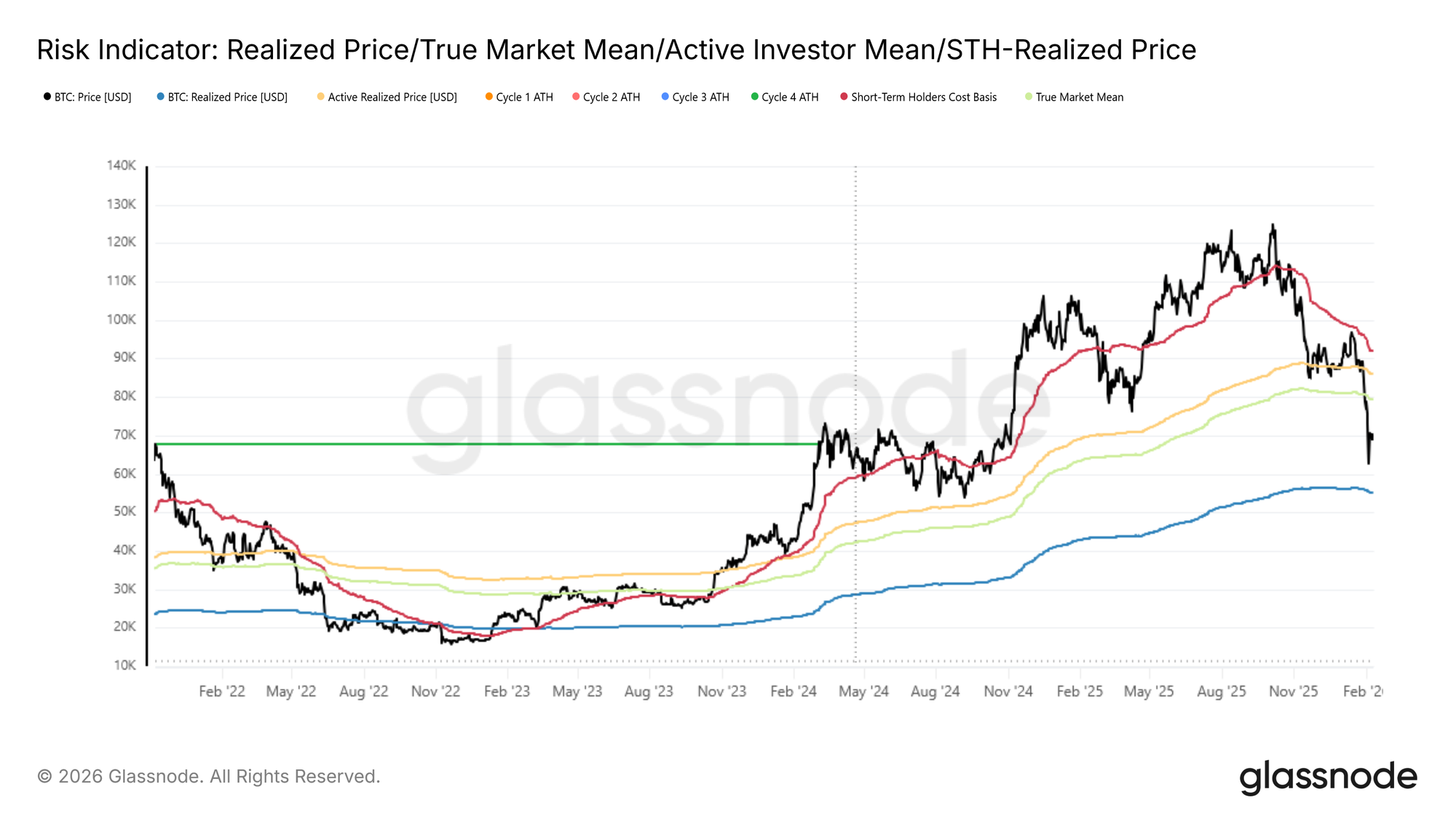
Since recording an all-time high in early October, Bitcoin has entered a structurally weak phase, trading within a range bounded by the Realized Price near $55k and the True Market Mean around $79.2k. The market is currently testing the $60k–$72k accumulation range from H1 2024, where buyer support has emerged, but overhead supply and negative institutional flows pose significant resistance. Off-chain data shows broad de-risking, with Digital Asset Treasury flows turning negative and spot volume lacking sustained demand. Derivatives markets indicate reduced speculative activity, elevated implied volatility, and persistent demand for downside protection, reflecting a cautious and fragile sentiment. Without a strong catalyst or renewed institutional demand, Bitcoin is likely to remain range-bound with elevated volatility, as the market struggles to establish a durable foundation for upward momentum.

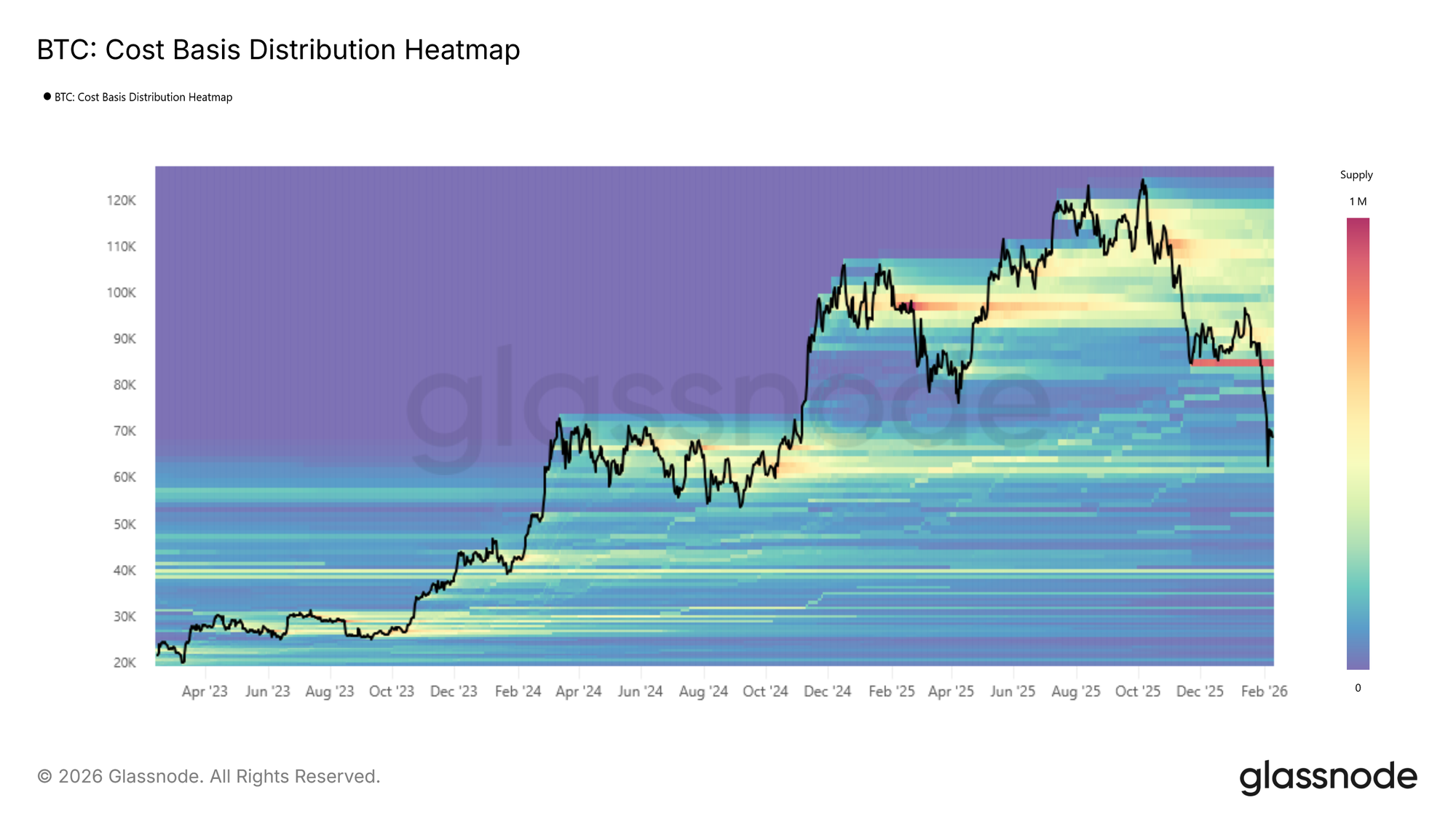
Since recording a new all-time high in early October, Bitcoin has progressed through three distinct structural phases. The first was a sharp contraction, with price rapidly declining toward the True Market Mean, a level repeatedly tested through late November 2025. This was followed by an extended consolidation period, where the price held marginally above this threshold into late January 2026. Most recently, the market entered a third phase, defined by a decisive breakdown below the True Market Mean, accelerating the move toward the $60k region.

New Trading Range

The prevailing range in the cited third phase, currently bounded by the True Market Mean near $79.2k and the Realized Price around $55k, closely resembles the structural environment observed during the first half of 2022.

Similar to Q2 2022, the price is expected to continue oscillating within the Realized Price and True Market Mean corridor, as time and further compression are required for new buyers to emerge and gradually accumulate supply.

A meaningful regime shift, in the short-term, would likely require an out-of-ordinary catalyst, either a decisive reclaim of the True Market Mean near $79.2k, signaling renewed structural strength, or a systemic dislocation similar to LUNA or FTX that forces price below the Realized Price around $55k. In the absence of such extremes, a prolonged phase of range-bound absorption remains the most probable path for the mid-term market.
Live Chart

Defending An Old Accumulation Range

Thus far, sell-side pressure has largely been absorbed within the same oscillatory band that defined much of H1 2024, between $60k and $72k. This repeated defense suggests emerging conviction among buyers willing to accumulate within this corridor. In a constructive scenario, sustained absorption across this range could mirror prior strong accumulation phases, laying a durable foundation for the next impulsive advance.

However, the durability of this structure ultimately depends on the intensity and persistence of demand. The extent to which buyers step in aggressively across the $60k–$72k zone will determine whether the market remains range-bound and stabilizes, or whether weakening absorption opens the door to deeper downside exploration.
Live Chart

Overhead Supply Risk

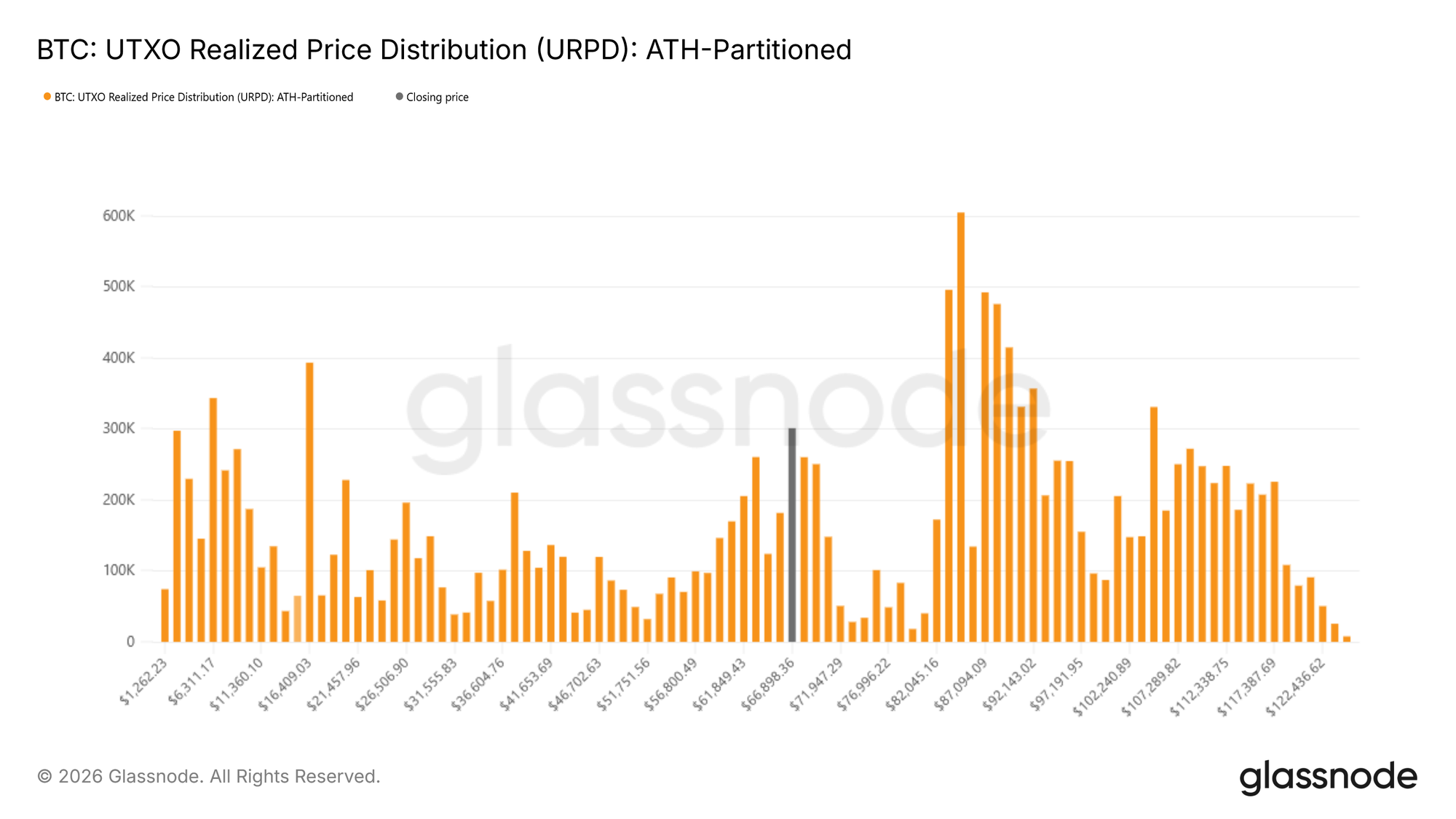
To evaluate whether demand within the $60k–$72k corridor is strengthening, we turn to cost-basis distribution data. The UTXO Realized Price Distribution (URPD) provides a granular view of supply based on the price at which coins last moved, allowing us to identify discrete accumulation clusters. Current readings show that price has so far found support within a dense supply band formed during H1 2024, concentrated between $60k and $72k. This suggests that prior buyers in this range are actively defending their positions.

However, overhead supply remains structurally heavy. Significant clusters are positioned between $82k–$97k and $100k–$117k, representing cohorts now holding substantial unrealized losses. These zones may act as latent sell-side overhang, particularly if prolonged time under water or renewed downside volatility triggers further capitulation.
Live Chart

Tracking Bear Market Tops

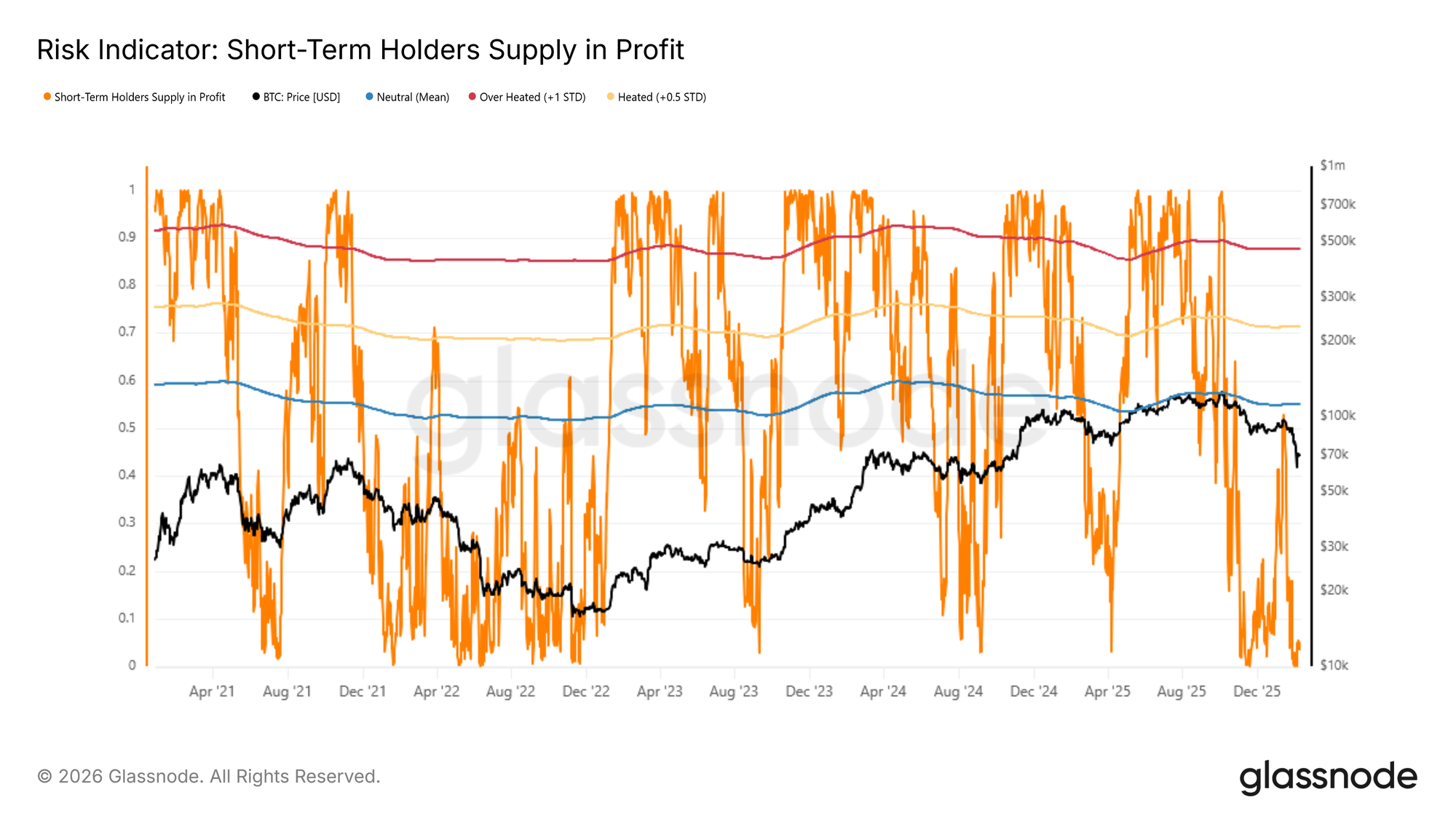
Within this range-bound structure, identifying tactical inflection points becomes critical. Assuming the mid-term corridor remains defined by the Realized Price on the downside and the True Market Mean overhead, monitoring local rally dynamics becomes particularly important in a bear regime. Historically, early-stage bear markets tend to see counter-trend rallies capped by recent buyers distributing into strength. As such, sharp expansions in their unrealized profit often precede local top formation.

The Short-Term Holders Supply in Profit metric provides a useful gauge of this oscillation. When positioned within its statistically derived “mean-heated” band, spanning from the historical average to +0.5 standard deviations, prior bear market rebounds have frequently stalled. At present, this metric sits near 4.9%, indicating that the majority of recent buyers remain underwater. This subdued profitability underscores a structurally fragile environment, where upside momentum may struggle to sustain without meaningful demand expansion.
Live Chart

Off-Chain Insights

Digital Asset Treasury Flows

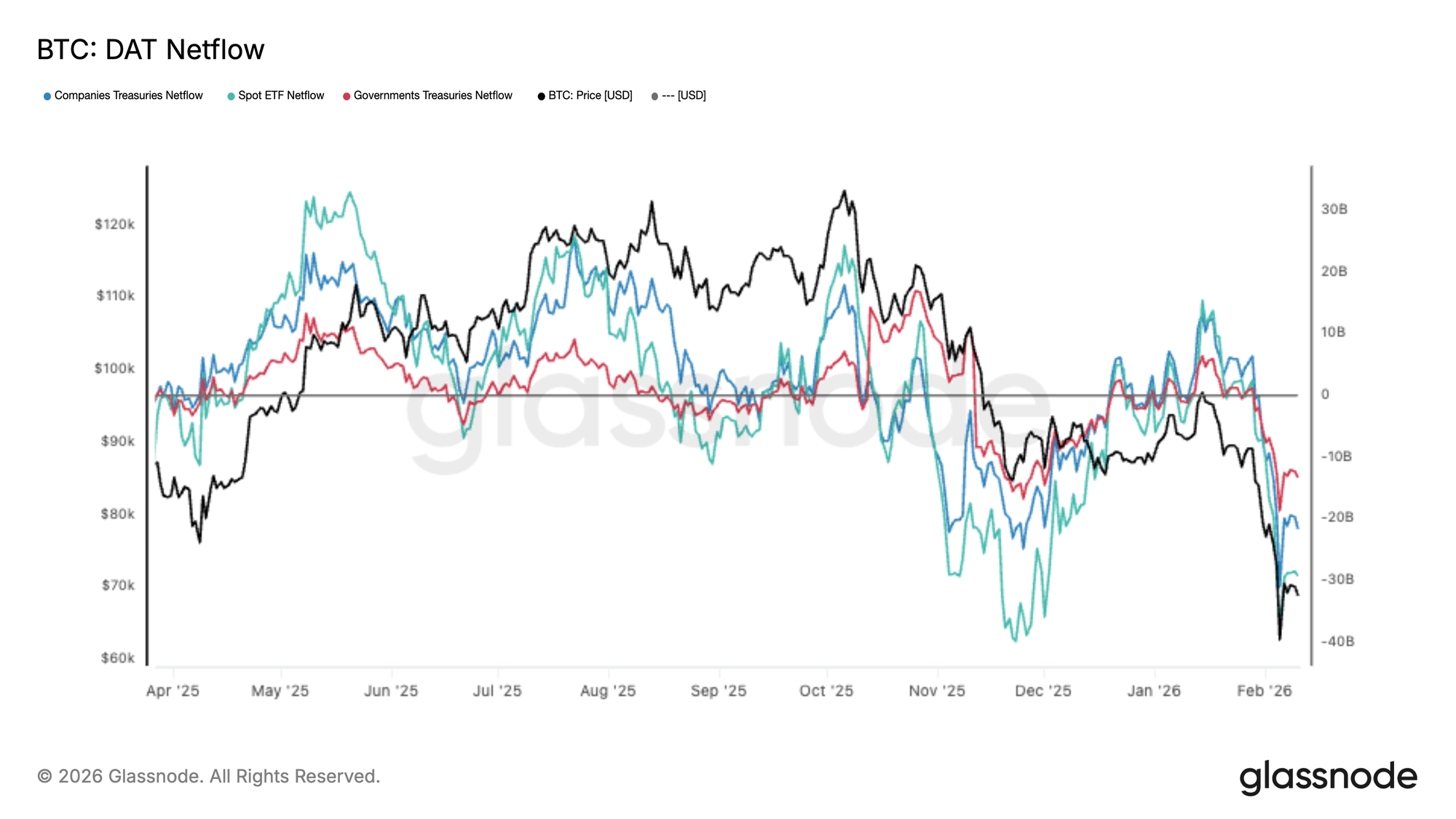
Digital Asset Treasury (DAT) flows have turned sharply negative, with spot ETF, corporate, and government treasuries all registering simultaneous net outflows as Bitcoin trades into fresh local lows. ETF treasuries are driving the majority of the move, while corporate and sovereign flows reinforce that selling pressure is broad rather than isolated. This alignment signals a clear shift toward de-risking, where marginal institutional demand has stepped back and supply is dominating near-term order flow.

The scale of these outflows highlights ‘heavy’ spot conditions, with absorption struggling to keep pace with distribution. Rather than reflecting tactical rotation within a single cohort, the synchronized nature of the move suggests a market-wide pullback in treasury exposure. Until DAT flows stabilize, price action remains sensitive to continued selling pressure, with volatility likely dictated by how quickly new buyers step in to counterbalance the current wave of institutional distribution.
Live Chart

Lackluster Spot Volume

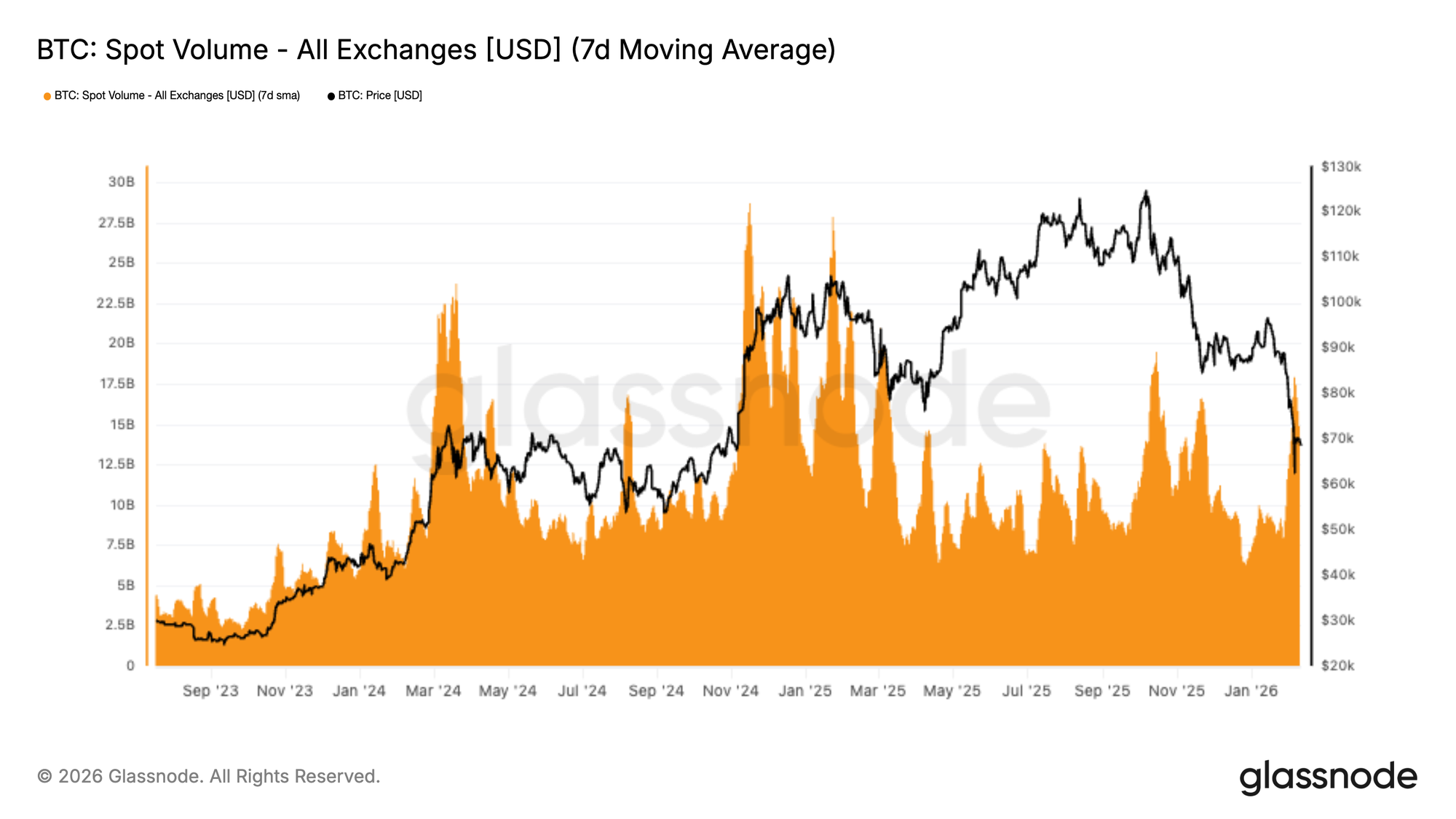
Spot trading volume expanded sharply during Bitcoin’s selloff into the low-$70Ks, with the 7-day average registering a clear spike as volatility accelerated. This increase reflects reactive participation as traders responded to rapid downside movement, rather than a broad wave of fresh conviction buying. Notably, the volume expansion faded quickly after the initial surge, suggesting that while the move drew attention, it did not translate into sustained spot demand.

The lack of follow-through indicates that absorption remains shallow relative to the scale of selling pressure. Instead of signalling accumulation, current activity appears driven by short-term repositioning and liquidation-related churn. Without continued participation on the bid, price remains sensitive to further volatility, as the market has yet to demonstrate the kind of persistent volume support typically associated with stabilization. For now, spot flows reflect engagement during stress, not a decisive shift toward constructive demand.
Live Chart

Futures Premium Cools Off

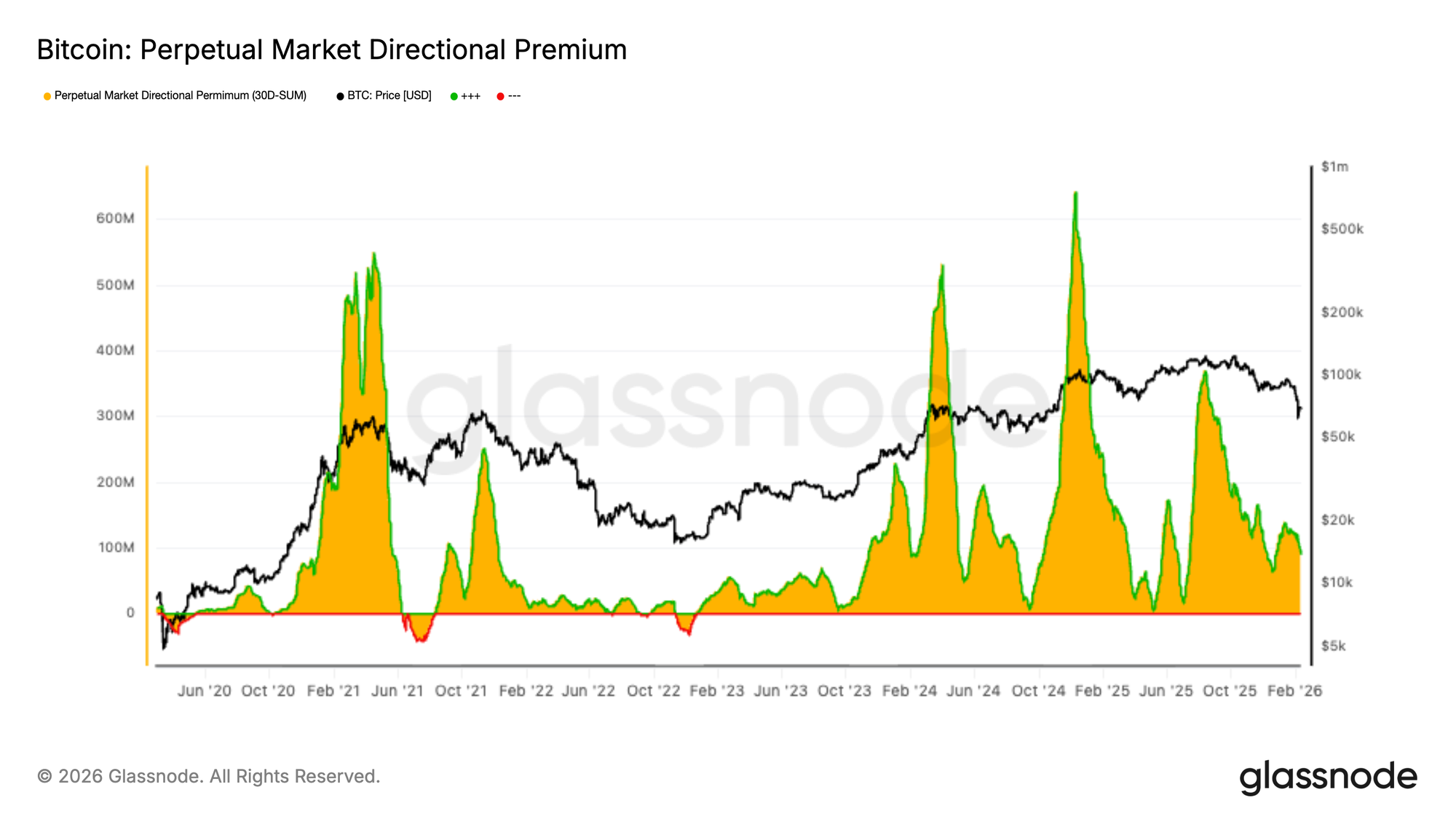
Perpetual futures positioning has cooled notably, with the directional premium compressing toward neutral territory following the recent pullback. This reflects a clear reduction in speculative activity, as leveraged traders step back rather than aggressively positioning for continuation in either direction. Earlier in the cycle, elevated premiums coincided with strong directional conviction, but the current regime suggests a market lacking appetite for leveraged exposure.

The contraction highlights a broader decline in futures participation, where risk appetite has faded alongside volatility. Instead of seeing aggressive short positioning or renewed long speculation, traders appear hesitant, resulting in thinner directional flows. This subdued derivatives activity removes a key source of momentum that often amplifies price swings, leaving spot markets to dictate near-term direction. For now, the futures complex signals caution and reduced conviction, consistent with a market transitioning into a lower-energy phase following the recent selloff.
Live Chart

Implied Volatility Signals a Higher Risk Regime

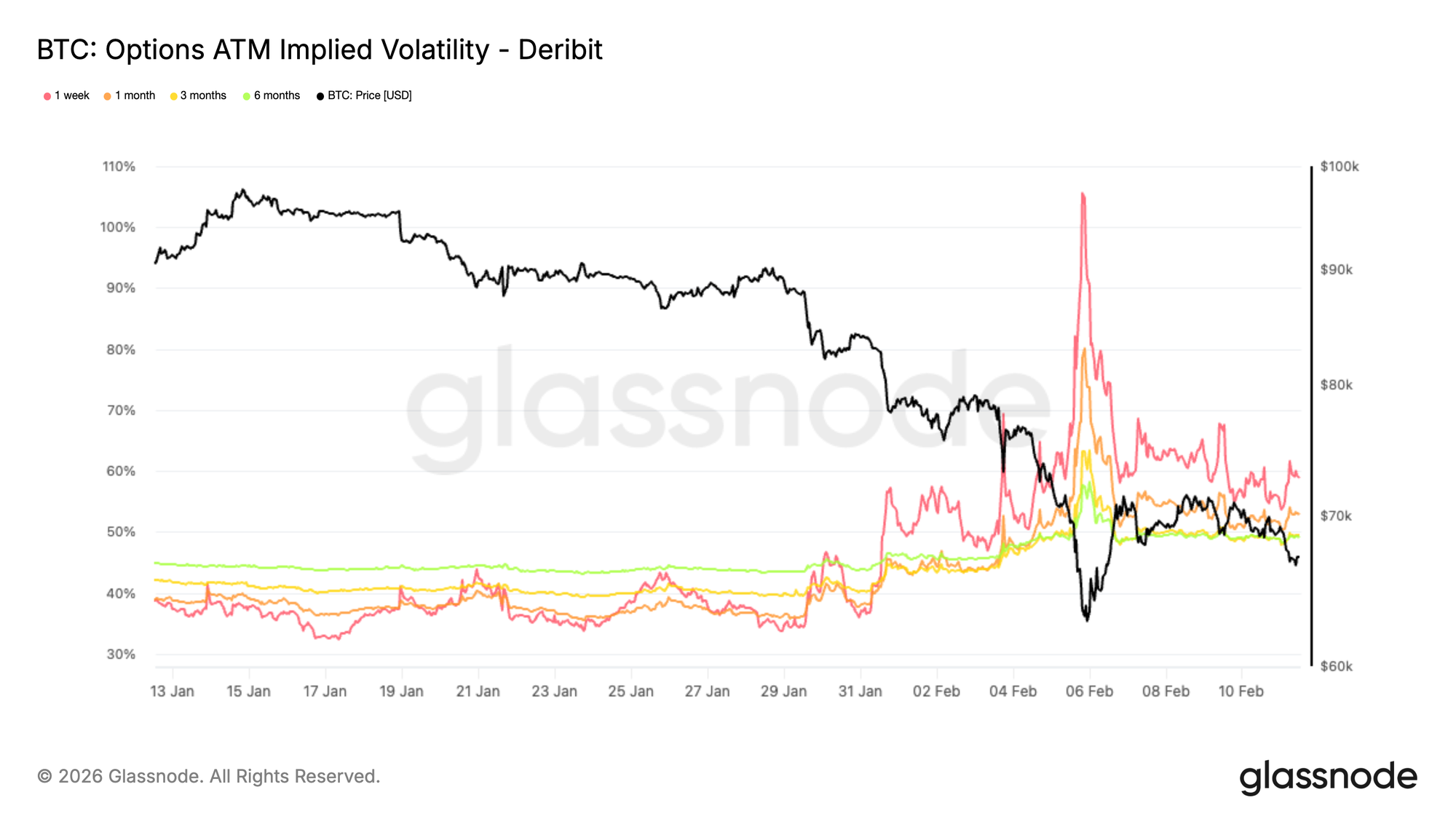
The first structural shift after the capitulation event is visible in the implied volatility regime. Looking at the 1 month ATM implied volatility chart, the distinction is clear. Longer dated maturities repriced higher, with 6 month implied volatility gaining more than 5 volatility points since the beginning of the month, and 3 month rising by roughly 9 points.

The most significant jump occurred in the front end, where 1 week implied volatility surged by more than 20 points. Implied volatility reflects how much movement the market expects going forward. Moves of this magnitude rarely represent a temporary spike. They signal a repricing of forward risk across the surface.

Although volatility has eased from its peak, it remains elevated across maturities, indicating that traders continue to price sustained uncertainty rather than a quick return to calm conditions.
Live Chart

25 Delta Skew Shows Persistent Downside Demand

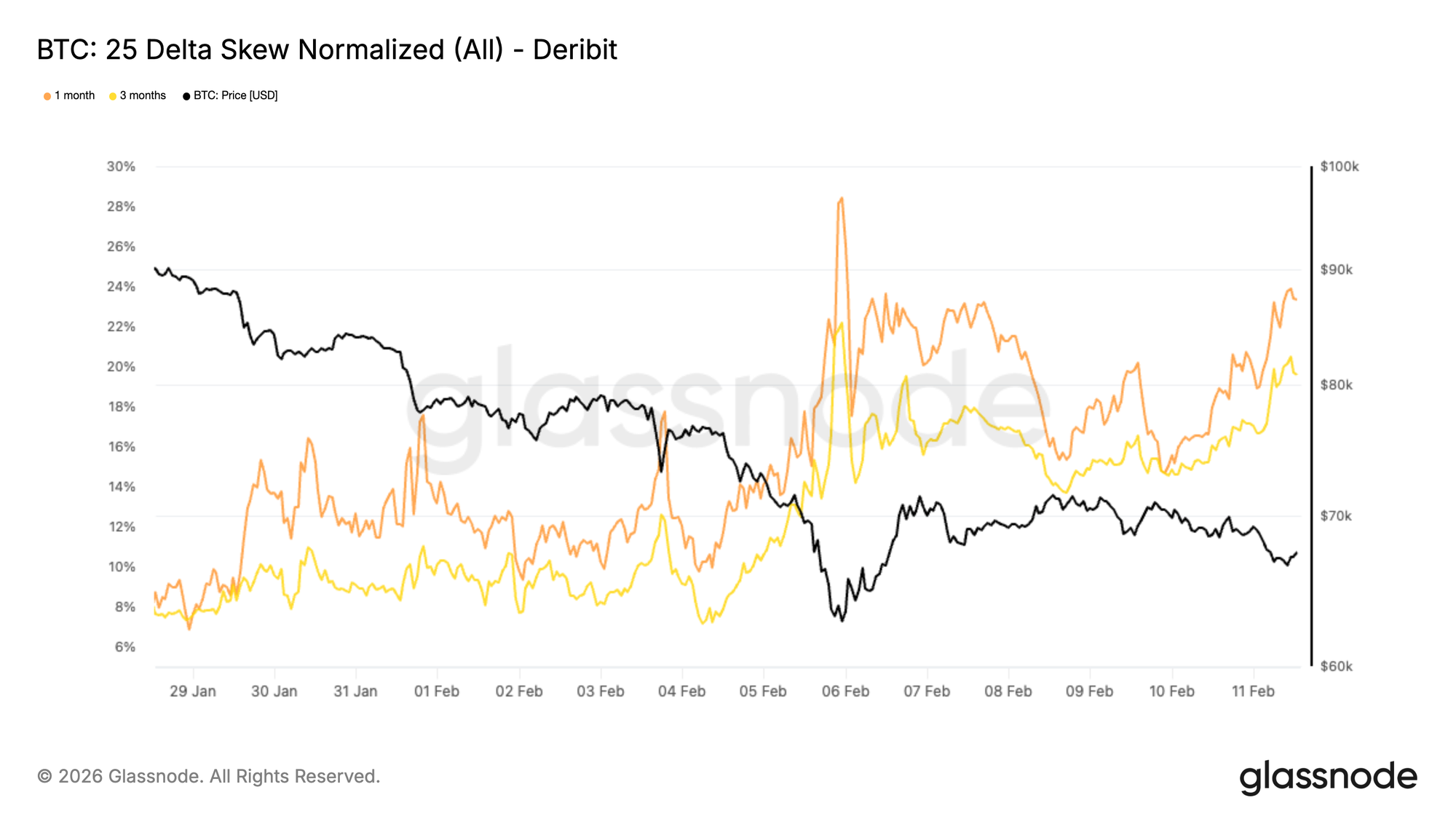
While overall volatility repriced higher, skew reveals how that demand is distributed across strikes. Looking at the 1 month and 3 month 25 delta skew, both moved sharply negative during the crash as traders aggressively bought puts.

Even after Friday’s relief rally, downside protection continues to trade at a significant premium and is now near the most extreme levels reached during the selloff. The 25 delta skew compares implied volatility of out of the money puts versus calls. When negative, it signals stronger demand for downside protection than for upside exposure. On January 28, the 1 month and 3 month skew were around 8 percent put premium. They now stand near 23 percent and 19 percent respectively.

The surface remains clearly tilted toward downside insurance, showing that caution, and fear, persists despite the bounce.
Live Chart

Dealer Gamma Positioning Keeps Price Reactive

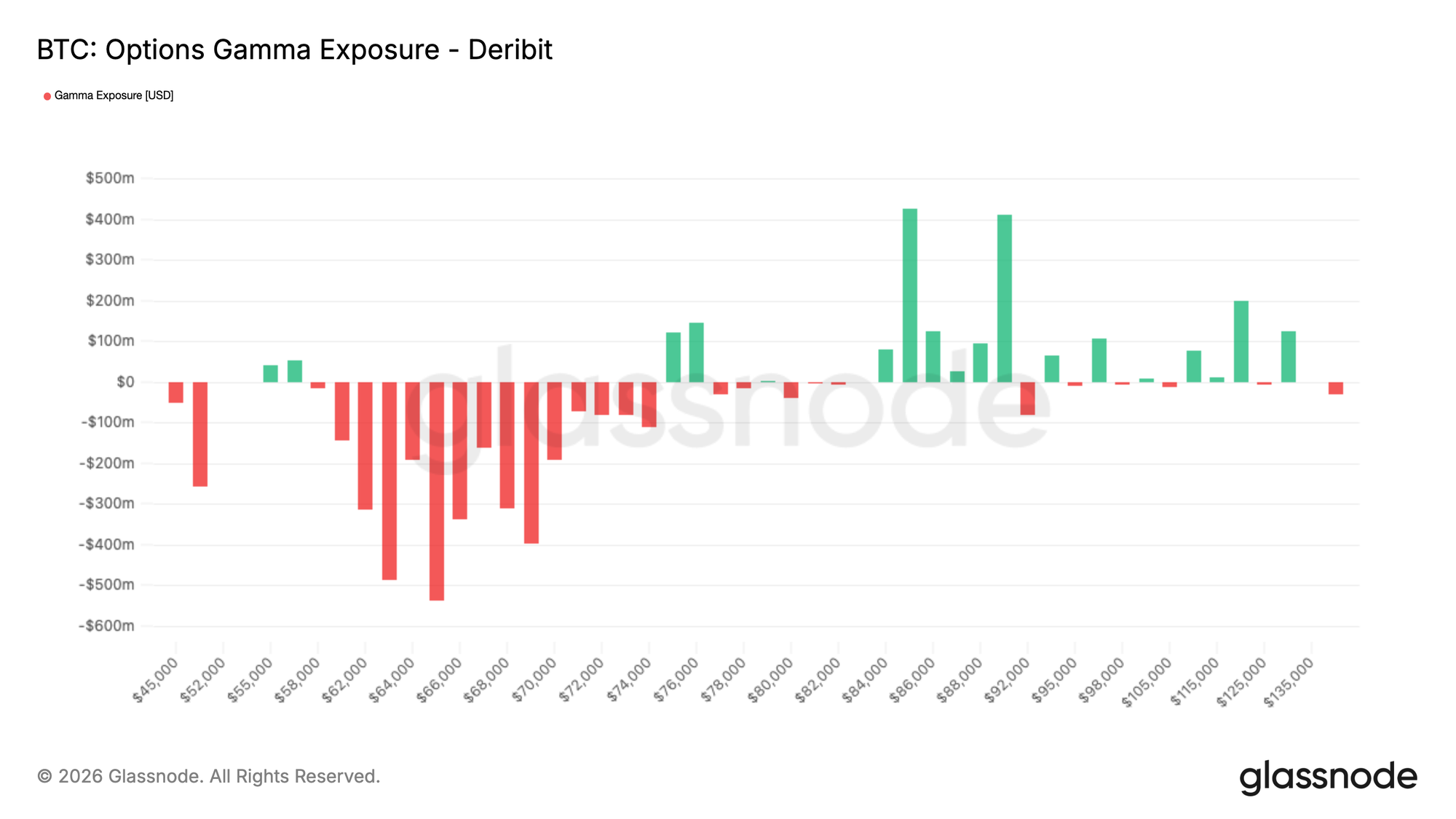
With BTC at 68K at the time of writing, spot sits in the middle of a pronounced short gamma corridor, with even larger gamma exposure stacked below.

This defensive options flow leaves a mechanical footprint in dealer positioning. When dealers are short gamma, they must buy into strength and sell into weakness to remain hedged. This behavior reinforces price moves rather than dampening them, particularly in elevated volatility conditions such as the current regime.

Following aggressive put buying during the crash, dealers remain structurally exposed in a way that can amplify swings. The recent rally has not fully neutralized that sensitivity. The result is a mechanically fragile market structure, where hedging flows can accelerate moves in either direction, with a skewed risk toward sharper downside extensions.
Live Chart

Open Interest Heatmap Reveals Broad Hedging Zones

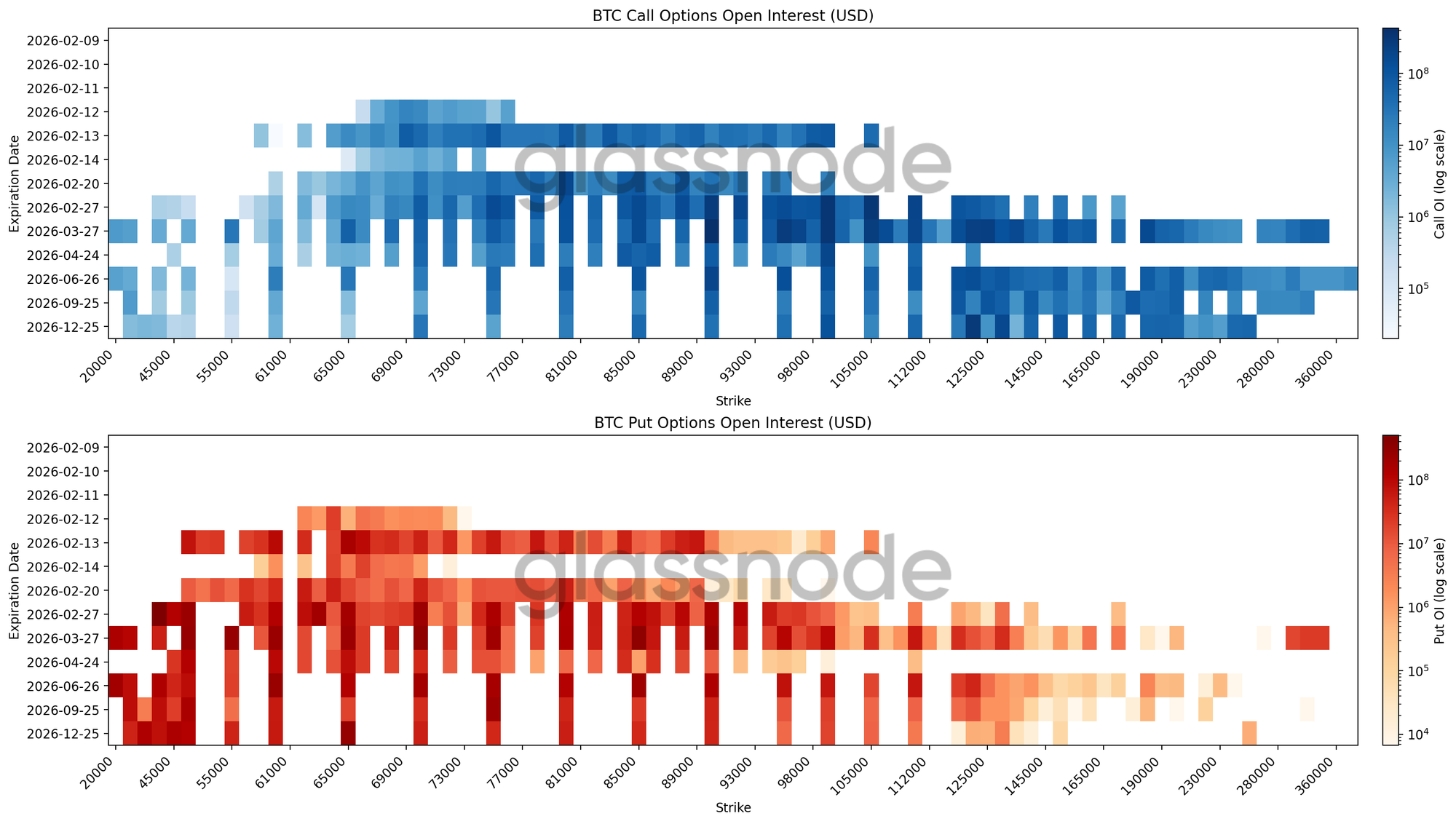
Our latest heatmap visualizes BTC options open interest across strikes and expiries in a single view, highlighting where positioning is concentrated and where structural price sensitivity may emerge. Put open interest is heavily stacked below spot. For the February expiry, the largest cluster sits between 70K and 60K. Further out the curve, a broader concentration builds between 50K and 30K across longer dated maturities into year end.

This structure spans multiple expiries, indicating persistent hedging demand rather than protection tied to a single event. Exposure is distributed across adjacent strikes, suggesting range based insurance rather than targeting a precise crash level. On the call side, open interest clusters above 120K into the second half of the year. Near term upside is being monetized, while longer dated downside remains owned as tail risk protection, reinforcing the deeply negative skew.

Positioning remains defensive and is not consistent with a market preparing for a snapback rally.
Live Chart

Conclusion

Bitcoin continues to trade within a structurally defensive regime, where price remains anchored between key cost-basis levels and absorption zones that are actively being tested. Sell-side pressure is still being met with demand in the $60k–$72k corridor, but overhead supply and negative short-term holder profitability suggest conviction remains fragile. This leaves rallies vulnerable to resistance while stabilization depends on sustained buyer participation.

Off-chain flows reinforce this cautious backdrop. Institutional treasury outflows point to ongoing de-risking, while spot activity has been reactive rather than accumulation-driven. At the same time, derivatives markets reflect a cooling in speculative appetite, with elevated hedging demand and dealer positioning keeping price action reactive rather than directional.

Taken together, the market appears to be navigating a period of balance under stress. Liquidity remains thin, participation selective, and positioning defensive. For conditions to improve, the market will likely require both renewed spot absorption and a shift in risk appetite. Until then, volatility is expected to remain driven by short-term positioning dynamics rather than broad-based expansion.


Disclaimer: This report does not provide any investment advice. All data is provided for informational and educational purposes only. No investment decision shall be based on the information provided here, and you are solely responsible for your own investment decisions.

Exchange balances presented are derived from Glassnode’s comprehensive database of address labels, which are amassed through both officially published exchange information and proprietary clustering algorithms. While we strive to ensure the utmost accuracy in representing exchange balances, it is important to note that these figures might not always encapsulate the entirety of an exchange’s reserves, particularly when exchanges refrain from disclosing their official addresses. We urge users to exercise caution and discretion when utilizing these metrics. Glassnode shall not be held responsible for any discrepancies or potential inaccuracies.

Please read our Transparency Notice when using exchange data.

Preguntas relacionadas

QWhat are the three distinct structural phases Bitcoin has progressed through since its all-time high in early October?

AThe first phase was a sharp contraction toward the True Market Mean, the second was an extended consolidation period above this threshold, and the third phase is a decisive breakdown below the True Market Mean, accelerating the move toward the $60k region.

QWhat key price levels currently bound the new trading range in Bitcoin's third structural phase?

AThe new trading range is bounded by the True Market Mean near $79.2k on the upper end and the Realized Price around $55k on the lower end.

QAccording to the article, what would likely be required for a meaningful short-term regime shift in Bitcoin's market structure?

AA meaningful regime shift would likely require an extraordinary catalyst, such as a decisive reclaim of the True Market Mean near $79.2k signaling renewed strength, or a systemic dislocation similar to LUNA or FTX that forces price below the Realized Price around $55k.

QWhat does the negative Digital Asset Treasury (DAT) flow indicate about institutional behavior?

AThe negative DAT flows, with simultaneous net outflows from spot ETF, corporate, and government treasuries, signal a clear shift toward de-risking and a market-wide pullback in treasury exposure, indicating marginal institutional demand has stepped back.

QHow does the article characterize the current options market positioning based on the 25 delta skew?

AThe 25 delta skew shows persistent downside demand, with puts trading at a significant premium to calls, indicating stronger demand for downside protection than upside exposure and that caution and fear persist despite any price bounces.

Lecturas Relacionadas

Solana Q1 Report: Revenue Plunges 68% Year-on-Year, Developers Decrease by 30%

Solana Q1 2026 Report: Key Metrics Show Significant Decline Amid Market Reset Solana experienced a substantial downturn in Q1 2026, with key performance indicators reflecting a broader market cooling. Total network revenue (REV) fell to $89.9 million, down 68% year-over-year (YoY) and 1.4% quarter-over-quarter (QoQ). This decline was driven by reduced speculative activity, which had previously fueled the network during the 2024/2025 bull market. Key revenue components saw mixed results: base fees dropped 8.7% QoQ, Jito tips (MEV) fell 19.7%, priority fees rose 23%, and vote fees declined 44.5%. The annualized real yield for stakers was just 0.17%, down 67% YoY. Network GDP, generated by top applications, fell 7% QoQ to $451 million. Pump Fun emerged as a standout, generating $103 million (up 3% QoQ), surpassing Solana's L1 revenue. However, daily active addresses averaged 2.4 million, down 4.8% YoY. Stablecoin supply on Solana reached $15.9 billion, down 2.7% QoQ but up 18% YoY. USDC and USDT remained dominant. DEX volumes averaged $3.2 billion daily, with private DEXs now accounting for 60% of all volume. The network's net dilution rate was 4.38%, while the cost to produce $1 of REV was $8.10, up 93% YoY. The number of new tokens created on launchpads grew 42% QoQ to 3 million, with Pump Fun dominating 85% of this market. Despite the downturn, Solana's core strengths remain: its position as a hub for retail trading apps, potential in perpetual markets, and growing use in stablecoin-based fintech applications, particularly in Latin America. However, developer activity declined 32% YoY, slightly worse than Ethereum's 29% drop. The network must now focus on attracting traditional finance, competing in perpetual markets, and sustaining developer ecosystem growth to drive the next expansion cycle.

marsbitHace 35 min(s)

Solana Q1 Report: Revenue Plunges 68% Year-on-Year, Developers Decrease by 30%

marsbitHace 35 min(s)

Trading

Spot
Futuros

Artículos destacados

Qué es BITCOIN

Entendiendo HarryPotterObamaSonic10Inu (ERC-20) y Su Posición en el Espacio Cripto En los últimos años, el mercado de criptomonedas ha sido testigo de un aumento en la popularidad de las monedas meme, capturando el interés no solo de los comerciantes, sino también de aquellos que buscan compromiso comunitario y valor de entretenimiento. Entre estos tokens únicos se encuentra HarryPotterObamaSonic10Inu (ERC-20), un proyecto intrigante que mezcla referencias culturales en el tejido de las criptomonedas. Este artículo profundiza en los aspectos clave de HarryPotterObamaSonic10Inu, explorando sus mecanismos, ethos impulsado por la comunidad y su relación con el paisaje cripto más amplio. ¿Qué es HarryPotterObamaSonic10Inu (ERC-20)? Como su nombre sugiere, HarryPotterObamaSonic10Inu es una moneda meme construida sobre la blockchain de Ethereum, clasificada bajo el estándar ERC-20. A diferencia de las criptomonedas tradicionales que pueden enfatizar la utilidad práctica o el potencial de inversión, este token prospera en el valor de entretenimiento y la fuerza de su comunidad. El proyecto tiene como objetivo fomentar un entorno donde los usuarios comprometidos puedan reunirse, compartir ideas y participar en actividades inspiradas por diversos fenómenos culturales. Una característica notable de HarryPotterObamaSonic10Inu es su cero impuestos en las transacciones. Este atractivo elemento tiene como objetivo incentivar el comercio y la participación comunitaria, sin cargos adicionales que puedan disuadir a los comerciantes de pequeña escala. El suministro total de la moneda está establecido en mil millones de tokens, una cifra que marca su intención de mantener una circulación sustancial dentro de la comunidad. Creador de HarryPotterObamaSonic10Inu (ERC-20) Los orígenes de HarryPotterObamaSonic10Inu están algo envueltos en misterio; los detalles sobre el creador siguen siendo desconocidos. El desarrollo de este token carece de un equipo identificable o de un plan explícito, lo cual no es inusual dentro del sector de monedas meme. En cambio, el proyecto ha surgido de manera orgánica, con su progreso muy dependiente del entusiasmo y la participación de su comunidad. Inversores de HarryPotterObamaSonic10Inu (ERC-20) En cuanto a inversiones externas y respaldo, HarryPotterObamaSonic10Inu también sigue siendo ambiguo. El token no lista ninguna fundación de inversión conocida o apoyo organizacional significativo. En cambio, la savia del proyecto es su comunidad de base, que informa su crecimiento y sostenibilidad a través de la acción colectiva y el compromiso en el espacio cripto. ¿Cómo Funciona HarryPotterObamaSonic10Inu (ERC-20)? Como una moneda meme, HarryPotterObamaSonic10Inu opera principalmente fuera de los marcos tradicionales que a menudo rigen el valor de los activos. Hay varios aspectos distintivos que definen cómo funciona el proyecto: Transacciones Sin Impuestos: Sin tarifas impositivas en las transacciones, los usuarios pueden comprar y vender el token libremente sin preocuparse por costos ocultos. Compromiso Comunitario: El proyecto prospera en la interacción comunitaria, aprovechando plataformas de redes sociales para crear entusiasmo y facilitar la participación. Las discusiones, el intercambio de contenido y el compromiso son elementos cruciales que ayudan a expandir su alcance y fomentar la lealtad entre los seguidores. Sin Utilidad Práctica: Cabe señalar que HarryPotterObamaSonic10Inu no ofrece utilidad concreta dentro del ecosistema financiero. Más bien, se clasifica como un token principalmente para actividades de entretenimiento y comunitarias. Referencia Cultural: El token incorpora astutamente elementos de la cultura popular para atraer interés, conectando con entusiastas de los memes y seguidores de las criptomonedas por igual. HarryPotterObamaSonic10Inu ejemplifica cómo las monedas meme operan de manera diferente a los proyectos de criptomonedas más tradicionales, ingresando al mercado como construcciones sociales innovadoras en lugar de activos utilitarios. Cronología de HarryPotterObamaSonic10Inu (ERC-20) La historia de HarryPotterObamaSonic10Inu está marcada por varios hitos notables: Creación: El token surgió de un meme viral, capturando la imaginación de muchos entusiastas de las criptomonedas. Las fechas específicas de creación no están disponibles, subrayando su ascenso orgánico. Listado en Exchanges: HarryPotterObamaSonic10Inu ha llegado a varios exchanges, permitiendo un acceso y comercio más fácil por parte de la comunidad. Iniciativas de Compromiso Comunitario: Actividades continuas destinadas a mejorar la interacción comunitaria, incluyendo concursos, campañas en redes sociales y generación de contenido por parte de fanáticos y defensores. Planes de Expansión Futuros: La hoja de ruta del proyecto incluye el lanzamiento de una colección de NFT, mercancía y un sitio de comercio electrónico relacionado con sus temas culturales, involucrando aún más a la comunidad e intentando añadir más dimensiones a su ecosistema. Puntos Clave Sobre HarryPotterObamaSonic10Inu (ERC-20) Naturaleza Impulsada por la Comunidad: El proyecto prioriza la participación colectiva y la creatividad, asegurando que la involucración de los usuarios esté a la vanguardia de su desarrollo. Clasificación como Moneda Meme: Representa la epítome de las criptomonedas basadas en el entretenimiento, diferenciándose de los vehículos de inversión tradicionales. Sin Afiliación Directa con Bitcoin: A pesar de la similitud en el nombre del ticker, HarryPotterObamaSonic10Inu es distinto y no tiene relación con Bitcoin u otras criptomonedas establecidas. Enfoque en la Colaboración: HarryPotterObamaSonic10Inu está diseñado para crear un espacio para la colaboración y el intercambio de historias entre sus poseedores, proporcionando una vía para la creatividad y el vínculo comunitario. Perspectivas Futuras: La ambición de expandirse más allá de su premisa inicial hacia NFTs y mercancías describe un camino para que el proyecto potencialmente ingrese a avenidas más tradicionales dentro de la cultura digital. A medida que las monedas meme continúan capturando la imaginación de la comunidad de criptomonedas, HarryPotterObamaSonic10Inu (ERC-20) se destaca debido a sus lazos culturales y su enfoque centrado en la comunidad. Si bien puede no encajar en el molde típico de un token impulsado por la utilidad, su esencia radica en la alegría y la camaradería fomentadas entre sus seguidores, destacando la naturaleza en evolución de las criptomonedas en una era cada vez más digital. A medida que el proyecto continúa desarrollándose, será importante observar cómo las dinámicas comunitarias influyen en su trayectoria en el cambiante paisaje de la tecnología blockchain.

1.2k Vistas totalesPublicado en 2024.04.01Actualizado en 2024.12.03

Qué es BITCOIN

Cómo comprar BTC

¡Bienvenido a HTX.com! Hemos hecho que comprar Bitcoin (BTC) sea simple y conveniente. Sigue nuestra guía paso a paso para iniciar tu viaje de criptos.Paso 1: crea tu cuenta HTXUtiliza tu correo electrónico o número de teléfono para registrarte y obtener una cuenta gratuita en HTX. Experimenta un proceso de registro sin complicaciones y desbloquea todas las funciones.Obtener mi cuentaPaso 2: ve a Comprar cripto y elige tu método de pagoTarjeta de crédito/débito: usa tu Visa o Mastercard para comprar Bitcoin (BTC) al instante.Saldo: utiliza fondos del saldo de tu cuenta HTX para tradear sin problemas.Terceros: hemos agregado métodos de pago populares como Google Pay y Apple Pay para mejorar la comodidad.P2P: tradear directamente con otros usuarios en HTX.Over-the-Counter (OTC): ofrecemos servicios personalizados y tipos de cambio competitivos para los traders.Paso 3: guarda tu Bitcoin (BTC)Después de comprar tu Bitcoin (BTC), guárdalo en tu cuenta HTX. Alternativamente, puedes enviarlo a otro lugar mediante transferencia blockchain o utilizarlo para tradear otras criptomonedas.Paso 4: tradear Bitcoin (BTC)Tradear fácilmente con Bitcoin (BTC) en HTX's mercado spot. Simplemente accede a tu cuenta, selecciona tu par de trading, ejecuta tus trades y monitorea en tiempo real. Ofrecemos una experiencia fácil de usar tanto para principiantes como para traders experimentados.

4.6k Vistas totalesPublicado en 2024.12.12Actualizado en 2025.03.21

Cómo comprar BTC

Qué es $BITCOIN

ORO DIGITAL ($BITCOIN): Un Análisis Integral Introducción al ORO DIGITAL ($BITCOIN) ORO DIGITAL ($BITCOIN) es un proyecto basado en blockchain que opera en la red Solana, cuyo objetivo es combinar las características de los metales preciosos tradicionales con la innovación de las tecnologías descentralizadas. Aunque comparte un nombre con Bitcoin, a menudo referido como “oro digital” debido a su percepción como un refugio de valor, ORO DIGITAL es un token separado diseñado para crear un ecosistema único dentro del paisaje Web3. Su meta es posicionarse como un activo digital alternativo viable, aunque los detalles sobre sus aplicaciones y funcionalidades aún están en desarrollo. ¿Qué es ORO DIGITAL ($BITCOIN)? ORO DIGITAL ($BITCOIN) es un token de criptomoneda diseñado explícitamente para su uso en la blockchain de Solana. A diferencia de Bitcoin, que proporciona un papel de almacenamiento de valor ampliamente reconocido, este token parece centrarse en aplicaciones y características más amplias. Aspectos notables incluyen: Infraestructura Blockchain: El token está construido sobre la blockchain de Solana, conocida por su capacidad para manejar transacciones de alta velocidad y bajo costo. Dinámicas de Suministro: ORO DIGITAL tiene un suministro máximo limitado a 100 cuatrillones de tokens (100P $BITCOIN), aunque los detalles sobre su suministro circulante no se han divulgado actualmente. Utilidad: Si bien las funcionalidades precisas no están delineadas explícitamente, hay indicios de que el token podría ser utilizado para diversas aplicaciones, potencialmente involucrando aplicaciones descentralizadas (dApps) o estrategias de tokenización de activos. ¿Quién es el Creador de ORO DIGITAL ($BITCOIN)? En la actualidad, la identidad de los creadores y el equipo de desarrollo detrás de ORO DIGITAL ($BITCOIN) sigue siendo desconocida. Esta situación es típica entre muchos proyectos innovadores dentro del espacio blockchain, particularmente aquellos alineados con las finanzas descentralizadas y fenómenos de monedas meme. Si bien tal anonimato puede fomentar una cultura impulsada por la comunidad, intensifica las preocupaciones sobre la gobernanza y la responsabilidad. ¿Quiénes son los Inversores de ORO DIGITAL ($BITCOIN)? La información disponible indica que ORO DIGITAL ($BITCOIN) no tiene patrocinadores institucionales conocidos ni inversiones destacadas de capital de riesgo. El proyecto parece operar en un modelo de peer-to-peer centrado en el apoyo y la adopción de la comunidad en lugar de rutas de financiamiento tradicionales. Su actividad y liquidez se sitúan principalmente en intercambios descentralizados (DEX), como PumpSwap, en lugar de plataformas de trading centralizadas establecidas, lo que resalta aún más su enfoque de base. Cómo Funciona ORO DIGITAL ($BITCOIN) Los mecanismos operativos de ORO DIGITAL ($BITCOIN) pueden elaborarse en función de su diseño blockchain y atributos de red: Mecanismo de Consenso: Al aprovechar el único proof-of-history (PoH) de Solana combinado con un modelo de proof-of-stake (PoS), el proyecto asegura una validación de transacciones eficiente que contribuye al alto rendimiento de la red. Tokenómica: Si bien los mecanismos deflacionarios específicos no se han detallado extensamente, el vasto suministro máximo de tokens implica que podría atender microtransacciones o casos de uso nicho que aún están por definirse. Interoperabilidad: Existe el potencial de integración con el ecosistema más amplio de Solana, incluyendo varias plataformas de finanzas descentralizadas (DeFi). Sin embargo, los detalles sobre integraciones específicas permanecen no especificados. Cronología de Eventos Clave Aquí hay una cronología que destaca hitos significativos relacionados con ORO DIGITAL ($BITCOIN): 2023: El despliegue inicial del token ocurre en la blockchain de Solana, marcado por su dirección de contrato. 2024: ORO DIGITAL gana visibilidad al estar disponible para trading en intercambios descentralizados como PumpSwap, permitiendo a los usuarios comerciar contra SOL. 2025: El proyecto presencia actividad de trading esporádica y potencial interés en compromisos liderados por la comunidad, aunque no se han documentado asociaciones notables o avances técnicos hasta el momento. Análisis Crítico Fortalezas Escalabilidad: La infraestructura subyacente de Solana soporta altos volúmenes de transacciones, lo que podría mejorar la utilidad de $BITCOIN en varios escenarios de transacción. Accesibilidad: El potencial bajo precio de trading por token podría atraer a inversores minoristas, facilitando una participación más amplia debido a oportunidades de propiedad fraccionada. Riesgos Falta de Transparencia: La ausencia de patrocinadores, desarrolladores o un proceso de auditoría conocidos públicamente puede generar escepticismo sobre la sostenibilidad y confiabilidad del proyecto. Volatilidad del Mercado: La actividad de trading depende en gran medida del comportamiento especulativo, lo que puede resultar en una volatilidad de precios significativa y en incertidumbre para los inversores. Conclusión ORO DIGITAL ($BITCOIN) surge como un proyecto intrigante pero ambiguo dentro del ecosistema de Solana en rápida evolución. Si bien intenta aprovechar la narrativa del “oro digital”, su alejamiento del papel establecido de Bitcoin como refugio de valor subraya la necesidad de una diferenciación más clara de su utilidad y estructura de gobernanza previstas. La aceptación y adopción futura dependerán probablemente de abordar la actual opacidad y de definir sus estrategias operativas y económicas de manera más explícita. Nota: Este informe abarca información sintetizada disponible hasta octubre de 2023, y pueden haber ocurrido desarrollos más allá del período de investigación.

83 Vistas totalesPublicado en 2025.05.13Actualizado en 2025.05.13

Qué es $BITCOIN

Discusiones

Bienvenido a la comunidad de HTX. Aquí puedes mantenerte informado sobre los últimos desarrollos de la plataforma y acceder a análisis profesionales del mercado. A continuación se presentan las opiniones de los usuarios sobre el precio de BTC (BTC).

活动图片