Strategy Watch: February

insights.glassnodePublicado a 2026-03-03Actualizado a 2026-03-03

Resumen

Glassnode launches Strategy Watch, a monthly newsletter analyzing fund performance and allocation trends in digital assets. The February 2026 edition reports a sharp negative shift in capital flows for Bitcoin, Ethereum, and stablecoins since late October 2025, signaling weakening institutional demand and a defensive market regime. ETF and Digital Asset Trust (DAT) net flows have also softened, indicating slowing institutional interest. Additionally, Ethereum's DeFi Total Value Locked (TVL) has been declining since August 2025, reflecting reduced conviction in DeFi yields. The CME basis yield for both Bitcoin and Ethereum has compressed significantly, suggesting a pullback in institutional leverage and market-neutral strategies.

The full report is available in PDF format.

Access PDF version

Welcome to Strategy Watch

In a rapidly evolving market, where traders and funds chase returns amid volatility, while asset allocators seek data-driven conviction for long-term positioning, Glassnode occupies a unique vantage point. Our on-chain and wider market intelligence has served as a cornerstone for both groups since 2018, earning their trust through consistent, impartial data, analytics and research.

A core Glassnode belief is that genuine insight in digital assets comes from neutrality and depth, unbiased data that empowers decisions across the ecosystem. That is why we are thrilled to launch Strategy Watch, a new monthly newsletter dedicated to the analysis of fund-level performance and allocation trends in digital assets.

We hope to bring value by regularly delivering clear, high-signal analysis of capital flows, head-to-head strategy performance benchmarks, and the most important allocation moves actually being made by institutions and funds. But this is just the beginning. We are actively exploring ways to bridge these worlds further, and would love your feedback as Strategy Watch evolves.

Inside the Latest Strategy Watch

You'll find a wealth of insides spread across 6 sections:

  • Institutional Flow Monitor
  • Fund and SMA Performance
  • On-chain Vault Performance
  • Manager Monitor
  • Allocation Updates
in partnership with

The Premier Digital Assets Allocator Platform. Learn more


Institutional Flow Monitor

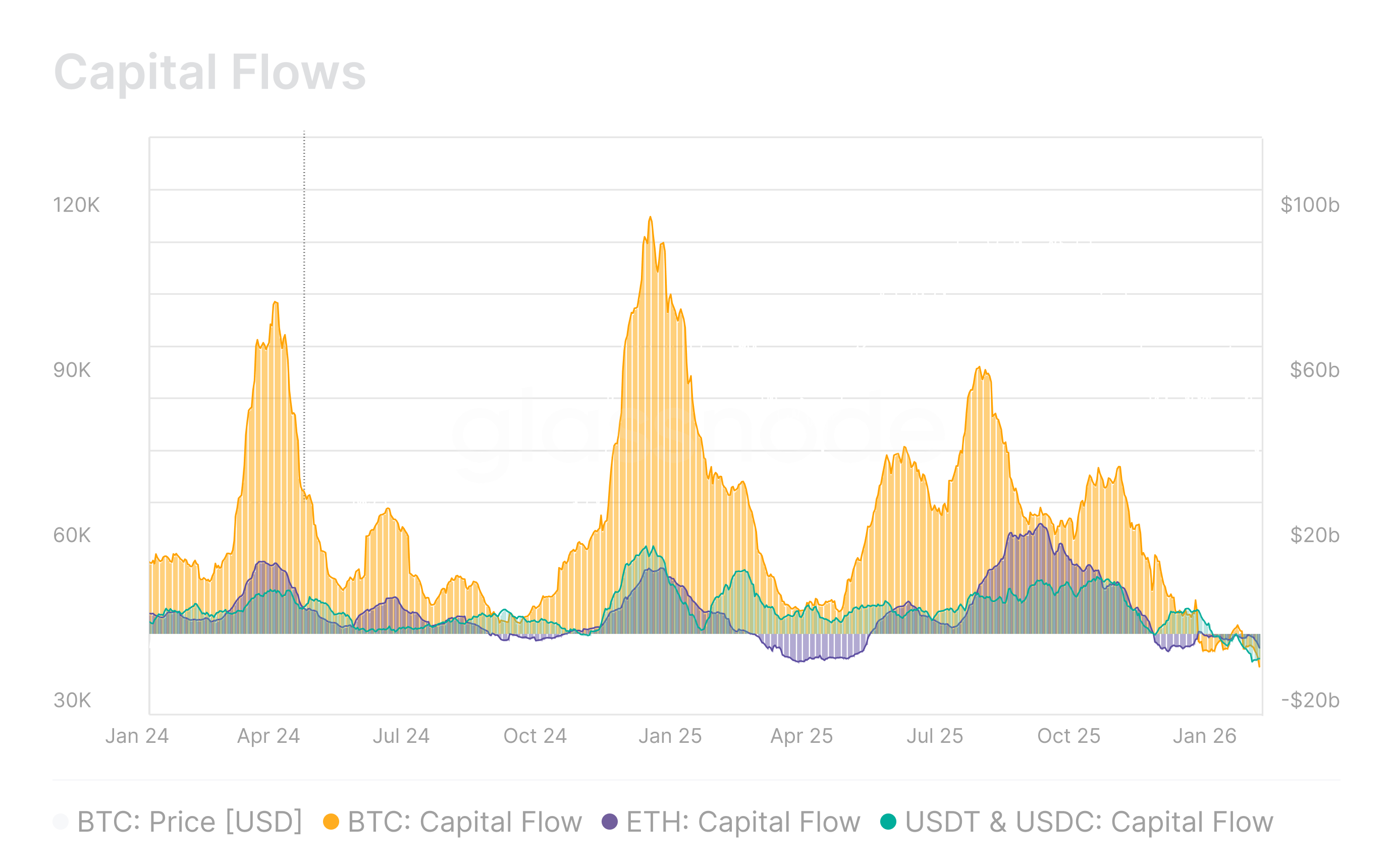
Since late October 2025, capital flows to BTC, ETH and Stablecoins have turned negative sharply.

Bitcoin, Ethereum, and Stablecoins have seen a clear slowdown in capital inflows, signalling weakening demand and a structural contraction in liquidity. All three assets have now shifted into net outflow, with Bitcoin at –$8.4B per month, Ethereum at –$3.8B, and stablecoins at –$6.4B. This broad-based drawdown across core crypto assets reflects a defensive regime, where institutional capital is de-risking rather than re-entering risk positions. This negative trend has further accelerated as of January 2026.
ETF & DAT Net Flows

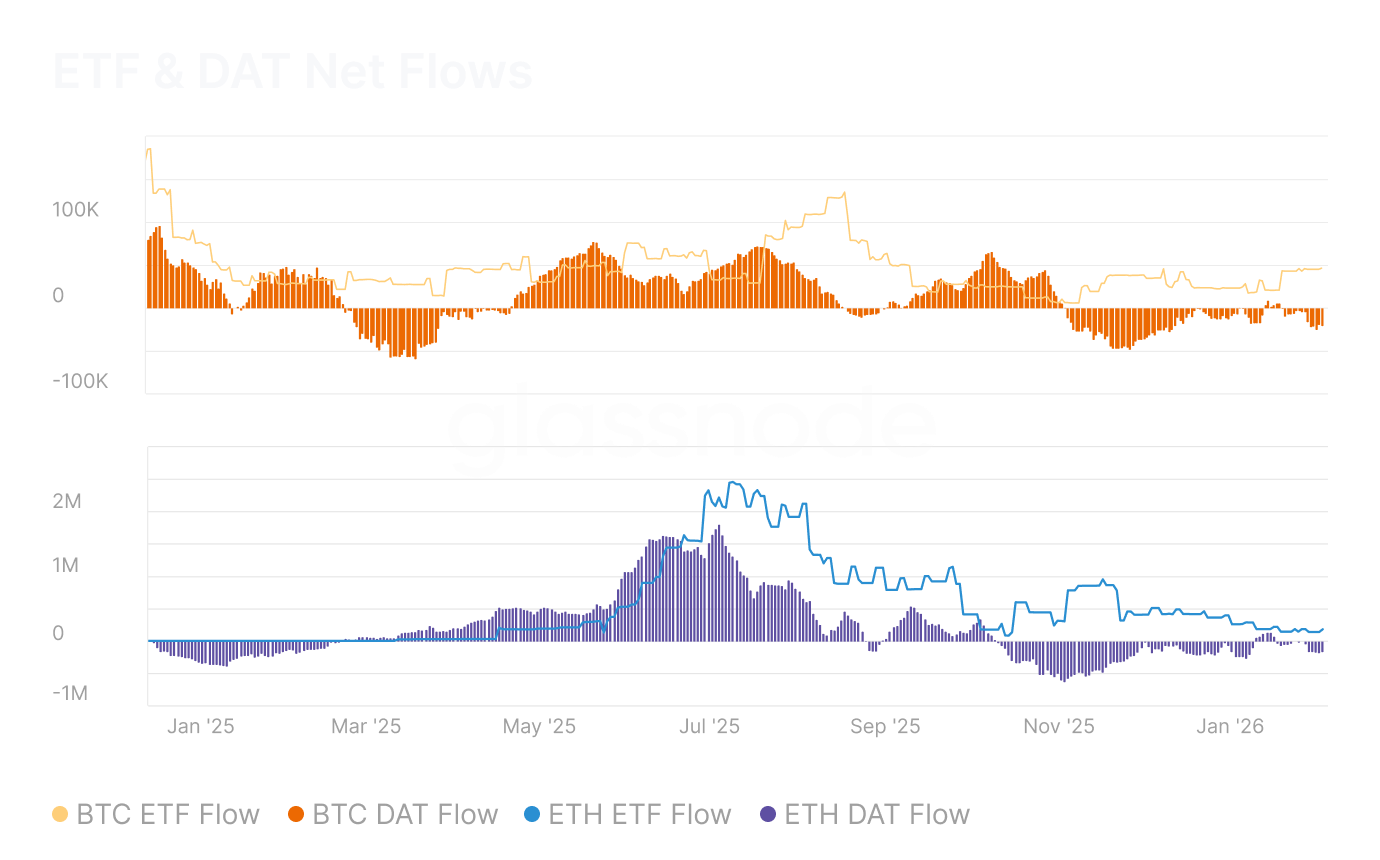
ETF & DAT net flows remain positive, but weakened, signalling slowing institutional demand.

Net flows into these vehicles act as a proxy for institutional demand. In Q4 2025 and early January, institutions were net sellers through the ETF channel, with Bitcoin ETF outflows approximating –35.8k BTC per month and Ethereum ETF flows around –257.6k ETH per month. Over the same period, DATs saw strong inflows in August 2025 driven by new product launches, but buy pressure has since softened; nonetheless, flows into DATs remain positive, indicating ongoing, albeit weaker, institutional interest via balance-sheet exposure.
DeFi TVL & Stablecoin Cap

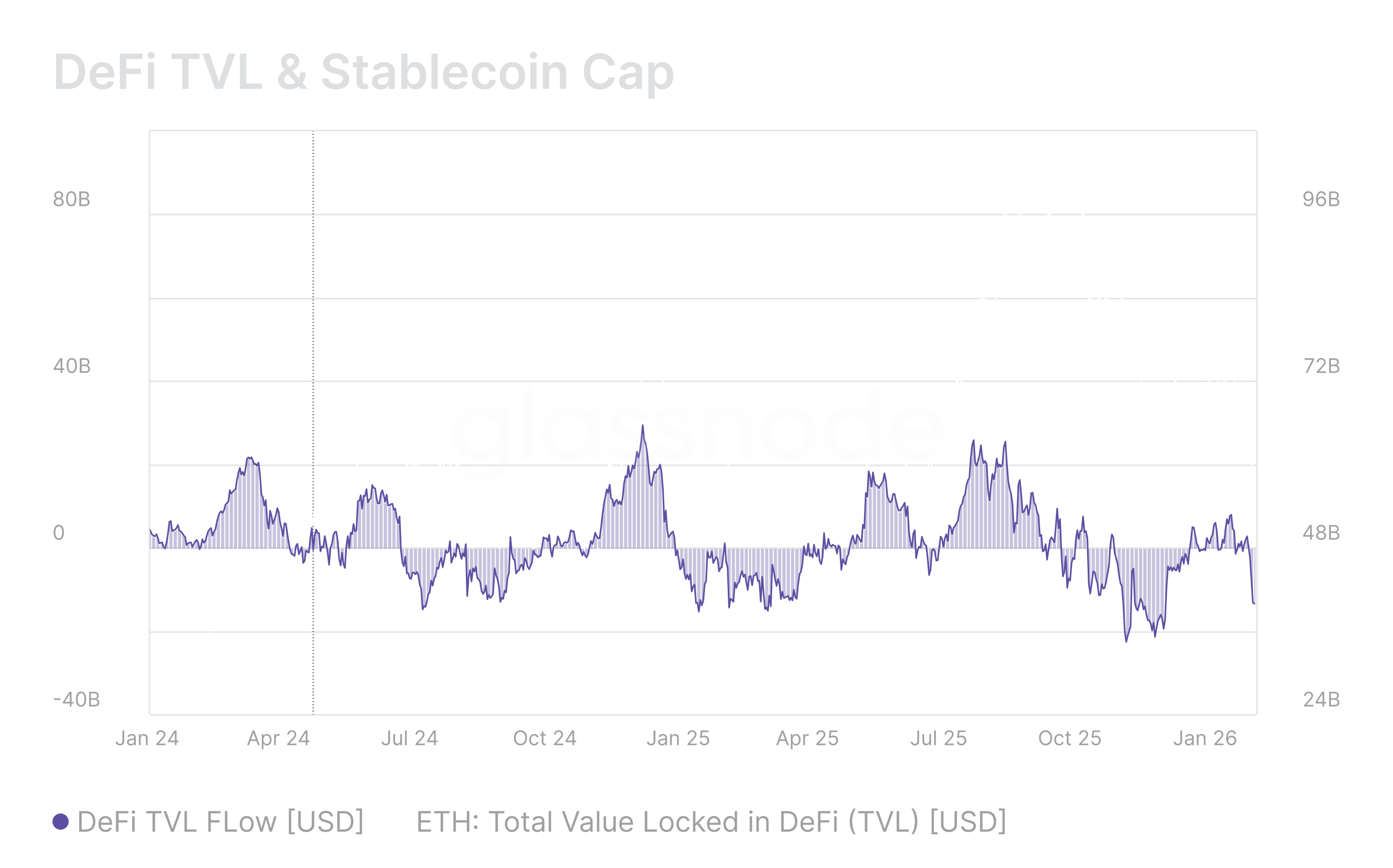
TVL on Ethereum has been declining since August 2025, signalling softer conviction in DeFi yield curves.

DeFi has served as another active playground for institutional capital through strategies such as liquidity provisioning, collateralized lending, and structured yield harvesting. Total Value Locked (TVL) on Ethereum, began to shrink from August 2025 onward, and is now declining at approximately –$15.3M per month. A contraction in TVL implies that larger allocators are withdrawing from on-chain financial services, reducing liquidity depth and signalling softer conviction in DeFi yield and risk-adjusted returns relative to alternative venues.
CME Basis Yield

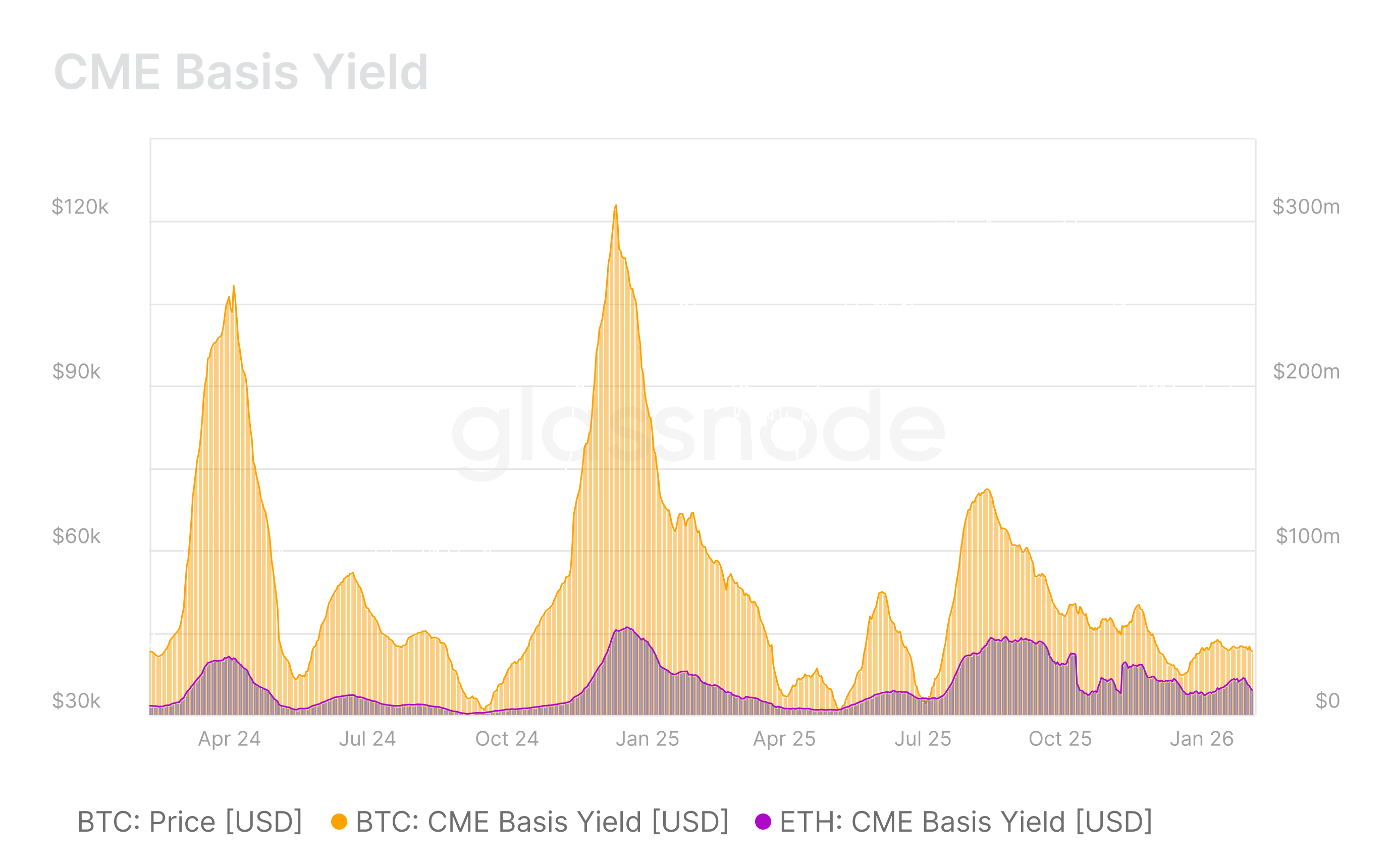
Contraction signals are waning incentive for market-neutral strategies.

Another key dimension of institutional engagement is the CME Basis Yield, which estimates the monthly dollar value earned by institutions from cash-and-carry strategies, capturing the premium between spot prices and CME calendar futures. Since August 2025, both Bitcoin and Ethereum have seen a sharp compression in this yield, with Bitcoin declining from approximately $136.6M to $38.6M per month, and Ethereum from $47.5M to $14.8M per month. This contraction rreflects reduced leverage deployment, softer futures demand, and a broader pullback in balance-sheet commitment amid tightening liquidity conditions.

Want to feature in the next edition of Strategy Watch? Share your updates on recent launches or milestones.

Submit an update

Disclaimer: This report does not provide any investment advice. All data is provided for information and educational purposes only. No investment decision shall be based on the information provided here and you are solely responsible for your own investment decisions.
Exchange balances presented are derived from Glassnode’s comprehensive database of address labels, which are amassed through both officially published exchange information and proprietary clustering algorithms. While we strive to ensure the utmost accuracy in representing exchange balances, it is important to note that these figures might not always encapsulate the entirety of an exchange’s reserves, particularly when exchanges refrain from disclosing their official addresses. We urge users to exercise caution and discretion when utilizing these metrics. Glassnode shall not be held responsible for any discrepancies or potential inaccuracies. Please read our Transparency Notice when using exchange data.

Preguntas relacionadas

QWhat is the main purpose of Glassnode's new Strategy Watch newsletter?

AStrategy Watch is a monthly newsletter dedicated to the analysis of fund-level performance and allocation trends in digital assets, providing clear analysis of capital flows, strategy performance benchmarks, and institutional allocation moves.

QWhich three core crypto assets have experienced a shift into net capital outflows according to the report?

ABitcoin, Ethereum, and Stablecoins have all shifted into net outflow, with Bitcoin at -$8.4B per month, Ethereum at -$3.8B, and stablecoins at -$6.4B.

QWhat does the contraction in CME Basis Yield for Bitcoin and Ethereum indicate about institutional activity?

AThe contraction in CME Basis Yield indicates reduced leverage deployment, softer futures demand, and a broader pullback in balance-sheet commitment amid tightening liquidity conditions, showing waning incentive for market-neutral strategies.

QHow many sections is the Strategy Watch report organized into, and what are two of them?

AThe report is organized into 6 sections, including Institutional Flow Monitor, Fund and SMA Performance, On-chain Vault Performance, Manager Monitor, and Allocation Updates.

QWhat trend does the declining Total Value Locked (TVL) on Ethereum signal about institutional behavior in DeFi?

AThe declining TVL on Ethereum signals that larger allocators are withdrawing from on-chain financial services, reducing liquidity depth and showing softer conviction in DeFi yield and risk-adjusted returns relative to alternative venues.

Lecturas Relacionadas

Dalio Warns: AI Boom Shows Signs of a Bubble, Day of Reckoning Will Be the Time of Burst

Ray Dalio, founder of Bridgewater Associates, warns that the current artificial intelligence investment boom shows classic signs of a bubble, which he expects will eventually burst. In a Bloomberg Television interview, he noted that great technological revolutions often lead to capital inflows that create bubbles, making it difficult for investors and companies to calibrate their spending accurately—either overspending to capture market share or underspending and losing their competitive position. This caution comes amid significant rallies in AI-related assets, particularly chipmakers, driven by soaring demand for data centers and high-bandwidth chips, raising debates about overheating valuations. In contrast, Nvidia CEO Jensen Huang recently asserted that investors embracing the AI wave would see "crazy" returns and dismissed concerns over return on investment for data center spending as outdated. Dalio, however, focuses on the risks in the profit realization phase. He argues that bubbles tend to show signs of破裂 when markets transition from investment to the need for tangible returns, describing the burst as a process of converting paper wealth into cash. While acknowledging AI's intrinsic value, he expressed concern over the future profitability of some AI companies, suggesting the market is repeating a familiar pattern. The 76-year-old billionaire, who fully exited Bridgewater in 2025, has a net worth estimated at $21.5 billion according to the Bloomberg Billionaires Index.

marsbitHace 22 min(s)

Dalio Warns: AI Boom Shows Signs of a Bubble, Day of Reckoning Will Be the Time of Burst

marsbitHace 22 min(s)

Privacy Coin Crisis of Confidence! ZEC Plunges Over 56% in a Single Day

Zcash (ZEC), a leading privacy-focused cryptocurrency, experienced a severe crash on June 5th, plummeting over 56% in a single day and erasing nearly two months of gains. The flash crash was triggered by the disclosure of a critical zero-knowledge proof vulnerability within Zcash's Orchard privacy pool, which had existed since the pool's launch in May 2022. The flaw theoretically allowed an attacker to forge unlimited ZEC undetectably due to the pool's privacy features. The vulnerability was discovered on May 29th by independent security researcher Taylor Hornby during a proactive audit commissioned by Shielded Labs, utilizing AI-assisted analysis. The Zcash development team responded swiftly, implementing an emergency soft fork to disable Orchard transactions on June 2nd and executing a permanent hard fork fix (NU6.2) on June 3rd. Despite the technical fix, a major crisis of confidence emerged. The core issue is that Orchard's privacy design makes it cryptographically impossible to prove whether the vulnerability was exploited over the past four years, casting permanent doubt on the historical supply integrity of ZEC. While Shielded Labs argues exploitation was unlikely, the inability to provide definitive proof has severely damaged market trust. This sentiment was exacerbated when BitMEX co-founder Arthur Hayes, a prominent ZEC supporter, announced he was selling his entire position. He stated that privacy assets require "perfect security" rather than "probable safety." The combined effect of the disclosure and Hayes's exit ignited widespread panic selling, leading to massive liquidations and significant price decline. Analysts note the event highlights a fundamental tension within privacy coins: the conflict between verifiable supply and cryptographic privacy.

链捕手Hace 25 min(s)

Privacy Coin Crisis of Confidence! ZEC Plunges Over 56% in a Single Day

链捕手Hace 25 min(s)

Trading

Spot
Futuros
活动图片