Strategy Scoops Up 10,000 BTC in a Single Week: How Much Is Left to Buy on the Market?

Odaily星球日报Publicado a 2025-12-17Actualizado a 2025-12-17

Resumen

Strategy, a major long-term Bitcoin holder, has significantly increased its BTC holdings by over 10,000 BTC (worth $900 million) in a single week, despite a declining market and its mNAV falling below 1. This brings its total holdings to approximately 671,000 BTC, valued at over $50 billion, reinforcing its position as one of the world's largest institutional Bitcoin holders. This aggressive accumulation raises questions about the actual available supply of Bitcoin on the market. While 19.96 million BTC have been mined (95% of the total 21 million cap), the truly liquid supply is far smaller. An estimated 30% of Bitcoin is held long-term in "dormant" wallets, and around 20% is presumed permanently lost. Furthermore, institutional ownership from public companies, ETFs, and national funds is rapidly growing, and exchange balances have hit multi-year lows, indicating a shrinking pool of immediately sellable "float." Key data points on illiquid supply: - Long-term holders possess ~14.35 million BTC (over 70% of circulating supply). - 153 corporations hold BTC, with 29 public companies accounting for 1.082 million BTC. Strategy alone holds 671,000 BTC, representing 62% of that corporate total. - Spot Bitcoin ETFs hold ~1.311 million BTC, led by BlackRock (777,000 BTC) and Fidelity (202,000 BTC). - Governments hold ~615,000 BTC, with the U.S. (325,000 BTC) and China (190,000 BTC, per Glassnode) as the largest holders. - ~3.409 million BTC haven't moved in over a decade, with at l...

Original | Odaily Planet Daily (@OdailyChina)

Author | Ding Dang (@XiaMiPP)
Over the past two weeks, Strategy has once again significantly increased its Bitcoin holdings: adding over 10,000 BTC in a single week, valued at more than $900 million.

As a well-known long-term holder in the market, against the backdrop of Bitcoin's continued price decline and its own mNAV falling below 1, Strategy has not sold off as the market feared, but instead provided a completely opposite answer—firmly buying. To date, Strategy holds approximately 671,000 BTC in total, with a total value exceeding $50 billion, continuously solidifying its position as one of the world's largest Bitcoin-holding institutions.
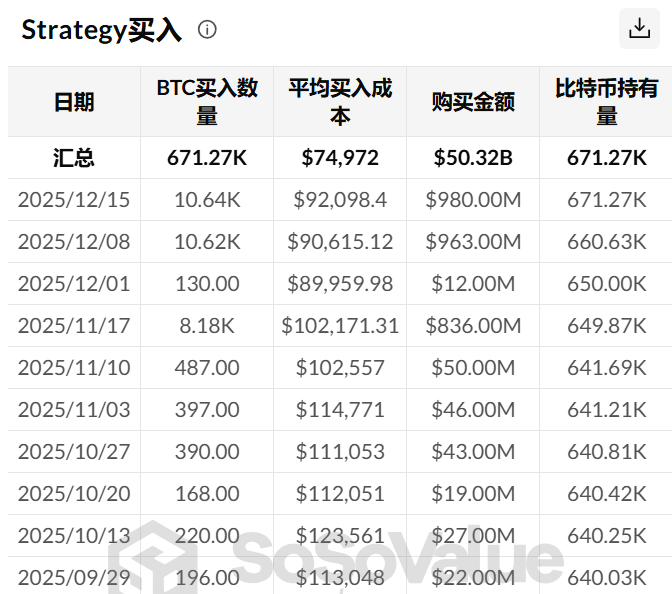
This move has also sparked deeper market reflection: With such large-scale continuous buying, how much Bitcoin is truly available for trading on the market?

The theoretical maximum supply of Bitcoin is 21 million, but the actual circulating supply is far less. Approximately 19.96 million have been mined so far, accounting for 95% of the total, with only about 1.04 million yet to be produced. The current block reward is 3.125 BTC, with about 450 new coins added daily, and it will halve again in 2028. At this pace, the last Bitcoin is expected to be mined around 2140.

However, what truly determines market supply is not the unmined new coins, but the liquid portion of the existing supply.

According to statistics, over 30% of Bitcoin has not moved for a long time and is considered "dormant holdings"; another approximately 20% is suspected to be permanently lost. Additionally, institutional and public holdings, including listed companies, ETFs, and national funds, continue to rise, with most of these BTC exiting high-frequency circulation. Furthermore, Bitcoin reserves on exchanges have dropped to multi-year lows, meaning the "floating supply" available for immediate sale is rapidly contracting. Against the backdrop of whales quietly accumulating and long-term holders holding firm, market liquidity is facing structural tightening.

Regarding the issue of Bitcoin's true circulating supply, crypto analyst Murphy has conducted a systematic review. Odaily Planet Daily has further integrated data and perspectives on this basis, attempting to present the full picture of data behind this scarcity narrative—as buying power persists and available supply shrinks, the market structure may be quietly shifting.

Long-Term Holders' "Institutionalized Hoarding" is Taking Over Circulating Supply

Long-term holders have now become the most important structural force in the Bitcoin market. According to Glassnode statistics, this group collectively holds approximately 14.35 million BTC, accounting for over 70% of the circulating supply.

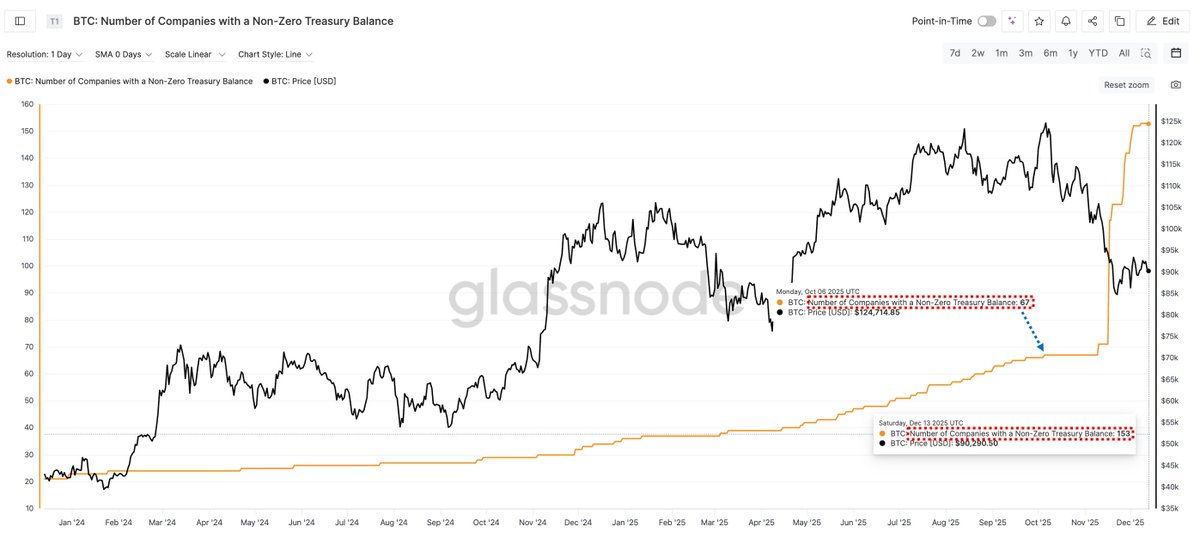
A further breakdown. There are currently 153 enterprises holding BTC with "non-zero balances," the core of which are 29 listed companies, collectively holding 1.082 million Bitcoin (including Other holding 54,331). Among these 29 listed companies, Strategy alone holds 671,000 BTC, accounting for a high 62%.

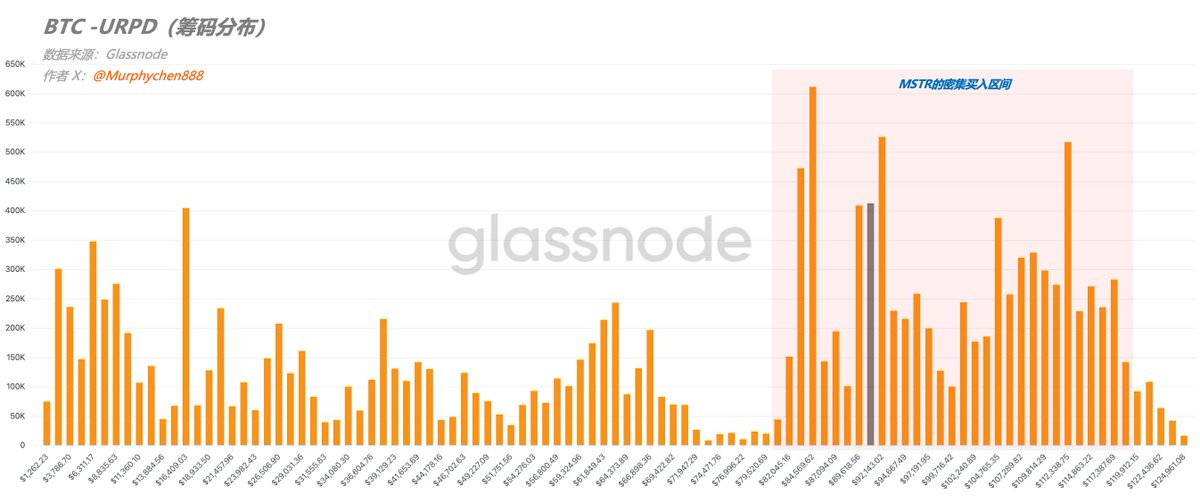
If combined with URPD (UTXO Realized Price Distribution) data, Strategy's intensive buying range coincides precisely with the most densely stacked area in BTC's chip structure, roughly concentrated between $80,000 and $118,000. This means that Strategy indeed played a significant role in the large amount of chip exchange in the high-price range. This is also why MSTR and ETFs are considered the driving force behind this bull cycle.
It is important to note that on October 6, there were only 67 enterprises holding "BTC non-zero balances." However, as BTC experienced a deep correction, this number suddenly surged, and there are now 153. Does this mean that new enterprise-level players are quietly entering the market during the price decline?
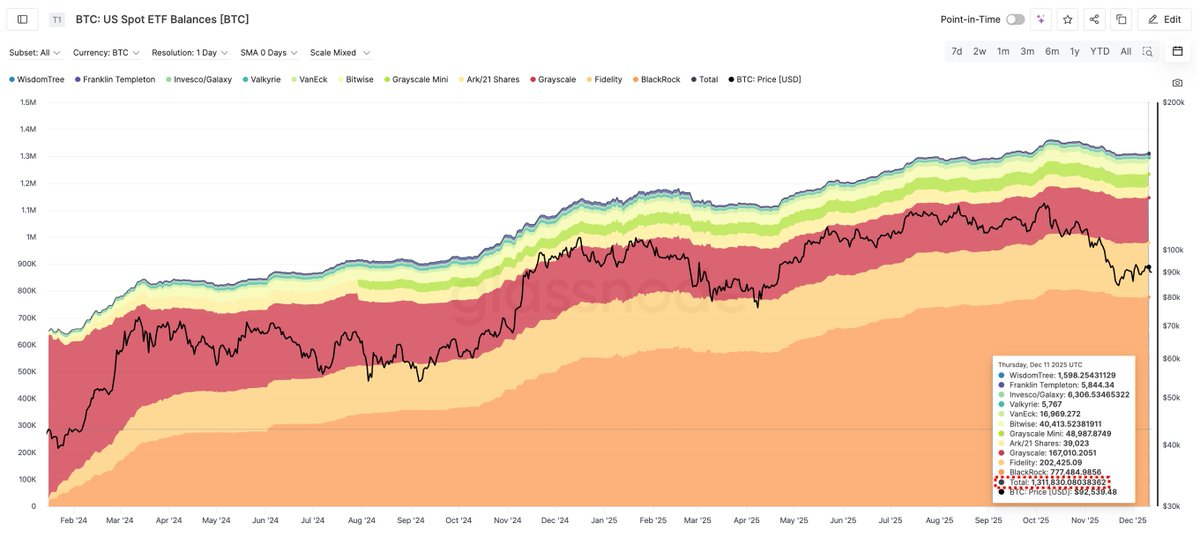
In addition to BTC reserves held by实体企业 (实体企业 - physical/real enterprises), spot Bitcoin ETFs currently hold approximately 1.311 million BTC in total. The top three are: BlackRock with about 777,000, Fidelity with about 202,000, and Grayscale with about 167,000.
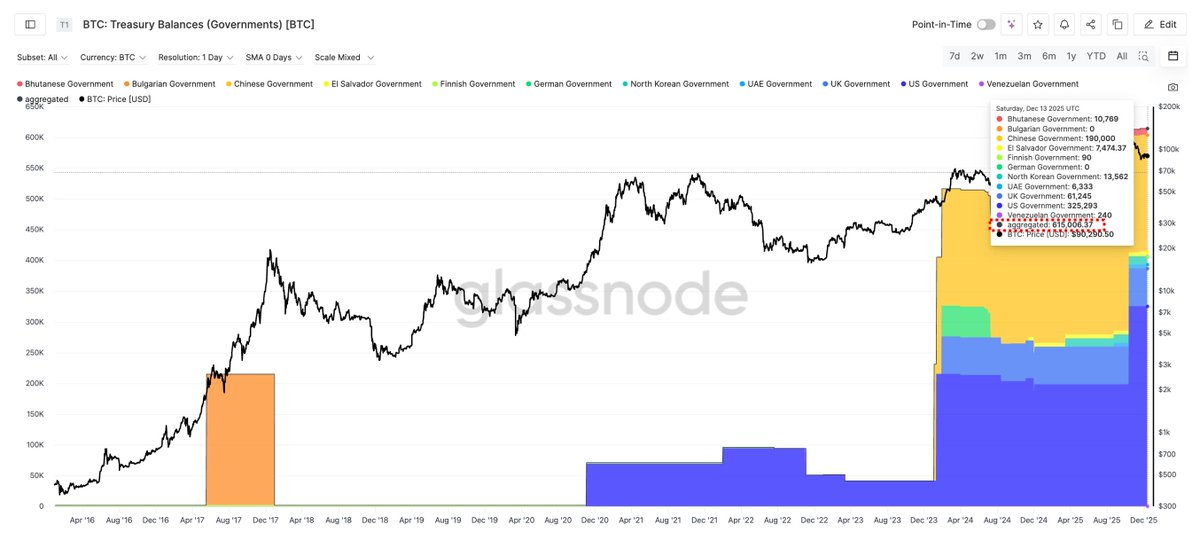
Furthermore, governments worldwide hold approximately 615,000 BTC in total. The U.S. government leads with 325,000; ranking second is the Chinese government, holding about 190,000 BTC. It should be noted that the Chinese government has never officially disclosed related holdings. This data primarily comes from Glassnode, and its statistical caliber still has uncertainties compared to the actual situation.
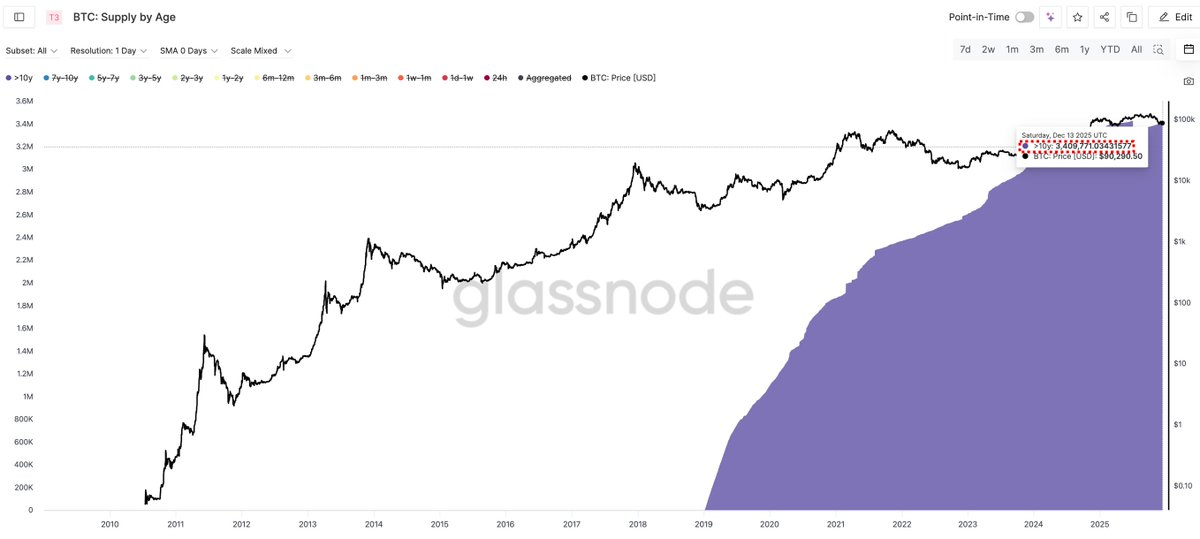
Additionally, the number of Bitcoins that have not moved for over 10 years is approximately 3.409 million. These assets consist of cold wallets from early exchanges and truly "faith-based OGs"; but it is also important not to overlook that a significant portion of these have likely exited the circulation system de facto due to reasons such as lost private keys or the holder's death. This includes the approximately 1 million BTC widely believed to belong to Satoshi Nakamoto.
How Much of the Mined BTC Is Actually "Unbuyable"?

Murphy subsequently provided a more detailed梳理 (sorting out) of this data. Unlike traditional bank accounts which have a "forgot password recovery" function, Bitcoin relies entirely on private keys to prove ownership. Once a private key is lost or becomes inaccessible, the corresponding Bitcoin can never be moved or spent again. Although they are still recorded on the blockchain, economically, they are equivalent to being permanently destroyed.

If we细分 (break down) the circulating supply by date range, where each date range refers to the creation date of the UTXO. Then we can see that the cumulative peak for BTC "born" from 2010-2014 occurred in December 2014, after which it declined rapidly (as they were spent); it has shown almost no significant change since around January 2019 to the present.
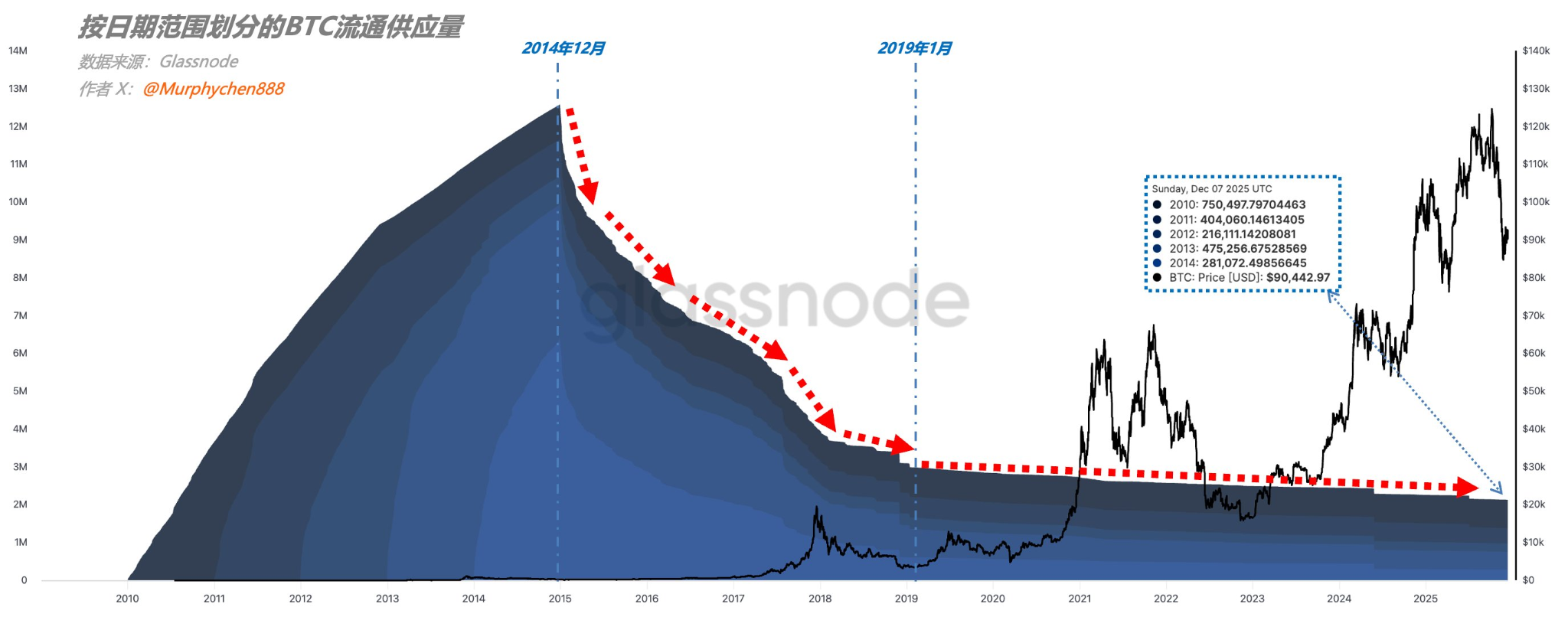
These ancient BTC that remain today, apart from those held by absolutely faithful holders, should mostly be lost. According to Murphy's estimate, this proportion is at least 50% or more, meaning at least 1.06 million or more.

There is another set of "supreme king" coins, with UTXO creation dates in 2009. They have hardly moved since after December 2011, and to this day, this address group holds 1.08 million BTC.

This means that at least approximately 2.14 million BTC may be permanently immovable in practice.

The Truly Liquid Supply

Looking at the most direct indicator—exchange balances—the Bitcoin held in exchange wallets is currently about 2.49 million, and this trend is continuously declining, having hit a new low since 2023.
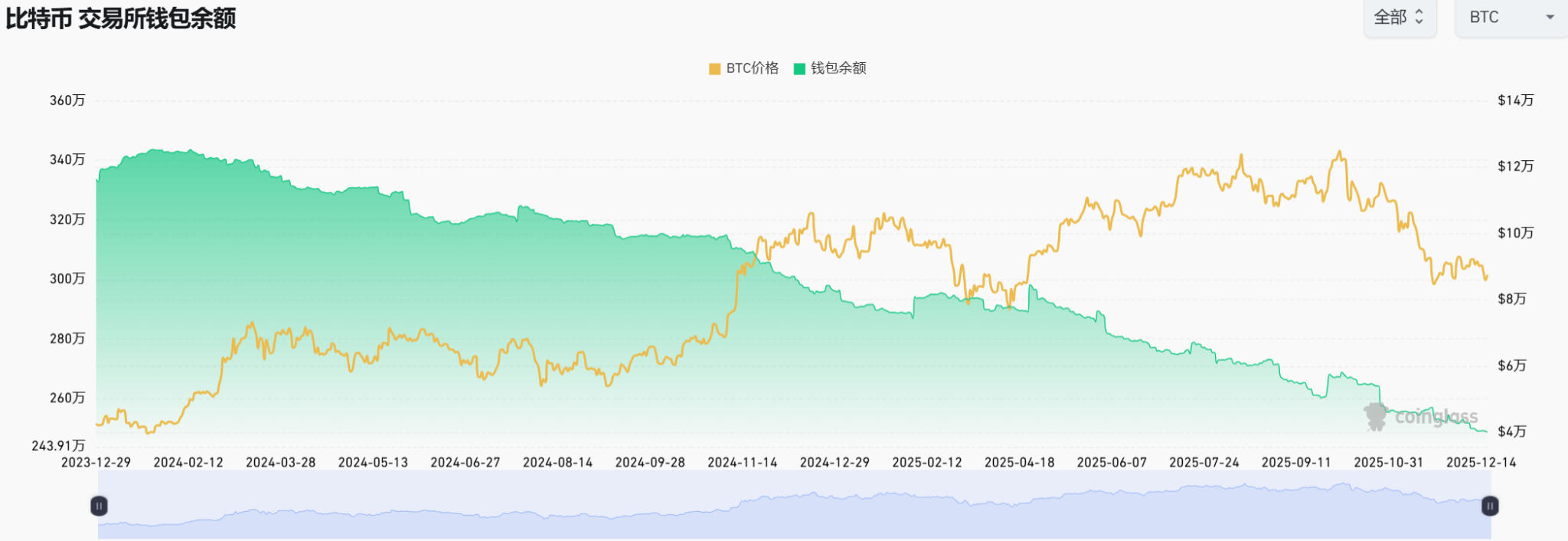
In other words, while demand continues to become "institutionalized," supply is continuously contracting. The pool of Bitcoin available for trading is getting smaller and smaller.


Preguntas relacionadas

QHow many bitcoins did Strategy purchase in a single week, and what was the total value?

AStrategy purchased over 10,000 bitcoins in a single week, with a total value exceeding $900 million.

QWhat is the total number of bitcoins that Strategy currently holds, and what is its total value?

AStrategy currently holds approximately 671,000 bitcoins, with a total value exceeding $50 billion.

QWhat percentage of the total Bitcoin supply has already been mined, and how many remain to be produced?

AApproximately 95% of the total Bitcoin supply has been mined, with about 19.96 million bitcoins already in existence. Only about 1.04 million remain to be produced.

QAccording to the article, what is the estimated amount of bitcoins that are permanently lost or otherwise unable to be moved?

AThe article estimates that at least 2.14 million bitcoins, including those from 2009 and 2010-2014, are likely permanently lost or unable to be moved due to lost private keys.

QHow many bitcoins are currently held on exchanges, and what does this trend indicate about market liquidity?

AThere are currently about 2.49 million bitcoins held on exchanges, a number that is trending downward and is at a multi-year low, indicating a contraction in immediately available supply and market liquidity.

Lecturas Relacionadas

Huang Renxun Dramatically 'Saves' South Korean Stock Market

In early June, South Korea's stock market experienced a sharp decline, with the KOSPI index dropping over 5% and triggering a trading halt. Amid this volatility, NVIDIA CEO Jensen Huang's visit to Seoul provided a dramatic boost to market sentiment. During his trip, Huang held a dinner meeting with SK Group Chairman Chey Tae-won and SK Hynix CEO Kwak Noh-Jung. He announced that NVIDIA's new Vera CPU would utilize SK Hynix DRAM and confirmed a multi-year technical collaboration between the two companies. This partnership aims to co-develop next-generation memory for NVIDIA's AI infrastructure roadmap, covering products from data center supercomputers to personal AI devices. Huang also publicly commented that AI company stocks were attractively priced. A key announcement was that NVIDIA's upcoming Vera Rubin AI supercomputer systems will use HBM4 memory, with supply qualifications granted to all three major suppliers: SK Hynix, Samsung Electronics, and Micron Technology. Despite this multi-sourcing strategy, Huang warned that the industry-wide chip shortage, affecting everything from wafers to packaging, is expected to persist for several years due to relentless demand from global AI factory construction. The collaboration extends beyond memory supply. SK Hynix will employ NVIDIA's AI platforms and Omniverse digital twin technology to enhance its own semiconductor design, simulation, and manufacturing processes, aiming for more autonomous factory operations. This visit builds upon a prior October 2025 agreement for SK Group to build a large-scale AI data center using over 50,000 NVIDIA GPUs. Huang's itinerary also included meetings with other Korean giants like Hyundai, LG, and Samsung, indicating NVIDIA's broader strategy to deepen ties with South Korea's tech industry.

链捕手Hace 2 hora(s)

Huang Renxun Dramatically 'Saves' South Korean Stock Market

链捕手Hace 2 hora(s)

When Inference Becomes a Scarce Resource, Who Captures the Value?

When Inference Becomes the Scarce Resource, Who Captures the Value? The core AI bottleneck has shifted from model training to inference (runtime execution). While concerns persisted about an "AI compute gap"—initially a $200B, now a $600B problem—the market is now recognizing that the solution and value lie in the inference layer. Nvidia's financial restructuring around "serving tokens" and Cerebras's successful IPO highlight this shift. Inference is a recurring, usage-based cost, estimated to be 10-50x larger than the one-time training market, especially with the rise of agentic AI. The inference stack spans six layers: silicon (e.g., Nvidia), bare metal (e.g., CoreWeave), GPU rental/aggregation, deployment/optimization, model APIs, and end applications. Most companies operate in one layer. However, Hyperbolic uniquely spans three layers (GPU rental, deployment, and model APIs) without owning any hardware. It aggregates fragmented GPU supply from multiple cloud providers into a standardized pool, offering developers the cheapest available compute through intelligent routing. Its multi-cloud aggregation creates a data moat and a flywheel: more supply leads to better pricing data and liquidity, attracting more developers and providers. In contrast, applications like Venice operate at the top of the stack, reselling privacy-wrapped inference but remaining dependent on and constrained by the underlying compute costs they purchase. As inference demand explodes, value accrues not just to consumer applications but increasingly to the aggregation and routing layer that captures their cost of revenue. The coming potential GPU oversupply reinforces this dynamic. While hardware owners may suffer from depreciation, asset-light aggregators like Hyperbolic benefit from price arbitrage, routing workloads to the cheapest available capacity. The ultimate winner in the inference economy may not be the entity with the most GPUs, but the one that can most efficiently discover, aggregate, and route the world's fragmented compute.

链捕手Hace 2 hora(s)

When Inference Becomes a Scarce Resource, Who Captures the Value?

链捕手Hace 2 hora(s)

Trading

Spot
Futuros

Artículos destacados

Cómo comprar BILL

¡Bienvenido a HTX.com! Hemos hecho que comprar Billions Network (BILL) sea simple y conveniente. Sigue nuestra guía paso a paso para iniciar tu viaje de criptos.Paso 1: crea tu cuenta HTXUtiliza tu correo electrónico o número de teléfono para registrarte y obtener una cuenta gratuita en HTX. Experimenta un proceso de registro sin complicaciones y desbloquea todas las funciones.Obtener mi cuentaPaso 2: ve a Comprar cripto y elige tu método de pagoTarjeta de crédito/débito: usa tu Visa o Mastercard para comprar Billions Network (BILL) al instante.Saldo: utiliza fondos del saldo de tu cuenta HTX para tradear sin problemas.Terceros: hemos agregado métodos de pago populares como Google Pay y Apple Pay para mejorar la comodidad.P2P: tradear directamente con otros usuarios en HTX.Over-the-Counter (OTC): ofrecemos servicios personalizados y tipos de cambio competitivos para los traders.Paso 3: guarda tu Billions Network (BILL)Después de comprar tu Billions Network (BILL), guárdalo en tu cuenta HTX. Alternativamente, puedes enviarlo a otro lugar mediante transferencia blockchain o utilizarlo para tradear otras criptomonedas.Paso 4: tradear Billions Network (BILL)Tradear fácilmente con Billions Network (BILL) en HTX's mercado spot. Simplemente accede a tu cuenta, selecciona tu par de trading, ejecuta tus trades y monitorea en tiempo real. Ofrecemos una experiencia fácil de usar tanto para principiantes como para traders experimentados.

238 Vistas totalesPublicado en 2026.05.07Actualizado en 2026.06.02

Cómo comprar BILL

Qué es ATWO

I. Introducción al ProyectoArena Two es una plataforma interactiva descentralizada que permite a los fanáticos jugar un papel activo y tokenizado en los resultados de eventos en tiempo real. A diferencia de los modelos de transmisión tradicionales que reducen a los fanáticos a espectadores pasivos, Arena Two aprovecha la tecnología blockchain para permitir que los fanáticos voten directamente en tiempo real e influyan en los resultados en el campo.II. Información del TokenNombre del token: ATWO (Arena Two)III. Enlaces RelacionadosSitio web: https://arenatwo.com/Exploradores: https://basescan.org/token/0x499D35eBE6cEe9B2Ac35Fd003fcBbeeB9CFc7B32Twitter: https://x.com/arenatwoXNota: La introducción del proyecto proviene de los materiales publicados o proporcionados por el equipo oficial del proyecto, que es solo para referencia y no constituye asesoramiento de inversión. HTX no se hace responsable de ninguna pérdida directa o indirecta resultante.

147 Vistas totalesPublicado en 2026.05.18Actualizado en 2026.06.02

Qué es ATWO

Cómo comprar ATWO

¡Bienvenido a HTX.com! Hemos hecho que comprar Arena Two (ATWO) sea simple y conveniente. Sigue nuestra guía paso a paso para iniciar tu viaje de criptos.Paso 1: crea tu cuenta HTXUtiliza tu correo electrónico o número de teléfono para registrarte y obtener una cuenta gratuita en HTX. Experimenta un proceso de registro sin complicaciones y desbloquea todas las funciones.Obtener mi cuentaPaso 2: ve a Comprar cripto y elige tu método de pagoTarjeta de crédito/débito: usa tu Visa o Mastercard para comprar Arena Two (ATWO) al instante.Saldo: utiliza fondos del saldo de tu cuenta HTX para tradear sin problemas.Terceros: hemos agregado métodos de pago populares como Google Pay y Apple Pay para mejorar la comodidad.P2P: tradear directamente con otros usuarios en HTX.Over-the-Counter (OTC): ofrecemos servicios personalizados y tipos de cambio competitivos para los traders.Paso 3: guarda tu Arena Two (ATWO)Después de comprar tu Arena Two (ATWO), guárdalo en tu cuenta HTX. Alternativamente, puedes enviarlo a otro lugar mediante transferencia blockchain o utilizarlo para tradear otras criptomonedas.Paso 4: tradear Arena Two (ATWO)Tradear fácilmente con Arena Two (ATWO) en HTX's mercado spot. Simplemente accede a tu cuenta, selecciona tu par de trading, ejecuta tus trades y monitorea en tiempo real. Ofrecemos una experiencia fácil de usar tanto para principiantes como para traders experimentados.

188 Vistas totalesPublicado en 2026.05.18Actualizado en 2026.06.02

Cómo comprar ATWO

Discusiones

Bienvenido a la comunidad de HTX. Aquí puedes mantenerte informado sobre los últimos desarrollos de la plataforma y acceder a análisis profesionales del mercado. A continuación se presentan las opiniones de los usuarios sobre el precio de A (A).

活动图片