Story Co-Founder Defends Token Unlock Delays; Why Long-Term Scaling Matters For $MAXI

bitcoinistPublicado a 2026-02-09Actualizado a 2026-02-09

Resumen

Story Protocol co-founder S.Y. Lee defends delayed token unlocks, arguing that extended vesting periods prevent premature sell pressure and support long-term protocol development. This approach prioritizes sustainable growth over short-term liquidity. Similarly, meme coin project Maxi Doge ($MAXI) emphasizes high-conviction holding through staking rewards, a 'Leverage King' culture, and planned utility features. Having raised over $4.5M in presale, it aims to build a resilient, engaged community by incentivizing long-term participation and reducing launch-day sell pressure.

In a market sector often defined by impatience and ‘up-only’ demands, Story Protocol co-founder S.Y. Lee has taken a contrarian stance: slower is better. Addressing the recent controversy surrounding delayed token unlocks, Lee defended the decision to extend vesting cliffs.

His argument? Premature liquidity often strangles protocol development before it achieves escape velocity. In a recent interview with CoinDesk, Lee pointed to Worldcoin’s extended lockups as a successful precedent, suggesting that longer runways prevent the rampant sell pressure that historically capsizes early-stage infrastructure projects.

That signals a fundamental shift in how crypto capital creates value. The era of ‘fair launch’ farming, where liquidity is mercenary and fleeting, is giving way to high-conviction retention models. Lee’s defense highlights a crucial friction point: retail traders want immediate access, but sustainable ecosystems require entrenched capital. By prioritizing long-term alignment over short-term liquidity events, Story is betting that patience pays a higher yield than speed.

This pivot toward strength accumulation rather than quick exits isn’t isolated to infrastructure layers. It’s beginning to permeate the high-octane world of meme coins, where community conviction is the only true fundamental. While Story locks up tokens to build IP rails, a new contender, Maxi Doge, is locking in value through a culture of ‘1000x leverage’ mentality and heavy staking incentives.

Just as Story demands patience for protocol health, Maxi Doge ($MAXI) demands grit for portfolio health, positioning itself as the counter-narrative to low-effort, low-reward trading.

Maxi Doge Brings ‘Never Skip Leg Day’ Mentality to Meme Sector

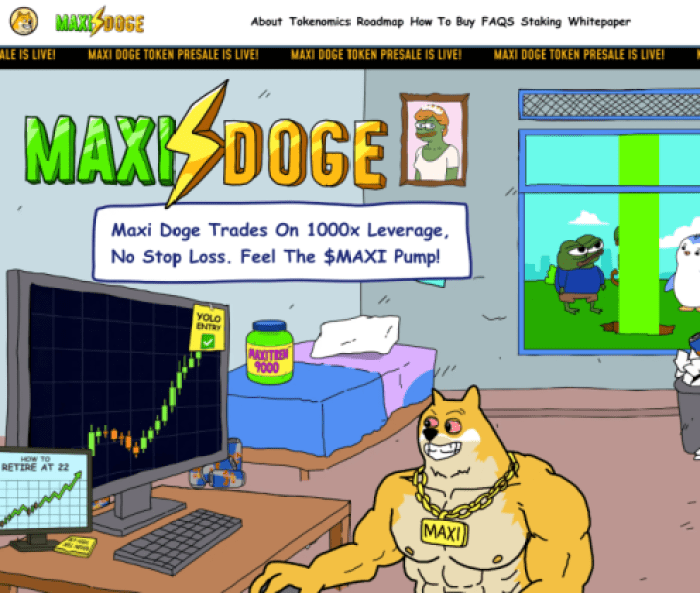
While Story Protocol focuses on intellectual property, Maxi Doge effectively tokenizes market resilience. The project operates under a distinct philosophy: ‘Never skip leg day, never skip a pump.’

In a sector cluttered with derivative dog coins that collapse at the first sign of volatility, $MAXI is engineered to mirror the psychology of high-conviction traders. It addresses a specific retail pain point, the lack of whale-sized conviction, by gamifying the holding process through a culture of strength and heavy leverage.

The project differentiates itself through its planned utility that reinforces holding behavior. Future features like holder-only trading competitions and a ‘Maxi Fund’ treasury are designed to deepen liquidity rather than drain it.

The ‘Leverage King’ culture isn’t just marketing fluff; it’s a mechanism to filter out weak hands. It creates a community base that mirrors the long-term alignment S.Y. Lee advocates for at the protocol level. By integrating viral gym-bro humor with actual financial incentives, the project creates a feedback loop where community engagement directly correlates with token stability.
Plus, the ecosystem includes planned partner events with futures platform integrations, allowing top ROI hunters to compete for leaderboard rewards. That turns passive holding into active participation. The risk here for casual observers? Dismissing the aesthetic as pure satire.

Beneath the ‘beefcake’ branding lies a structured economy designed to outperform the original $DOGE by rewarding those who grind through the bear and bull cycles alike.

EXPLORE THE HEAVYWEIGHT DIVISION AT MAXI DOGE

Whale Activity and Staking Rewards Signal High Conviction

The market’s appetite for this high-conviction model is visible in the on-chain data. Maxi Doge has raised over $4.5M. That significant figure suggests retail and institutional interest is coalescing around the project before it hits open markets. With tokens currently priced at $0.0002803, early entrants are positioning themselves ahead of the public listing, betting on the project’s ability to capture the ‘gym-bro’ meme niche. If you want to know more check out our ‘What is Maxi Doge?‘ guide.

Smart money seems to be validating this thesis. On-chain data from Etherscan shows 2 whale wallets each accumulated $314K. Although not a sign of success, this level of capital injection during a presale phase is rare for standard meme coins and implies that sophisticated actors see value beyond the hype.

To lock in this capital, Maxi Doge uses a dynamic staking APY, with daily planned automatic smart contract distributions derived from a 5% staking allocation pool. This setup mirrors the delayed gratification model defended by Story Protocol’s founders, rewarding users who commit their assets to the network for up to one year. By incentivizing a lock-up of supply, the project aims to reduce sell pressure on launch day, creating a firmer floor price than competitors relying solely on viral momentum.

CHECK OUT THE $MAXI PRESALE

This article is for informational purposes only and does not constitute financial advice. Cryptocurrencies are high-risk assets; invest only what you can afford to lose.


Preguntas relacionadas

QWhat is the main argument made by Story Protocol co-founder S.Y. Lee regarding token unlock delays?

AS.Y. Lee argues that slower token unlocks and extended vesting cliffs are beneficial because premature liquidity often strangles protocol development before it achieves escape velocity. He believes longer runways prevent rampant sell pressure that can capsize early-stage projects, prioritizing long-term alignment over short-term liquidity events.

QHow does Maxi Doge ($MAXI) differentiate itself from other meme coins in the market?

AMaxi Doge differentiates itself by tokenizing market resilience and promoting a high-conviction 'Never skip leg day' mentality. It gamifies the holding process through features like holder-only trading competitions, a 'Maxi Fund' treasury, and staking incentives, aiming to create a community with long-term alignment and reduce sell pressure.

QWhat on-chain data indicates significant interest in Maxi Doge before its public listing?

AOn-chain data shows that Maxi Doge has raised over $4.5M in its presale, with two whale wallets each accumulating $314K worth of tokens. This level of capital injection during the presale phase is rare for standard meme coins and suggests both retail and institutional interest.

QHow does Maxi Doge's staking mechanism work to incentivize long-term holding?

AMaxi Doge uses a dynamic staking APY with daily automatic smart contract distributions derived from a 5% staking allocation pool. This rewards users who commit their assets to the network for up to one year, reducing sell pressure on launch day and creating a firmer floor price.

QWhat is the core philosophy behind Maxi Doge's approach to the meme coin sector?

AMaxi Doge's core philosophy is 'Never skip leg day, never skip a pump,' which emphasizes market resilience and high-conviction trading. It aims to counter low-effort, low-reward trading by fostering a culture of strength, leverage, and active community participation through financial incentives and gamified holding.

Lecturas Relacionadas

Fu Peng's First Public Speech in 2026: What Exactly Are Crypto Assets? Why Did I Join the Crypto Asset Industry?

Fu Peng, a renowned macroeconomist and now Chief Economist at New火 Group, delivered his first public speech of 2026 at the Hong Kong Web3 Festival. He explained his perspective on crypto assets and why he joined the industry, framing it within the context of macroeconomic trends and financial evolution. Fu emphasized that crypto assets are transitioning from an early, belief-driven phase to a mature, institutionally integrated asset class. He drew parallels to the 1970s-80s, when technological advances (like computing) revolutionized traditional finance, leading to the rise of FICC (Fixed Income, Currencies, and Commodities). Similarly, current advancements in AI, data, and blockchain are reshaping finance, with crypto assets becoming part of a new "FICC + C" (C for Crypto) framework. He noted that institutional capital, including traditional hedge funds, avoided early crypto due to its speculative nature but are now engaging as regulatory clarity emerges (e.g., stablecoin laws, CFTC classifying crypto as a commodity). Fu predicted that 2025-2026 marks a turning point where crypto becomes a standardized, financially viable asset for diversified portfolios, akin to commodities or derivatives in traditional finance. Fu defined Bitcoin not as "digital gold" in a simplistic sense but as a value-preserving, financially tradable asset. He highlighted that crypto's future lies in regulated, institutional adoption, moving away from retail-dominated trading. His entry into crypto signals this maturation, where traditional finance integrates crypto into mainstream asset management.

marsbitHace 4 min(s)

Fu Peng's First Public Speech in 2026: What Exactly Are Crypto Assets? Why Did I Join the Crypto Asset Industry?

marsbitHace 4 min(s)

Justin Sun Sues Trump Family: What $75 Million Bought Was Only a Blacklist

Justin Sun, founder of Tron, has filed a lawsuit in federal court against World Liberty Financial (WLF), alleging he was made the "primary target of a fraudulent scheme" after investing $75 million. Sun claims the investment secured him an advisor title and WLFI tokens, which were later frozen by WLF, causing "hundreds of millions in losses." The dispute began in late 2024 when Sun's investment helped revive WLF's struggling token sale, which ultimately raised $550 million. Shortly after, the SEC dropped its lawsuit against Sun following Donald Trump's inauguration. However, relations soured when Sun refused WLF's demands for additional funding. In August 2025, WLF added a "blacklist" function to its smart contract, allowing it to unilaterally freeze tokens. Sun's holdings, worth approximately $107 million, were frozen, and he was threatened with token destruction. The lawsuit highlights WLF's structure, which directs 75% of token sale profits to the Trump family, who had earned $1 billion by December 2025. WLF's CEO is Zach Witkoff, son of U.S. Middle East envoy Steve Witkoff. The project faces scrutiny for opaque operations, including a controversial loan arrangement on the Dolomite platform, co-founded by a WLF advisor. Despite Sun's history with the SEC, the case underscores centralization risks within DeFi, as WLF controls governance and holds powers to freeze assets arbitrarily. Sun's tokens remain frozen as legal proceedings begin.

marsbitHace 12 min(s)

Justin Sun Sues Trump Family: What $75 Million Bought Was Only a Blacklist

marsbitHace 12 min(s)

$500 to Buy OpenAI Stock: Silicon Valley's Most Respectable Liquidity Invitation

Silicon Valley's largest venture capital platform, AngelList, has launched a new fund called USVC, allowing U.S. retail investors to buy into high-profile AI companies like OpenAI, Anthropic, and xAI with a minimum investment of $500—no accredited investor status required. Promoted by AngelList co-founder Naval Ravikant, the fund is framed as an opportunity for ordinary people to access high-growth private tech investments traditionally reserved for VCs. However, critics argue it functions more like an exit vehicle for early insiders. USVC acquires shares not through primary rounds but largely via secondary transactions—purchasing stakes from early investors, VC funds, and employees looking to cash out at peak valuations. With companies like xAI heavily weighted in the portfolio, the fund effectively channels retail money into providing liquidity for insiders who entered at much lower valuations. The fund’s structure raises concerns: shares are illiquid, with no secondary market, and buybacks are limited and discretionary. The actual annual fee reaches 3.61%, far above the advertised 1% management fee. This model parallels the "low float, high fully diluted valuation" strategy seen in crypto, where early investors profit by selling to latecomers at inflated prices. The timing—alongside similar moves by platforms like Robinhood—suggests that Silicon Valley’s sudden interest in retail inclusion may be less about democratizing access and more about securing exits for insiders.

marsbitHace 42 min(s)

$500 to Buy OpenAI Stock: Silicon Valley's Most Respectable Liquidity Invitation

marsbitHace 42 min(s)

Trading

Spot
Futuros
活动图片