Stop Staring at GPUs: CPUs Are Becoming the 'New Bottleneck' in the AI Era

marsbitPublicado a 2026-04-13Actualizado a 2026-04-13

Resumen

In the AI era, while GPUs have long been the focus for computational power, the narrative is shifting as CPUs are increasingly becoming the new bottleneck. By 2026, system performance is more dependent on execution and scheduling capabilities, with CPUs playing a critical role in enabling AI operations. A supply crisis is emerging, with server CPU prices rising about 30% in Q4 2025 due to high demand and production constraints, as GPU orders compete for limited semiconductor capacity. Companies like Google and Intel have deepened collaborations, and Elon Musk is investing in custom CPU solutions for his ventures, highlighting the strategic importance of CPU infrastructure. The shift is driven by the rise of agentic AI, where CPUs handle tasks such as multi-step reasoning, API calls, and data I/O, accounting for 50–90.6% of total latency in intelligent workloads. Expanding context windows in AI models further strain GPU memory, necessitating CPU offloading for key-value cache management. Major players are adopting varied strategies: Intel is strengthening its Xeon processor line and partnerships; AMD is benefiting from increased demand, with server CPU revenue surpassing 40%; and NVIDIA is designing CPUs like Grace to optimize GPU-CPU synergy through high-speed interconnects. The industry is witnessing a rebalancing of compute infrastructure, with CPUs gaining prominence as essential enablers of scalable AI agent systems. By 2030, the CPU market is projected to double to ...

In the years of AI's rapid advancement, the industry has been largely dominated by one logic: computing power determines the ceiling, and GPUs are the core of that computing power.

However, entering 2026, this logic is beginning to shift: model inference is no longer the sole bottleneck; system performance increasingly depends on execution and scheduling capabilities. GPUs remain important, but the key factor determining whether AI can 'run' is gradually shifting to the long-overlooked CPU.

On April 9th, US local time, Google and Intel reached a multi-year agreement to deploy Intel's 'Xeon processors' at scale in global AI data centers, precisely to break this bottleneck. Intel CEO Pat Gelsinger (Note: The original Chinese name 陈立武 is likely a misattribution; the current CEO is Pat Gelsinger) stated bluntly that AI runs on the entire system, and CPUs and IPUs are the key to performance, efficiency, and flexibility. In other words, the CPU, which has been treated as a 'supporting role' for the past two years, is now choking the 'neck' of AI scaling.

Intel CEO Pat Gelsinger stated on social media: Intel is deepening its collaboration with Google, expanding from traditional CPUs to AI infrastructure (such as IPUs), to jointly advance AI and cloud computing capabilities.

The CPU is no longer just a passive supporting component but is becoming one of the key variables in AI infrastructure.

01

A 'Silent' Supply Crisis

While everyone was watching GPU delivery cycles, the tension in the CPU market had already quietly peaked.

According to the latest reports from multiple IT distributors, in the fourth quarter of 2025, the average selling price of server CPUs increased by about 30%. Such an increase is very rare in the relatively mature CPU market.

AMD's Data Center Group head, Forrest Norrod, revealed that CPU demand growth over the past three quarters has been beyond imagination. Currently, AMD's delivery lead times have extended from the original eight weeks to over ten weeks, with some models even facing delays of up to six months.

This shortage is primarily caused by a 'secondary effect' triggering a resource crunch. Industry insiders indicate that due to the extreme tightness of TSMC's 3nm production lines, wafer capacity originally allocated for CPUs is constantly being squeezed out by more profitable GPU orders. This has led to an ironic situation: AI labs have enough GPUs but find they cannot buy enough top-tier CPUs on the market to 'drive' these graphics cards.

Among those caught in this wave of CPU buying frenzy is Elon Musk.

Intel CEO Pat Gelsinger confirmed on social platforms that Musk has commissioned Intel to design and manufacture custom chips for his 'Terafab' project in Texas. This massive project aims to provide a unified computing base for xAI, SpaceX, and Tesla.

Musk's trust in Intel is largely because Intel is trying to embed itself into every layer, from ground-based data centers to orbital computing in space.
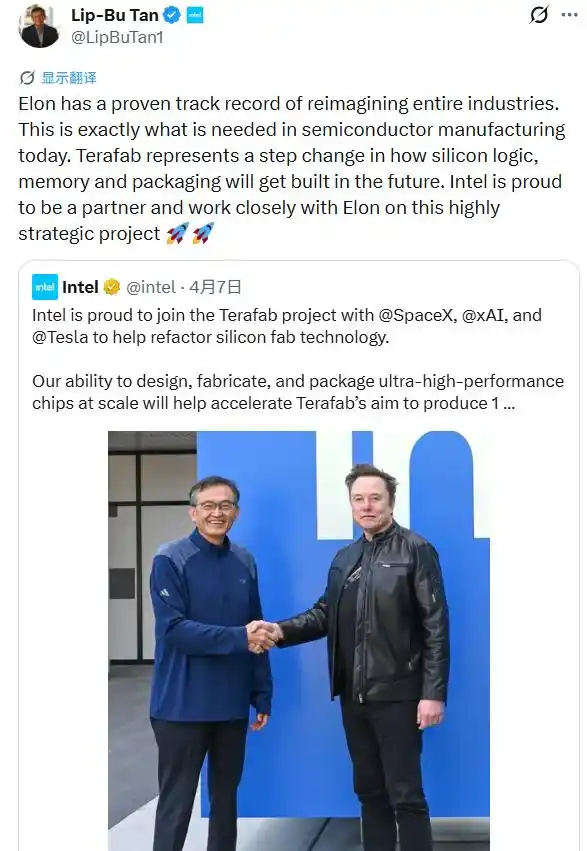
For Intel, this is undoubtedly a shot in the arm. Some industry analysts predicted that AMD's revenue share in the server CPU market would surpass Intel's in 2026, but Intel's deep inertia and manufacturing capabilities within the x86 ecosystem remain chips that major customers like Musk cannot ignore.

This kind of deep cross-industry bundling is elevating the competition in the CPU market from a pure parameter contest to a game of ecosystem and supply chain stability.

02

Why Has the CPU Become the 'Bottleneck'?

The core reason the CPU has suddenly become a bottleneck is that the work it needs to handle has fundamentally changed in the age of agents.

In the traditional chatbot model, the CPU is primarily responsible for scheduling and data processing, while the GPU handles the core inference computation. Since compute-intensive tasks are concentrated on the GPU side, overall latency is usually dominated by the GPU, and the CPU rarely becomes a performance bottleneck.

But agent workloads are completely different. An agent needs to perform multi-step reasoning, call APIs, read and write databases, orchestrate complex business flows, and integrate intermediate results into a final output. Tasks like search, API calls, code execution, file I/O, and result orchestration mostly fall on the CPU and host system side. The GPU is responsible for token generation (i.e., 'thinking'), while the CPU is responsible for translating the 'thoughts' into actual actions.

A paper published by Georgia Tech scholars in November 2025, 'A CPU-Centric Perspective on Agentic AI,' quantified the latency distribution in agent workloads. The study found that the time consumed by tool processing on the CPU side accounts for 50% to 90.6% of the total latency. In some scenarios, the GPU is ready to process the next batch of tasks while the CPU is still waiting for tool calls to return.

Another key factor is the rapid expansion of context windows. In 2024, mainstream models mostly supported 128K to 200K tokens. Entering 2025, models like Gemini 2.5 Pro, GPT-4.1, and Llama 4 Maverick began supporting over 1 million tokens. The KV cache (Key-Value Cache, used to accelerate the Transformer model inference process) grows linearly with the number of tokens, reaching about 200GB at 1 million tokens, far exceeding the 80GB VRAM capacity of a single H100.

One solution to this problem is to offload part of the KV cache to CPU memory. This means the CPU must not only manage orchestration and tool calls but also help bear data that doesn't fit in VRAM. CPU memory capacity, memory bandwidth, and the interconnect speed between the CPU and GPU thus become critical to system performance.

Therefore, CPUs suited for the agent era require low latency, consistent memory access capabilities, and stronger system-level协同 capabilities, rather than单纯 core count expansion.

03

What Are the Vendors Doing? Some Grab Territory, Others Change Designs

Faced with this sudden surge in CPU demand, the major players have completely different strategies.

Intel is the traditional leader in server CPUs. Data from Mercury Research shows that in Q4 2025, Intel still held a 60% share of the server CPU market, AMD had 24.3%, and Nvidia had 6.2%. But Intel has been playing catch-up with new technologies in recent years; this CPU demand explosion is both an opportunity and a test for them.

Intel's current strategy is a two-pronged approach. On one hand, continue selling Xeon processors, deeply绑定 with hyperscale customers like Google; on the other hand, partner with SambaNova to launch a combined solution based on Xeon processors and their self-developed RDU accelerators,主打 the selling point of 'running agent inference without GPUs'. The roadmap for Xeon 6 Granite Rapids and the 18A process will be key tests of whether Intel can turn the tables.

AMD is one of the biggest beneficiaries of this CPU demand surge. In Q4 2025, AMD's Data Center revenue was $5.4 billion, a year-on-year increase of 39%. Fifth-gen EPYC Turin accounted for over half of server CPU revenue, and deployments of cloud instances running EPYC grew over 50% year-on-year. AMD's server CPU revenue share exceeded 40% for the first time.

AMD CEO Lisa Su directly attributed the growth to the development of 'agents'—agent workloads push tasks 'back' to traditional CPU tasks.

In February 2026, AMD also announced a potential deal with Meta worth over $100 billion to supply MI450 GPUs and Venice EPYC CPUs.

However, AMD still has room for improvement in system-level协同, lacking a mature high-speed CPU-GPU interconnect capability类似 NVLink C2C. As agent (Agent) systems place increasing demands on data interaction and协同 efficiency, the importance of this aspect is also gradually rising.

Nvidia's approach to CPU design is completely different from Intel's and AMD's.

The Nvidia Grace CPU has only 72 cores, while AMD EPYC and Intel Xeon typically have 128. Nvidia's AI Infrastructure VP, Dion Harris, explained: 'If you're a hyperscaler, you want to maximize the number of cores per CPU, which basically drives down the cost, the dollar-per-core cost. So it's a business model.'

In other words, in the AI computing体系, the CPU's role is no longer that of a general-purpose workhorse but rather a 'scheduling hub' serving the GPU. If the CPU can't keep up, the expensive GPUs are forced to wait, and overall efficiency drops.

Therefore, Nvidia prioritizes efficient协同 between the CPU and GPU in its design. For example, through the NVLink C2C interconnect, the bandwidth between the CPU and GPU is boosted to about 1.8TB/s, far higher than traditional PCIe, and the CPU can directly access GPU memory, greatly simplifying KV cache management.

Currently, Nvidia sells the Vera CPU as a standalone product. CoreWeave was the first customer. The deal with Meta is even more夸张; this is its first large-scale 'pure Grace deployment,' meaning CPUs deployed大规模 independently without GPUs paired.

Ben Bajarin, Principal Analyst at Creative Strategies, pointed out that in high-intensity system collaboration, the CPU's processing power must keep pace with the accelerator's iteration speed. If there is even a one percent delay in the data通道, the entire AI cluster's economic efficiency suffers significantly. This pursuit of极致 system efficiency is forcing all major players to re-evaluate CPU performance metrics.

Holger Mueller, VP and Principal Analyst at Constellation Research, stated that as AI workloads shift towards agent-driven architectures, the CPU's position is becoming more central. He noted: 'In the agent world, agents need to call APIs and various business applications, tasks most suitable for CPUs to complete.'

He added: 'Currently, there is no consensus on whether GPUs or CPUs are more suitable for handling inference tasks. GPUs have an advantage in model training, and custom ASICs like TPUs have their specialties. But one thing is clear: Google needs to adopt a hybrid processor architecture. Therefore, Google's choice to partner with Intel is reasonable.'

04

Conclusion: In the Agent Era, the Computing Power Balance is Swinging Back

In the latest industry observations, one data point deserves attention. In the massive $38 billion合作协议 between Amazon AWS and OpenAI, the official announcement also explicitly mentioned scaling 'tens of millions of CPUs'.

In recent years, the industry's focus has typically been on those 'hundreds of thousands of GPUs'. However, the fact that cutting-edge labs like OpenAI are proactively treating CPU scale as a key planning variable sends a clear signal: scaling agent workloads must be built upon a massive CPU infrastructure.

Bank of America predicts that by 2030, the global CPU market size could double from the current $27 billion to $60 billion. Almost all of this additional share will be driven by AI.

We are witnessing the expansion of a全新的 infrastructure: big tech is no longer just stacking GPUs but is simultaneously expanding an entire layer of 'CPU scheduling infrastructure' specifically to support the operation of AI agents.

The alliance between Intel and Google, as well as Musk's heavy investment in custom chips, all prove one fact: the winning point in the AI race is moving forward. When computing power is no longer scarce, whoever can solve the system-level 'bottleneck' first will have the last laugh in this trillion-dollar game.

*Special contributor Jin Lu also contributed to this article.

This article is from the WeChat public account 'Tencent Technology', author: Li Hailun, editor: Xu Qingyang


Criptos en tendencia

Preguntas relacionadas

QWhy is CPU becoming the new bottleneck in the AI era according to the article?

ACPU is becoming the bottleneck because AI workloads, especially in the agentic AI era, require extensive multi-step reasoning, API calls, database operations, and complex task orchestration. These tasks are primarily handled by the CPU, and studies show that CPU-side tool processing can account for 50% to 90.6% of total latency. Additionally, the expansion of context windows in models requires KV cache offloading to CPU memory, making CPU memory capacity, bandwidth, and interconnect speed critical.

QWhat significant partnership is mentioned in the article to address the CPU bottleneck?

AGoogle and Intel have entered into a multi-year agreement to deploy Intel's Xeon processors globally in AI data centers. This partnership aims to enhance system performance, efficiency, and flexibility by leveraging CPUs and IPUs (Infrastructure Processing Units) as key components in AI infrastructure.

QHow did the CPU market change in Q4 2025 as reported?

AIn Q4 2025, the average selling price of server CPUs increased by approximately 30%, which is rare in the mature CPU market. Delivery cycles extended, with AMD's wait times increasing from eight to over ten weeks, and some models facing delays of up to six months due to supply constraints and competition for wafer capacity from GPU production.

QWhat role does CPU play in agentic AI workloads compared to traditional AI models?

AIn traditional AI models, CPUs mainly handle scheduling and data processing while GPUs perform core inference tasks. In agentic AI, CPUs are responsible for executing multi-step reasoning, calling APIs, reading/writing databases, orchestrating complex workflows, and integrating results—tasks that constitute the majority of the latency. The GPU generates tokens ('thinking'), but the CPU turns those results into actionable outputs.

QHow are major companies like Intel, AMD, and NVIDIA adapting to the increased importance of CPUs in AI?

AIntel is deepening partnerships (e.g., with Google) and developing combinations like Xeon processors with accelerators. AMD is benefiting from increased demand, with its EPYC CPUs seeing significant growth and new large deals (e.g., with Meta). NVIDIA is designing CPUs like Grace with a focus on high-efficiency coordination with GPUs through technologies like NVLink C2C, prioritizing system-level synergy over core count.

Lecturas Relacionadas

After Three Consecutive Quarters of Decline, Can the Crypto Market Find a Window for Stabilization in Q3?

The cryptocurrency market has just concluded its worst-performing quarter since 2022, with total capitalization dropping 12.6% to $2.1 trillion. All core metrics indicate capital is leaving the sector, not just rotating within it. Bitcoin fell 14.2% and Ethereum dropped 25.4% in Q2, breaking their previous correlation with US tech stocks. A key driver is the reversal in US spot Bitcoin ETF flows, which saw a net outflow of approximately $4.67 billion in Q2, including a record monthly outflow near $4.5 billion in June. While recent data suggests long-term holders are accumulating again, sustained ETF outflows mean continued selling pressure. Market focus is now singularly on the Federal Reserve. The upcoming July FOMC meeting is seen as the most critical event for Q3. A dovish signal could support Bitcoin reclaiming a $68,000-$84,000 range, while a hawkish stance might establish a new trading band around $50,000-$56,000. Additionally, regulatory uncertainty persists, with the progress of the crucial *CLARITY Act* stalling in the Senate, reducing its perceived 2026 passage probability to 40-45%. Despite the broad downturn, a few sectors showed growth. Prediction markets saw nominal volume surge 48.7% year-over-year to $113.8 billion, and tokenized collectibles transaction volume rose 143% quarterly to $1.4 billion. The Real-World Asset (RWA) tokenization sector also continued steady growth, now representing ~$28.1 billion in on-chain value. The market's foundation for an extreme crash appears limited, with Bitcoin price hovering near its 200-week moving average. However, the trading paradigm has shifted from narrative-driven speculation to decisions based on price action, policy developments, and interest rate expectations, making a broad sentiment-driven rally unlikely in the near term.

marsbitHace 14 hora(s)

After Three Consecutive Quarters of Decline, Can the Crypto Market Find a Window for Stabilization in Q3?

marsbitHace 14 hora(s)

BIT Trading Moment: BTC Still Suppressed by Weekly 200 EMA, Rejection May Restart Decline; Storage and Semiconductors that Surged Last Night Begin Falling in Evening Trading

**Crypto & Stock Market Wrap: Bitcoin Tests Resistance, Stocks Retreat After AI Surge** Bitcoin consolidates around $66,000, facing key resistance near $68,000—an area seen as a major psychological and technical hurdle where previous rallies have failed. Analysts note the cryptocurrency is caught between its 200-week moving average (~$63,333) and 200-week EMA (~$68,328). A clear break above $68k is needed to signal a stronger bullish trend, while a rejection could lead to a retest of $63k support. Market sentiment remains cautious, with low futures open interest pointing to a low-liquidity rebound rather than a full bull market. Bitcoin spot ETFs saw another $203 million inflow. US stock futures pointed lower after a strong Tuesday session led by a massive rebound in semiconductors and memory stocks. The rally was fueled by renewed optimism about AI-driven hardware demand, with Micron, SanDisk, and SK Hynix surging. However, those gains reversed in pre-market trading. Super Micro Computer (SMCI) soared over 20% after hours on strong guidance and a record backlog. Other standouts included Rocket Lab and nuclear energy plays Oklo and X-Energy. Rising oil prices (Brent above $91) and climbing Treasury yields (10-year near 4.64%), however, are reigniting inflation concerns and acting as a headwind for equities. In Asia, markets were mixed. South Korea's KOSPI pared early gains to close slightly higher as semiconductor stocks like SK Hynix gave back initial surges. Japan's Nikkei edged lower as the yen hit a fresh 38-year low against the dollar, raising fears of potential market intervention. Key events to watch include the Samsung Galaxy launch, AMD's AI event, and a slew of major tech earnings from Alphabet, Tesla, and IBM after the close on Wednesday, followed by the ECB meeting and Intel's earnings on Thursday.

marsbitHace 14 hora(s)

BIT Trading Moment: BTC Still Suppressed by Weekly 200 EMA, Rejection May Restart Decline; Storage and Semiconductors that Surged Last Night Begin Falling in Evening Trading

marsbitHace 14 hora(s)

Former CFTC Chairman, Circle President Tarbert: Preaching Long-Termism While Cashing Out $30 Million Himself

Former CFTC Chairman and Circle President Heath Tarbert has consistently advocated for a long-term vision in public, urging patience from investors as Circle’s stock price has fallen significantly from its peak. However, it has been revealed that since Circle’s IPO, Tarbert has continuously sold his CRCL shares through pre-arranged trading plans, cashing out approximately $30 million, without making any public market purchases. This contrast between his public messaging and personal actions has drawn criticism. Tarbert joined Circle in July 2023 as Chief Legal Officer, leveraging his regulatory experience to help guide the company through its IPO and expansion. Despite promoting stablecoins as long-term infrastructure, he established a 10b5-1 trading plan just before Circle went public, leading to substantial stock sales over the following year. In March 2026, he initiated another plan to sell more shares. His career trajectory highlights a pattern of moving between high-level regulatory roles and influential positions in the financial sector. After resigning as CFTC Chairman in early 2021, he joined Citadel Securities as Chief Legal Officer just 27 days later, during a period of intense regulatory scrutiny for the firm. He later joined Circle, aiding its efforts to navigate regulatory challenges for its public listing. While Tarbert's expertise in policy and compliance is valuable to companies like Circle, his actions—advocating long-term confidence while personally divesting—raise questions about the alignment between his public statements and his private financial decisions, leaving investors who followed his advice to bear the market risks.

marsbitHace 14 hora(s)

Former CFTC Chairman, Circle President Tarbert: Preaching Long-Termism While Cashing Out $30 Million Himself

marsbitHace 14 hora(s)

Gate Research Institute: The 'Wall Street-ization' Wave of Crypto Financial Products – Competition or Integration?

The article titled "Gate Research Institute: Are Crypto Financial Products Sparking a 'Wall Street' Wave—Competition or Convergence?" explores the evolving relationship between the crypto ecosystem and traditional finance (TradFi). The piece begins by reflecting on Bitcoin's original 2009 vision of decentralization, disintermediation, and moving away from banks. It then contrasts this with the 2024 landscape, where key crypto assets like Bitcoin are increasingly held through Wall Street products like ETFs issued by giants like BlackRock. The article questions whether this signifies that TradFi is systematically taking over the rights to issue, price, custody, and distribute crypto financial assets. The core argument is that this is not a zero-sum takeover but rather a bidirectional convergence where each side addresses the other's weaknesses. Crypto offers 24/7 global markets, programmable settlement, and open access but lacks compliant channels, institutional-grade custody, deep fiat liquidity, and mainstream distribution. TradFi possesses these but is constrained by legacy systems, limited operating hours, and slow settlement. Two primary convergence paths are highlighted: * **Path A (CEX to TradFi):** Exemplified by Gate, which has progressed from offering tokenized stocks and CFDs to providing direct, real stock trading (US, Hong Kong, South Korea) within its platform, using USDT. * **Path B (TradFi to Crypto):** Exemplified by Robinhood, which has integrated crypto trading, acquired exchanges like Bitstamp, and is moving traditional assets like stocks onto the blockchain via tokenization and its own Layer 2. Both paths are ultimately competing to become the next-generation, unified financial account—a "super account" where users can seamlessly trade cryptocurrencies, stocks, ETFs, RWA (Real World Assets), and tokenized treasury products in one interface. The growth of RWA and tokenized treasuries (e.g., BlackRock's BUIDL) is presented as the asset-layer fusion, providing stable, yield-bearing assets on-chain and acting as a bridge between the two worlds. In conclusion, the "Wall Street-ization" of crypto is framed as a mutual transformation. Decentralized ideals persist in the protocol layer, while at the application layer, a more efficient, global, and accessible unified capital market is emerging from this convergence. The future competition lies not between crypto exchanges and stockbrokers, but between platforms vying to offer the most comprehensive asset coverage, liquidity, and user experience within a single account.

marsbitHace 14 hora(s)

Gate Research Institute: The 'Wall Street-ization' Wave of Crypto Financial Products – Competition or Integration?

marsbitHace 14 hora(s)

Trading

Spot

Artículos destacados

Cómo comprar ERA

¡Bienvenido a HTX.com! Hemos hecho que comprar Caldera (ERA) sea simple y conveniente. Sigue nuestra guía paso a paso para iniciar tu viaje de criptos.Paso 1: crea tu cuenta HTXUtiliza tu correo electrónico o número de teléfono para registrarte y obtener una cuenta gratuita en HTX. Experimenta un proceso de registro sin complicaciones y desbloquea todas las funciones.Obtener mi cuentaPaso 2: ve a Comprar cripto y elige tu método de pagoTarjeta de crédito/débito: usa tu Visa o Mastercard para comprar Caldera (ERA) al instante.Saldo: utiliza fondos del saldo de tu cuenta HTX para tradear sin problemas.Terceros: hemos agregado métodos de pago populares como Google Pay y Apple Pay para mejorar la comodidad.P2P: tradear directamente con otros usuarios en HTX.Over-the-Counter (OTC): ofrecemos servicios personalizados y tipos de cambio competitivos para los traders.Paso 3: guarda tu Caldera (ERA)Después de comprar tu Caldera (ERA), guárdalo en tu cuenta HTX. Alternativamente, puedes enviarlo a otro lugar mediante transferencia blockchain o utilizarlo para tradear otras criptomonedas.Paso 4: tradear Caldera (ERA)Tradear fácilmente con Caldera (ERA) en HTX's mercado spot. Simplemente accede a tu cuenta, selecciona tu par de trading, ejecuta tus trades y monitorea en tiempo real. Ofrecemos una experiencia fácil de usar tanto para principiantes como para traders experimentados.

421 Vistas totalesPublicado en 2025.07.17Actualizado en 2026.06.02

Cómo comprar ERA

Discusiones

Bienvenido a la comunidad de HTX. Aquí puedes mantenerte informado sobre los últimos desarrollos de la plataforma y acceder a análisis profesionales del mercado. A continuación se presentan las opiniones de los usuarios sobre el precio de ERA (ERA).

活动图片












