Stop Focusing Only on Bitcoin—We Are Already in a Bear Market

marsbitPublicado a 2025-12-18Actualizado a 2025-12-18

Resumen

The author argues that the crypto market has been in a bear market for about a year, despite many investors' reluctance to accept it. The peak of market euphoria occurred around November 2024, with the launch of $TRUMP marking the final exuberance. Two key misconceptions are highlighted: First, the meme coin frenzy was not a precursor to an "altseason"—it *was* the altseason itself. Unlike previous cycles with distinct new narratives and liquidity splits between "dumb money" and "hot money," this cycle lacked differentiation, keeping both groups in the same arena. Second, Bitcoin is no longer driven primarily by crypto-native cycles but by institutional and macro factors, meaning its price resilience doesn’t indicate an ongoing bull market. The bear market began after the $TRUMP peak, and the market has since gone through phases of anxiety, denial, panic, and now anger and depression. The author writes to encourage debate, correct flawed mental models, and signal a intention to begin accumulating near what they believe is the bottom.

Author: XY

Compiled by: Tim, PANews

One Year into the Bear Market

It took me some time to convince myself: we are in a bear market, and it has been going on for about a year.

November 2024 was a period of market excitement, and the launch of $TRUMP pushed the market into extreme euphoria—it was the final frenzy that no one wanted to believe was the end.

Below, I will explain my perspective.

It all starts with that old cliché: "History doesn't repeat itself, but it often rhymes."

This foolish saying has been hugely misleading for market analysis—it's downright harmful.

It has made us overly reliant on historical patterns and, at the same time, eroded our ability to question.

Yes, this reliance on historical patterns for prediction is like viewing the world through a prism carved with old designs. It inevitably misinterprets new realities and ultimately causes us to overlook the latest driving factors in the market. This is precisely where the danger lies.

More specifically, we misread two fundamental changes.

Change One

We thought Meme mania was the spark that would ignite altseason, but in reality, Meme mania was altseason itself.

When Meme coins surged one after another, we thought it was just the beginning.

Some talked about altseason, and a few bold ones even mentioned a raging bull market.

We were all wrong.

Keep in mind that previous cycles always featured bubble叠加-bubble phenomena, typically driven by new narratives. These new narratives gave rise to new markets, which often led to differentiation.

This differentiation was important because it split liquidity into two distinct groups.

The first group is dumb money.

This type of capital prefers simple operations, market depth, and low barriers to entry, staying within highly liquid tokens.

The second group is hot money.

This capital actively pursues returns and is willing to overcome complexity to find opportunities.

The subsequent short-term rotation of hot money fueled bullish trends, which eventually evolved into what people called altseason.

This cycle never produced that trend. There was no new narrative to explore this time.

From start to finish, both groups remained in the same arena.

Dumb money could participate effortlessly, and hot money could still profit by getting in early.

Our mistake was expecting an "altseason" to occur.

But it never happened.

The only path the market had was: from Bitcoin to a new narrative, then to altseason.

That used to be the script you wanted.

But the reality is that Meme mania became the altseason people anticipated.

November 2024 marked the peak profitability for most traders, and TRUMP was the climax of the market狂欢.

Change Two

Bitcoin is no longer driven internally by the crypto market but is instead dominated by institutions and macro markets.

And the macro environment follows a different timeline and reacts differently to changes.

After the TRUMP surge, many interpreted Bitcoin's resilience as the market still being in a consolidation or bull market correction phase.

This interpretation stemmed from an anchoring bias based on past experiences: people are accustomed to the idea that Bitcoin must crash sharply to confirm a bear market, applying this to a market structure now dominated by institutions.

This cognitive framework is outdated.

Bitcoin has actually decoupled from the native cryptocurrency market cycle.

Once you recognize this, the subsequent developments make perfect sense.

The bear market began after the MEME coin TRUMP, regardless of Bitcoin's price performance.

So, stop focusing only on Bitcoin.

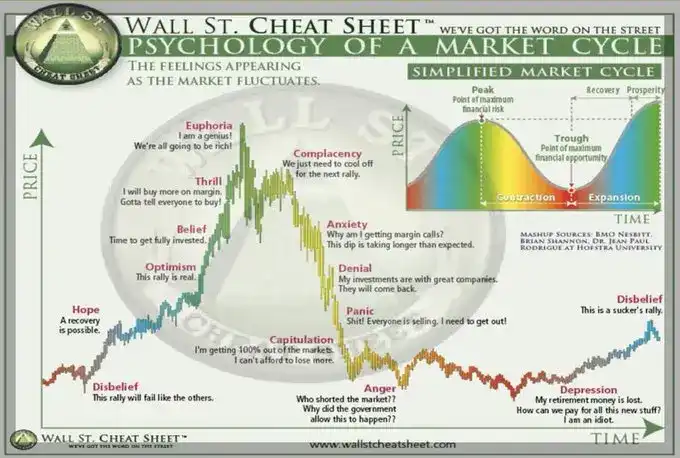
From January 2025 to the present, the market has fully gone through the three stages of anxiety, denial, and panic. If you've made profits, you can clearly see these stages in the people around you; if you've suffered losses, you've experienced these emotions firsthand.

We are now in the stage of anger and depression.

So, why am I writing this post?

Two reasons.

First, one of the reasons the crypto market has been profitable for me is the ability to buy near the bottom. If you misjudge the market phase, this advantage disappears.

If you think the bear market isn't over yet, you'll keep waiting for the bottom to arrive, unaware that you're already in it.

Second, I hope this perspective sparks fierce debate or helps people become alert and break free from the wrong cognitive framework.

I have extremely high confidence in this judgment.

That's why I will soon start acting to prove my judgment.
Preguntas relacionadas

QAccording to the author, when did the bear market in cryptocurrency actually begin?

AThe author states that the bear market began around the time of the $TRUMP meme coin frenzy, which was in November 2024, and has been going on for about a year.

QWhat were the two fundamental changes that the author believes most people misread about the market cycle?

AThe two changes were: 1) Meme frenzy was the altcoin season itself, not a precursor to it, and 2) Bitcoin is now dominated by institutional and macro markets, not the internal crypto market cycle.

QWhy does the author argue that there was no traditional 'altcoin season' in this cycle?

AThe author argues there was no traditional altcoin season because no new narrative emerged to create a differentiation between 'dumb money' and 'hot money.' Both groups operated in the same arena of meme coins, so the expected rotation of hot money into other altcoins never occurred.

QWhat is the danger of relying on the saying 'history doesn't repeat itself, but it often rhymes' for market analysis?

AThe author calls this saying misleading and pernicious because it creates a path dependency and reduces our ability to question new realities, causing us to misread new market factors and ignore the latest driving forces.

QWhat is the author's main purpose for writing this article?

AThe author's main purposes are: 1) To help people recognize they are already in a bear market so they can take advantage of buying near the bottom, and 2) To spark debate and help people break free from incorrect cognitive frameworks about the market.

Lecturas Relacionadas

From Return to Resignation: Chen Hang's 437 Days at DingTalk

The 437-Day Return and Departure of Chen Hang at DingTalk This article chronicles the 437-day period from March 31, 2025, to June 11, 2026, when Chen Hang (also known as "No Move") returned as CEO of DingTalk, the enterprise communication platform he originally founded, only to later step down. Chen Hang, the creator of DingTalk in 2015, was brought back by Alibaba in 2025 after the company acquired his subsequent startup, HHO. His return was driven by Alibaba's renewed focus on AI and DingTalk's strategic role as its key to-B AI application. However, his aggressive management style, marked by strict work policies like mandatory clock-ins and extended hours, quickly caused internal friction and was criticized as being at odds with Alibaba's culture. Despite the internal turmoil, Chen Hang drove significant product launches. In August 2025, he unveiled "AI DingTalk 1.0," featuring new products like the AI-native entry point "DingTalk ONE." By March 2026, he announced "Wukong," touted as the world's first enterprise-grade AI-native work platform, representing a fundamental rebuild of DingTalk's architecture. The turning point came in early June 2026. A detailed internal post criticizing DingTalk's work culture went viral, followed by a public critique from a former executive. This prompted an unprecedented public rebuke from the Alibaba Partners Committee, which stated such management was not aligned with company values. One day later, on June 11, Alibaba announced Chen Hang's departure. He was succeeded by Chen Yusen, a 32-year-old technical expert known for founding cybersecurity firm Changting Technology. While Chen Hang's tenure laid the technical foundation for DingTalk's AI transformation with "Wukong," his leadership style ultimately led to his replacement as the company seeks a new direction under younger leadership.

marsbitHace 11 min(s)

From Return to Resignation: Chen Hang's 437 Days at DingTalk

marsbitHace 11 min(s)

The 2026 Landscape of Decentralized AI: Why Blockchain is the Inevitable 'Antidote' for AI?

Decentralized AI 2026 Landscape: Why Blockchain is AI's Essential "Antidote" Centralized AI faces structural bottlenecks—expensive compute, concentrated control, unverifiable outputs, and difficult data access—that cannot be solved by capital or code alone. Blockchain offers a path to make intelligence open, verifiable, and economically accessible. The decentralized AI stack comprises: * **Infrastructure:** The foundation with compute, verifiable inference, distributed training, data/storage, and privacy/verification layers. Projects like Akash, Render, and Filecoin provide cheaper, decentralized alternatives for raw resources. * **Middleware:** The coordination layer for agent discovery, identity, and commerce. Key players include Bittensor (a network of specialized AI subnets), Virtuals (an agent economy OS), and frameworks providing agent identity and tooling. * **Applications & Services:** Dominated by Agentic Finance (AI agents executing on-chain actions based on natural language) and Agentic Payments (machine-to-machine transactions using blockchain as a settlement layer). Projects like Giza, Infinit Labs, and x402 are enabling these use cases. Key trends for 2026-2027 show AI demand outgrowing infrastructure, compute becoming an asset class, and tokenomics emerging as a structural advantage for coordinating capital, compute, and data. While still early—with adoption uneven and revenue often trailing token incentives—projects like Bittensor, NEAR, and Venice demonstrate decentralized AI is evolving from a narrative into a new model for coordinating intelligence.

Foresight NewsHace 31 min(s)

The 2026 Landscape of Decentralized AI: Why Blockchain is the Inevitable 'Antidote' for AI?

Foresight NewsHace 31 min(s)

Trading

Spot
Futuros

Artículos destacados

Cómo comprar BILL

¡Bienvenido a HTX.com! Hemos hecho que comprar Billions Network (BILL) sea simple y conveniente. Sigue nuestra guía paso a paso para iniciar tu viaje de criptos.Paso 1: crea tu cuenta HTXUtiliza tu correo electrónico o número de teléfono para registrarte y obtener una cuenta gratuita en HTX. Experimenta un proceso de registro sin complicaciones y desbloquea todas las funciones.Obtener mi cuentaPaso 2: ve a Comprar cripto y elige tu método de pagoTarjeta de crédito/débito: usa tu Visa o Mastercard para comprar Billions Network (BILL) al instante.Saldo: utiliza fondos del saldo de tu cuenta HTX para tradear sin problemas.Terceros: hemos agregado métodos de pago populares como Google Pay y Apple Pay para mejorar la comodidad.P2P: tradear directamente con otros usuarios en HTX.Over-the-Counter (OTC): ofrecemos servicios personalizados y tipos de cambio competitivos para los traders.Paso 3: guarda tu Billions Network (BILL)Después de comprar tu Billions Network (BILL), guárdalo en tu cuenta HTX. Alternativamente, puedes enviarlo a otro lugar mediante transferencia blockchain o utilizarlo para tradear otras criptomonedas.Paso 4: tradear Billions Network (BILL)Tradear fácilmente con Billions Network (BILL) en HTX's mercado spot. Simplemente accede a tu cuenta, selecciona tu par de trading, ejecuta tus trades y monitorea en tiempo real. Ofrecemos una experiencia fácil de usar tanto para principiantes como para traders experimentados.

262 Vistas totalesPublicado en 2026.05.07Actualizado en 2026.06.02

Cómo comprar BILL

Qué es ATWO

I. Introducción al ProyectoArena Two es una plataforma interactiva descentralizada que permite a los fanáticos jugar un papel activo y tokenizado en los resultados de eventos en tiempo real. A diferencia de los modelos de transmisión tradicionales que reducen a los fanáticos a espectadores pasivos, Arena Two aprovecha la tecnología blockchain para permitir que los fanáticos voten directamente en tiempo real e influyan en los resultados en el campo.II. Información del TokenNombre del token: ATWO (Arena Two)III. Enlaces RelacionadosSitio web: https://arenatwo.com/Exploradores: https://basescan.org/token/0x499D35eBE6cEe9B2Ac35Fd003fcBbeeB9CFc7B32Twitter: https://x.com/arenatwoXNota: La introducción del proyecto proviene de los materiales publicados o proporcionados por el equipo oficial del proyecto, que es solo para referencia y no constituye asesoramiento de inversión. HTX no se hace responsable de ninguna pérdida directa o indirecta resultante.

161 Vistas totalesPublicado en 2026.05.18Actualizado en 2026.06.02

Qué es ATWO

Cómo comprar ATWO

¡Bienvenido a HTX.com! Hemos hecho que comprar Arena Two (ATWO) sea simple y conveniente. Sigue nuestra guía paso a paso para iniciar tu viaje de criptos.Paso 1: crea tu cuenta HTXUtiliza tu correo electrónico o número de teléfono para registrarte y obtener una cuenta gratuita en HTX. Experimenta un proceso de registro sin complicaciones y desbloquea todas las funciones.Obtener mi cuentaPaso 2: ve a Comprar cripto y elige tu método de pagoTarjeta de crédito/débito: usa tu Visa o Mastercard para comprar Arena Two (ATWO) al instante.Saldo: utiliza fondos del saldo de tu cuenta HTX para tradear sin problemas.Terceros: hemos agregado métodos de pago populares como Google Pay y Apple Pay para mejorar la comodidad.P2P: tradear directamente con otros usuarios en HTX.Over-the-Counter (OTC): ofrecemos servicios personalizados y tipos de cambio competitivos para los traders.Paso 3: guarda tu Arena Two (ATWO)Después de comprar tu Arena Two (ATWO), guárdalo en tu cuenta HTX. Alternativamente, puedes enviarlo a otro lugar mediante transferencia blockchain o utilizarlo para tradear otras criptomonedas.Paso 4: tradear Arena Two (ATWO)Tradear fácilmente con Arena Two (ATWO) en HTX's mercado spot. Simplemente accede a tu cuenta, selecciona tu par de trading, ejecuta tus trades y monitorea en tiempo real. Ofrecemos una experiencia fácil de usar tanto para principiantes como para traders experimentados.

193 Vistas totalesPublicado en 2026.05.18Actualizado en 2026.06.02

Cómo comprar ATWO

Discusiones

Bienvenido a la comunidad de HTX. Aquí puedes mantenerte informado sobre los últimos desarrollos de la plataforma y acceder a análisis profesionales del mercado. A continuación se presentan las opiniones de los usuarios sobre el precio de A (A).

活动图片














