StarDynamics Secures 2.5 Billion in Two Months, State-Owned Capital Consortium Joins In

marsbitPublicado a 2026-07-06Actualizado a 2026-07-06

Resumen

Star Era Raises 25 Billion Yuan in Two Months with State Capital Leading the Charge. Chinese humanoid robotics leader Star Era has secured a new 10-billion-yuan funding round led by state-owned capital, including funds like Chengtong Fund under the SASAC, marking 25 billion yuan raised within two months. The company, a spin-off from Tsinghua University, has built a comprehensive capital matrix combining state guidance, top-tier financial backers, and industrial partners. Founded in 2023 by Dr. Chen Jianyu, one of Tsinghua's youngest doctoral supervisors, Star Era stands out for its early and pioneering work on "world models" for embodied AI, notably releasing its PAD world action model ahead of major global players. The company follows an AI-native, full-stack R&D strategy from data and AI brain to control, dexterous hands (XHAND series), and robot bodies (bipedal L7, wheeled Q5). A core innovation is its fully direct-drive dexterous hands, which act as high-fidelity data collectors for training its AI models like the ERA-42 and VLAW, creating a virtuous cycle of data and intelligence. Star Era claims to possess one of the world's largest real-world dexterous hand datasets. Commercially, Star Era has achieved product-market fit, most notably in logistics, with robots operating 24/7 in distribution centers for partners like SF Express and China Post, handling over 1,200 parcels per hour. It is also expanding into high-end manufacturing (Samsung, Geely) and commercial servi...

China's top embodied intelligence companies are engaged in a battle of titans—

Investment community learned that today (July 6), StarDynamics completed a new round of 1 billion yuan financing. This round was led by the State-owned Assets Supervision and Administration Commission's (SASAC) state-owned capital operation company, Chengtong Fund. Other major state-owned capital participants included Jiangxi State-owned Capital Operation Holding Group, Guoyuan Equity, Yufu Zhongxin Fund, Hangzhou Capital, and others. Additionally, CICC Renault, Jiukun Venture Capital, Hony Capital, Juntai Capital, and Shenghe Capital followed on; existing shareholders Houxue Capital, Tsinghua Unigroup Tiancheng, and Qianshan Capital continued to invest.

With this, StarDynamics has raised 2.5 billion yuan in intensive financing over two months, constructing a triple capital matrix of "National-Level Capital Leadership + Top-Tier Financial Empowerment + Industrial Ecosystem Synergy," which assembles the industry's most extensive industrial capital injections, totaling over 20 entities.

In past communications with investors, StarDynamics left a deep impression on us: it is Tsinghua University's only equity-held embodied company, one of the earliest to propose world models in embodied AI, and despite being only three years old, it has already achieved scaled deployment in logistics scenarios. China's embodied intelligence landscape is filled with various schools, yet StarDynamics has quietly broken through.

Tsinghua's Direct Robotics Lineage

2.5 Billion in Financing in Two Months

The outside world may not know that StarDynamics is the proponent of the world model concept in embodied intelligence.

Rewind to 2024, VLA (Vision-Language-Action) was still the industry mainstream, but StarDynamics had already begun exploring research on world models. Not only did StarDynamics first propose the "world model" approach, it also released its world model achievement earlier than most globally—the PAD model released in September 2024 was the world's first World Action Model (WAM), integrating video prediction and action prediction, released nearly a year before similar solutions from NVIDIA (like DreamZero).

At the time, this was a pioneering, "minority" voice, somewhat esoteric.

It wasn't until the second half of 2025 that discussions about world models began frequently appearing in the embodied field. In October that year, StarDynamics collaborated with the Stanford University team led by Chelsea Finn to introduce Ctrl-World, using world models as data simulators to generate training data approximating real-world physics, improving performance by 45% over Pi0.5. Subsequently, we witnessed a global explosion of world models, with the entire industry converging towards this direction.

Being able to move slightly ahead of the industry is inseparable from the unique academic background of its helmsman, Chen Jianyu.

Born in 1992, he was admitted to Tsinghua University's Department of Precision Instruments in 2011—one of China's earliest institutions engaged in bipedal humanoid robotics research. During his undergraduate studies, Chen Jianyu began researching gait planning for bipedal robots. He later went to the University of California, Berkeley, for a direct Ph.D., studying under Professor Masayoshi Tomizuka, a member of the U.S. National Academy of Engineering and a pioneer in mechatronic control, delving deeply into robot reinforcement learning and motion control algorithms.

After earning his Ph.D. in 2020, upon invitation from Turing Award laureate and Chinese Academy of Sciences academician Yao Qizhi, Chen Jianyu returned to China and joined Tsinghua University's Institute for Interdisciplinary Information Sciences, serving as an assistant professor. At 28, he became one of the youngest doctoral supervisors at Tsinghua at the time.

These academic and research experiences made Chen Jianyu a rare talent in the industry with both hardware + brain capabilities, leading to very forward-thinking and keen choices in technical roadmaps and model iterations. In August 2023, leveraging Tsinghua's technology transfer policies, Beijing StarDynamics was officially established. It is the only embodied intelligence enterprise with direct equity held by Tsinghua University, with Chen Jianyu as its founder.

His core judgment is: to achieve true general intelligence, robots must simultaneously possess a smart "brain" and a dexterous "body"—a robot without a brain easily becomes scrap metal, and a brain without a body can hardly be called a robot.

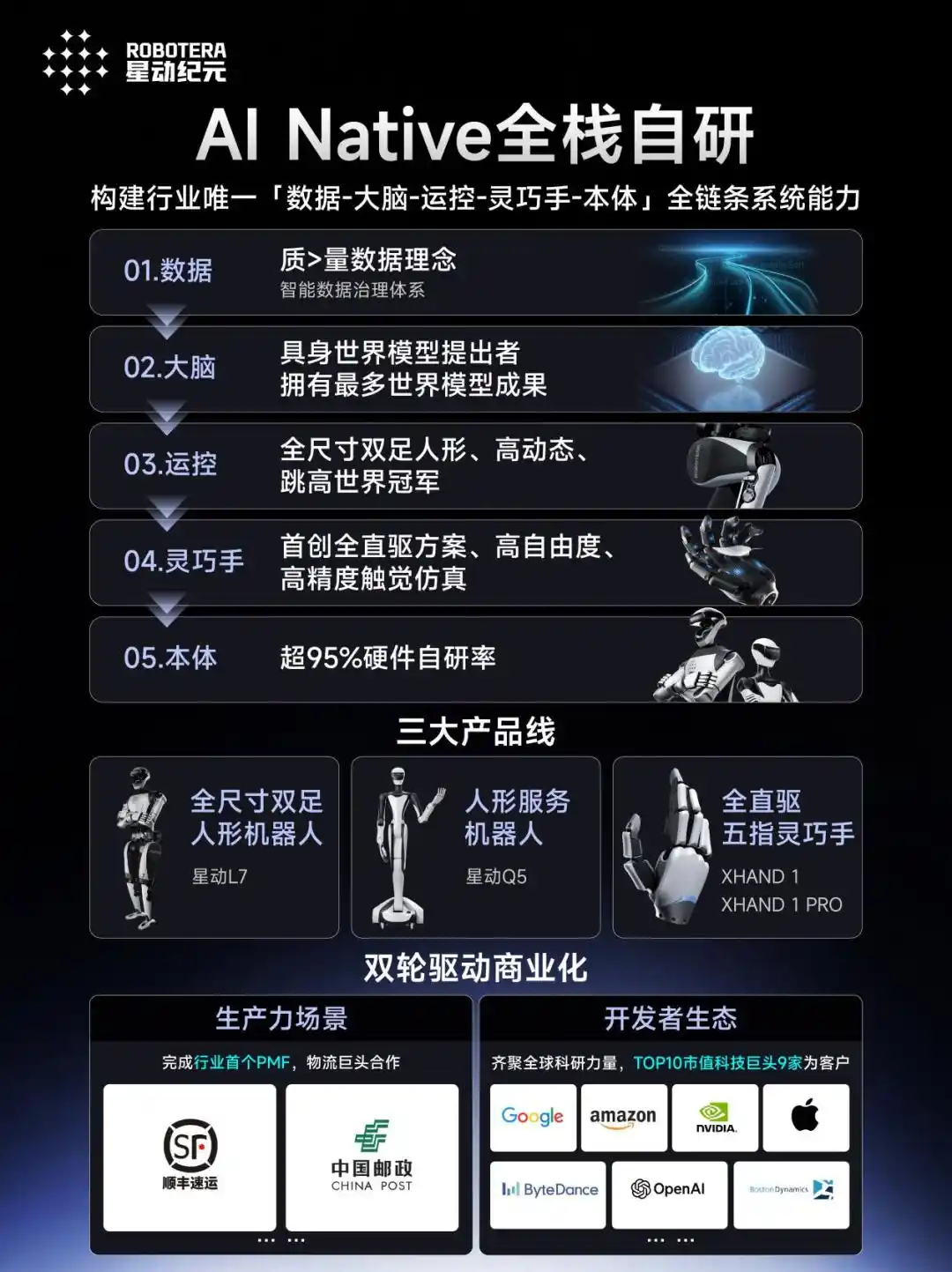
Therefore, from day one, StarDynamics has been driven by AI Native principles, constructing the industry's only full-stack self-developed barrier encompassing "data-brain-motion control-dexterous hand-body." The core logic is "algorithm requirements first, data value first," starting from the actual needs of brain model training and deployment, and reverse-defining hardware design. To date, it possesses three major product lines: the full-size bipedal humanoid robot Star-L7, the wheeled humanoid service robot Star-Q5, and the full direct-drive five-finger dexterous hand Star-XHAND series.
In less than three years, a long queue of investors has lined up behind Chen Jianyu. From early backers like Tsinghua University and Alibaba, to top-tier financial institutions like CDH VGC, Sequoia Capital China, IDG Capital, Qingliu Capital, CICC Capital, to industry giants like SF Express, Samsung, Geely Capital, Haier, Lenovo, Singtel, BAIC Capital, Dongfeng Capital, CICC Porsche, CICC Renault, and funds under China Unicom, as well as local state-owned capital like the Beijing Artificial Intelligence Industry Investment Fund—StarDynamics' shareholder list almost covers the most complete capital spectrum in the embodied intelligence sector.

Entering 2026, the financing pace accelerated dramatically: In March, it completed a 1 billion yuan strategic financing round, with valuation breaking through the 10 billion yuan mark. South Korea's Samsung and Singapore's Singtel appeared among its shareholders as overseas industrial capital for the first time. Just a month later, $200 million in financing arrived, led by SF Express, with leading institutions like Sequoia Capital China and IDG Capital jointly following on, while the industrial investor lineup expanded simultaneously. And today, with national-level state-owned capital platforms like Chengtong Fund collectively joining, a new 1 billion yuan financing round was announced. Securing three consecutive large-scale financings within three months, it set one of the fastest financing speeds in the embodied sector this year.

Thus, StarDynamics has constructed a triple capital matrix of "National-Level Capital Leadership + Top-Tier Financial Empowerment + Industrial Ecosystem Synergy," with over 20 industrial capital entities assembled behind it—a lineup not commonly seen in the industry.

Strengthening the Brain Through the Hand, Forging a New Path in Embodiment

At this juncture, for embodied intelligence to deliver industrial value, the competition is no longer about individual strengths, but the systemic capability integrating software and hardware—the brain (model and data) determines the upper limit of value, while the body (whole machine and end-effectors) constrains the lower limit of capability.

But within this system, there is a core hub often overlooked: the dexterous hand.

StarDynamics adheres to the AI Native principle of full-stack self-development across the entire embodied chain of "data-brain-motion control-dexterous hand-body," meaning hardware design does not start from mechanical structures but is reverse-defined from "what kind of data is most valuable for the brain." The five-finger dexterous hand is precisely the richest and most precise data collection entry point for physical world interaction—whether a grasp is successful, how force feedback changes, if an object slips, these high-dimensional data points directly determine what the model can learn.

Over the past two years, StarDynamics' models have continuously evolved:

In the first half of 2024, the team first proposed the robot fast-slow system VLA architecture (frequency-separated VLA), achieving the unity of "acting in real-time" and "deep thinking"; in the second half, they combined world models with VLA, releasing the VLA algorithm framework PAD and VPP integrating world models, and consolidating them to launch the end-to-end native robot brain model ERA-42.

ERA-42 is one of StarDynamics' core models, integrating vision, understanding, prediction, and action into one, enabling control of whole-body dexterous operations through a single end-to-end VLA model.

In February this year, building upon Ctrl-World, StarDynamics launched VLAW, pioneering the world's first VLA reinforcement learning framework based on world models, achieving synergistic iteration of policy and simulator, making world models not only "look right" but also "be physically correct." To date, StarDynamics is one of the embodied companies with the most world model achievements.

Breakthroughs in brain capability depend on high-quality data. On this front, relying on its self-developed dexterous hand and deployment applications, StarDynamics possesses the world's largest dataset from real dexterous hand hardware.

Simply put, StarDynamics uses dexterous hand hardware to obtain high-quality dexterous manipulation data, then uses this data to train smarter "brain" models, and finally feeds the evolved models back to the dexterous hands, forming a virtuous cycle of "the more used, the smarter; the smarter, the more capable." Therefore, the "dexterous hand" business is not merely a single-point component on the robot body but a core hub connecting the entire full-stack capability, the central entry point for collecting physical world interaction data.

Having long anticipated that end-effectors would become a bottleneck for embodied intelligence deployment, StarDynamics' dexterous hand adopted a brain-friendly, pioneering full direct-drive technical route—joint module output directly acts on joints, with no transmission backlash, elasticity, or friction loss. The generated data inherently possesses high precision, low latency, and reproducibility, and can be directly used for model training, fundamentally solving the quality issue of physical interaction data.

Currently, StarDynamics employs a "dual-hand strategy" with two differently positioned dexterous hand products:

1. Star-XHAND 1 PRO (Brain Hand), emphasizing high performance, core positioning as a data collection and algorithm validation platform, anchoring the upper limit of model capability;
2. Star-XHAND 1 (Work Hand), achieving precise force control and flexible operation through a full direct-drive technical architecture, adaptable to various humanoid robot platforms, solidifying the lower limit for scaled deployment.

It is reported that Star-XHAND 1 is now widely adopted to meet diverse needs in scenarios like industrial sorting and routine operations, becoming a shared choice for global robot manufacturers—American embodied intelligence unicorn Skild AI, South Korea's Rainbow Robotics, UK's Extend Robotics and Discover Robotics, as well as the new-generation humanoid robot HMND 01 from UK's Humanoid AI, among others, have all adopted Star-XHAND 1 as a core end-effector.

When the valuation of a single dexterous hand within the industry can even exceed that of the entire robot body, StarDynamics' narrative of "strengthening the brain through the hand" gains more substance. But ultimately, "strengthening the brain through the hand" is not the goal, but a means—obtaining high-quality data through the hand, training a stronger brain through the data, driving more intelligent robots through the brain, ultimately running through the full-stack system capability of "data-brain-motion control-dexterous hand-body," becoming real productivity in industrial scenarios—that is StarDynamics' true moat.

Relying on its self-developed dexterous hand and deployment applications, StarDynamics has accumulated a leading-scale dataset from real dexterous hand hardware within the industry. Based on this, the company has built a triple-gradient data source system:

Core Value Layer: Long-duration real hardware interaction data from real scenarios like logistics and industry, with 100% physical authenticity, forming the core foundation for models to align with industrial needs;
Precision Training Layer: High-precision teleoperation data, providing standardized action reference paradigms; currently has over 12 million clips of real hardware teleoperation data, including over 1.5 million clips of dexterous hand real hardware teleoperation data, one of the largest datasets of its kind in the industry;
Breadth Expansion Layer: First-person human behavior data and large-scale internet video data, enabling million-hour scaling, cost-effectively covering vast daily behaviors and scenarios.

Among these, long-duration real hardware interaction data from real scenarios and large-scale human video data simultaneously satisfy authenticity and diversity, constituting the dual core engines of the data system.

Currently, StarDynamics' overall dataset covers 100+ real scenarios and 1000+ dexterous manipulation tasks, sufficiently ensuring scene richness and behavioral diversity, laying a high-quality data foundation for the continuous iteration of the general embodied brain.

On this foundation, StarDynamics begins to answer the next question: Can this data support the brain in achieving commercial closed loops in real industrial scenarios?

Robots Begin Stable Deployment

The Watershed Moment

The answer lies on the industrial front lines where robots can stably deploy and work continuously.

StarDynamics adheres to a "B2B first, then B2C" commercialization path, gradually deploying in logistics, high-end manufacturing, and commercial service scenarios.

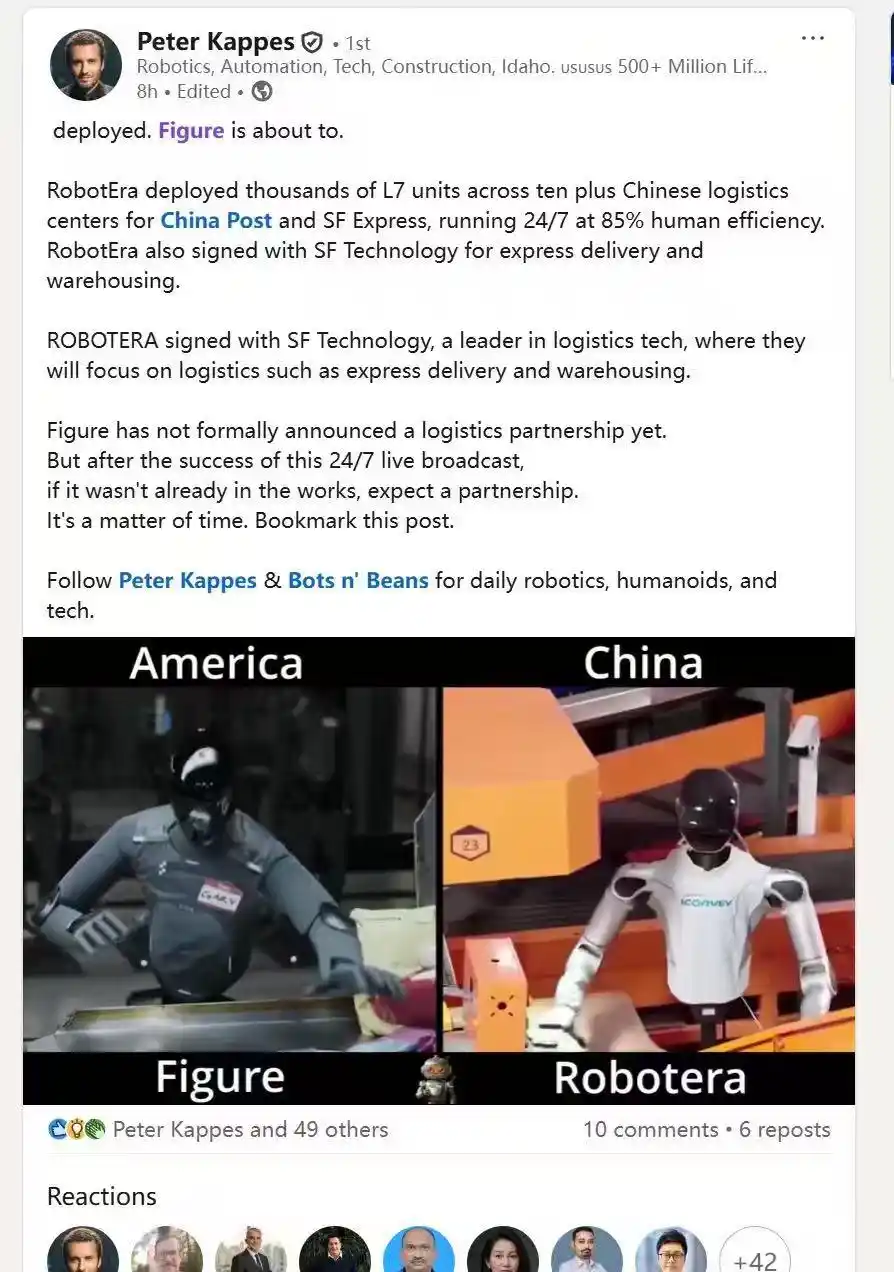
As we have seen, StarDynamics first achieved the industry's first PMF (Product-Market Fit) in logistics scenarios, deeply cooperating with leading clients like SF Express and China Post, batch-deploying to over 10 logistics centers across 5 provinces/municipalities in North, East, and South China, with some achieving normal 7×24 hour operations.

Here, embodied robots can flexibly handle various parcel sorting tasks involving packages of different shapes, materials, and sizes—grasping, turning parcel labels face-up, placing, etc. It's reported that efficiency in some scenarios even surpasses human levels, with processing speeds reaching over 1200 pieces per hour.

There's an interesting anecdote here—when the overseas embodied leader Figure conducted a live stream from its testing room, it was called out by foreign media: "StarDynamics' robots in China are already working at SF Express and China Post. When will Figure step out of the testing room and truly deploy?"
It is revealed that in the future, StarDynamics will continue to expand logistics scenarios, building a full-process embodied logistics service system covering inbound logistics, in-plant logistics, sales logistics, after-sales logistics, and extended express logistics links.

Meanwhile, high-end manufacturing and commercial service scenarios are also being rolled out. In high-end manufacturing for 3C electronics and automotive, StarDynamics has partnered with industry leaders like Samsung, Lenovo, Haier, and Geely. The real hardware data flowing back from these industrial sites continuously provides iterative nourishment for the embodied brain. Additionally, the Star-Q5 super-realistic service robot has been deployed in scenarios like Haier, Lenovo, and Century Golden Resources, providing services like store attraction, guided tours, explanation, and product delivery, exploring B2C entry points.

The underlying body capabilities supporting these deployments are also being validated by global top-tier institutions. StarDynamics' dexterous hands, universal body base, and development kits are not only used internally but have also been shipped globally, serving 9 out of the world's top 10 tech companies by market capitalization, becoming the shared choice of top tech firms and research institutions including OpenAI, Boston Dynamics, NVIDIA, Apple, Google, Amazon, ByteDance, as well as MIT, UC Berkeley, Stanford University, Tsinghua University, and Shanghai Qizhi Research Institute. Feedback from top-tier research clients further drives continuous upgrades to StarDynamics' hardware base.

As robots begin stable deployment, the prelude to the era of embodied intelligence leaders opens. As more robots enter the real world to perform tasks, those who can first establish data moats and evolution barriers for the next-generation robot brain that others find difficult to replicate will occupy key positions in the new round of competition.

As widely believed, 2026 is a watershed year for embodied models: in the first half, model capabilities diverge; in the second half, commercialization closed loops diverge. Capital markets no longer pay for stories, only recognizing one thing—whether technology can deploy, whether deployment can scale, and whether scale can feed back into technology.

The watershed moment has emerged—not under the spotlight of the laboratory, but on the logistics sorting lines at 3 a.m.

This article is from the WeChat public account "Investment Community" (ID: pedaily2012), author: Yang Jiyun


Criptos en tendencia

Preguntas relacionadas

QWhat is the significance of Xingdong Jiyuan's recent financing round, and which type of investors led it?

AXingdong Jiyuan recently completed a new 10 billion RMB financing round. It is significant because it was led by the State-owned Assets Supervision and Administration Commission (SASAC) state-owned capital operation company, Chengtong Fund, and involved participation from other major state-owned entities. This builds a 'three-fold capital matrix' of national capital leadership, top-tier financial empowerment, and industrial ecosystem collaboration. The company has raised 25 billion RMB in just two months.

QAccording to the article, what core technical concept did Xingdong Jiyuan pioneer in the field of embodied intelligence?

AXingdong Jiyuan was the proposer of the World Model concept in the field of embodied intelligence. It was an early pioneer, releasing its PAD model (a World Action Model) in September 2024, nearly a year before similar solutions like NVIDIA's DreamZero were announced.

QHow does Xingdong Jiyuan's 'AI Native' approach and its focus on dexterous hands (XHAND) create a competitive advantage?

AXingdong Jiyuan's 'AI Native' approach reverses the traditional hardware-first design. It starts by asking 'what data is most valuable for the AI brain?' and uses its self-developed, fully direct-drive dexterous hands (XHAND) as the primary sensor to collect high-quality, high-precision physical interaction data. This data is then used to train smarter brain models. This creates a virtuous cycle where better hands gather better data, which trains a better brain, enabling more capable robots, forming a core barrier through its full-stack 'data-brain-control-hand-body' capability.

QIn which industrial sector has Xingdong Jiyuan first achieved Product-Market Fit (PMF) with its robots?

AXingdong Jiyuan has first achieved Product-Market Fit (PMF) in the logistics sector. Its robots are deployed in-depth with leading clients like SF Express and China Post, operating 24/7 in over 10 logistics centers across China. They perform tasks like parcel sorting, handling items of various shapes and materials, with reported efficiency exceeding human levels in some scenarios.

QWhat does the article suggest is the key factor for success in the embodied intelligence field as of 2026?

AThe article suggests that 2026 is a watershed year where success is no longer about stories or isolated technologies. The key factors are whether the technology can be implemented, whether that implementation can be scaled, and whether the scale can, in turn, feed back to improve the technology. The 'dividing line' is now drawn in real-world industrial settings, like late-night logistics sorting lines, rather than in research labs.

Lecturas Relacionadas

DeepMind's Classic Masterpiece Crowned Again, ICML 2026 Awards Announced

ICML 2026 has announced its annual awards, with diffusion models and AI safety ethics taking center stage. The Outstanding Paper Award was shared by two diffusion model studies. One challenges a core assumption of diffusion language models (DLMs), arguing that their touted "arbitrary order generation" is a "flexibility trap" that harms performance. The other provides a high-accuracy sampling method, pushing the technical ceiling for diffusion models and log-concave distributions. A position paper winning the Outstanding Award raises a critical ethical concern: AI alignment research is unintentionally building a "censor's toolkit," where safety tools like RLHF can be repurposed for content control. Several papers received Honorable Mentions, spanning key areas: mapping where honesty emerges in RLHF-trained models, motion attribution in video generation, quantifying how much language models memorize, analyzing diffusion model consistency via random matrix theory, and providing a mathematical proof for the "grokking" phenomenon in a simple model. The Test of Time Award was given to DeepMind's 2016 seminal work "Asynchronous Methods for Deep Reinforcement Learning," recognizing the enduring impact of the A3C algorithm. Overall, the awards signal a shift in AI research from rapid expansion to deeper scrutiny—validating diffusion models as a major architectural contender while prompting serious ethical reflection within the safety community.

marsbitHace 14 min(s)

DeepMind's Classic Masterpiece Crowned Again, ICML 2026 Awards Announced

marsbitHace 14 min(s)

ARK's Massive Buying Spree in Crypto-Linked Stocks: Lower Risk, or Double the Pressure?

ARK Invest, led by Cathie Wood, significantly increased its holdings in crypto-related public stocks in June, purchasing $77 million worth of shares in Coinbase, Circle, and Bullish during Bitcoin's worst monthly performance in four years. The investment thesis is that these stocks offer regulated exposure to the crypto cycle without direct Bitcoin ownership. However, data analysis reveals significant downsides: these stocks exhibit nearly double the volatility of Bitcoin (68%-90% vs. 37.6% 30-day annualized volatility) and carry substantial company-specific risks like earnings, competition, and equity dilution, which account for much of their price movement. Only MicroStrategy closely tracks Bitcoin, acting as a leveraged proxy. Coinbase shows moderate correlation, while Circle and Robinhood have low correlation, being more influenced by stablecoin competition and diversified brokerage operations, respectively. Mining companies like RIOT and MARA have surged due to AI-related ventures, decoupling from Bitcoin's price. The case of Strategy highlights additional equity-structure risks, such as potential value erosion when its market value falls below its net asset value. Ultimately, investing in crypto stocks often means accepting amplified Bitcoin volatility or layering on unrelated business risks, rather than obtaining a safer alternative to direct cryptocurrency ownership.

Foresight NewsHace 18 min(s)

ARK's Massive Buying Spree in Crypto-Linked Stocks: Lower Risk, or Double the Pressure?

Foresight NewsHace 18 min(s)

Karpathy's Latest Outburst: A Single Sentence That Silenced the Entire Agent Developer Community

Andrej Karpathy, a core researcher at Anthropic, recently critiqued the current AI agent development frenzy. He argues that the biggest mistake is forcing agents to perform tasks without first thoroughly understanding the underlying large language models. Drawing from his 2016 "World of Bits" project at OpenAI—an early attempt at web-based agents that ultimately failed due to premature technology—he emphasizes that foundational model work is crucial. Karpathy offers three key pieces of advice: First, focus on getting the base models right before pushing agents. Second, recognize that creating a demo is easy, but building a real product takes a decade, akin to the journeys of autonomous driving and VR. Third, the product is the core capability, not the agent shell; a robust foundation will naturally enable advanced agents. He also suggests looking to neuroscience for inspiration, comparing agent components to brain structures like the hippocampus and thalamus. Despite his caution, Karpathy concludes that independent developers and startups, not large labs like OpenAI, are at the forefront of agent innovation. This is because the agent field is new, with no entity having a five-year head start, leveling the playing field for agile experimenters. His core message is not to abandon agent work, but to build it on a solid, deeply understood foundation.

marsbitHace 18 min(s)

Karpathy's Latest Outburst: A Single Sentence That Silenced the Entire Agent Developer Community

marsbitHace 18 min(s)

Tsinghua University's Special Award Winner, Gu Yuxian, Joins DeepSeek

Tsinghua University's prestigious Graduate Special Scholarship recipient and 2021 Ph.D. candidate, Yuxian Gu, has officially joined DeepSeek. This news coincides with DeepSeek's major recruitment drive and the imminent launch of DeepSeek V4, on whose research paper Gu is listed as an author. A doctoral student in the Conversational AI group under Professor Minlie Huang at Tsinghua, Gu's research focuses on enhancing efficiency throughout the entire lifecycle of large language models. His key contributions span three areas: innovative methods for pre-training data selection (e.g., PDS), advanced knowledge distillation techniques for model compression (notably MiniLLM), and the development of efficient model architectures like Jet-Nemotron. His work has gained significant recognition, with nearly 5,000 citations on Google Scholar. Key publications include the highly cited surveys and papers on pre-trained models and the MiniLLM distillation method. As first author, he has presented at top-tier AI conferences including NeurIPS, ICLR, and ACL. One of his notable achievements is the Jet-Nemotron architecture, which combines Post-Neural Architecture Search (PostNAS) and a novel linear attention module called JetBlock. This model series demonstrates state-of-the-art performance rivaling larger models while achieving substantial efficiency gains in inference. Gu's expertise in creating powerful yet efficient AI systems aligns with industry needs, as evidenced by the adoption of his MiniLLM method by leading tech companies. His move to DeepSeek is anticipated to contribute further advancements in the field.

marsbitHace 44 min(s)

Tsinghua University's Special Award Winner, Gu Yuxian, Joins DeepSeek

marsbitHace 44 min(s)

Trading

Spot

Artículos destacados

Qué es $S$

Entendiendo SPERO: Una Visión General Completa Introducción a SPERO A medida que el panorama de la innovación continúa evolucionando, la aparición de tecnologías web3 y proyectos de criptomonedas juega un papel fundamental en la configuración del futuro digital. Un proyecto que ha atraído la atención en este campo dinámico es SPERO, denotado como SPERO,$$s$. Este artículo tiene como objetivo reunir y presentar información detallada sobre SPERO, para ayudar a entusiastas e inversores a comprender sus fundamentos, objetivos e innovaciones dentro de los dominios web3 y cripto. ¿Qué es SPERO,$$s$? SPERO,$$s$ es un proyecto único dentro del espacio cripto que busca aprovechar los principios de descentralización y tecnología blockchain para crear un ecosistema que promueva la participación, la utilidad y la inclusión financiera. El proyecto está diseñado para facilitar interacciones de igual a igual de nuevas maneras, proporcionando a los usuarios soluciones y servicios financieros innovadores. En su esencia, SPERO,$$s$ tiene como objetivo empoderar a los individuos al proporcionar herramientas y plataformas que mejoren la experiencia del usuario en el espacio de las criptomonedas. Esto incluye habilitar métodos de transacción más flexibles, fomentar iniciativas impulsadas por la comunidad y crear caminos para oportunidades financieras a través de aplicaciones descentralizadas (dApps). La visión subyacente de SPERO,$$s$ gira en torno a la inclusividad, buscando cerrar brechas dentro de las finanzas tradicionales mientras aprovecha los beneficios de la tecnología blockchain. ¿Quién es el Creador de SPERO,$$s$? La identidad del creador de SPERO,$$s$ sigue siendo algo oscura, ya que hay recursos públicos limitados que proporcionan información de fondo detallada sobre su(s) fundador(es). Esta falta de transparencia puede derivarse del compromiso del proyecto con la descentralización, una ética que muchos proyectos web3 comparten, priorizando las contribuciones colectivas sobre el reconocimiento individual. Al centrar las discusiones en torno a la comunidad y sus objetivos colectivos, SPERO,$$s$ encarna la esencia del empoderamiento sin señalar a individuos específicos. Como tal, comprender la ética y la misión de SPERO sigue siendo más importante que identificar a un creador singular. ¿Quiénes son los Inversores de SPERO,$$s$? SPERO,$$s$ cuenta con el apoyo de una diversa gama de inversores que van desde capitalistas de riesgo hasta inversores ángeles dedicados a fomentar la innovación en el sector cripto. El enfoque de estos inversores generalmente se alinea con la misión de SPERO, priorizando proyectos que prometen avances tecnológicos sociales, inclusión financiera y gobernanza descentralizada. Estas fundaciones de inversores suelen estar interesadas en proyectos que no solo ofrecen productos innovadores, sino que también contribuyen positivamente a la comunidad blockchain y sus ecosistemas. El respaldo de estos inversores refuerza a SPERO,$$s$ como un contendiente notable en el dominio de proyectos cripto que evoluciona rápidamente. ¿Cómo Funciona SPERO,$$s$? SPERO,$$s$ emplea un marco multifacético que lo distingue de los proyectos de criptomonedas convencionales. Aquí hay algunas de las características clave que subrayan su singularidad e innovación: Gobernanza Descentralizada: SPERO,$$s$ integra modelos de gobernanza descentralizada, empoderando a los usuarios para participar activamente en los procesos de toma de decisiones sobre el futuro del proyecto. Este enfoque fomenta un sentido de propiedad y responsabilidad entre los miembros de la comunidad. Utilidad del Token: SPERO,$$s$ utiliza su propio token de criptomoneda, diseñado para servir diversas funciones dentro del ecosistema. Estos tokens permiten transacciones, recompensas y la facilitación de servicios ofrecidos en la plataforma, mejorando la participación y la utilidad general. Arquitectura en Capas: La arquitectura técnica de SPERO,$$s$ apoya la modularidad y escalabilidad, permitiendo la integración fluida de características y aplicaciones adicionales a medida que el proyecto evoluciona. Esta adaptabilidad es fundamental para mantener la relevancia en el cambiante paisaje cripto. Participación de la Comunidad: El proyecto enfatiza iniciativas impulsadas por la comunidad, empleando mecanismos que incentivan la colaboración y la retroalimentación. Al nutrir una comunidad sólida, SPERO,$$s$ puede abordar mejor las necesidades de los usuarios y adaptarse a las tendencias del mercado. Enfoque en la Inclusión: Al ofrecer tarifas de transacción bajas e interfaces amigables para el usuario, SPERO,$$s$ busca atraer a una base de usuarios diversa, incluyendo a individuos que anteriormente pueden no haber participado en el espacio cripto. Este compromiso con la inclusión se alinea con su misión general de empoderamiento a través de la accesibilidad. Cronología de SPERO,$$s$ Entender la historia de un proyecto proporciona información crucial sobre su trayectoria de desarrollo y hitos. A continuación se presenta una cronología sugerida que mapea eventos significativos en la evolución de SPERO,$$s$: Fase de Conceptualización e Ideación: Las ideas iniciales que forman la base de SPERO,$$s$ fueron concebidas, alineándose estrechamente con los principios de descentralización y enfoque comunitario dentro de la industria blockchain. Lanzamiento del Whitepaper del Proyecto: Tras la fase conceptual, se lanzó un whitepaper completo que detalla la visión, los objetivos y la infraestructura tecnológica de SPERO,$$s$ para generar interés y retroalimentación de la comunidad. Construcción de Comunidad y Primeras Interacciones: Se realizaron esfuerzos de divulgación activa para construir una comunidad de primeros adoptantes y posibles inversores, facilitando discusiones en torno a los objetivos del proyecto y obteniendo apoyo. Evento de Generación de Tokens: SPERO,$$s$ llevó a cabo un evento de generación de tokens (TGE) para distribuir sus tokens nativos a los primeros seguidores y establecer liquidez inicial dentro del ecosistema. Lanzamiento de la dApp Inicial: La primera aplicación descentralizada (dApp) asociada con SPERO,$$s$ se puso en marcha, permitiendo a los usuarios interactuar con las funcionalidades centrales de la plataforma. Desarrollo Continuo y Alianzas: Actualizaciones y mejoras continuas a las ofertas del proyecto, incluyendo alianzas estratégicas con otros actores en el espacio blockchain, han moldeado a SPERO,$$s$ en un jugador competitivo y en evolución en el mercado cripto. Conclusión SPERO,$$s$ se erige como un testimonio del potencial de web3 y las criptomonedas para revolucionar los sistemas financieros y empoderar a los individuos. Con un compromiso con la gobernanza descentralizada, la participación comunitaria y funcionalidades diseñadas de manera innovadora, allana el camino hacia un paisaje financiero más inclusivo. Como con cualquier inversión en el espacio cripto que evoluciona rápidamente, se anima a los posibles inversores y usuarios a investigar a fondo y participar de manera reflexiva con los desarrollos en curso dentro de SPERO,$$s$. El proyecto muestra el espíritu innovador de la industria cripto, invitando a una mayor exploración de sus innumerables posibilidades. Mientras el viaje de SPERO,$$s$ aún se desarrolla, sus principios fundamentales pueden, de hecho, influir en el futuro de cómo interactuamos con la tecnología, las finanzas y entre nosotros en ecosistemas digitales interconectados.

111 Vistas totalesPublicado en 2024.12.17Actualizado en 2024.12.17

Qué es $S$

Qué es AGENT S

Agent S: El Futuro de la Interacción Autónoma en Web3 Introducción En el paisaje en constante evolución de Web3 y las criptomonedas, las innovaciones están redefiniendo constantemente cómo los individuos interactúan con las plataformas digitales. Uno de estos proyectos pioneros, Agent S, promete revolucionar la interacción humano-computadora a través de su marco agente abierto. Al allanar el camino para interacciones autónomas, Agent S busca simplificar tareas complejas, ofreciendo aplicaciones transformadoras en inteligencia artificial (IA). Esta exploración detallada profundizará en las complejidades del proyecto, sus características únicas y las implicaciones para el dominio de las criptomonedas. ¿Qué es Agent S? Agent S se presenta como un marco agente abierto innovador, diseñado específicamente para abordar tres desafíos fundamentales en la automatización de tareas informáticas: Adquisición de Conocimiento Específico del Dominio: El marco aprende inteligentemente de diversas fuentes de conocimiento externas y experiencias internas. Este enfoque dual le permite construir un rico repositorio de conocimiento específico del dominio, mejorando su rendimiento en la ejecución de tareas. Planificación a Largo Plazo de Tareas: Agent S emplea planificación jerárquica aumentada por la experiencia, un enfoque estratégico que facilita la descomposición y ejecución eficiente de tareas complejas. Esta característica mejora significativamente su capacidad para gestionar múltiples subtareas de manera eficiente y efectiva. Manejo de Interfaces Dinámicas y No Uniformes: El proyecto introduce la Interfaz Agente-Computadora (ACI), una solución innovadora que mejora la interacción entre agentes y usuarios. Utilizando Modelos de Lenguaje Multimodal de Gran Escala (MLLMs), Agent S puede navegar y manipular diversas interfaces gráficas de usuario sin problemas. A través de estas características pioneras, Agent S proporciona un marco robusto que aborda las complejidades involucradas en la automatización de la interacción humana con las máquinas, preparando el terreno para una multitud de aplicaciones en IA y más allá. ¿Quién es el Creador de Agent S? Si bien el concepto de Agent S es fundamentalmente innovador, la información específica sobre su creador sigue siendo elusiva. El creador es actualmente desconocido, lo que resalta ya sea la etapa incipiente del proyecto o la elección estratégica de mantener a los miembros fundadores en el anonimato. Independientemente de la anonimidad, el enfoque sigue siendo en las capacidades y el potencial del marco. ¿Quiénes son los Inversores de Agent S? Dado que Agent S es relativamente nuevo en el ecosistema criptográfico, la información detallada sobre sus inversores y patrocinadores financieros no está documentada explícitamente. La falta de información disponible públicamente sobre las bases de inversión u organizaciones que apoyan el proyecto plantea preguntas sobre su estructura de financiamiento y hoja de ruta de desarrollo. Comprender el respaldo es crucial para evaluar la sostenibilidad del proyecto y su posible impacto en el mercado. ¿Cómo Funciona Agent S? En el núcleo de Agent S se encuentra una tecnología de vanguardia que le permite funcionar de manera efectiva en diversos entornos. Su modelo operativo se basa en varias características clave: Interacción Humano-Computadora Similar a la Humana: El marco ofrece planificación avanzada de IA, esforzándose por hacer que las interacciones con las computadoras sean más intuitivas. Al imitar el comportamiento humano en la ejecución de tareas, promete elevar las experiencias de los usuarios. Memoria Narrativa: Empleada para aprovechar experiencias de alto nivel, Agent S utiliza memoria narrativa para hacer un seguimiento de las historias de tareas, mejorando así sus procesos de toma de decisiones. Memoria Episódica: Esta característica proporciona a los usuarios una guía paso a paso, permitiendo que el marco ofrezca apoyo contextual a medida que se desarrollan las tareas. Soporte para OpenACI: Con la capacidad de ejecutarse localmente, Agent S permite a los usuarios mantener el control sobre sus interacciones y flujos de trabajo, alineándose con la ética descentralizada de Web3. Fácil Integración con APIs Externas: Su versatilidad y compatibilidad con varias plataformas de IA aseguran que Agent S pueda encajar sin problemas en ecosistemas tecnológicos existentes, convirtiéndolo en una opción atractiva para desarrolladores y organizaciones. Estas funcionalidades contribuyen colectivamente a la posición única de Agent S dentro del espacio cripto, ya que automatiza tareas complejas y de múltiples pasos con una intervención humana mínima. A medida que el proyecto evoluciona, sus posibles aplicaciones en Web3 podrían redefinir cómo se desarrollan las interacciones digitales. Cronología de Agent S El desarrollo y los hitos de Agent S pueden encapsularse en una cronología que resalta sus eventos significativos: 27 de septiembre de 2024: El concepto de Agent S fue lanzado en un documento de investigación integral titulado “Un Marco Agente Abierto que Usa Computadoras Como un Humano”, mostrando las bases del proyecto. 10 de octubre de 2024: El documento de investigación fue puesto a disposición del público en arXiv, ofreciendo una exploración profunda del marco y su evaluación de rendimiento basada en el benchmark OSWorld. 12 de octubre de 2024: Se lanzó una presentación en video, proporcionando una visión visual de las capacidades y características de Agent S, involucrando aún más a posibles usuarios e inversores. Estos marcadores en la cronología no solo ilustran el progreso de Agent S, sino que también indican su compromiso con la transparencia y la participación comunitaria. Puntos Clave Sobre Agent S A medida que el marco Agent S continúa evolucionando, varios atributos clave destacan, subrayando su naturaleza innovadora y potencial: Marco Innovador: Diseñado para proporcionar un uso intuitivo de las computadoras similar a la interacción humana, Agent S aporta un enfoque novedoso a la automatización de tareas. Interacción Autónoma: La capacidad de interactuar de manera autónoma con las computadoras a través de GUI significa un salto hacia soluciones informáticas más inteligentes y eficientes. Automatización de Tareas Complejas: Con su metodología robusta, puede automatizar tareas complejas y de múltiples pasos, haciendo que los procesos sean más rápidos y menos propensos a errores. Mejora Continua: Los mecanismos de aprendizaje permiten a Agent S mejorar a partir de experiencias pasadas, mejorando continuamente su rendimiento y eficacia. Versatilidad: Su adaptabilidad en diferentes entornos operativos como OSWorld y WindowsAgentArena asegura que pueda servir a una amplia gama de aplicaciones. A medida que Agent S se posiciona en el paisaje de Web3 y criptomonedas, su potencial para mejorar las capacidades de interacción y automatizar procesos significa un avance significativo en las tecnologías de IA. A través de su marco innovador, Agent S ejemplifica el futuro de las interacciones digitales, prometiendo una experiencia más fluida y eficiente para los usuarios en diversas industrias. Conclusión Agent S representa un audaz avance en la unión de la IA y Web3, con la capacidad de redefinir cómo interactuamos con la tecnología. Aunque aún se encuentra en sus primeras etapas, las posibilidades para su aplicación son vastas y atractivas. A través de su marco integral que aborda desafíos críticos, Agent S busca llevar las interacciones autónomas al primer plano de la experiencia digital. A medida que nos adentramos más en los reinos de las criptomonedas y la descentralización, proyectos como Agent S sin duda desempeñarán un papel crucial en la configuración del futuro de la tecnología y la colaboración humano-computadora.

517 Vistas totalesPublicado en 2025.01.14Actualizado en 2025.01.14

Qué es AGENT S

Cómo comprar S

¡Bienvenido a HTX.com! Hemos hecho que comprar Sonic (S) sea simple y conveniente. Sigue nuestra guía paso a paso para iniciar tu viaje de criptos.Paso 1: crea tu cuenta HTXUtiliza tu correo electrónico o número de teléfono para registrarte y obtener una cuenta gratuita en HTX. Experimenta un proceso de registro sin complicaciones y desbloquea todas las funciones.Obtener mi cuentaPaso 2: ve a Comprar cripto y elige tu método de pagoTarjeta de crédito/débito: usa tu Visa o Mastercard para comprar Sonic (S) al instante.Saldo: utiliza fondos del saldo de tu cuenta HTX para tradear sin problemas.Terceros: hemos agregado métodos de pago populares como Google Pay y Apple Pay para mejorar la comodidad.P2P: tradear directamente con otros usuarios en HTX.Over-the-Counter (OTC): ofrecemos servicios personalizados y tipos de cambio competitivos para los traders.Paso 3: guarda tu Sonic (S)Después de comprar tu Sonic (S), guárdalo en tu cuenta HTX. Alternativamente, puedes enviarlo a otro lugar mediante transferencia blockchain o utilizarlo para tradear otras criptomonedas.Paso 4: tradear Sonic (S)Tradear fácilmente con Sonic (S) en HTX's mercado spot. Simplemente accede a tu cuenta, selecciona tu par de trading, ejecuta tus trades y monitorea en tiempo real. Ofrecemos una experiencia fácil de usar tanto para principiantes como para traders experimentados.

1.1k Vistas totalesPublicado en 2025.01.15Actualizado en 2026.06.02

Cómo comprar S

Discusiones

Bienvenido a la comunidad de HTX. Aquí puedes mantenerte informado sobre los últimos desarrollos de la plataforma y acceder a análisis profesionales del mercado. A continuación se presentan las opiniones de los usuarios sobre el precio de S (S).

活动图片