Standing Tall Through Storms, Gathering in Hong Kong to Ride the Tide | Registration Opens for Conflux Tree-Graph Digital Finance & Ecosystem Development Conference

marsbitPublicado a 2026-05-09Actualizado a 2026-05-09

Resumen

Every technological wave quietly reshapes the world. From the steam engine to the internet and the digital economy, each has been a growth engine. Today, the convergence of blockchain, AI, and digital finance is accelerating a new transformation. Digital assets are reaching new peaks, global regulatory attitudes are clarifying, and concepts like RWA and stablecoins are scaling into real-world applications. AI Agents are beginning to participate in human production. We stand at a historic juncture where traditional and digital finance are deeply integrating, presenting clear opportunities and tangible challenges. Having operated stably for five years and connected multiple regions globally, Conflux Network continues to serve digital finance and on-chain applications. Hong Kong, as an international financial hub bridging China and the world, is seeing progressive exploration and improved frameworks for Web3 and digital finance. Leveraging Conflux's technical foundation, the Conflux Digital Finance and Ecosystem Development Summit will be held in Hong Kong from May 13 to 15, 2026. This event will foster in-depth dialogue on the future: discussing the evolution of digital financial infrastructure, the compliant implementation of RWA and stablecoins, ecosystem reshaping and on-chain governance in the age of AI Agents, and Web3 security frameworks. It will gather global scholars, entrepreneurs, investors, financial institutions, and industry representatives for cross-disciplina...

Every wave of technological advancement quietly reshapes the world's operating paradigms. The steam engine propelled the rise of industry, information technology and the internet turned the "global village" into a reality, and the digital economy has gradually become a key engine of global growth. Today, the convergence of blockchain, AI, and digital finance is accelerating the arrival of a new transformative era.

The scale of digital assets continues to hit historical highs, global regulatory attitudes toward digital financial innovation are becoming increasingly clear, RWA and stablecoins are evolving from concepts to large-scale implementation, and AI Agents are beginning to actively participate in human production and creation. We stand at a historical juncture where traditional finance and digital finance are deeply integrating. Opportunities have never been so clear, and challenges have never been so tangible.

The Conflux Network tree-graph public blockchain has been operating stably for five years, connecting multiple countries and regions globally, and continuously serving the development of digital finance and on-chain applications. Hong Kong, as an international financial center, has long played a pivotal role as a hub connecting Mainland China with the world, where capital, information, and industries converge and flow. In recent years, explorations around digital finance and Web3 have been steadily advancing here, with institutional and market environments gradually improving, providing clearer space for the experimentation and implementation of new technologies.

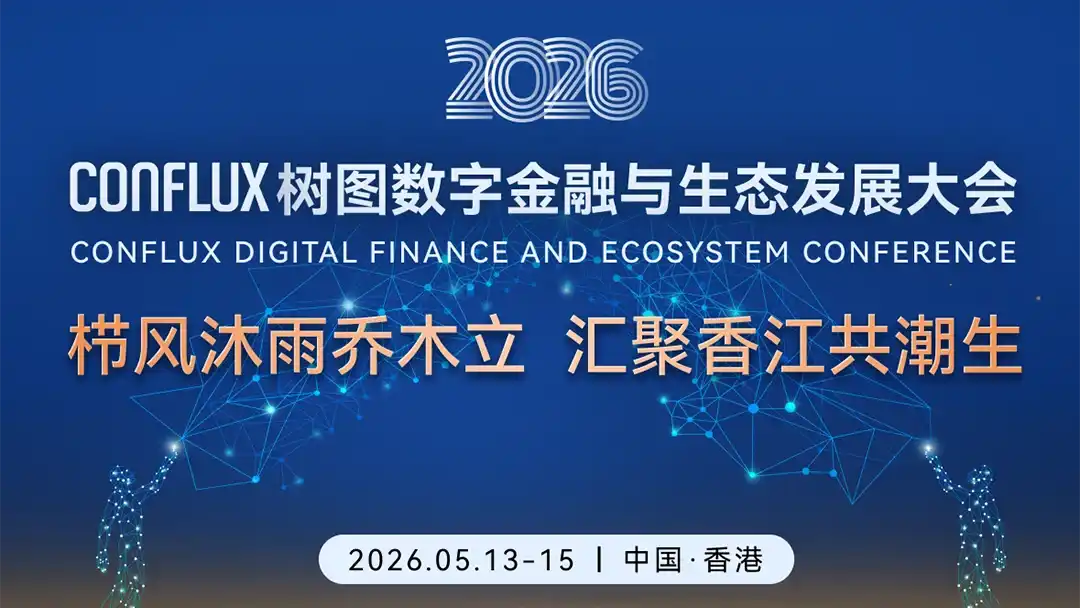
Leveraging Conflux's technological foundation, the Conflux Tree-Graph Digital Finance & Ecosystem Development Conference will be held in Hong Kong from May 13th to 15th, 2026.

This will be an in-depth dialogue about the present and the future: centering on core topics such as the evolution of digital financial infrastructure, the compliant implementation of RWA and stablecoins, ecosystem restructuring and on-chain governance in the era of AI Agents, and the construction of Web3 security systems, the event will gather academics, entrepreneurs, investors, financial institutions, and industry representatives from around the world for profound cross-disciplinary exchanges. On the final day of the conference, Conflux will co-host a themed salon with The University of Hong Kong, planting seeds of future-oriented thought in the minds of the younger generation.

Scan the QR code above to register

As technology transitions from "usable" to "scalably applicable," and as finance evolves from "digitalization" to "on-chain and intelligent" operation, the restructuring of industrial architecture has already begun. Whether you are a developer, researcher, entrepreneur, or an explorer keeping a watchful eye on digital finance and Web3, we look forward to meeting you in Hong Kong.


Preguntas relacionadas

QWhat is the main topic of the "Conflux Tree-Graph Digital Finance and Ecosystem Development Conference"?

AThe main topic is the intersection of blockchain, AI, and digital finance, focusing on infrastructure evolution, RWA and stablecoin compliance, ecosystem reshaping in the AI Agent era, on-chain governance, and Web3 security.

QWhen and where will the "Conflux Tree-Graph Digital Finance and Ecosystem Development Conference" take place?

AThe conference will take place in Hong Kong from May 13th to 15th, 2026.

QAccording to the article, why is Hong Kong considered a suitable location for this conference?

AHong Kong is a global financial hub connecting Mainland China and the world. It has increasingly clear regulations and a supportive market environment for exploring digital finance and Web3, providing space for the practical implementation of new technologies.

QWhat specific event is mentioned for the final day of the conference?

AOn the final day, Conflux will co-host a thematic salon with the University of Hong Kong, aiming to share insights about the future with the younger generation.

QWho is the target audience for this conference according to the article?

AThe target audience includes developers, researchers, entrepreneurs, investors, financial institutions, industry representatives, and anyone exploring or interested in digital finance and Web3.

Lecturas Relacionadas

ByteDance Adopts Arm CPUs, Jensen Huang: So Sad I Didn't Buy Arm

**Summary:** At Computex 2026, Arm CEO Rene Haas announced that ByteDance and Oracle have adopted Arm's self-designed Arm AGI data center CPU. The company expects significant revenue growth from this product, projecting $20 billion in demand for the 2027/2028 fiscal years. Haas noted that restricting AI-capable CPUs from the US to China is nearly impossible due to their widespread applications. Arm's stock has surged dramatically this year, notably rising 16% after NVIDIA's Arm-based Vera CPU and RTX Spark announcements. A highlight was the informal, humorous on-stage conversation between Haas and NVIDIA CEO Jensen Huang. Huang joked about NVIDIA's failed attempt to acquire Arm and playfully lamented selling his Arm shares. Both executives showed a clear sense of camaraderie and shared regret over the missed merger. Key technical topics were discussed: 1. **AI PC Design:** Huang explained NVIDIA's RTX Spark superchip (with a 20-core Arm CPU) is designed for future AI agents that will autonomously run and use tools on PCs, blending local and cloud processing. 2. **Agent vs. OS:** Huang emphasized the operating system remains crucial, as AI agents rely on its APIs and tools to function. 3. **Growth Constraints:** He identified the shift to "useful AI" that generates profitable tokens as a primary driver for immense, almost limitless, computational demand. Haas outlined Arm's strategy across PC and data centers. For PCs, Arm collaborates with partners like NVIDIA and MediaTek, offering its compute subsystem (CSS) for custom SoCs. In data centers, its Arm AGI CPU (built on TSMC's 3nm process) has gained major partners including OpenAI, Meta, and now ByteDance and Oracle. Arm presented a multi-year roadmap for its in-house CPU line. The article concludes that while GPUs dominated the AI training race, the explosion of AI agents is shifting significant focus to CPUs for inference, state management, and tool orchestration. The industry is trending towards vertical integration, with companies like cloud providers designing chips and chip/IP firms offering full solutions, all competing to deliver more efficient computing per watt.

marsbitHace 4 min(s)

ByteDance Adopts Arm CPUs, Jensen Huang: So Sad I Didn't Buy Arm

marsbitHace 4 min(s)

New Wall Street Play: Yen Shorts Still Adding, But Japan Stocks Don't Rely on Carry Trade Unwinding

On June 3rd, USD/JPY hit 160.44, its highest level since July 2024, while the Nikkei 225 surged past 68,000 points. Contrary to popular narratives of an imminent "carry trade unwind" akin to August 2024, data reveals a more complex picture. Speculative net short positions in yen futures have actually increased, reaching -114,667 contracts by late May, suggesting traders are doubling down rather than retreating. Meanwhile, Japan's Finance Ministry conducted its largest-ever single-round FX intervention (11.73 trillion yen) in April-May but failed to hold the 160 yen line. The Nikkei's rally is not driven by carry trade dynamics. Foreign investors are aggressively buying Japanese stocks, with net purchases in 2026 running nearly 16 times higher than 2025 levels. This inflow is concentrated in AI and semiconductor-related stocks like SoftBank and Socionext, fueled by positive sector outlooks, rather than being a flight from unwinding yen shorts. Furthermore, the Nikkei has continued climbing despite the Bank of Japan's (BOJ) rate hikes to 0.75%. This disconnect exists because the current equity boom is fueled by AI-driven foreign investment, not reliant on cheap yen funding. However, this relationship remains fragile. Should the BOJ hike rates further (e.g., to 1.0%) while dollar weakness increases carry trade costs, the trajectories of the yen and Japanese stocks could reconverge, potentially triggering volatility.

marsbitHace 9 min(s)

New Wall Street Play: Yen Shorts Still Adding, But Japan Stocks Don't Rely on Carry Trade Unwinding

marsbitHace 9 min(s)

Broadcom's Q3 Guidance Misses Expectations by $12 Billion, After-Hours Trading Plummets Over 13%, AI Narrative "Cooling"?

On June 3, Broadcom released record Q2 FY26 results with revenue of $22.19B, up 48% YoY, and AI chip sales of $10.8B, up 143%. Adjusted EPS of $2.44 beat estimates. However, its Q3 AI semiconductor revenue guidance of $16B, while up over 200% YoY, fell roughly $1.2B (7%) short of analyst consensus expectations of $17.2B. This miss, coupled with slightly weaker-than-expected software revenue, triggered a severe market reaction. CEO Hock Tan maintained the FY26 AI revenue outlook of over $100B but did not raise it, disappointing investors who had priced in more robust growth. The stock plummeted over 13% in after-hours trading, erasing roughly $270B in market cap. The sell-off extended to peers like Marvell. A key concern for markets, particularly for Chinese optical module suppliers, was Tan's comment that the contribution of AI networking (e.g., Ethernet switches, optical interconnect chips) to AI revenue, currently near 40%, is expected to normalize to around 30% over time, signaling a potential peak in growth for that segment. Despite the guidance shortfall, Tan reiterated that AI demand remains "insatiable" and reaffirmed the long-term target of exceeding $100B in AI revenue by FY27. The reaction highlights the heightened sensitivity and premium valuation placed on AI-exposed stocks, where anything less than stellar guidance can prompt significant profit-taking. The broader question is whether this represents a cooling AI narrative or a correction in overstretched valuations.

marsbitHace 9 min(s)

Broadcom's Q3 Guidance Misses Expectations by $12 Billion, After-Hours Trading Plummets Over 13%, AI Narrative "Cooling"?

marsbitHace 9 min(s)

Trading

Spot
Futuros

Artículos destacados

Cómo comprar TREE

¡Bienvenido a HTX.com! Hemos hecho que comprar TREEHOUSE (TREE) sea simple y conveniente. Sigue nuestra guía paso a paso para iniciar tu viaje de criptos.Paso 1: crea tu cuenta HTXUtiliza tu correo electrónico o número de teléfono para registrarte y obtener una cuenta gratuita en HTX. Experimenta un proceso de registro sin complicaciones y desbloquea todas las funciones.Obtener mi cuentaPaso 2: ve a Comprar cripto y elige tu método de pagoTarjeta de crédito/débito: usa tu Visa o Mastercard para comprar TREEHOUSE (TREE) al instante.Saldo: utiliza fondos del saldo de tu cuenta HTX para tradear sin problemas.Terceros: hemos agregado métodos de pago populares como Google Pay y Apple Pay para mejorar la comodidad.P2P: tradear directamente con otros usuarios en HTX.Over-the-Counter (OTC): ofrecemos servicios personalizados y tipos de cambio competitivos para los traders.Paso 3: guarda tu TREEHOUSE (TREE)Después de comprar tu TREEHOUSE (TREE), guárdalo en tu cuenta HTX. Alternativamente, puedes enviarlo a otro lugar mediante transferencia blockchain o utilizarlo para tradear otras criptomonedas.Paso 4: tradear TREEHOUSE (TREE)Tradear fácilmente con TREEHOUSE (TREE) en HTX's mercado spot. Simplemente accede a tu cuenta, selecciona tu par de trading, ejecuta tus trades y monitorea en tiempo real. Ofrecemos una experiencia fácil de usar tanto para principiantes como para traders experimentados.

174 Vistas totalesPublicado en 2025.07.29Actualizado en 2026.06.02

Cómo comprar TREE

Discusiones

Bienvenido a la comunidad de HTX. Aquí puedes mantenerte informado sobre los últimos desarrollos de la plataforma y acceder a análisis profesionales del mercado. A continuación se presentan las opiniones de los usuarios sobre el precio de TREE (TREE).

活动图片