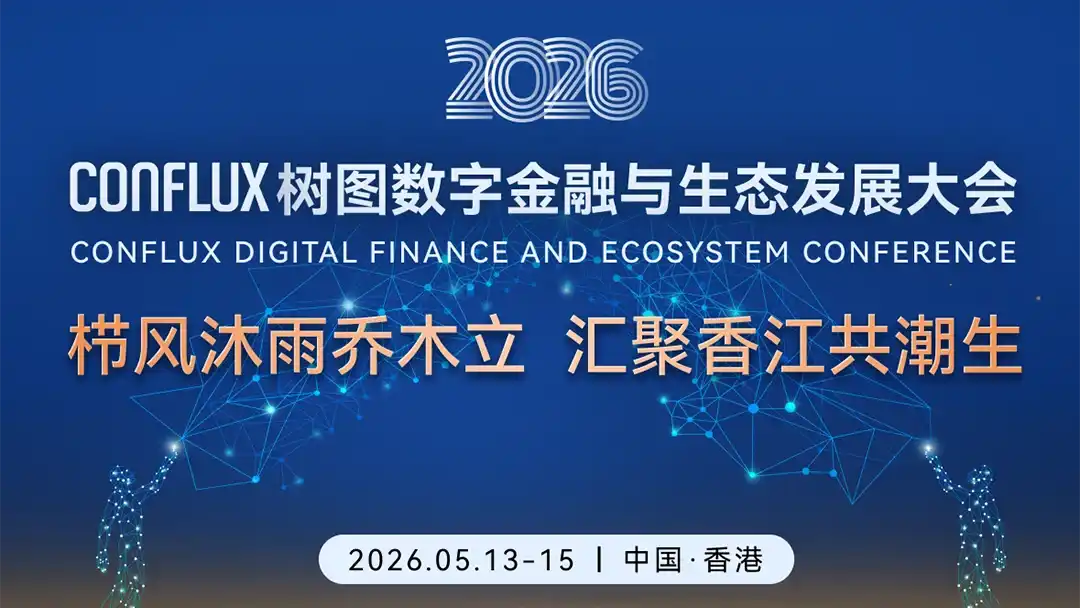
Standing Tall Through Storms, Gathering in Hong Kong to Ride the Tide | Registration Opens for Conflux Tree-Graph Digital Finance & Ecosystem Development Conference

marsbitPublicado a 2026-05-09Actualizado a 2026-05-09

Resumen

Every technological wave quietly reshapes the world. From the steam engine to the internet and the digital economy, each has been a growth engine. Today, the convergence of blockchain, AI, and digital finance is accelerating a new transformation. Digital assets are reaching new peaks, global regulatory attitudes are clarifying, and concepts like RWA and stablecoins are scaling into real-world applications. AI Agents are beginning to participate in human production. We stand at a historic juncture where traditional and digital finance are deeply integrating, presenting clear opportunities and tangible challenges. Having operated stably for five years and connected multiple regions globally, Conflux Network continues to serve digital finance and on-chain applications. Hong Kong, as an international financial hub bridging China and the world, is seeing progressive exploration and improved frameworks for Web3 and digital finance. Leveraging Conflux's technical foundation, the Conflux Digital Finance and Ecosystem Development Summit will be held in Hong Kong from May 13 to 15, 2026. This event will foster in-depth dialogue on the future: discussing the evolution of digital financial infrastructure, the compliant implementation of RWA and stablecoins, ecosystem reshaping and on-chain governance in the age of AI Agents, and Web3 security frameworks. It will gather global scholars, entrepreneurs, investors, financial institutions, and industry representatives for cross-disciplina...

Every wave of technological advancement quietly reshapes the world's operating paradigms. The steam engine propelled the rise of industry, information technology and the internet turned the "global village" into a reality, and the digital economy has gradually become a key engine of global growth. Today, the convergence of blockchain, AI, and digital finance is accelerating the arrival of a new transformative era.

The scale of digital assets continues to hit historical highs, global regulatory attitudes toward digital financial innovation are becoming increasingly clear, RWA and stablecoins are evolving from concepts to large-scale implementation, and AI Agents are beginning to actively participate in human production and creation. We stand at a historical juncture where traditional finance and digital finance are deeply integrating. Opportunities have never been so clear, and challenges have never been so tangible.

The Conflux Network tree-graph public blockchain has been operating stably for five years, connecting multiple countries and regions globally, and continuously serving the development of digital finance and on-chain applications. Hong Kong, as an international financial center, has long played a pivotal role as a hub connecting Mainland China with the world, where capital, information, and industries converge and flow. In recent years, explorations around digital finance and Web3 have been steadily advancing here, with institutional and market environments gradually improving, providing clearer space for the experimentation and implementation of new technologies.

Leveraging Conflux's technological foundation, the Conflux Tree-Graph Digital Finance & Ecosystem Development Conference will be held in Hong Kong from May 13th to 15th, 2026.

This will be an in-depth dialogue about the present and the future: centering on core topics such as the evolution of digital financial infrastructure, the compliant implementation of RWA and stablecoins, ecosystem restructuring and on-chain governance in the era of AI Agents, and the construction of Web3 security systems, the event will gather academics, entrepreneurs, investors, financial institutions, and industry representatives from around the world for profound cross-disciplinary exchanges. On the final day of the conference, Conflux will co-host a themed salon with The University of Hong Kong, planting seeds of future-oriented thought in the minds of the younger generation.

Scan the QR code above to register

As technology transitions from "usable" to "scalably applicable," and as finance evolves from "digitalization" to "on-chain and intelligent" operation, the restructuring of industrial architecture has already begun. Whether you are a developer, researcher, entrepreneur, or an explorer keeping a watchful eye on digital finance and Web3, we look forward to meeting you in Hong Kong.


Preguntas relacionadas

QWhat is the main topic of the "Conflux Tree-Graph Digital Finance and Ecosystem Development Conference"?

AThe main topic is the intersection of blockchain, AI, and digital finance, focusing on infrastructure evolution, RWA and stablecoin compliance, ecosystem reshaping in the AI Agent era, on-chain governance, and Web3 security.

QWhen and where will the "Conflux Tree-Graph Digital Finance and Ecosystem Development Conference" take place?

AThe conference will take place in Hong Kong from May 13th to 15th, 2026.

QAccording to the article, why is Hong Kong considered a suitable location for this conference?

AHong Kong is a global financial hub connecting Mainland China and the world. It has increasingly clear regulations and a supportive market environment for exploring digital finance and Web3, providing space for the practical implementation of new technologies.

QWhat specific event is mentioned for the final day of the conference?

AOn the final day, Conflux will co-host a thematic salon with the University of Hong Kong, aiming to share insights about the future with the younger generation.

QWho is the target audience for this conference according to the article?

AThe target audience includes developers, researchers, entrepreneurs, investors, financial institutions, industry representatives, and anyone exploring or interested in digital finance and Web3.

Lecturas Relacionadas

Anthropic's IPO Launch: Commercial Miracle or Valuation Bubble?

Anthropic has confidentially filed for an IPO, led by Morgan Stanley and Goldman Sachs, potentially going public by October. Following its latest $650 billion funding round, its pre-IPO valuation stands at $965 billion, with projections reaching up to $2 trillion at listing, which would make it the highest-valued private company ever. The article, written by Fu Sheng, addresses skepticism that this represents an AI bubble akin to the 2000 dot-com crash. It argues the current situation differs fundamentally. Unlike the internet bubble era, which relied on speculative narratives with little revenue, Anthropic's valuation is backed by unprecedented, measurable financial performance. Key data points include: * **Revenue Growth:** ARR skyrocketed from $10 billion in early 2025 to $470 billion by May 2026, targeting $100 billion by year-end—a growth curve unmatched in business history. * **Profitability:** It achieved operating profitability in Q2 2026 with an estimated $5.6 billion profit. * **Efficiency:** With ~3,000 employees and ~$470 billion ARR, its revenue per employee exceeds $10 million. Products like Claude Code, launched less than a year ago, already generate $25 billion in annualized revenue. * **Enterprise Adoption:** It boasts a strong enterprise client base, with 8 of the Fortune 10 and over 1,000 large firms spending over $1 million annually on Claude. The valuation is framed using a traditional SaaS model (e.g., a 10x Price-to-Sales multiple on $100 billion revenue). The author contends the core question for analysts has shifted from "How big could this be?" to "How much is it earning and will earn next quarter?" The discussion extends beyond Anthropic to a broader paradigm shift: the transition from a "carbon-based" to a "silicon-based" economy. Companies are increasingly prioritizing investment in compute and AI capabilities over human resources, as these directly scale productivity and competitive advantage. Anthropic's IPO is thus positioned not just as a corporate milestone, but as a price anchor for this new economic era.

链捕手Hace 1 hora(s)

Anthropic's IPO Launch: Commercial Miracle or Valuation Bubble?

链捕手Hace 1 hora(s)

Near Returns to the AI Stage: Transformation into a Public Chain Due to 'Payroll Difficulties,' Agent and Privacy Emerge as New Growth Narratives

NEAR Returns to AI Origins: From Payroll Struggles to Blockchain, Now Focusing on AI Agents and Privacy NEAR Protocol's journey began not with grand blockchain ambitions, but from a practical hurdle: its AI startup founders, including Transformer paper co-author Illia Polosukhin, couldn't efficiently pay international developers in 2017. This led them to pivot and build a high-performance, scalable blockchain. After years navigating various crypto narratives like sharding and cross-chain interoperability, NEAR is now leveraging its AI roots to re-enter the AI arena. A key driver is its "NEAR Intents" layer, which abstracts complex cross-chain transactions. Users simply state their goal (e.g., swap BTC for ETH), and a solver network finds the optimal route. This system has processed over $20B in cross-chain volume, generating significant fee revenue. A major growth area is private transactions via "Confidential Intents/Swaps," which hide trade details until settlement to protect against MEV and front-running. Remarkably, private swaps recently accounted for over 40% of NEAR's transaction volume, highlighting strong demand but also potential regulatory scrutiny. With its AI-founder pedigree, NEAR is positioning itself at the intersection of blockchain, AI agents, and privacy, aiming to become infrastructure for the emerging agent economy while navigating the challenges of its rapid adoption.

marsbitHace 4 hora(s)

Near Returns to the AI Stage: Transformation into a Public Chain Due to 'Payroll Difficulties,' Agent and Privacy Emerge as New Growth Narratives

marsbitHace 4 hora(s)

From Ethereum to AI's 'CROPS': What Exactly is This Set of 'Slow Variables' That Vitalik Repeatedly Emphasizes?

In recent discussions, Vitalik Buterin has frequently emphasized the concept of "CROPS," a framework defining core values for Ethereum's development. CROPS stands for Censorship Resistance, Capture Resistance, Open Source, Privacy, and Security. Initially outlined in the Ethereum Foundation's "EF Mandate," it represents a commitment to user sovereignty, ensuring that the network resists external control, remains open, protects privacy, and prioritizes security. The relevance of CROPS extends beyond Ethereum's foundational principles, becoming crucial in the context of AI integration. As AI agents begin handling wallet operations and automated transactions, the risk increases that users may cede control over their digital assets, privacy, and intentions to centralized AI service providers. A "CROPS AI" would therefore emphasize local execution where possible, privacy-preserving remote model calls (e.g., using zero-knowledge proofs), and transparent, verifiable processes to maintain user agency. Vitalik highlights a significant convergence between "CROPS Ethereum access layer" and "CROPS AI." Both address the same fundamental challenge: how users can access powerful services—be it blockchain data via RPCs or AI models—without exposing sensitive information or relinquishing ultimate control. This intersection points toward a future digital entry point that is more private, secure, and user-controlled. Ultimately, CROPS is not merely an abstract ideal but a practical guidepost. It steers development—from protocol resilience and wallet design to AI agent safety—towards a future where users retain self-sovereignty even as digital systems grow more complex and powerful. In an era of accelerating AI adoption, these "slow variables" of censorship resistance, openness, privacy, and security may define Ethereum's enduring value.

marsbitHace 4 hora(s)

From Ethereum to AI's 'CROPS': What Exactly is This Set of 'Slow Variables' That Vitalik Repeatedly Emphasizes?

marsbitHace 4 hora(s)

Trading

Spot
Futuros

Artículos destacados

Cómo comprar TREE

¡Bienvenido a HTX.com! Hemos hecho que comprar TREEHOUSE (TREE) sea simple y conveniente. Sigue nuestra guía paso a paso para iniciar tu viaje de criptos.Paso 1: crea tu cuenta HTXUtiliza tu correo electrónico o número de teléfono para registrarte y obtener una cuenta gratuita en HTX. Experimenta un proceso de registro sin complicaciones y desbloquea todas las funciones.Obtener mi cuentaPaso 2: ve a Comprar cripto y elige tu método de pagoTarjeta de crédito/débito: usa tu Visa o Mastercard para comprar TREEHOUSE (TREE) al instante.Saldo: utiliza fondos del saldo de tu cuenta HTX para tradear sin problemas.Terceros: hemos agregado métodos de pago populares como Google Pay y Apple Pay para mejorar la comodidad.P2P: tradear directamente con otros usuarios en HTX.Over-the-Counter (OTC): ofrecemos servicios personalizados y tipos de cambio competitivos para los traders.Paso 3: guarda tu TREEHOUSE (TREE)Después de comprar tu TREEHOUSE (TREE), guárdalo en tu cuenta HTX. Alternativamente, puedes enviarlo a otro lugar mediante transferencia blockchain o utilizarlo para tradear otras criptomonedas.Paso 4: tradear TREEHOUSE (TREE)Tradear fácilmente con TREEHOUSE (TREE) en HTX's mercado spot. Simplemente accede a tu cuenta, selecciona tu par de trading, ejecuta tus trades y monitorea en tiempo real. Ofrecemos una experiencia fácil de usar tanto para principiantes como para traders experimentados.

174 Vistas totalesPublicado en 2025.07.29Actualizado en 2026.06.02

Cómo comprar TREE

Discusiones

Bienvenido a la comunidad de HTX. Aquí puedes mantenerte informado sobre los últimos desarrollos de la plataforma y acceder a análisis profesionales del mercado. A continuación se presentan las opiniones de los usuarios sobre el precio de TREE (TREE).

活动图片