Standard Chartered To Launch Crypto Prime Brokerage Through VC Unit – Report

bitcoinistPublicado a 2026-01-13Actualizado a 2026-01-13

Resumen

Standard Chartered is reportedly planning to launch a cryptocurrency prime brokerage through its venture capital unit SC Ventures, according to a Bloomberg report. The initiative, still in early stages, would expand the bank’s digital asset offerings and operate under the previously announced Project37C joint venture, which focuses on custody, tokenization, and market access. This move aligns with the bank’s growing involvement in crypto, including backing custodians, offering Bitcoin and Ethereum trading, and partnering with platforms like OKX and Coinbase. Launching the brokerage through its VC arm may help Standard Chartered navigate strict global banking capital requirements for crypto, which impose high risk charges on direct holdings. Global regulators are currently reviewing these rules, with the US leading calls for amendments ahead of their planned 2026 implementation.

Banking giant Standard Chartered is reportedly planning to launch a prime brokerage for cryptocurrency trading amid a global push by banks to establish digital asset ventures and compete in the sector.

Standard Chartered Plans Crypto Expansion

On Monday, Bloomberg reported that London-based Standard Chartered is allegedly preparing to expand its crypto efforts with the launch of a prime brokerage for digital assets trading.

According to sources familiar with the matter, discussions are in the early stages, and an official timeline for the launch has not been defined. However, they revealed that the major global bank plans to launch the new crypto business within its venture capital (VC) unit SV Ventures.

Notably, Standard Chartered’s VC unit recently announced that it is developing Project37C, a joint venture related to digital assets, but did not specifically call the platform a crypto prime brokerage. The joint venture is set to offer custody, tokenization, and market access, and “complement the broader Standard Chartered digital asset ecosystem.”

At the time, Harald Eltvedt, Operating Member and Head of Venture Building at SV Ventures, affirmed that “as we see institutional engagement with digital assets accelerating, there is similarly a growing need for platforms that combine innovation with a high standard.”

As the report noted, the banking giant has been one of the most active global financial institutions in the digital assets sector. Notably, it has backed multiple crypto ventures, including custodians and institutional trading platforms.

In July, the institution became the first global systemically important bank to offer spot Bitcoin and Ethereum trading for institutional clients. In Q4 2025, Standard Chartered announced its partnership with crypto exchange OKX in the European Economic Area (EEA) and its collaboration with DCS Card Center as the banking partner for a credit card that enables users to make stablecoin transactions.

Last month, Standard Chartered expanded its partnership with Coinbase to develop a suite of crypto prime services for institutional clients, including trading, staking, custody, and lending.

Global Banking Rules’ Challenge

Bloomberg highlighted that Standard Chartered could benefit from launching the new business through SC Ventures, as it may help circumvent some strict capital requirements for digital assets in corporate and investment banks.

It’s worth noting that the Basel Committee on Banking Supervision (BCBS) released its standard for the “prudential treatment of banks’ exposures to cryptoassets” in 2022, including tokenized traditional assets, stablecoins, and unbacked digital assets.

Under Basel III rules, banks that hold cryptocurrencies face a risk charge far higher than with any other risk assets. The institutions are required to comply with a 1,250% risk charge for exposure to permissionless crypto assets such as Bitcoin and Ether. Meanwhile, some VC investments under the latest Basel capital package only face a 400% charge.

As reported by Bitcoinist, global regulators are in talks to review and potentially overhaul rules for banks’ crypto holdings, set to come into force in 2026. Senior executives stated that banks have largely interpreted the standards as a signal to avoid crypto “since they imposed a heavy capital burden on such holdings.”

However, the recent global shift toward the crypto industry has sparked debates at the BCBS regarding the suitability of these rules under the current environment, with major jurisdictions, including the US and UK, not committing to implementing them on time.

The US has been reportedly leading calls to amend these standards, arguing that the rules are “incompatible with the industry’s evolution,” particularly in the stablecoin sector. Moreover, some countries seem to agree with the US’s reasoning and favor reviewing the standards before they are widely implemented.
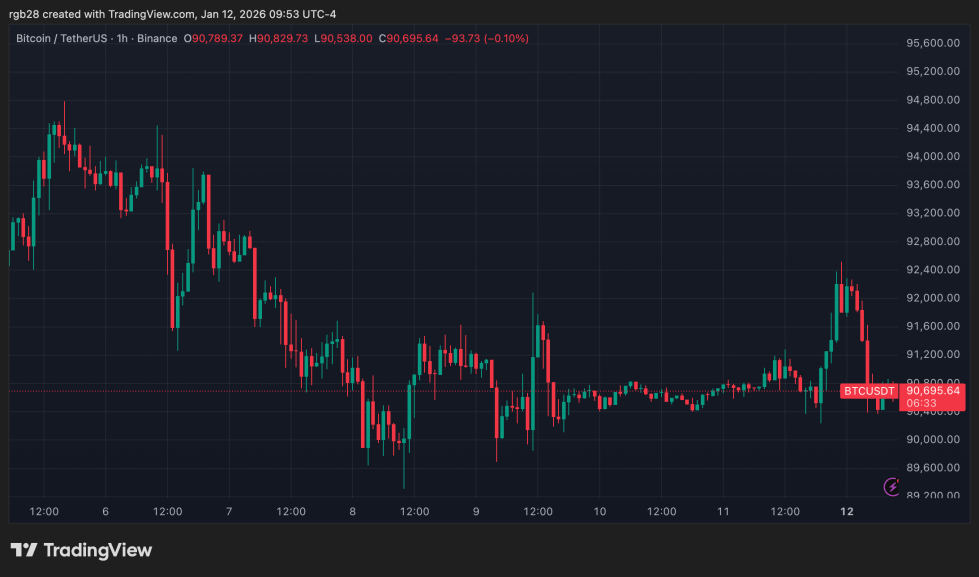
Bitcoin (BTC) trades at $90,695 in the one-week chart. Source: BTCUSDT on TradingView


Preguntas relacionadas

QWhat is Standard Chartered reportedly planning to launch in the crypto space?

AStandard Chartered is reportedly planning to launch a prime brokerage for cryptocurrency trading through its venture capital unit, SC Ventures.

QThrough which specific unit does Standard Chartered plan to launch its new crypto business?

AThe bank plans to launch the new crypto business within its venture capital (VC) unit, SC Ventures.

QWhat is the name of the joint venture Standard Chartered's VC unit is developing, and what services will it offer?

AThe joint venture is called Project37C, and it is set to offer custody, tokenization, and market access for digital assets.

QWhat is a key regulatory challenge for banks holding cryptocurrencies under the Basel III rules?

AUnder Basel III rules, banks face a punitive 1,250% risk charge for exposure to unbacked crypto assets like Bitcoin and Ether, which is a major capital burden.

QWhy might launching the crypto business through its VC unit be beneficial for Standard Chartered from a regulatory perspective?

ALaunching through the VC unit may help the bank circumvent the strict capital requirements for digital assets that apply to corporate and investment banks, as some VC investments face a lower 400% charge.

Lecturas Relacionadas

How Many Tokens Away Is Yang Zhilin from the 'Moon Chasing the Light'?

The article explores the intense competition between two leading Chinese AI companies, DeepSeek and Kimi (Moon Dark Side), and the mounting pressure on Yang Zhilin, the founder of Kimi. While DeepSeek re-emerged after 15 months of silence with its powerful V4 model—boasting 1.6 trillion parameters and low-cost, long-context capabilities—Kimi has been focusing on long-context processing and multi-agent systems with its K2.6 model. Yang faces a threefold challenge: technological rivalry, commercialization pressure, and investor expectations. Despite Kimi’s high valuation (reaching $18 billion), its revenue heavily relies on a single product with low paid conversion rates, while DeepSeek’s strategic silence and open-source influence have strengthened its market position and valuation prospects, now targeting over $20 billion. Both companies reflect broader trends in China’s AI ecosystem: Kimi aims for global influence through open-source contributions and agent-based advancements, while DeepSeek prioritizes foundational innovation and hardware independence, notably shifting to Huawei’s chips. Their competition is seen as vital for China’s AI progress, with the gap between top Chinese and U.S. models narrowing to just 2.7% on the Elo rating scale. Ultimately, the article argues that this rivalry, though anxiety-inducing for leaders like Zhilin, is essential for driving innovation and solidifying China’s role in the global AI landscape.

marsbitHace 6 hora(s)

How Many Tokens Away Is Yang Zhilin from the 'Moon Chasing the Light'?

marsbitHace 6 hora(s)

TechFlow Intelligence Bureau: ChatGPT Helps Amateur Mathematician Crack 60-Year-Old Problem, CFTC Sues New York Regulator Over Coinbase and Gemini

An amateur mathematician, with the assistance of ChatGPT, has solved a combinatorial mathematics puzzle originally proposed by Hungarian mathematician Paul Erdős in the 1960s. This marks another milestone in AI-aided mathematical research, demonstrating the evolving capabilities of large language models in formal reasoning. In other AI developments, OpenAI introduced a new privacy filter tool for enterprise API usage, automatically screening sensitive data. Meanwhile, the Qwen3.6-27B model achieved 100 tokens per second on a single RTX 5090 GPU using quantization, significantly lowering the cost barrier for local AI deployment. In crypto and Web3, the U.S. CFTC sued New York’s financial regulator, challenging its oversight of Coinbase and Gemini—a first-of-its-kind federal-state regulatory clash. Following a vulnerability, KelpDAO and major DeFi protocols established a recovery fund. Tether froze $344 million in assets linked to Iran’s central bank upon U.S. Treasury request, highlighting the centralized control risks in stablecoins. Separately, Litecoin underwent a 3-hour chain reorganization to undo a privacy-layer exploit. In the U.S., former President Trump invoked the Defense Production Act to address power grid bottlenecks affecting AI data centers and dismissed the entire National Science Board, raising concerns over research independence. A retail trader gained 250% on a $600k Intel options bet amid AI-related speculation. Xiaomi announced its first performance electric vehicle, targeting rivals like Tesla. Meanwhile, iPhone users reported devices automatically reinstalling a hidden app daily, suspected to be MDM-related. A Chinese securities report noted that A-share institutional crowding has reached its second-longest streak since 2007, signaling high valuations and potential style rotation. The day’s developments reflect a dual narrative: AI is enabling unprecedented individual breakthroughs, while centralized power structures—whether governmental or corporate—are becoming more assertive, underscoring that decentralization is as much a political-economic challenge as a technical one.

marsbitHace 6 hora(s)

TechFlow Intelligence Bureau: ChatGPT Helps Amateur Mathematician Crack 60-Year-Old Problem, CFTC Sues New York Regulator Over Coinbase and Gemini

marsbitHace 6 hora(s)

Trading

Spot
Futuros
活动图片