Standard Chartered To Launch Crypto Prime Brokerage Through VC Unit – Report

bitcoinistPublicado a 2026-01-13Actualizado a 2026-01-13

Resumen

Standard Chartered is reportedly planning to launch a cryptocurrency prime brokerage through its venture capital unit SC Ventures, according to a Bloomberg report. The initiative, still in early stages, would expand the bank’s digital asset offerings and operate under the previously announced Project37C joint venture, which focuses on custody, tokenization, and market access. This move aligns with the bank’s growing involvement in crypto, including backing custodians, offering Bitcoin and Ethereum trading, and partnering with platforms like OKX and Coinbase. Launching the brokerage through its VC arm may help Standard Chartered navigate strict global banking capital requirements for crypto, which impose high risk charges on direct holdings. Global regulators are currently reviewing these rules, with the US leading calls for amendments ahead of their planned 2026 implementation.

Banking giant Standard Chartered is reportedly planning to launch a prime brokerage for cryptocurrency trading amid a global push by banks to establish digital asset ventures and compete in the sector.

Standard Chartered Plans Crypto Expansion

On Monday, Bloomberg reported that London-based Standard Chartered is allegedly preparing to expand its crypto efforts with the launch of a prime brokerage for digital assets trading.

According to sources familiar with the matter, discussions are in the early stages, and an official timeline for the launch has not been defined. However, they revealed that the major global bank plans to launch the new crypto business within its venture capital (VC) unit SV Ventures.

Notably, Standard Chartered’s VC unit recently announced that it is developing Project37C, a joint venture related to digital assets, but did not specifically call the platform a crypto prime brokerage. The joint venture is set to offer custody, tokenization, and market access, and “complement the broader Standard Chartered digital asset ecosystem.”

At the time, Harald Eltvedt, Operating Member and Head of Venture Building at SV Ventures, affirmed that “as we see institutional engagement with digital assets accelerating, there is similarly a growing need for platforms that combine innovation with a high standard.”

As the report noted, the banking giant has been one of the most active global financial institutions in the digital assets sector. Notably, it has backed multiple crypto ventures, including custodians and institutional trading platforms.

In July, the institution became the first global systemically important bank to offer spot Bitcoin and Ethereum trading for institutional clients. In Q4 2025, Standard Chartered announced its partnership with crypto exchange OKX in the European Economic Area (EEA) and its collaboration with DCS Card Center as the banking partner for a credit card that enables users to make stablecoin transactions.

Last month, Standard Chartered expanded its partnership with Coinbase to develop a suite of crypto prime services for institutional clients, including trading, staking, custody, and lending.

Global Banking Rules’ Challenge

Bloomberg highlighted that Standard Chartered could benefit from launching the new business through SC Ventures, as it may help circumvent some strict capital requirements for digital assets in corporate and investment banks.

It’s worth noting that the Basel Committee on Banking Supervision (BCBS) released its standard for the “prudential treatment of banks’ exposures to cryptoassets” in 2022, including tokenized traditional assets, stablecoins, and unbacked digital assets.

Under Basel III rules, banks that hold cryptocurrencies face a risk charge far higher than with any other risk assets. The institutions are required to comply with a 1,250% risk charge for exposure to permissionless crypto assets such as Bitcoin and Ether. Meanwhile, some VC investments under the latest Basel capital package only face a 400% charge.

As reported by Bitcoinist, global regulators are in talks to review and potentially overhaul rules for banks’ crypto holdings, set to come into force in 2026. Senior executives stated that banks have largely interpreted the standards as a signal to avoid crypto “since they imposed a heavy capital burden on such holdings.”

However, the recent global shift toward the crypto industry has sparked debates at the BCBS regarding the suitability of these rules under the current environment, with major jurisdictions, including the US and UK, not committing to implementing them on time.

The US has been reportedly leading calls to amend these standards, arguing that the rules are “incompatible with the industry’s evolution,” particularly in the stablecoin sector. Moreover, some countries seem to agree with the US’s reasoning and favor reviewing the standards before they are widely implemented.
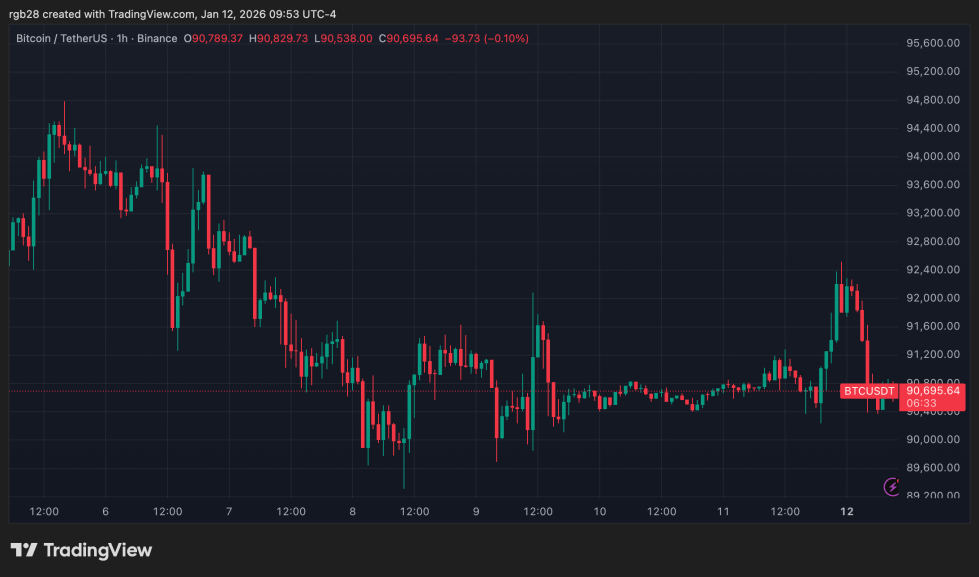
Bitcoin (BTC) trades at $90,695 in the one-week chart. Source: BTCUSDT on TradingView


Preguntas relacionadas

QWhat is Standard Chartered reportedly planning to launch in the crypto space?

AStandard Chartered is reportedly planning to launch a prime brokerage for cryptocurrency trading through its venture capital unit, SC Ventures.

QThrough which specific unit does Standard Chartered plan to launch its new crypto business?

AThe bank plans to launch the new crypto business within its venture capital (VC) unit, SC Ventures.

QWhat is the name of the joint venture Standard Chartered's VC unit is developing, and what services will it offer?

AThe joint venture is called Project37C, and it is set to offer custody, tokenization, and market access for digital assets.

QWhat is a key regulatory challenge for banks holding cryptocurrencies under the Basel III rules?

AUnder Basel III rules, banks face a punitive 1,250% risk charge for exposure to unbacked crypto assets like Bitcoin and Ether, which is a major capital burden.

QWhy might launching the crypto business through its VC unit be beneficial for Standard Chartered from a regulatory perspective?

ALaunching through the VC unit may help the bank circumvent the strict capital requirements for digital assets that apply to corporate and investment banks, as some VC investments face a lower 400% charge.

Lecturas Relacionadas

Agents Take Over Traffic Distribution Power: What Are Tencent, ByteDance, and Alibaba Competing For?

In the race to dominate the AI era's entry point, China's tech giants—Tencent, ByteDance, and Alibaba—are aggressively deploying AI Agents to control the future of traffic distribution. Alibaba is pursuing a dual-track "closed loop + openness" strategy. Its Qianwen app is evolving into a super-Agent integrated across its ecosystem (Taobao, Alipay, etc.) to handle complex tasks like travel planning. Concurrently, it is opening its platform to external brands (Luckin Coffee, KFC) and has launched a B2B Agent platform, "Wukong," targeting enterprise automation. Its other flagship, Quark, aims to be an "AI super search box" for information and tasks. ByteDance is executing an omnipresent "sprawl strategy." Its Doubao app boasts over 300 million monthly active users and is evolving into a default AI entry point for daily life, with plans for paid versions and e-commerce integration. Its core weapon is the Kouzi platform, a visual "AI assembly factory" for developers to build custom Agents. ByteDance is also pushing hardware integration, collaborating on AI phones and developing smart glasses to embed Doubao everywhere. Tencent is playing its long-held "ultimate card" by quietly embedding an AI Agent directly into WeChat. This Agent, accessible via a swipe, can understand user commands and automatically execute tasks by calling upon WeChat's millions of mini-programs (e.g., finding and ordering coffee). This leverages WeChat's unparalleled 1.4-billion-user ecosystem to position the app as an AI-powered "service operating system," a move that could dramatically reshape the competitive landscape. The core battleground is shifting from competing for "user screen time" to competing to be the "default execution layer" for user intent. The business model is evolving from an "attention economy" to an "intent economy," where the Agent that can most efficiently fulfill a user's need gains control over service access and token flow. This represents a fundamental change in how users connect with digital services, making the fight for the Agent入口 (entry point) a pivotal moment for redefining industry leadership in the AI age.

marsbitHace 55 min(s)

Agents Take Over Traffic Distribution Power: What Are Tencent, ByteDance, and Alibaba Competing For?

marsbitHace 55 min(s)

From Banning Doubao to Embracing Honor: Why Did WeChat Suddenly 'Change Its Face'?

The article explores the sudden shift in WeChat's strategy towards AI assistants from mobile phone manufacturers, transitioning from strict opposition to active collaboration. For over a year, WeChat fiercely resisted attempts by phone AI assistants (like ByteDance's Doubao in late 2025) to control its features via GUI automation ("simulated clicking"), citing security and data control concerns. This stance created a significant barrier for system-level AI integration. Now, Tencent has initiated A2A (Agent-to-Agent) partnerships with major phone brands like Honor, Xiaomi, OPPO, and vivo. This model allows a phone's system AI (e.g., Honor's YOYO) to parse a user's voice command and send a structured request directly to WeChat's own internal AI agent via secure APIs. WeChat then executes the action (e.g., sending a message) and returns the result. The article attributes Tencent's "change of face" to strategic pressure. While leading in social app usage, Tencent trails rivals like ByteDance and Alibaba in standalone AI app popularity. WeChat, with its vast mini-program ecosystem, is Tencent's key asset for an AI comeback. The upcoming WeChat AI agent aims to handle tasks like booking and payments within the app. However, phone system assistants remain the primary AI entry point for most users. The A2A collaboration allows Tencent to extend WeChat's AI reach to this crucial system layer while maintaining control over its core functions and data. For phone manufacturers, embracing A2A is a pragmatic move. The GUI route proved unviable due to WeChat's blocks. A2A offers a compliant path to integrate a vital service, enhancing their AI assistants' usefulness. It allows them to focus on developing their own AI ecosystems for other services while cooperating on WeChat access. The collaboration is framed as a mutual, strategic necessity: Tencent gains a distribution channel, and manufacturers gain a key functionality. The partnership relies on a "dual authorization" mechanism for security, requiring both user and app consent for each action. While questions about long-term data privacy practices remain, experts note A2A is more secure and compliant than GUI automation. Ultimately, this cooperation is seen as a tentative, calculated truce. Tencent's long-term goal is to make WeChat an AI-powered "service OS." Phone manufacturers aim to make their system AI the central user interface. Their paths may converge or clash in the future, but for now, the A2A deal represents the opening chapter in the battle for the AI-era user入口, driven by necessity and strategic calculus on both sides.

marsbitHace 2 hora(s)

From Banning Doubao to Embracing Honor: Why Did WeChat Suddenly 'Change Its Face'?

marsbitHace 2 hora(s)

Trading

Spot
Futuros
活动图片