Standard Chartered, AirAsia parent to test ringgit stablecoin in Malaysia

cointelegraphPublished on 2025-12-12Last updated on 2025-12-12

Abstract

Standard Chartered Bank Malaysia and Capital A, the parent company of AirAsia, have signed a letter of intent to jointly explore a ringgit-pegged stablecoin. The initiative falls under Malaysia’s Digital Asset Innovation Hub, a regulatory framework introduced by the central bank. Standard Chartered will serve as the issuer, while Capital A and its ecosystem partners will develop and pilot wholesale use cases. This move aligns with Malaysia’s broader effort to modernize its financial system with digital assets, supported by recent regulatory developments including a central bank roadmap for asset tokenization and the formation of an industry working group.

Standard Chartered Bank Malaysia and Capital A, the parent company of AirAsia, plan to jointly explore a stablecoin pegged to Malaysia’s local currency, the ringgit.

In a statement Friday, the bank’s Malaysian arm and Capital A said they signed a letter of intent to explore a ringgit-pegged stablecoin under the country’s Digital Asset Innovation Hub, an initiative announced by Bank Negara Malaysia (BNM) in June.

This is Capital A’s first interaction with the regulated digital asset space. The initiative will rely on Standard Chartered’s infrastructure and financial expertise, as well as Capital A’s ecosystem, to pilot the stablecoin in a wholesale fashion, rather than focusing on the retail market.

Standard Chartered Malaysia will serve as the issuer of the stablecoin, while Capital A and companies within its ecosystem will be tasked with developing, testing, and piloting wholesale use cases.
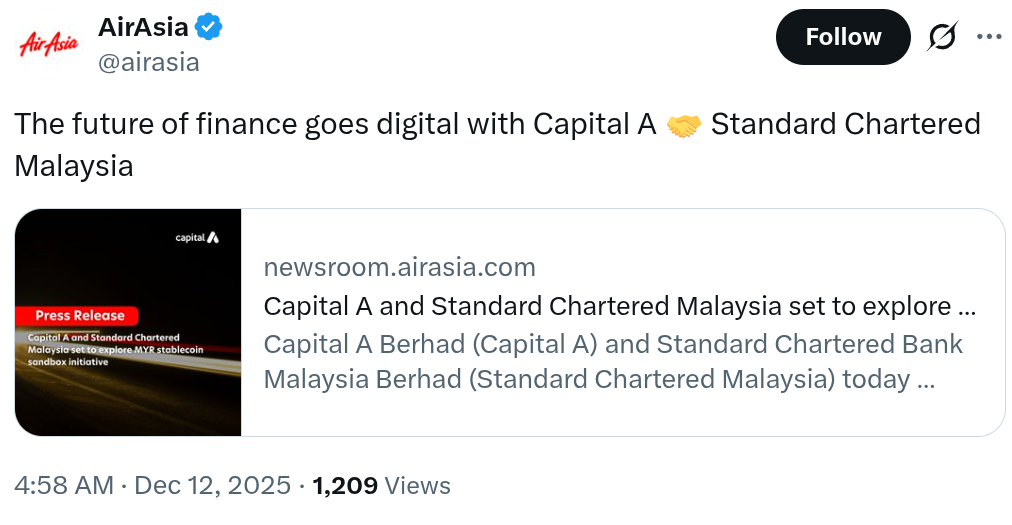
Source: Air Asia

Related: Malaysian regulator proposes easing crypto asset listing process

Malaysia is not getting left behind

Malaysia is moving to ensure it is not left behind as more countries weave crypto and stablecoins into mainstream finance. Capital A’s announcement said the effort “supports the aspirations of Malaysia,” positioning the stablecoin work as part of a broader national push to modernize payments and capital markets with digital asset technology.

That direction appears to have backing at the highest levels. The eldest son of Malaysia’s billionaire king recently launched a stablecoin pegged to the national currency. The Digital Asset Innovation Hub allows fintech and digital asset firms to test new technologies under BNM oversight.

Related: Illegal crypto mining surges in Malaysia amid unclear policies

Last month, BNM also unveiled a three-year roadmap to explore and test asset tokenization across the financial sector while building on the regulatory sandbox framework. The roadmap anticipates that the institution will launch proof-of-concept projects and conduct live pilots.

The central bank also decided to create an Asset Tokenization Industry Working Group to coordinate industry-wide exploration, share knowledge and identify regulatory and legal challenges in the country.

Malaysia has been considering a change in its approach to the digital asset industry since the beginning of 2025. In mid-January, the local government reportedly began exploring the possibility of establishing a cryptocurrency policy that could recognize the industry and modernize the nation’s financial system.

Related Reads

Ripple (XRP) Buy Signal Flashes as Funding Rate Plummets Deep into Negative: Will Bulls Step In?

XRP's funding rate on perpetual futures contracts plunged to -20% on Thursday, December 11, its lowest level since the October market crash. This negative funding—where short sellers pay long holders—typically suggests bearish dominance but can sometimes signal a potential bullish reversal. However, despite this classic buy signal, several factors are dampening trader optimism. XRP broke below the $2.00 support level this week, falling 9% over two days. Open interest in XRP futures remained stagnant near $2.8 billion, failing to recover to November's $3.2 billion level. This indicates a lack of new short positions even after XRP dropped 45% from its July high of $3.66. Institutional interest also appears weak. U.S.-listed XRP ETF trading volumes have significantly declined, rarely exceeding $30 million daily. These ETFs hold approximately $3.1 billion in assets under management, slightly less than Solana ETFs. Furthermore, on-chain activity on the XRP Ledger (XRPL) has diminished. Its Total Value Locked (TVL) fell to a 2025 low of $68 million, and Ripple's own stablecoin, Ripple USD (RLUSD), is primarily issued on Ethereum, with only $235 million on XRPL. These factors—coupled with strong competition from chains like BNB and Solana that offer more robust DApp ecosystems and native staking yields—suggest limited short-term upside potential for XRP. The lack of clear mechanisms linking XRPL activity to value accrual for XRP holders further reduces bullish momentum.

cointelegraph_中文Hace 1 min(s)

Ripple (XRP) Buy Signal Flashes as Funding Rate Plummets Deep into Negative: Will Bulls Step In?

cointelegraph_中文Hace 1 min(s)

Kalshi Teams Up with Coinbase, Robinhood, and Others to Form Prediction Market Alliance, Aiming to End the 'Casino' Argument

Kalshi, a leading prediction market platform, has formed the Coalition for Prediction Markets (CPM) alongside major platforms including Coinbase, Robinhood, Crypto.com, and Underdog. This move is a strategic response to increasing regulatory pressure and opposition from traditional gambling lobbyists, particularly following legal challenges in states like Connecticut and Nevada. The coalition aims to advocate for the prediction market industry, counter misinformation, and push for federal-level regulation, arguing that prediction markets are distinct from gambling. They emphasize that prediction markets generate valuable public information, outperform traditional polls by approximately 30%, and are used by nearly half of Americans under 45. With the industry valued at $28 billion as of October and platforms like Kalshi and Polymarket each exceeding $10 billion in valuation, the sector is expanding rapidly. Kalshi’s CEO, Tarek Mansour, asserts that attacks from gambling interests are motivated by profit protection rather than consumer safety. The CPM will focus on promoting transparency, market integrity, and customer protection while leveraging federal jurisdiction to overcome state-level regulatory obstacles. This development signals the maturation of prediction markets as a significant new internet-driven sector, potentially surpassing traditional gambling in relevance and utility.

Odaily星球日报Hace 21 min(s)

Kalshi Teams Up with Coinbase, Robinhood, and Others to Form Prediction Market Alliance, Aiming to End the 'Casino' Argument

Odaily星球日报Hace 21 min(s)

Trading

Spot
Futures
活动图片