Standard Chartered adds custody of Ripple's RLUSD and considers LMAX collateral deal

cryptonews.ruPublished on 2026-10-12Last updated on 2026-10-12

Abstract

Standard Chartered has launched institutional custody services for Ripple's RLUSD stablecoin and plans to expand its use as trading collateral. The UK-based multinational bank announced that it implemented support for RLUSD on the XRP Ledger (XRPL) through its branch in the Dubai International Financial Centre (DIFC). This provides eligible institutional clients access to its digital asset custody infrastructure. The bank also intends to extend its mirror collateral model to the LMAX Group, an institutional trading firm. This would allow clients to use RLUSD as trading collateral while keeping the tokens in custody at Standard Chartered.

Standard Chartered has launched institutional custody services for Ripple's stablecoin $RLUSD and plans to expand its use as trading collateral.

The UK-based multinational bank announced on Monday that it has implemented support for $RLUSD on the $XRP Ledger (XRPL) through its branch at the Dubai International Financial Centre (DIFC), providing eligible institutional clients with access to its digital asset custody infrastructure.

Standard Chartered plans to extend its mirror collateral model to the LMAX Group — an institutional trading firm. This will allow clients to use $RLUSD as trading collateral while keeping the tokens in custody at the bank.

Related Questions

QWhat new service has Standard Chartered launched regarding Ripple's stablecoin?

AStandard Chartered has launched institutional custody services for Ripple's $RLUSD stablecoin.

QThrough which division did Standard Chartered implement support for $RLUSD?

ASupport for $RLUSD was implemented through its branch at the Dubai International Financial Centre (DIFC).

QOn which network is the $RLUSD support provided by Standard Chartered?

AThe support for $RLUSD is provided on the XRP Ledger (XRPL) network.

QWhat is Standard Chartered planning to extend to LMAX Group?

AStandard Chartered is planning to extend its mirrored collateral model to LMAX Group.

QHow can clients potentially use $RLUSD in the context of the deal with LMAX Group?

AClients will be able to use $RLUSD as trading collateral while keeping the tokens in custody at Standard Chartered.

Related Reads

Strategy stock sheds 5% amid MSCI index removal, Bitcoin sell-off

Strategy (Michael Saylor's Bitcoin treasury company) fell 6.49% on Thursday to close at $114.41, after MSCI confirmed the company's removal from its global equity indexes, compounded by a broader crypto market sell-off. The removal takes effect after the Nov. 30 market close and could trigger selling by index-tracking funds; JPMorgan previously estimated roughly $2.8 billion in potential selling pressure. Ryan Kirkley, CEO of Global Settlement Network, said the decision could distinguish Bitcoin treasury companies from traditional operating businesses and limit indirect crypto exposure for passive investors, noting that index inclusion had given ordinary passive investors leveraged Bitcoin exposure they never chose. He added it raises questions about whether such companies should be classified alongside traditional operating businesses, arguing that buying and holding an asset isn't an operating business but rather a fund that doesn't follow fund rules. In its Aug. 31 response to MSCI's proposed rules, Strategy called the changes a pretext for targeting digital asset treasury companies and downplayed the impact, saying MSCI-linked funds held about 13 million of its shares, just 3.1% of basic shares outstanding. The decline coincided with a broader crypto sell-off, with Bitcoin near $71,340, down 4.3% in 24 hours, and total crypto market capitalization down 3% to about $2.49 trillion.

cointelegraph1h ago

Strategy stock sheds 5% amid MSCI index removal, Bitcoin sell-off

cointelegraph1h ago

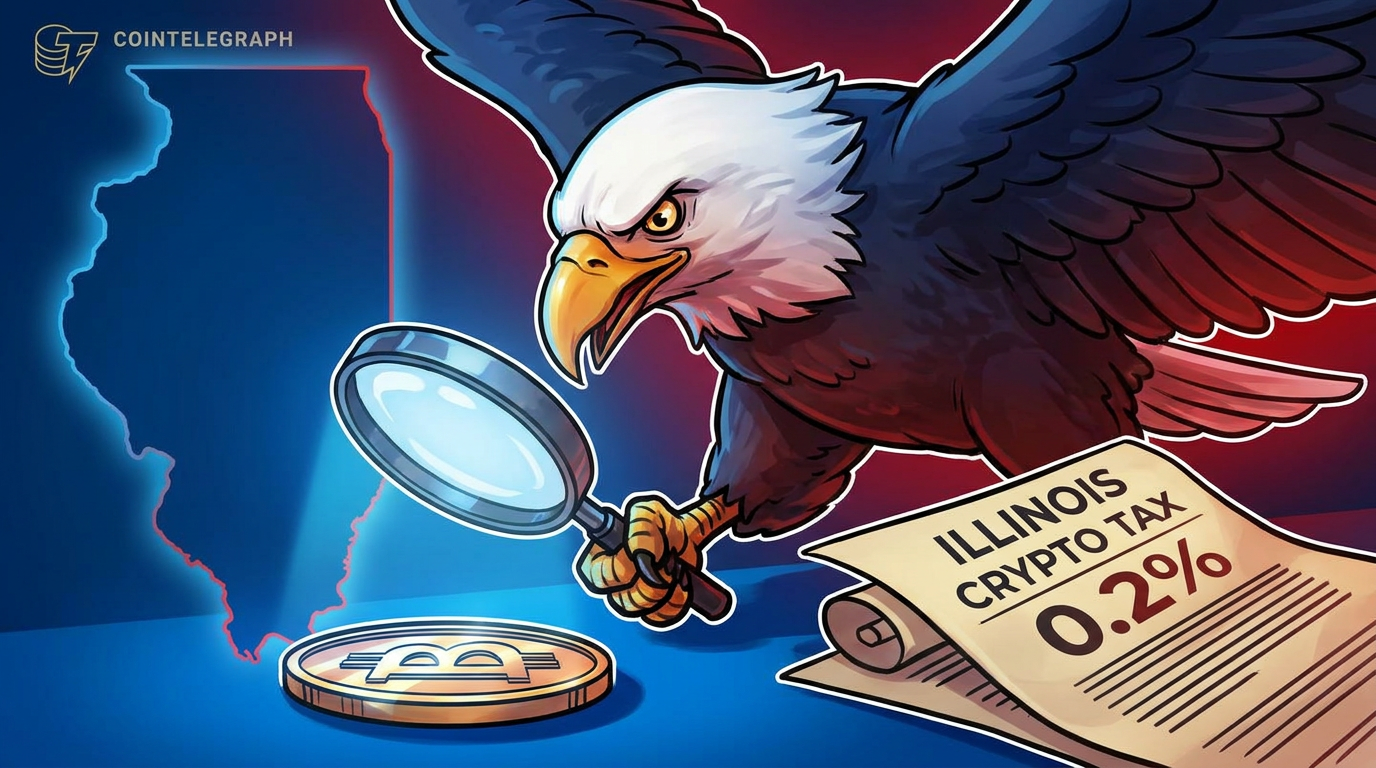
US Justice Department, business groups and DeFi firms challenge Illinois crypto tax

The US Department of Justice, business and financial industry groups, and a coalition of DeFi firms have backed a legal challenge to Illinois' 0.2% digital asset tax, arguing it unfairly targets crypto transactions and could impose taxes even without profit. The Justice Department filed a statement of interest, while the US Chamber of Commerce and SIFMA submitted an amicus filing. A coalition including Andreessen Horowitz, Paradigm, Uniswap and Aave Labs also filed a brief. The law, enacted in June, taxes the value of digital assets exchanged, transferred or stored regardless of profit. The Digital Chamber sued Illinois officials in July, followed by a separate challenge from the Blockchain Association and Crypto Council for Innovation in August. Originally set for Jan. 1, 2027, the tax was delayed to July 1, 2027. Illinois projected $60 million in fiscal year 2027 revenue. SIFMA and the Chamber warned the tax would affect banks, broker-dealers, custodians and asset managers nationwide, exposing them to compliance costs and burdening customers—someone who loses money owes the same tax as someone who profits, and moving assets between accounts could trigger tax without a sale or gain. They argued it discriminates against digital assets and may violate federal internet tax protections and constitutional interstate commerce requirements. The DOJ said the tax undermines federal efforts to promote crypto innovation, citing the Strategic Bitcoin Reserve and GENIUS Act. The DeFi coalition warned the rules could impose obligations on software developers and blockchain participants lacking customer information or control over funds.

cointelegraph1h ago

US Justice Department, business groups and DeFi firms challenge Illinois crypto tax

cointelegraph1h ago

DTCC Plans Solana Expansion as Wallet Rules Limit Access

DTCC plans to connect its tokenization service to Solana in the second half of 2027, allowing certain securities held by its DTC subsidiary to be converted into digital tokens on the network. Analysts say the move could attract more traditional financial institutions to Solana, which is known for fast transactions and low fees and had about $4.94 billion in total value locked as of Nov. 12. However, the impact may be limited by US regulatory rules. Alex Lin of Reforge noted that Solana's experience handling memecoin trading served as a public stress test, giving the network credibility to handle retail-scale volume reliably. Still, under a December 2025 SEC no-action letter, DTC participants must register wallets to hold tokenized securities, and tokens can only be transferred between registered wallets. Lin said the near-term impact is overstated because the tokens remain in a walled garden, inaccessible to permissionless retail and DeFi liquidity until regulators allow these assets to function as true onchain collateral. DTCC launched its tokenization service on the Canton Network and its private Besu network on Oct. 28, with 20 DTC participants signed on, though it has not said whether any plan to use Solana. Kha Nguyen of Birdeye said Solana has already seen growing demand for tokenized stocks, with trading volume reaching around $4.9 billion in H1 2026 and over 1 million accounts holding tokenized stocks by late September. However, broader Solana activity has slowed, with transactions down nearly 40%, DEX volume down 34.4%, and fees down 39%, while tokenized RWA value rose almost 7% to $4.76 billion. Nguyen said DTCC's integration would need banks, brokers, and issuers to actively issue, trade, and settle on Solana, with enough liquidity for large trades. He stressed that assets must be active rather than idle—traded around the clock, used as collateral, and earning yield. Lin agreed that long-term impact depends on where assets are used for secondary trading and collateral activity, not where they are issued.

cointelegraph2h ago

DTCC Plans Solana Expansion as Wallet Rules Limit Access

cointelegraph2h ago

Trading

Spot
活动图片