Stablecoins are leaving exchanges – and traders aren’t buying the dip

ambcryptoPublicado a 2025-12-23Actualizado a 2025-12-23

Resumen

Stablecoins are being withdrawn from cryptocurrency exchanges at the fastest rate in the current market cycle, signaling a sharp decline in short-term risk appetite among traders. Despite a growing overall stablecoin supply—largely backed by U.S. Treasuries—investors are choosing to hold capital off exchanges rather than deploy it during the market downturn. This cautious behavior is evident in the significant outflows from major exchanges like Binance, which saw nearly $1.9 billion in net outflows over 30 days. While Bitcoin has corrected roughly 36% from its October highs, traders have been unwinding leverage, with open interest falling more than 40%. However, stablecoins aren't exiting the crypto ecosystem entirely. Instead, they are migrating to safer blockchain networks like TON, Ethereum, and Polygon, while trading-focused chains such as Solana and Tron experience outflows. The shift reflects a defensive strategy: investors are prioritizing safety and yield offered by stablecoins—which function like low-risk money market instruments—over exposure to volatile assets. This trend is likely to persist until market confidence returns.

Stablecoins are moving off crypto exchanges at the fastest pace this cycle. Instead of putting capital to work, investors are choosing to wait.

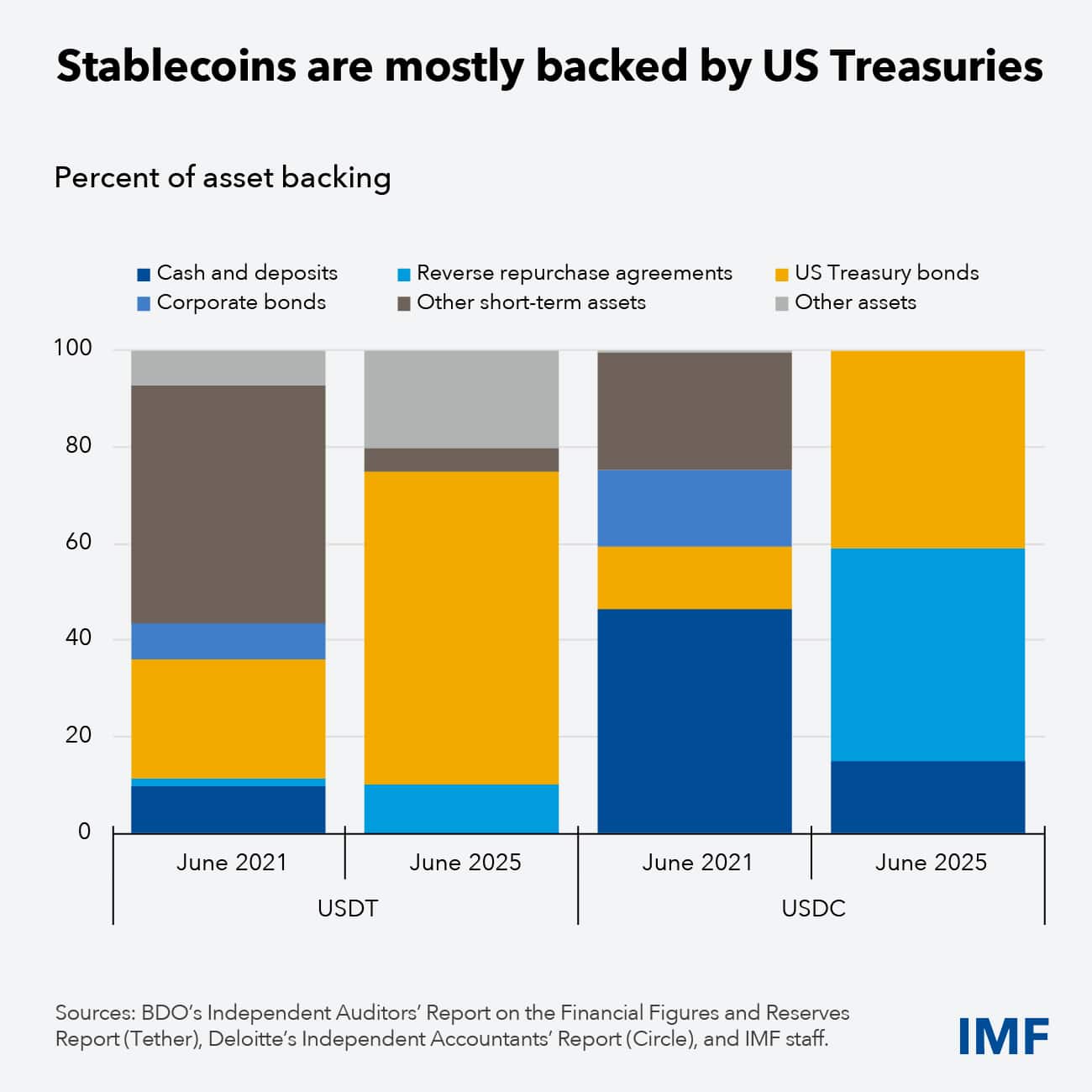
This is happening even as stablecoin supply continues to grow, backed largely by U.S. Treasuries. Everyone’s staying liquid, but holding back until market conditions improve.

Traders take a step back

The speed at which stablecoins are being pulled has caused a drop in short-term risk appetite.

While Bitcoin’s correction fell further (now down roughly 36% from its early October highs), traders have been unwinding leverage. OI has fallen more than 40%.

Source: CryptoQuant

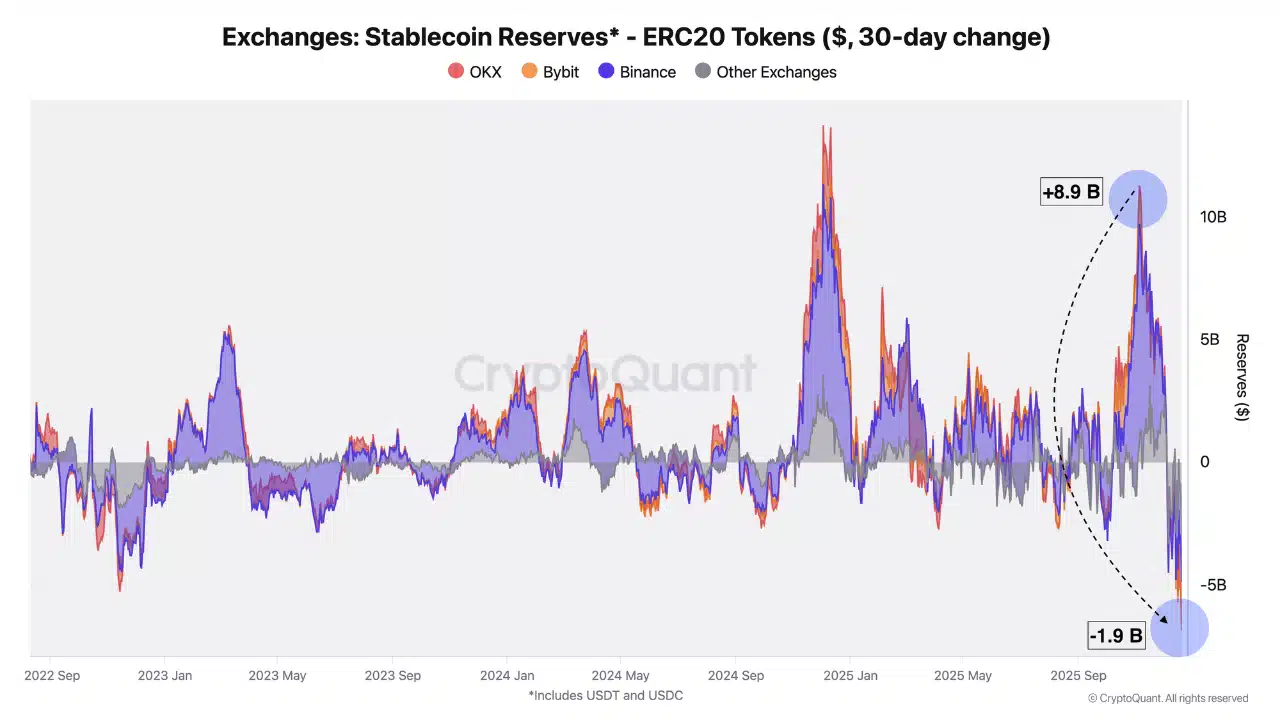
December was the steepest decline in ERC-20 stablecoin reserves across major exchanges in this cycle. These tokens are usually on exchanges ready to be deployed.

This time, they are being pulled out instead. The change is easily visible on Binance, where an inflow trend flipped into nearly $1.9 billion in net outflows over 30 days. This is an obviously cautious move.

Stablecoins aren’t quitting crypto altogether though

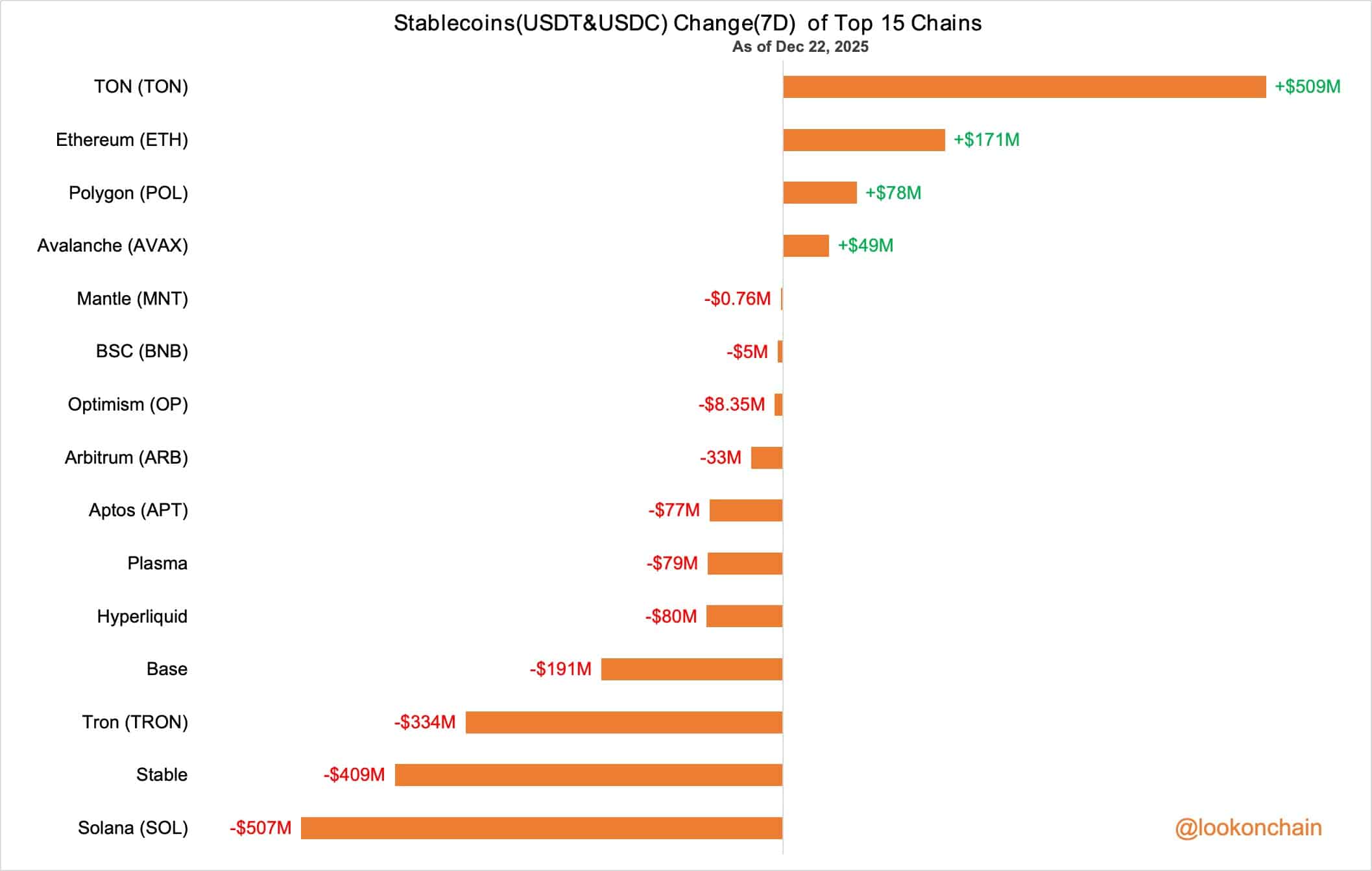
They are simply shifting across networks instead of being on exchanges. Over the past week, total stablecoin supply still grew by about $509 million.

Source: Lookonchain

The biggest inflows were seen on TON, which added over $500 million, followed by Ethereum and Polygon. In contrast, networks tied more closely to trading activity, such as Solana and Tron, saw large outflows.

Investors aren’t taking any new risks, and are simply waiting for clear signs before committing.

Defensive, not disappearing

Today, most major stablecoins are backed largely by U.S. Treasuries and other short-term government assets, making them more or less low-risk money market instruments.

Source: IMF

This explains why capital is staying in stablecoins even as it leaves exchanges. Investors are choosing safety and yield over chaos. Until confidence returns, this defensive positioning is likely to persist.


Final Thoughts

  • Stablecoins are leaving exchanges at record speed as traders cut risk.
  • Capital is on safer chains until confidence returns.
Next: Solana: Short-term pain, long-term hope? SOL faces liquidation test
Share
  • Share
  • Tweet

Criptos en tendencia

Preguntas relacionadas

QWhat is the main trend observed with stablecoins on crypto exchanges in the current cycle?

AStablecoins are moving off crypto exchanges at the fastest pace this cycle, with investors choosing to hold liquid assets rather than deploying capital.

QHow has the withdrawal of stablecoins affected market activity and trader behavior?

AThe rapid withdrawal of stablecoins has caused a drop in short-term risk appetite, leading traders to unwind leverage, with open interest falling more than 40%.

QWhich blockchain networks saw the largest inflows of stablecoins, and what does this indicate?

ATON saw the largest inflows, adding over $500 million, followed by Ethereum and Polygon, indicating a shift to safer chains rather than those tied to active trading like Solana and Tron.

QWhy are investors choosing to hold stablecoins even as they leave exchanges?

AInvestors are opting for safety and yield, as stablecoins are largely backed by U.S. Treasuries and short-term government assets, making them low-risk money market instruments.

QWhat was notable about Binance's stablecoin flows in December?

ABinance experienced a significant shift from inflows to nearly $1.9 billion in net outflows over 30 days, reflecting a cautious move by investors.

Lecturas Relacionadas

SemiAnalysis on the Epic Plunge: It's Not Over Yet

SemiAnalysis Weekly discusses the recent sharp correction in the semiconductor market after a historic first half. Analysts Doug O'Loughlin and Dylan note that despite healthy fundamentals, markets like South Korea's KOSPI have plunged 40%, wiping out leveraged retail investors. A core debate focuses on AI demand versus supply constraints. Dylan cites SemiAnalysis's internal use of AI coding agents, leading to a 100x increase in AI spending, as evidence of powerful demand. Doug agrees demand is strong but questions its exact magnitude, calling it a "trillion-dollar question." His primary concern is physical and financial bottlenecks: a shortage of 100,000 electricians in the US, massive $450B in corporate debt issuance by hyperscalers (funded by a shrinking pension pool), and labor/scale limits in regions like Taiwan, where TSMC constitutes 20% of GDP. The conversation covers market dynamics, including the typical semiconductor cycle where over-ordering leads to crashes, China's growing memory capacity, and the potential for older chips like the H100 to lose value as models scale. Politically, AI is seen as a likely scapegoat in upcoming elections, though not a top-tier voter priority. The analysts conclude that while the long-term potential is significant, the scaling path is narrowing. The challenge is matching exponential compute demands with real-world constraints on capital, labor, and permits, risking scenarios where massive investment outpaces near-term revenue generation.

marsbitHace 49 min(s)
SemiAnalysis on the Epic Plunge: It's Not Over Yet

marsbitHace 49 min(s)

After Robinhood's Aggressive Entry, Why is PUMP Defying the Trend and Rising?

Amid a prolonged crypto bear market that has strained many projects, Pump.fun stands out by maintaining strong profitability. Despite a major token unlock in mid-July that was expected to cause selling pressure, its native token PUMP has risen nearly 48% over the past month. Analysis shows only a small portion of unlocked tokens were sold, with 92% of investor allocations still held. A buyback-and-burn mechanism has also supported the price, though daily回购 funds have declined by 77.5% from their peak, partly due to a change in tokenomics and lower platform revenue. Pump.fun remains a top revenue generator in crypto, with annualized revenue of around $450 million, ranking just behind giants like Tether and Circle. However, its daily revenue is down about 69% from its all-time high, reflecting dependence on meme coin market cycles. The platform also faces a class-action lawsuit alleging market manipulation and securities violations. New competition has emerged with Robinhood Chain's launchpad, which recently saw higher weekly volume and active addresses than Pump.fun. While Pump.fun's metrics haven't declined yet, it has responded with a new token launch mechanism called BOOST to improve liquidity. This has increased platform activity but raised community concerns about potential exploitation for short-term pumps. Ultimately, Pump.fun's success remains tightly linked to meme coin speculation and broader market sentiment.

marsbitHace 49 min(s)

After Robinhood's Aggressive Entry, Why is PUMP Defying the Trend and Rising?

marsbitHace 49 min(s)

Trading

Spot

Artículos destacados

Cómo comprar T

¡Bienvenido a HTX.com! Hemos hecho que comprar Threshold Network Token (T) sea simple y conveniente. Sigue nuestra guía paso a paso para iniciar tu viaje de criptos.Paso 1: crea tu cuenta HTXUtiliza tu correo electrónico o número de teléfono para registrarte y obtener una cuenta gratuita en HTX. Experimenta un proceso de registro sin complicaciones y desbloquea todas las funciones.Obtener mi cuentaPaso 2: ve a Comprar cripto y elige tu método de pagoTarjeta de crédito/débito: usa tu Visa o Mastercard para comprar Threshold Network Token (T) al instante.Saldo: utiliza fondos del saldo de tu cuenta HTX para tradear sin problemas.Terceros: hemos agregado métodos de pago populares como Google Pay y Apple Pay para mejorar la comodidad.P2P: tradear directamente con otros usuarios en HTX.Over-the-Counter (OTC): ofrecemos servicios personalizados y tipos de cambio competitivos para los traders.Paso 3: guarda tu Threshold Network Token (T)Después de comprar tu Threshold Network Token (T), guárdalo en tu cuenta HTX. Alternativamente, puedes enviarlo a otro lugar mediante transferencia blockchain o utilizarlo para tradear otras criptomonedas.Paso 4: tradear Threshold Network Token (T)Tradear fácilmente con Threshold Network Token (T) en HTX's mercado spot. Simplemente accede a tu cuenta, selecciona tu par de trading, ejecuta tus trades y monitorea en tiempo real. Ofrecemos una experiencia fácil de usar tanto para principiantes como para traders experimentados.

660 Vistas totalesPublicado en 2024.12.10Actualizado en 2026.06.02

Cómo comprar T

Discusiones

Bienvenido a la comunidad de HTX. Aquí puedes mantenerte informado sobre los últimos desarrollos de la plataforma y acceder a análisis profesionales del mercado. A continuación se presentan las opiniones de los usuarios sobre el precio de T (T).

活动图片