Stablecoin giant Tether makes $1B bid to buy Juventus FC

cointelegraphPublicado a 2025-12-13Actualizado a 2025-12-13

Resumen

Stablecoin issuer Tether has made a binding all-cash offer to acquire a controlling 65.4% stake in Italian soccer club Juventus FC from the Agnelli family's holding company, Exor. The bid, which would value the publicly traded club at approximately $1.1 billion, has reportedly been rejected, with a source stating "Juventus is not for sale." Tether CEO Paolo Ardoino, a lifelong fan, expressed the company's commitment to investing 1 billion euros into the club's development. Tether, which already owns over 10% of Juventus and recently secured a board seat, has been expanding its investments beyond crypto into AI, robotics, and health.

Crypto stablecoin issuer Tether says it has launched a bid to fully acquire the Italian professional soccer club, Juventus Football Club, which has reportedly already been shot down.

Tether said on Friday that it submitted a binding all-cash proposal to Exor, the holding company of the Agnelli family, for its 65.4% controlling stake in Juventus that it has held for over 100 years.

If Exor agrees, then Tether will make a “public offer for the remaining shares at the same price.” Juventus is a public company with a market capitalization of 944.49 million euros ($1.1 billion), having closed trading on Friday up 2.3% to 2.23 euros ($2.62).

However, AFP reported that Tether’s bid has already been rebuffed, with a source close to Exor saying that “Juventus is not for sale.” Exor and Tether did not immediately respond to Cointelegraph’s request for comment.

Tether promises $1.1 billion investment

Tether said it’s prepared to invest 1 billion euros ($1.1 billion) in the support and development of Juventus if the transaction completes.

“Tether is in a position of strong financial health and intends to support Juventus with stable capital and a long horizon,” said Tether CEO Paolo Ardoino.
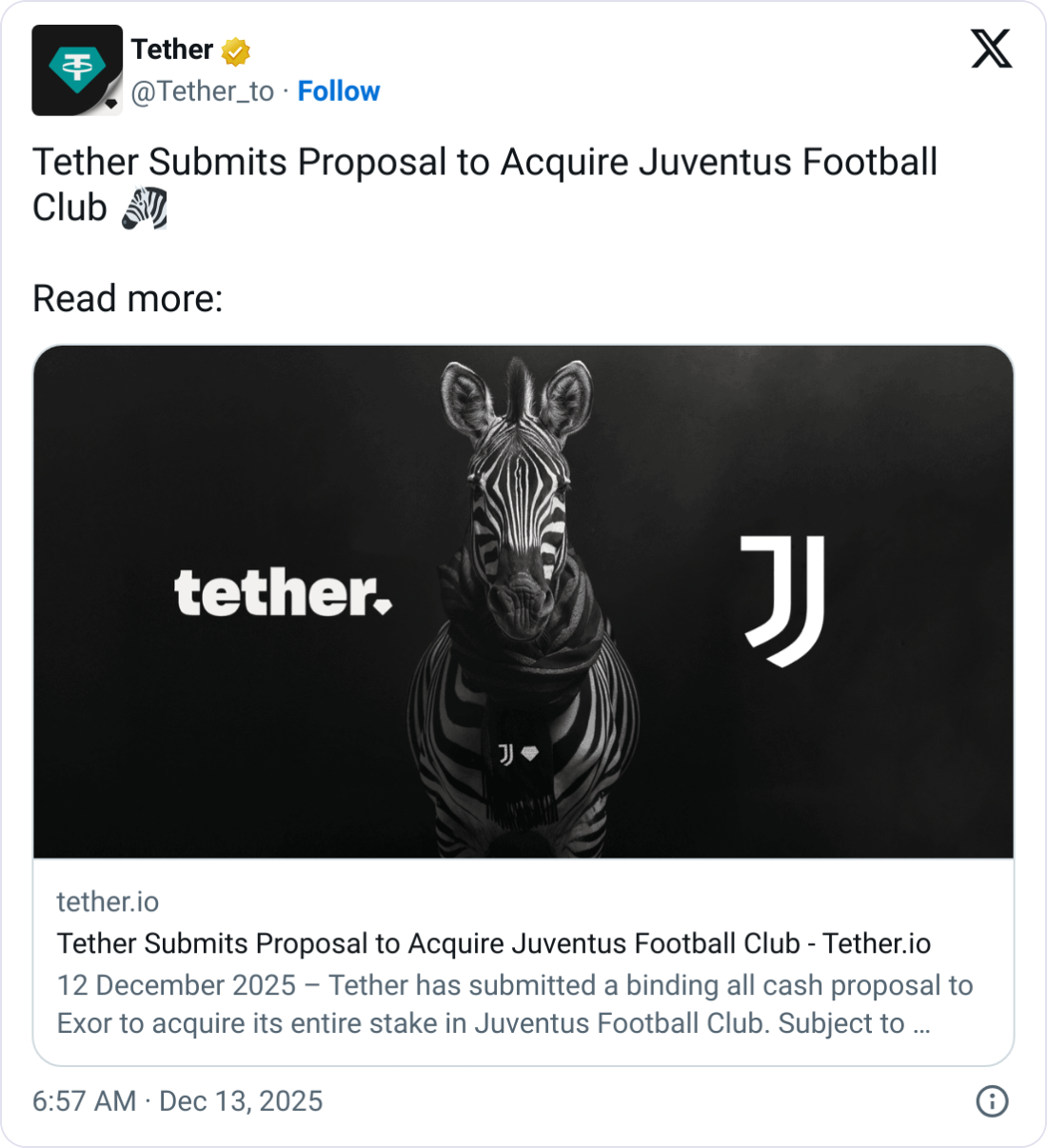
Source: Tether

“For me, Juventus has always been part of my life,” Ardoino added. “I grew up with this team. As a boy, I learned what commitment, resilience, and responsibility meant by watching Juventus face success and adversity with dignity.”

Related: Major fantasy sports operator enters prediction markets with Polymarket

Tether, which issues the self-named stablecoin Tether (USDT), has looked to expand its business beyond the token and has taken up investing in artificial intelligence, robotics and a health platform.

The company first bought a stake in Juventus in February and boosted its stake to over 10% in April.

It has since looked to boost its influence on the club and, in October, nominated its deputy investment chief, Zachary Lyons, along with Francesco Garino, to the football club’s board of directors.

The bids have paid off, as Juventus shareholders approved Garino’s appointment to the board of directors last month.

Magazine: Peter McCormack’s Real Bedford Football Club puts Bitcoin on the map

Lecturas Relacionadas

From Survival to Accelerated Growth: The Journey of Zcash's Three-Year Rise as Told by the Founder of ZODL

**From Survival to Accelerated Growth: Zcash Founder Details the 3-Year Rise** Three years ago, Zcash (ZEC) was a struggling pioneer in privacy technology, with a price near $30, low shielded supply (11%), and a community mired in governance disputes. Today, ZEC trades around $600, with over 31% of its supply (~$3B) in user-controlled shielded pools. This transformation resulted from breaking key constraints. First, **governance shackles were removed**. The old model guaranteed funding to two entities (ECC and ZF) regardless of performance, creating a monopoly. In 2024, ECC rejected further direct funding, forcing a change. The NU6 upgrade ended direct funding, allocating 8% to community grants and 12% to a protocol-controlled treasury for retroactive rewards, expiring in 2028 unless renewed by overwhelming consensus. The entities also relinquished their trademark-based veto power, freeing community governance. Second, the **product focus shifted** from pure cryptography to user growth. Previously, engineering excelled at privacy tech but failed to attract users. In early 2024, the team (later ZODL) pivoted to building products users wanted, like the Zodl wallet (default privacy, hardware support, cross-asset swaps). This drove shielded supply to grow over 400% in ZEC terms, with 86.5% of recent transactions being shielded, representing real user adoption. Third, the **narrative evolved** from the limiting "privacy coin" label to "unstoppable private money." This clarified Zcash's value proposition: a Bitcoin-like monetary policy with verifiable private payments via advanced cryptography. This structural narrative—protocol (Zcash), asset (ZEC), gateway (Zodl)—enabled broader exchange listings, institutional interest, and ETF filings. Finally, **organizational constraints were broken**. In early 2026, the ECC team left its non-profit structure after disputes over control, forming Zcash Open Development Lab (ZODL). ZODL raised $25M from top VCs (Paradigm, a16z, etc.), gaining the capital and agility of a startup to scale consumer products. Current metrics show strong momentum: social discussion volume for ZEC surged 15,245% in a year, with 81% positive sentiment. The focus is now on enhancing user experience (Zodl wallet), scalability (Tachyon project targeting Visa-level throughput with 25-second blocks), and post-quantum security (quantum-recoverable wallets coming soon). Zcash is positioned to become faster, more usable, scalable, and quantum-resistant.

marsbitHace 10 min(s)

From Survival to Accelerated Growth: The Journey of Zcash's Three-Year Rise as Told by the Founder of ZODL

marsbitHace 10 min(s)

Five Counterparty Risk Architectures: A Settlement-Layer Methodology for Classifying TradFi Models in Crypto Exchanges

**Summary:** This companion piece reframes the five TradFi-on-crypto exchange architectures, previously classified by "architectural fingerprint," through the lens of counterparty risk. The core question is: whose balance sheet bears the loss first in a stress scenario, and has it historically done so? Each of the five models corresponds to a distinct risk holder with its own documented failure modes. * **Model 1 (Stablecoin-Settled CEX Perpetuals):** Risk is held by the stablecoin issuer (e.g., reserve composition, bank connectivity) and the CEX's own book. History includes Tether's banking disconnections (2017) and reserve misrepresentations (CFTC 2021 Order). * **Model 2 (CFD Brokers):** Risk resides on the broker's balance sheet (B-book model). Regulatory differences (e.g., ESMA's mandatory negative balance protection vs. Mauritius FSC's lack thereof) define loss allocation rules, as seen in the 2015 SNB event (Alpari UK insolvency). * **Model 3 (Off-Chain Custody & Transfer Agent Chain):** Risk lies with the off-chain custodian/platform. User asset recovery depends on Terms of Use and corporate structure, exemplified by the Celsius bankruptcy ruling (2023) where Earn Account assets were deemed property of the estate. * **Model 4 (DEX Perpetual Protocols):** No single balance sheet bears risk. Loss absorption relies on a protocol's insurance fund and Auto-Deleveraging (ADL) mechanism, as demonstrated in the GMX V1 (2022) and dYdX v3 YFI (2023) incidents. * **Model 5 (Regulated CCP - DCM-DCO-FCM):** The most institutionalized model concentrates risk in the Central Counterparty (CCP). However, history shows CCPs can employ non-standard tools under extreme stress, such as mass trade cancellation (LME Nickel, 2022) or enabling negative price settlements (CME WTI, 2020). The report argues that regulatory choices and counterparty risk structures are co-extensive, not in an upstream-downstream relationship. It concludes with five separate observation checklists (not predictions) for monitoring the structural vulnerabilities of each risk model.

marsbitHace 27 min(s)

Five Counterparty Risk Architectures: A Settlement-Layer Methodology for Classifying TradFi Models in Crypto Exchanges

marsbitHace 27 min(s)

Trading

Spot
Futuros
活动图片




