Stable sees a 20% surge: Can price see another bullish push?

ambcryptoPublicado a 2026-04-01Actualizado a 2026-04-01

Resumen

Stable (STABLE) experienced a significant 20% price surge after bouncing from a key demand zone around $0.022, which aligned with an ascending trendline support. This bullish move was supported by a substantial increase in trading volume, rising from $19 million to approximately $130 million, indicating strong market participation. The next major resistance level is the psychological barrier at $0.040. With higher lows intact and over $500K in short liquidations during the recent dip, the market structure favors further upward momentum. However, sustained bullish pressure and maintained volume levels are crucial for the rally to continue toward the target.

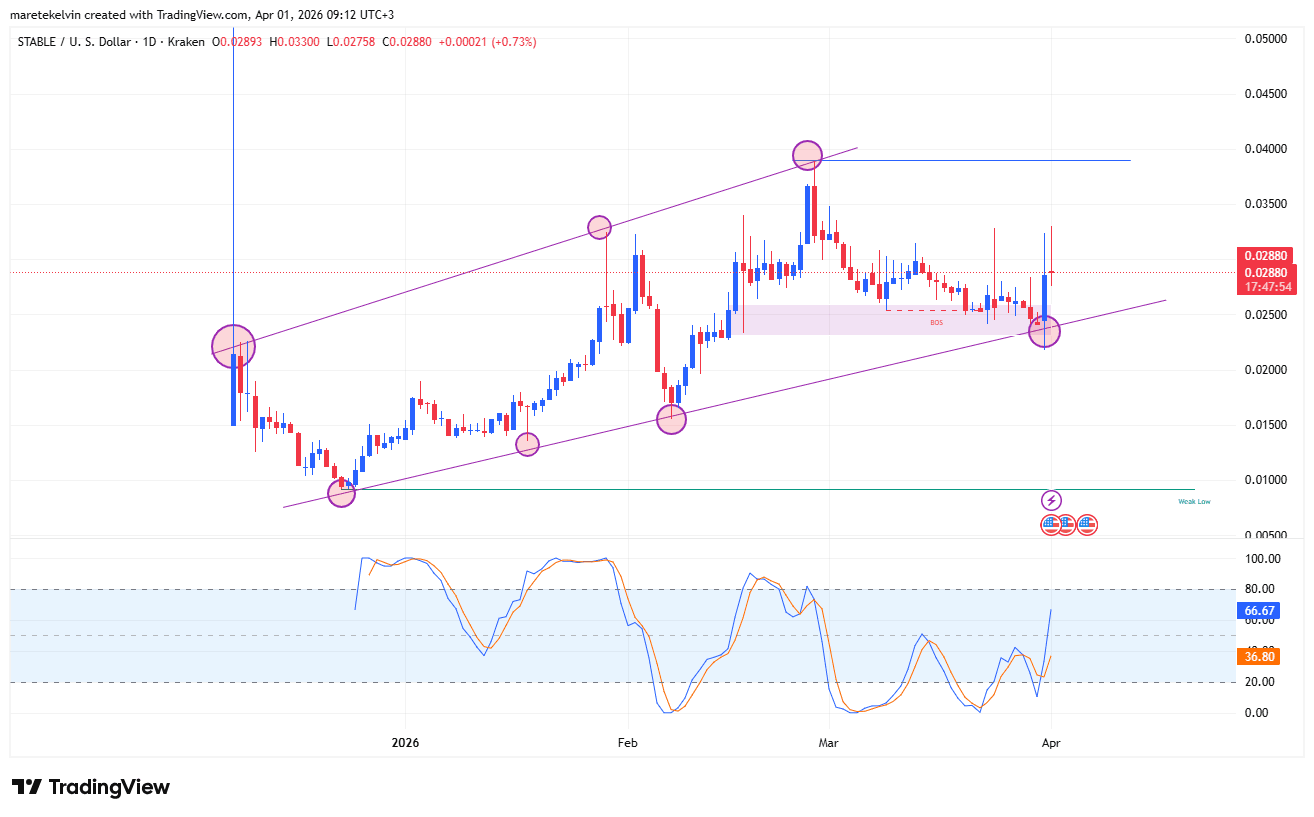
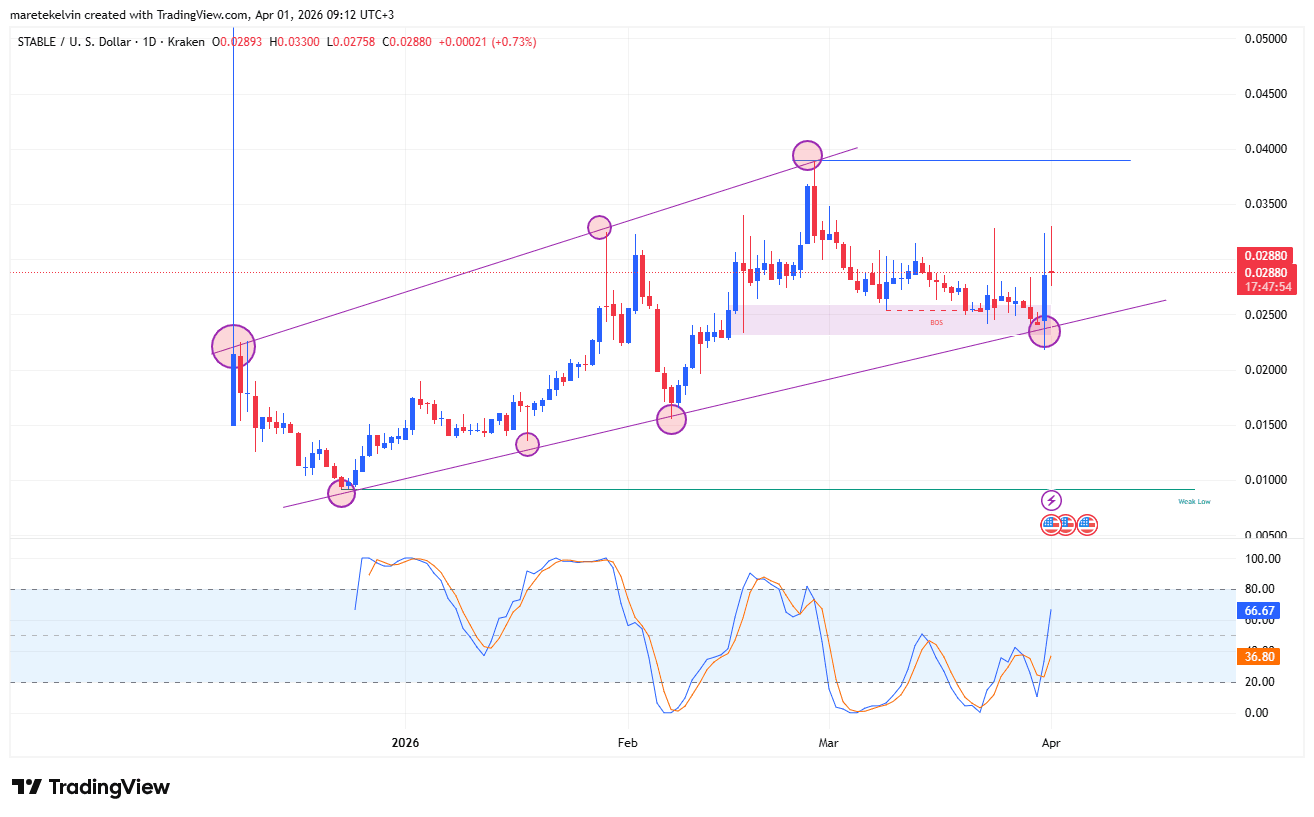
Stable has staged a sharp recovery over the last 48 hours. Price surged by over 20% after rejecting a key demand zone at around $0.022.

That zone aligned with an ascending trend line support. The confluence made it a strong reaction point. Buyers stepped in decisively and aggressively.

STABLE’s volume surge strengthens bullish pressure

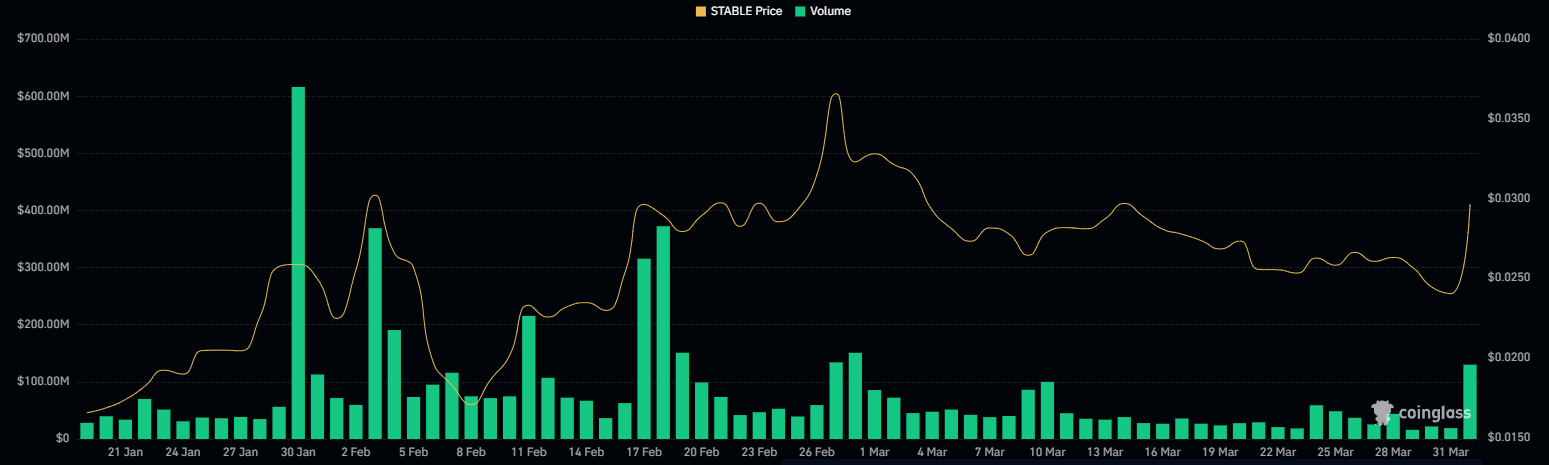
Momentum is not just seen on the price chart. Stable’s trading volume has also seen a significant spike in the last 24 hours.

According to recent derivative data, the token’s trading volume has climbed to around $130 million from $19 million on the 31st of March, marking a strong double-digit increase. This suggests that the move is backed by real participation, not just thin liquidity.

In most cases, when prices and volumes go up together, the setup highlights a stronger trend. The same could come into play for Stable.
Source: CoinGlass

The $0.040 level comes into focus

With momentum building, attention now shifts to the $0.040 psychological level. This level stands as the next key target. Usually, psychological levels often act as magnets during strong trends.

If buying pressure continues, price could push toward that zone in the near term.
Source: TradingView

Can the rally sustain?

The structure currently favors the bulls. Higher lows remain intact, and the recent bounce confirms the demand zone strength. However, continuation depends on follow-through bullish pressure.

If volume holds and buyers maintain control, the rally could extend. But if momentum fades, price may pause or consolidate before the next move.

What’s ahead for Stable?

Stable is showing clear signs of strength. A strong bounce, rising volume, and a clear upside target all support a bullish outlook.

As it stands, the market leans towards the bulls’ favor. The next substantial test lies at the $0.040 resistance level.

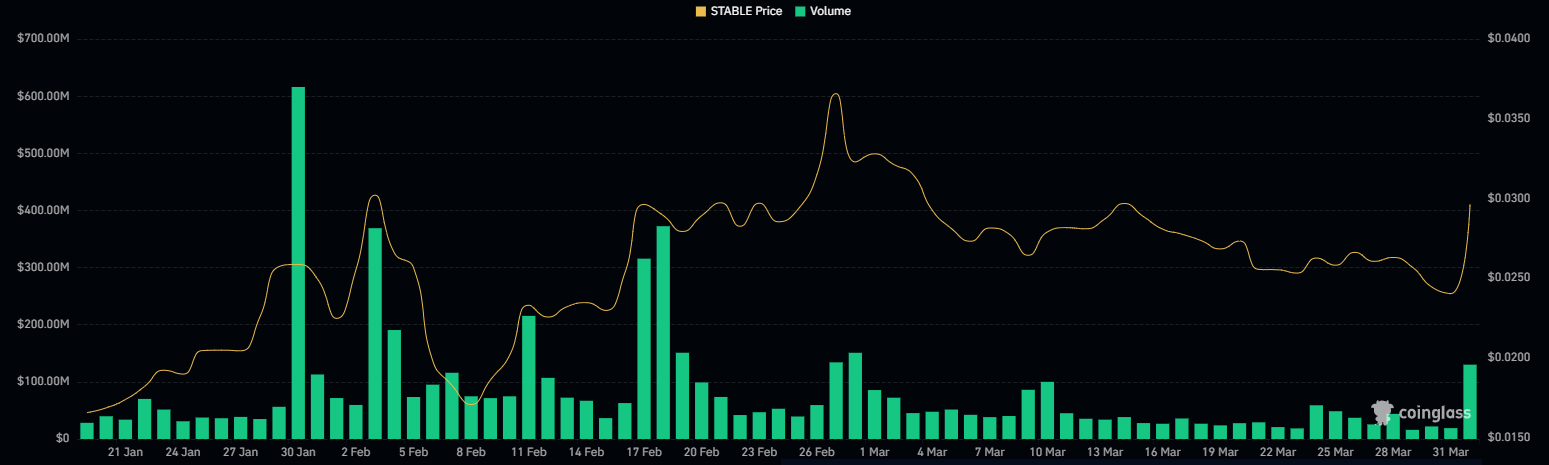
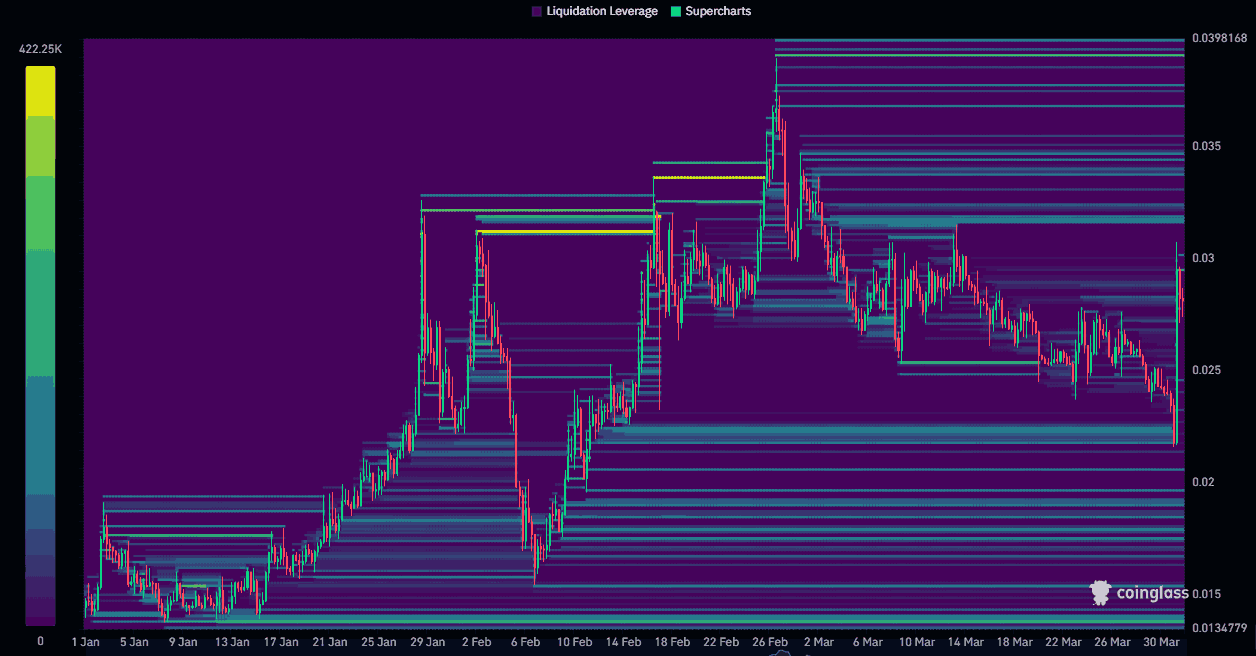
With over $500K worth of short liquidity clusters squeezed at the $0.021-$0.023 price range during the recent dip, a continuation of the bullish trend is more than likely to occur.
Source: CoinGlass

Final Summary

  • STABLE jumped 20% after bouncing from a key demand zone and trend line support.
  • Rising volume to $130M supports a potential move toward the $0.040 level.

Criptos en tendencia

Preguntas relacionadas

QWhat was the key demand zone price level that STABLE rejected before surging 20%?

ASTABLE rejected a key demand zone at around $0.022 before the 20% surge.

QWhat does the significant increase in STABLE's trading volume to $130 million indicate?

AThe surge in trading volume to $130 million indicates the price move is backed by real participation and strong bullish pressure, not just thin liquidity.

QWhat is the next key psychological resistance level for STABLE's price according to the article?

AThe next key psychological resistance level for STABLE is $0.040.

QWhat two technical factors formed a confluence to create a strong reaction point for buyers?

AThe key demand zone at $0.022 aligned with an ascending trend line support, creating a confluence that formed a strong reaction point for buyers.

QHow much short liquidity was squeezed during the recent dip, making a bullish continuation likely?

AOver $500,000 worth of short liquidity was squeezed at the $0.021-$0.023 price range during the recent dip, making a bullish continuation more likely.

Lecturas Relacionadas

Rubin Ultra Makes Major Cuts, Even Nvidia Can't Handle Memory Price Hikes?

NVIDIA's Rubin Ultra, the top-tier variant of the newly announced Rubin AI accelerators, has reportedly seen significant specification downgrades, according to an industry report from SemiAnalysis. Initially designed with four compute dies (4-die), the Rubin Ultra is now said to be reduced to a 2-die design. Key changes highlighted in the report include: * **No increase in peak theoretical compute performance**, remaining at 35 PFLOPs like the standard Rubin. * **Severe reduction in memory capacity** to 192GB using 8-Hi HBM stacks, which is less than the standard Rubin's 288GB using 12-Hi stacks. * **Negligible memory bandwidth improvement** of only 1 TB/s. * **Slightly higher chip-level power consumption**. * The **primary upgrade is a massive increase in scale-up interconnect capacity**, supporting connections for up to 576 GPUs via NVLink, compared to 72 for the standard Rubin. The report suggests the redesign is primarily a cost-optimization move driven by the sharp rise in HBM (High-Bandwidth Memory) prices. By reducing the expensive HBM content and shifting investment towards enhanced system-scale networking, NVIDIA aims to maintain the platform's value for large-scale AI training clusters while managing soaring material costs. The news reportedly triggered a sell-off in South Korean memory stocks, with SK Hynix and Samsung shares falling around 8%, as markets grew concerned that NVIDIA—a major HBM buyer—might be reducing its reliance on high-capacity memory, potentially capping future pricing power for memory makers.

Odaily星球日报Hace 11 min(s)

Rubin Ultra Makes Major Cuts, Even Nvidia Can't Handle Memory Price Hikes?

Odaily星球日报Hace 11 min(s)

Can Generative Models Finally Be Trained End-to-End? The Core Is a For Loop

This article introduces a novel training paradigm for generative models called Explorative Modeling (XM), which enables true end-to-end training. Traditionally, powerful generative models like autoregressive and diffusion models are not trained end-to-end. They are trained to predict a single small step but require iterative multi-step sampling for inference. This "exposure bias" leads to error accumulation and limits performance. The core challenge XM addresses is "mode blurring." In generative tasks, a single input (e.g., "generate a dog") corresponds to many valid outputs (multiple modes). Standard training objectives like reconstruction loss force the model to average these modes, producing unrealistic, blurry outputs. To avoid this, existing models break generation into many small, almost deterministic steps, sacrificing end-to-end training. XM tackles this by restructuring the training loop itself. Its key insight is to amplify "generative expressivity." For each training input, instead of generating one sample, the model generates K candidate outputs. Only the candidate closest to the real data is used for computing the loss and updating the model via backpropagation. This simple "best-of-K" mechanism is implemented as a short for-loop. By exploring multiple possibilities, the model learns to distribute its guesses across different modes rather than collapsing to their uninformative average. The paper demonstrates that "exploration" acts as a new, powerful scaling axis. Gains from XM increase with model size, data scale, and compute. Experiments show improvements in FID scores for image generation and significant efficiency gains, sometimes outperforming larger models without exploration. When pushed to the limit, XM enables fully single-step, end-to-end generative models. In robotics tasks, an "Explorative Policy" matched the performance of a 100-step Diffusion Policy with a single forward pass, drastically improving inference speed. While the best-of-K concept is not entirely new, the authors' contribution lies in formally understanding it as a direct method to boost generative expressivity without fragmenting the generation process. This work suggests that as models scale, enhancing exploration during training may become crucial for overcoming fundamental performance bottlenecks.

marsbitHace 1 hora(s)

Can Generative Models Finally Be Trained End-to-End? The Core Is a For Loop

marsbitHace 1 hora(s)

Trading

Spot

Artículos destacados

Cómo comprar PUSH

¡Bienvenido a HTX.com! Hemos hecho que comprar Push Protocol (PUSH) sea simple y conveniente. Sigue nuestra guía paso a paso para iniciar tu viaje de criptos.Paso 1: crea tu cuenta HTXUtiliza tu correo electrónico o número de teléfono para registrarte y obtener una cuenta gratuita en HTX. Experimenta un proceso de registro sin complicaciones y desbloquea todas las funciones.Obtener mi cuentaPaso 2: ve a Comprar cripto y elige tu método de pagoTarjeta de crédito/débito: usa tu Visa o Mastercard para comprar Push Protocol (PUSH) al instante.Saldo: utiliza fondos del saldo de tu cuenta HTX para tradear sin problemas.Terceros: hemos agregado métodos de pago populares como Google Pay y Apple Pay para mejorar la comodidad.P2P: tradear directamente con otros usuarios en HTX.Over-the-Counter (OTC): ofrecemos servicios personalizados y tipos de cambio competitivos para los traders.Paso 3: guarda tu Push Protocol (PUSH)Después de comprar tu Push Protocol (PUSH), guárdalo en tu cuenta HTX. Alternativamente, puedes enviarlo a otro lugar mediante transferencia blockchain o utilizarlo para tradear otras criptomonedas.Paso 4: tradear Push Protocol (PUSH)Tradear fácilmente con Push Protocol (PUSH) en HTX's mercado spot. Simplemente accede a tu cuenta, selecciona tu par de trading, ejecuta tus trades y monitorea en tiempo real. Ofrecemos una experiencia fácil de usar tanto para principiantes como para traders experimentados.

251 Vistas totalesPublicado en 2024.12.13Actualizado en 2026.06.02

Cómo comprar PUSH

Discusiones

Bienvenido a la comunidad de HTX. Aquí puedes mantenerte informado sobre los últimos desarrollos de la plataforma y acceder a análisis profesionales del mercado. A continuación se presentan las opiniones de los usuarios sobre el precio de PUSH (PUSH).

活动图片