SpaceX IPO Creates Trillion-Dollar Billionaire: Musk's Wealth Equals Half of Crypto Market

Foresight NewsPublicado a 2026-06-15Actualizado a 2026-06-15

Resumen

SpaceX's record-breaking IPO has propelled Elon Musk to become the first modern billionaire with a personal net worth exceeding $1 trillion, reaching $1.11 trillion according to Bloomberg. This staggering wealth surpasses the total market capitalization of all cryptocurrencies excluding Bitcoin and equals roughly half of the entire crypto market's value. The milestone highlights extreme wealth concentration and the significant devaluation of the altcoin market, whose total cap has nearly halved since late 2025 as capital flows into large tech stocks. SpaceX's Nasdaq debut saw its valuation hit $2.2 trillion, with shares soaring from a $135 offer price to close at $161. Its first-day trading volume of $85 billion set a new global IPO record. Musk owns 42% of the company. Despite his wealth dwarfing the altcoin sector, Musk maintains deep ties to digital assets. He personally holds Bitcoin, Ethereum, and Dogecoin, while his companies, SpaceX and Tesla, collectively hold over 30,000 Bitcoin, ranking among the top corporate BTC holders globally. His acquisition and integration of financial data tools into X (formerly Twitter) further connect his ecosystem to the markets. Ultimately, Musk's trillion-dollar status underscores the immense wealth controlled by tech founders, though this fortune remains largely tied to volatile stock prices rather than liquid assets.


Author: Oluwapelumi Adejumo

Compiled by: Saoirse, Foresight News


Key Takeaways


  • After SpaceX's public listing, Elon Musk becomes the first person in modern history with a personal net worth exceeding $1 trillion.
  • His total wealth of $1.11 trillion already surpasses the total market capitalization of all cryptocurrencies excluding Bitcoin, highlighting extreme wealth concentration and the ongoing valuation contraction of altcoins.
  • This wealth milestone remains highly dependent on stock price volatility; meanwhile, several of Musk's companies hold Bitcoin, and he himself remains an active, public figure in the digital asset space.


Elon Musk has become the first person in modern history with a personal net worth exceeding the $1 trillion mark. Last week's record-breaking public listing of SpaceX propelled him past this historic wealth threshold.


According to the Bloomberg Billionaires Index, the total wealth of this tech entrepreneur now stands at $1.11 trillion.


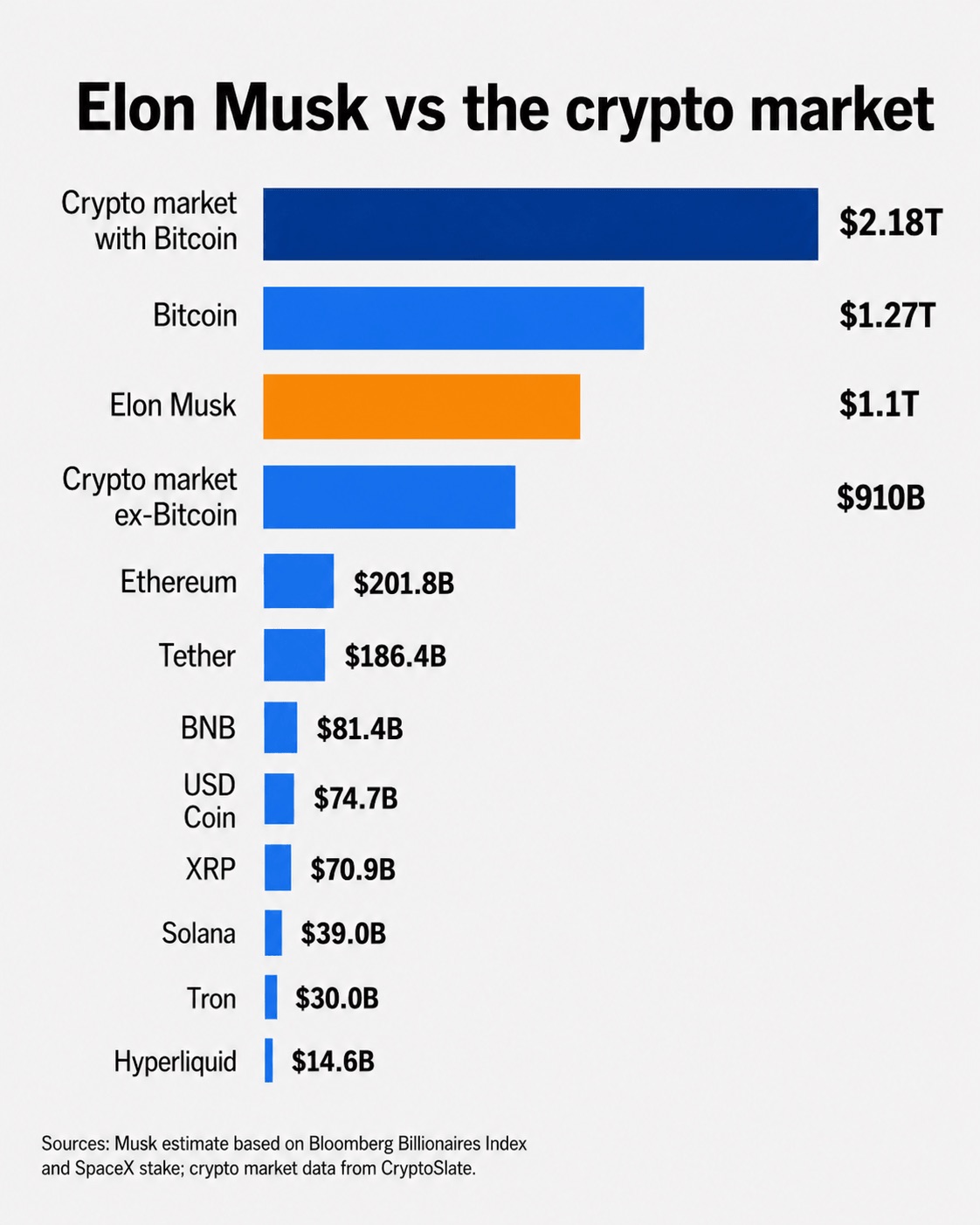
To put the unprecedented scale of this capital into perspective: Musk's personal net worth is already higher than the total market capitalization of the global cryptocurrency market excluding Bitcoin. If the world's largest digital asset, Bitcoin, is included in the statistics, his wealth is exactly equal to half the total market capitalization of the entire crypto industry.


This wealth milestone quickly sparked global discussions about wealth concentration, with the scale of Musk's controlled wealth even exceeding the gross domestic product of several developed nations.


SpaceX IPO Shatters Multiple Records


The direct catalyst for Musk's wealth surge was the highly anticipated Nasdaq listing of SpaceX.


The company, which focuses on rocket development, communication services, and artificial intelligence, reached a staggering valuation of $2.2 trillion post-listing.


Underwriters initially set the offering price at $135 per share, successfully raising $75 billion before trading began.


However, market enthusiasm for the commercial space sector and Musk-related companies was unprecedented. The stock opened at $150, surged to a session high of $176.50 during the day, and ultimately closed at $161 last Friday.


Market observers noted that the stock listing brought unprecedented market liquidity.


Bloomberg ETF analyst Eric Balchunas pointed out that the stock's trading volume on its first day reached $85 billion. This figure set a new global record for single-day IPO trading volume and ranked among the top ten historical single-day trading volumes for any individual stock, surpassing Apple's highest daily trading volume over the past 40 years.
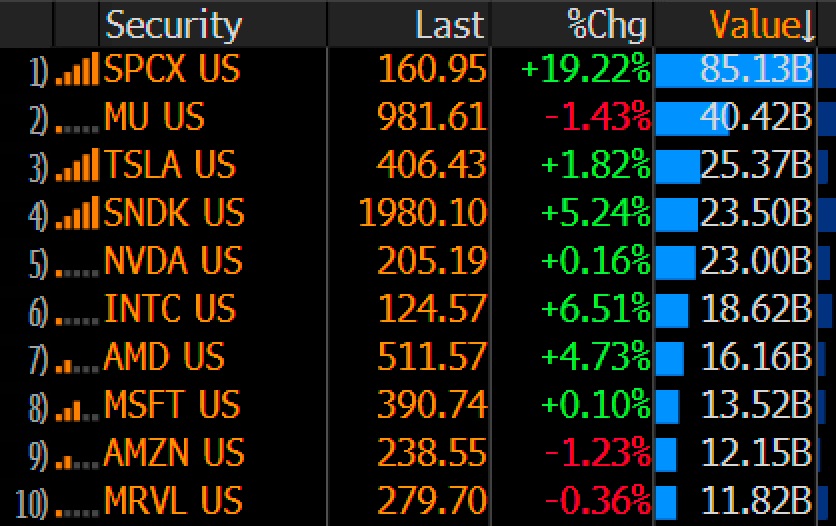

SpaceX Initial Public Offering Trading Volume (Source: Eric Balchunas)


Musk holds a 42% stake in the Hawthorne, California-based company, granting him near-unilateral voting control over its operations and strategic decisions.


Musk's Connection to Cryptocurrency


Comparing Musk's wealth scale to the digital asset market clearly reveals the significant shift in global capital allocation over the past year.


Data from the TradingView TOTAL2 index shows that the total market capitalization of all altcoins (excluding stablecoins) is approximately $880 billion. Musk's $1.11 trillion paper wealth easily surpasses this figure.


Even using the broader statistical scope of data platform CoinGecko—which puts the total global crypto market cap at about $2.27 trillion, with Bitcoin's market cap at $1.28 trillion—the combined value of all remaining altcoins after excluding Bitcoin still falls short of the personal net worth of the SpaceX CEO.


This market cap gap intuitively reflects the significant valuation contraction of mainstream altcoins compared to previous cycles. Data from Tradingview shows that in October 2025, the total market cap of crypto assets excluding Bitcoin once exceeded $1.7 trillion.
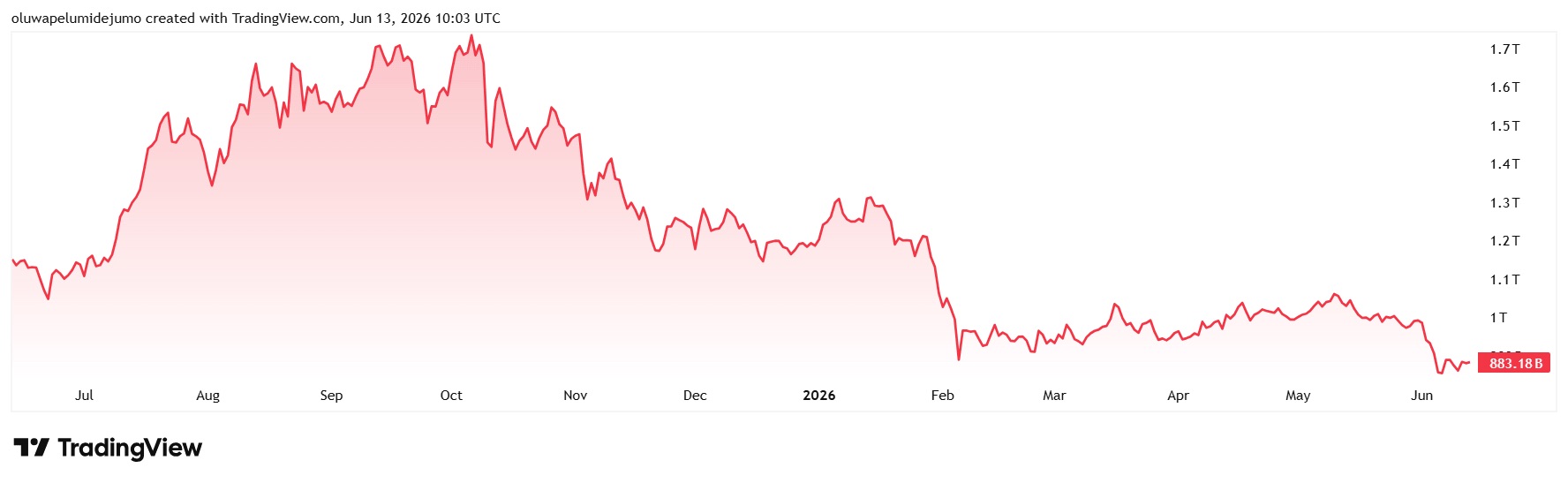

Total Cryptocurrency Market Cap Excluding Bitcoin (Source: Tradingview)


Today, that value has nearly halved. Behind this is the continued liquidity drain in the digital asset market, with institutional capital broadly exiting the crypto sector and flowing into large-cap tech stocks and artificial intelligence-related equities.


Despite his personal wealth now dwarfing the entire altcoin market, Musk remains deeply intertwined with the digital asset ecosystem, both in terms of personal holdings and corporate balance sheets.


Musk has publicly confirmed that he holds Bitcoin, Ethereum, and Dogecoin. Apart from mentioning a gift of 0.25 Bitcoin in 2018, he has never disclosed his full personal portfolio. However, several of his companies hold institutional-scale positions in the crypto market.


Post-listing regulatory filings show that SpaceX's corporate treasury holds 18,712 Bitcoin, with a market value exceeding $1.3 billion. His electric vehicle company Tesla follows a similar strategy, maintaining a long-term holding of 11,509 Bitcoin as part of its corporate liquid reserves.


If the holdings of both companies were combined, the total Bitcoin held would rank fifth globally among listed companies.
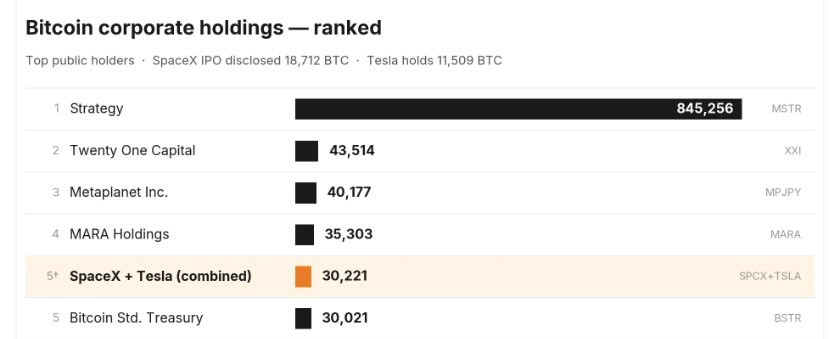

Bitcoin Holdings of SpaceX and Tesla (Source: Bitcoin Treasuries)


Furthermore, Musk's $44 billion acquisition of the social platform X (formerly Twitter) and the embedding of financial data tools within the platform have integrated financial markets directly into the public information stream. The platform's built-in cash tag function displays real-time prices for traditional stocks and various digital assets.


X's official statement clarifies that the platform serves solely as a market data tool and does not directly act as a securities broker or cryptocurrency exchange. Nonetheless, this feature further intertwines Musk's media and commercial ecosystem with the daily operations of financial markets.


Ultimately, Musk's staggering wealth scale reveals the severe concentration of private wealth within founder-controlled tech giants; it is also important to note that this trillion-dollar fortune is essentially tied to stock market prices and is not freely accessible cash assets.


Preguntas relacionadas

QWhat event made Elon Musk the first person in modern history to surpass a $1 trillion net worth?

ASpaceX's record-breaking public listing (IPO) propelled Elon Musk's net worth to over $1 trillion.

QHow does Elon Musk's current wealth compare to the total market capitalization of the cryptocurrency market excluding Bitcoin?

AElon Musk's net worth of $1.11 trillion is greater than the total market capitalization of all cryptocurrencies excluding Bitcoin, which is approximately $880 billion.

QWhich of Elon Musk's companies hold Bitcoin on their balance sheets, and what are their approximate holdings?

ABoth SpaceX and Tesla hold Bitcoin. SpaceX holds 18,712 BTC and Tesla holds 11,509 BTC, giving them a combined holding of over 30,000 BTC.

QWhat was the remarkable trading volume statistic for SpaceX's stock on its first day of public trading?

AOn its first day of public trading, SpaceX's stock reached a trading volume of $85 billion, setting a new record for IPO trading volume.

QWhat broader societal and market trend is highlighted by the comparison between Musk's wealth and the altcoin market's value?

AIt highlights both the extreme concentration of private wealth in founder-led tech giants and the significant valuation decline/contraction (nearly halved) in the altcoin market as capital has flowed towards large-cap tech and AI stocks.

Lecturas Relacionadas

Misjudged A-Shares: Resilience, Expectations, and Confidence

China's A-share market recently faced selling pressure, especially in tech sectors, initially triggered by a global tech sell-off that began in South Korea. However, the article argues this is a case of "mistaken injury" and highlights the market's underlying resilience. This resilience stems from three main pillars: **1) Tech Sector Fundamentals:** Unlike Korea's market dominated by a few memory chip stocks, China's tech sector is diversified across computing, communications, electronics, and semiconductors, supported by dual narratives of global AI supply chains and domestic substitution. Core areas like optical modules and fiber optics continue to show strong earnings growth. **2) "National Team" Support:** State-backed institutions and large corporations have made significant market purchases and announced buybacks, providing liquidity and signaling confidence. This is seen as a stabilizing policy signal, often associated with market bottoms. **3) Broader Market Pillars:** Other major sectors are showing endogenous recovery momentum. Consumer stocks benefit from stabilizing CPI and signs of sector recovery (e.g., liquor price hikes). Cyclical sectors like aluminum have high earnings, potential price increases due to tight supply, and low valuations. The financial sector offers stable dividends and low valuations. The conclusion is that the sell-off was driven by external contagion, not a collapse in fundamentals. With strong policy support and recovering momentum across key sectors, the A-share market possesses the toughness to regain stability.

marsbitHace 7 min(s)

Misjudged A-Shares: Resilience, Expectations, and Confidence

marsbitHace 7 min(s)

The Clarity Act's Journey Through Congress: The Thorny Path of Bipartisan Compromise in the U.S.

The U.S. Congress is struggling to advance the crypto market structure bill known as the Clarity Act, with bipartisan compromise proving difficult. Key hurdles include unresolved disputes over "yield" products and, more critically, the inclusion of strong ethics provisions for elected officials—a non-negotiable demand for many Democrats. While a compromise on yield was reached in May, securing only limited Democratic support in committee, the separate Senate Agriculture Committee version later passed with no Democratic votes due to the ethics impasse. As Republicans push for a full Senate vote in July, demands for ethics rules have expanded, and other contentious issues like developer protections and concerns from law enforcement and large banks further complicate negotiations. Despite consensus on the need for legislation, the path forward is unclear. Recent discussions between senators and White House officials aim to find acceptable ethics language. Some lawmakers question whether a compromise text can garner enough bipartisan support, with one Democrat stating the current proposal lacks the strong ethics provisions required for their vote. Potential short-term goals for the crypto community include symbolic Senate action before the August recess, a longer-term aim for passage by 2026, or establishing a detailed framework that addresses ethics and other compromises. The process remains arduous, relying on the traditional, vote-by-vote effort to build bipartisan support.

marsbitHace 26 min(s)

The Clarity Act's Journey Through Congress: The Thorny Path of Bipartisan Compromise in the U.S.

marsbitHace 26 min(s)

Are Kalshi and Polymarket Founders at Odds? This Business Rivalry Is More Brutal Than You Think

"The Rivalry Between Kalshi and Polymarket Founders Turns Bitter and Litigious" The intense feud between Tarek Mansour, CEO of Kalshi, and Shayne Coplan, founder of Polymarket, has escalated far beyond typical business competition into personal animosity and regulatory battles. Both lead billion-dollar prediction market platforms, but their approaches differ sharply. Kalshi positions itself as the compliant operator, securing U.S. regulatory approval before launching. In contrast, Polymarket initially operated offshore, allowing U.S. users to access its platform via VPN, which drew regulatory scrutiny. The conflict reached a peak in November 2024 when FBI agents raided Coplan's New York apartment. While Coplan publicly blamed political motives, his team privately suspected Kalshi was involved. According to sources, Kalshi's lawyers had previously reported Polymarket's operations to federal prosecutors, highlighting its accessibility to U.S. users despite a ban. This incident fueled mutual accusations and underhanded tactics, including social media smear campaigns and attempts to sabotage each other's major business deals. Their rivalry also played out in Washington, influencing regulatory debates. Kalshi actively lobbied against Polymarket's practices, framing them as illegal and unethical. Polymarket, after facing a CFTC fine and investigation, later acquired a licensed U.S. firm to launch a domestic app, regaining a foothold. Despite the hostility, both companies have seen massive growth, with combined trading volumes soaring. However, increased regulatory scrutiny, particularly around insider trading on Polymarket's platform, continues to pose challenges. The founders' deep-seated mutual disdain ensures their battle for market dominance remains as much a personal vendetta as a commercial one.

marsbitHace 35 min(s)

Are Kalshi and Polymarket Founders at Odds? This Business Rivalry Is More Brutal Than You Think

marsbitHace 35 min(s)

Trading

Spot
活动图片




