Space Review|Farewell to Narrative Frenzy, Web3 Enters a New Structured Phase of Pragmatic Foundation Building

marsbitPublicado a 2026-01-01Actualizado a 2026-01-01

Resumen

Reflecting on the final days of 2025, a cross-ecosystem Space hosted by key projects within the TRON network—SunPump, JUST, AINFT, BitTorrent, and WINkLink—brought together industry participants to review the past year and look ahead. The discussion centered on a shift in crypto markets: a move away from narrative-driven speculation toward a more pragmatic, utility-focused phase. Key takeaways from 2025 included a heightened awareness of systemic risk, exemplified by events like the “10.11” flash crash, which underscored the dangers of over-leverage and low liquidity. Capital increasingly flowed toward established assets like Bitcoin and Ethereum, reflecting a preference for proven value and security. Within this context, the TRON ecosystem demonstrated resilience and growth through concrete developments: - JUST reinforced its role as a DeFi cornerstone, with JustLend DAO nearing $10B in TVL and introducing a token burn mechanism to enhance JST value. Its GasFree feature also improved accessibility. - AINFT evolved into an AI + Web3 infrastructure platform, with its token listed on Binance Alpha. - SunPump drove meme token creation and trading innovation, supported by tools like SunGenX and SunX perpetual contracts. - WINkLink expanded as a decentralized oracle, while BitTorrent Chain (BTTC) upgraded to v2.0, strengthening cross-chain and data storage capabilities. Looking to 2026, participants anticipated a more structured market with heightened institutional involvement...

As the clock struck midnight on the last night of 2025, a unique gathering of minds unfolded within the TRON ecosystem. A New Year's Eve Space, jointly initiated by the five projects SunPump, JUST, AINFT, BitTorrent, and WINkLink, blended festive cheer with profound industry insights, creating a distinctive annual "thought salon" through relaxed interaction.

The event, structured around the core narrative of "Review × Sentiment × Choice × Outlook," aimed to systematically recap the key turning points in the crypto market over the past year and, on this basis, build consensus on the direction of future value. The discussions not only delved into the structural changes affecting the market but also collectively explored the innovative signals and value foundations truly worth attention as the industry transitions toward a phase of pragmatic development.

This article aims to systematically organize the essence of the dialogue and industry insights from this Space. It presents not only the reflections of market participants on extreme volatility and observations of capital flows but also deeply decodes how the TRON ecosystem, through synergistic practices in areas such as decentralized finance (DeFi), cross-chain infrastructure, and AI integration innovation, is building a value ecosystem with resilience, vitality, and long-term development potential amidst complex cycles. This gathering was not just an annual summary but can also be seen as a collective reflection and前瞻 on the future evolution path of the Web3 world.

Looking Back at 2025: The Collaborative Evolution and Value Accumulation of the TRON Ecosystem

The year 2025 was one of profound "realist" calibration for the crypto market. The guests, having experienced the market firsthand, reached a consensus: the industry is moving away from narrative-driven frenzy and entering a calmer, more pragmatic stage. As guest Anna Tangyuan summarized, this year was "a year of gradually calming down after being educated by reality." The simple logic of "narrative driving price" repeatedly failed, and market sentiment shifted from optimistic expectations at the beginning of the year to caution and pragmatism by year's end.

One of the triggers for this shift was the "10.11" market flash crash, which left a deep impression on several guests. Anna Tangyuan, who experienced it firsthand, pointed out that with a "40% leveraged position still being liquidated," market risk lies not only in misjudging direction but also in severely underestimating extreme market conditions and instantaneous liquidity drying up. In the face of systemic risk, any leverage strategy seems insignificant, and "survival" becomes the primary rule for navigating cycles.

Furthermore, the market's冷静 is also reflected in its choice of capital. Guest web3 Monkey used "the strong get stronger" to point out the structural flow of capital: after numerous emerging projects were validated (or disproven) by the market, capital反而 accelerated its回流 to core assets like Bitcoin and Ethereum, indicating that the market is seeking more solid value anchors.

Despite the challenges, innovation did not stop; it simply became more考验 of meticulous cultivation. It is precisely under this new industry基调 of pursuing real utility and emphasizing risk management that the annual performance of the TRON ecosystem provides an excellent example of "how to navigate cycles."

Throughout 2025, the five core projects of the TRON ecosystem—SunPump, JUST, AINFT, BitTorrent, and WINkLink—wrote a vivid footnote for "pragmatic construction" and "ecological deepening" through their practical actions. They not only achieved breakthrough progress in their respective tracks but also, through close collaboration, jointly built a more resilient and vibrant decentralized ecosystem.

First, at the DeFi application level, JUST, with its solid protocol performance, established its position as the value anchor of the TRON ecosystem. The Total Value Locked (TVL) of its core protocol, JustLend DAO, approached the $10 billion mark mid-year and consistently ranked among the industry leaders, demonstrating the market's high recognition of its security and innovative model. Meanwhile, the robustness of the ecosystem is also reflected in the broad participation in core businesses: as of December 31, 2025, the on-chain staking volume of TRX exceeded 9.25 billion, the number of addresses participating in staking surpassed 13,417, and the staking annualized yield stabilized at 6.65%, forming a solid收益 foundation within the ecosystem.

Beyond the solid performance and market recognition of the protocol, the token buyback and burn mechanism driven by community consensus also became a key decision boosting the long-term confidence of JST holders. This mechanism, in an on-chain transparent manner, directly links protocol revenue to token value. The first burn utilized the existing revenue of JustLend DAO, totaling 59,087,137 USDT, of which 30% (17,726,141 USDT) was used for the initial buyback and burn of 559,890,753 JST, approximately 5.66% of the total supply. This substantial deflationary action laid a credible foundation for JST's long-term value model.

While JUST is committed to creating value through buyback and burn, it also致力于 lowering the participation barrier through its GasFree function, ensuring users can deeply engage with the ecosystem. Currently, the number of GasFree partners has expanded to 9, with total transactions in November reaching 423,173, averaging 14,105 per day, and the total transaction amount exceeding $7.5 billion. This innovation significantly benefits small and medium users and promotes the sustained and healthy growth of the ecosystem scale.

Second, at the frontier of innovative applications and asset paradigm exploration, AINFT and SunPump played the role of ecosystem pioneers. In 2025, AINFT successfully completed its brand strategy upgrade from a digital art platform to an "AI+Web3" infrastructure, aiming to bring empowerment ranging from intelligent interactive tools to decentralized AI models to the TRON ecosystem. Its platform token, NFT, was successfully listed on Binance Alpha in September 2025, gaining liquidity support and market exposure from a top global exchange.

SunPump, by building a vibrant Meme trading ecosystem, became the core hub connecting cultural creation and asset flow within the TRON network. Its launched AI one-click token issuance tool, SunGenX, significantly lowered the threshold for creation and issuance, seamlessly transforming cultural creativity into tradable assets. Driven by this innovative tool, the cumulative number of Meme tokens created on the platform has exceeded 100,000. Meanwhile, the SUN.io ecosystem deeply collaborated with SunPump through a series of combined efforts, including forming a CEX alliance, upgrading the AI assistant SunAgent, and launching the decentralized perpetual contract platform SunX, building a complete ecological closed loop from issuance and trading to derivative services.

Finally, the expansion of oracle and cross-chain infrastructure opened channels for the ecosystem to connect with the real world and diverse blockchain networks. The decentralized oracle WINkLink, with its reliable data services, penetrated key areas such as payments, trading, wallets, and even privacy computing, becoming the security foundation driving innovative applications like DeFi and RWA. Over the past year, WINkLink established strategic partnerships with 17 new projects, bringing the total number of ecosystem partners to 36.

At the same time, BitTorrent Chain (BTTC) completed a leapfrog upgrade to version 2.0, with the total cross-chain volume exceeding $1.63 billion. More notably, its BitTorrent File System (BTFS) boasts over 2 million global nodes and an annual storage capacity exceeding 800 PB. The synergy between WINkLink and BitTorrent共同构建了 the underlying network for data and asset circulation within the TRON ecosystem, providing solid guarantee for the ecosystem's interoperability and value expansion.

As the market scrutinizes the intrinsic value of projects amidst macro volatility, the TRON ecosystem, through its solid accumulation in technical infrastructure, economic models, and community operations over the past year, has proven that it can not only weather storms but also possesses the potential to continuously lead innovation waves.

Outlook for 2026: Pragmatic Development and Value Signals in the Web3 Market
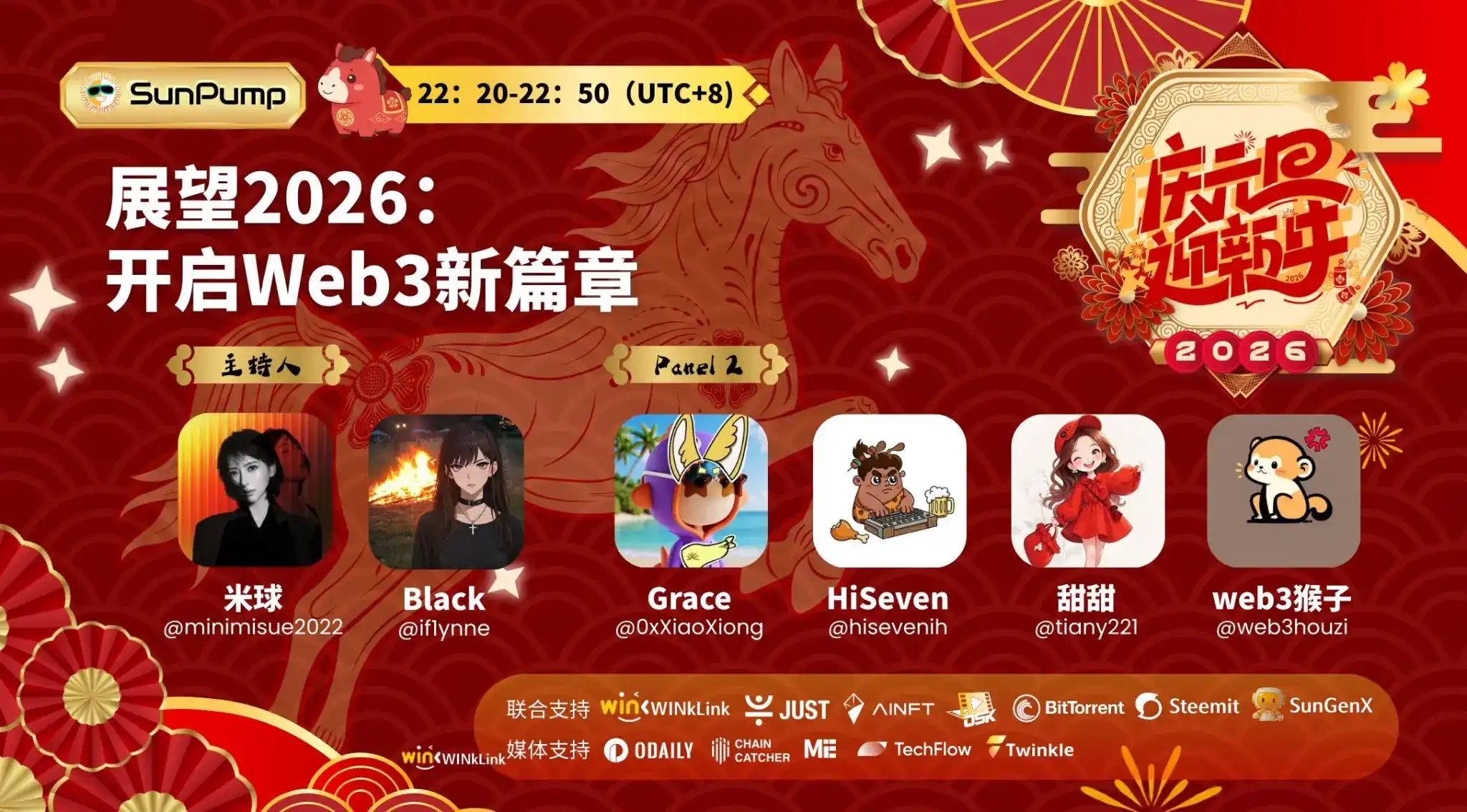
In the second half of this New Year's roundtable, the focus of discussion shifted from reviewing the past to looking toward the future. Based on their profound experiences in 2025, the guests shared their expectations for 2026 and the market signals they are most bullish on. Their discussions共同描绘出一幅 industry consensus picture: the market is moving away from expectations of a broad bull run and entering a new, more structured stage with higher demands, where opportunities and challenges are more nuanced, and individual success will depend more on the construction of systemic capabilities and the grasp of core trends.

Regarding the overall market in 2026,币圈Peter, based on macro perspectives such as continued institutional accumulation and the influx of traditional capital, remains "optimistic" about the underpinning力量 of mainstream assets. However, he敏锐地 pointed out that capital will be more discerning, and the Matthew effect of "the strong get stronger" will intensify the行情分化 between mainstream coins and altcoins.

This judgment coincides with the current trend of value flow in the market, namely that capital is shifting from assets solely reliant on narratives to those with real utility, stable cash flow, and massive ecosystem support. For example, the TRON ecosystem,凭借 its absolute dominance in the stablecoin settlement领域 (carrying over half of the global on-chain circulation of USDT) and the powerful DeFi ecosystem derived from it, has built a "digital financial infrastructure" with endogenous循环 capabilities, not reliant on short-term subsidies. This ecosystem, driven by real payment and lending demands, demonstrates precisely the resilience and sustainability the market seeks.

Regarding "which market signals are most worth carrying into 2026," the guests' analysis focused on a triangular framework of liquidity, innovation, and compliance. First, innovative application scenarios with real utility, such as AI, prediction markets, and RWA, are highly anticipated, reflecting the market's demand for native high-level on-chain applications. These are not just "narratives" but pragmatic explorations attempting to create new demands and business models.

Second, the profound changes in capital structure are a fundamental signal of the market's maturation. This is reflected in two irreversible trends: firstly, the sustained, large-scale inflow of institutional capital through transparent, compliant channels like ETFs. This is not just incremental capital but also brings higher requirements for risk management, custody services, and fundamental analysis, raising the professional threshold and stability of the market. Secondly, the structural growth and multi-scenario penetration of stablecoins on-chain have elevated them beyond mere mediums of exchange to become the foundational assets of on-chain finance. Their scale and reliability directly determine the ability of DeFi and even the crypto ecosystem to承接 incremental capital.

Finally, the weight of compliance and fundamentals will continue to increase. With the rapid evolution of global regulatory frameworks and institutional investors becoming major market participants, "regulation-friendly" and "audit-worthy" will change from plus points to entry tickets. This means that a project's compliance progress (e.g., license acquisition, operational transparency), actual utility (user activity, revenue generation capability), and token economic fundamentals (value capture mechanism, inflation/deflation model) will彻底取代 vague visions and marketing narratives, becoming the core basis for capital decisions. As the guests insightfully noted, those capable of navigating future cycles will必定 be projects that have built transparent, robust economic systems with real value capture capabilities. Their growth will rely more on endogenous value creation within the ecosystem rather than external liquidity speculation.

In converting compliance potential into capital momentum, the practices of the TRON ecosystem in 2025 serve as a标志性范例. Tron Inc. not only went public on Nasdaq but also initiated the "TRX MicroStrategy" plan, listing TRX as a reserve asset on the balance sheet of a listed company, opening a core channel for the entire ecosystem towards mainstream compliant capital. The strong confidence and transparency红利 released by this move directly drove the simultaneous rise in the Total Value Locked (TVL) of its DeFi ecosystem and network revenue, powerfully proving the systemic value that compliance building can bring.

Overall, the crypto market in 2026 will reward those ecosystems and projects that can establish advantages within the "triangular framework": capable of opening new局面 in innovation, attracting and accommodating institutional-grade liquidity, while also building solid fundamentals within a compliant framework. This预示着 that the Web3 market is transitioning from a speculative market chasing hotspots to a mature ecological system based on value discovery and sustainable construction. The advances of the TRON ecosystem in 2025 are precisely the先行答卷 delivered towards this future.


Criptos en tendencia

Preguntas relacionadas

QWhat was the main theme of the New Year's Space event hosted by the TRON ecosystem, and what was its purpose?

AThe main theme was 'Review × Emotion × Choice × Outlook', and its purpose was to systematically review the key turning points in the crypto market over the past year and build consensus on future value trends.

QAccording to the discussion, what major shift is the Web3 industry undergoing as it moved through 2025?

AThe industry is shifting away from a狂热 (frenzy) driven by narratives and entering a more冷静 (calm) and务实 (pragmatic) phase that emphasizes real utility and risk management.

QWhich TRON ecosystem project is highlighted as the 'cornerstone of value' for its performance in DeFi, and what evidence supports this claim?

AJUST is highlighted as the 'cornerstone of value'. Evidence includes its JustLend DAO protocol's TVL nearing $10 billion, over 13,417 addresses staking 9.25 billion TRX, and its substantial token buyback and burn mechanism.

QWhat are the three key areas of focus (the 'triangular framework') that guests identified as most important for the Web3 market in 2026?

AThe three key areas are: 1) Innovative application scenarios with real utility (like AI, prediction markets, RWA), 2) Profound changes in capital structure (institutional inflows, stablecoin growth), and 3) Increased weight of compliance and fundamentals.

QHow did the TRON ecosystem demonstrate the conversion of 'compliance momentum into capital kinetic energy' in 2025?

ATron Inc. listed on Nasdaq and initiated the 'TRX MicroStrategy' plan, which involved adding TRX to the company's balance sheet as a reserve asset. This opened a core channel for mainstream compliant capital, boosting DeFi TVL and network revenue.

Lecturas Relacionadas

Annual Salary of Millions Competing for Electricians, Meta Rushes to Open Its Own Technical School

The AI boom is facing an unexpected bottleneck: a severe shortage of skilled construction workers and electricians. As tech giants like Meta, OpenAI, and Alphabet race to build massive data centers—such as OpenAI's $16 billion "Stargate" project—they are hitting a critical labor wall. The U.S. needs an estimated 130,000 more electricians, 240,000 construction workers, and 150,000 supervisors by 2030 for AI infrastructure alone, but tens of thousands of electrician jobs go unfilled each year. While AI companies offer high premiums, with electricians earning up to $280,000 annually, worker scarcity still causes massive losses—delays on a single project can cost $14.2 million per month. The complexity of building AI data centers, which require immense power (equivalent to powering hundreds of thousands of homes), sophisticated electrical systems, and advanced liquid cooling solutions, demands highly skilled technicians who are in short supply. To combat this, companies are investing heavily in training. Meta has committed $115 million to a free training school offering tuition, housing, and stipends, targeting 5,000 new workers. OpenAI is partnering with unions to secure skilled labor. These efforts are paying off, with a significant rise in Gen Z interest in trade schools over college. However, the power demands are staggering. AI data centers are driving a rapid surge in electricity consumption, projected to account for up to 12% of U.S. power use by 2028 and raising costs for consumers. Furthermore, the construction boom is project-based, leading to a potential future glut of trained workers once building peaks, which could depress wages industry-wide. The race for AI supremacy now depends as much on skilled hands as on advanced chips.

marsbitHace 57 min(s)

Annual Salary of Millions Competing for Electricians, Meta Rushes to Open Its Own Technical School

marsbitHace 57 min(s)

OpenAI No Longer Sells Its Most Expensive Model for Profit

OpenAI is shifting its business strategy away from promoting its most expensive, flagship models for every task. Recent price cuts—80% for GPT-5.6 Luna and 20% for Terra—signal a deeper change: the company now actively advises users that many tasks don't require the most powerful model. Instead, OpenAI recommends a tiered approach: use the high-end GPT-5.6 Sol for complex planning and analysis, then delegate execution to cheaper models like Luna. This mirrors moves by Anthropic, which recently launched Claude Opus 5 at half the price of its top model, Fable 5. Both companies are de-emphasizing flagship models as primary revenue drivers, using them instead for brand prestige and technological showcases. The industry is entering a "mass-market" phase, similar to automotive, where high-volume, cost-effective models handle daily operations and drive scale. OpenAI's price reductions are partly enabled by AI models themselves optimizing underlying code and infrastructure, creating a self-reinforcing cycle of efficiency gains and cost reduction. Competition is shifting from "who is smartest" to "who offers the best value." The goal is no longer selling individual models but fostering widespread API adoption and ecosystem lock-in. By making AI calls cheap and ubiquitous, companies like OpenAI aim to become the indispensable, utility-like infrastructure powering automated workflows—the "water and electricity" of software, quietly embedded everywhere.

marsbitHace 57 min(s)

OpenAI No Longer Sells Its Most Expensive Model for Profit

marsbitHace 57 min(s)

Will the Fed Definitely Raise Interest Rates in September? How Will Crypto and U.S. Stocks Withstand the Pressure?

The market's expectation for a September Fed rate hike surged dramatically in early August, jumping from under 50% to over 80% within a week. This shift followed a contentious July FOMC meeting, where a 9-3 vote to hold rates revealed growing dissent from hawkish members advocating for an immediate hike to combat persistent inflation. The primary catalyst for this repricing is rising oil prices, driven by renewed geopolitical tensions around the Strait of Hormuz, which threaten global supply. Energy costs directly influence inflation metrics, making the upcoming July CPI report (due August 12th) a critical data point. If it shows inflation reaccelerating, the probability of a September hike will solidify. For Bitcoin and crypto assets, this is typically bearish news. Bitcoin continues to behave as a high-beta, liquidity-sensitive risk asset. A rate hike raises the opportunity cost of holding non-yielding assets and could drive capital toward money markets, pressuring crypto prices in the short term. However, historical patterns suggest that if a hike is perceived as the end of a tightening cycle rather than the start, any negative price impact may be brief. U.S. stocks, particularly crypto-linked equities like Coinbase and growth-oriented tech stocks, are also vulnerable. Higher rates increase discount rates in valuation models, putting pressure on high-multiple companies. This coincides with a pivotal tech earnings season where investor focus has shifted from massive AI capital expenditure to tangible revenue and cash flow generation. Companies with negative cash flow and weak growth narratives could face heightened volatility if borrowing costs rise in September. In summary, a September Fed hike has evolved into a mainstream market scenario. Key factors to watch are oil prices, the July CPI report, and Fed communications, which will determine the final decision and its impact on volatile crypto and equity markets.

marsbitHace 1 hora(s)

Will the Fed Definitely Raise Interest Rates in September? How Will Crypto and U.S. Stocks Withstand the Pressure?

marsbitHace 1 hora(s)

Trading

Spot

Artículos destacados

Cómo comprar O

¡Bienvenido a HTX.com! Hemos hecho que comprar O1 exchange (O) sea simple y conveniente. Sigue nuestra guía paso a paso para iniciar tu viaje de criptos.Paso 1: crea tu cuenta HTXUtiliza tu correo electrónico o número de teléfono para registrarte y obtener una cuenta gratuita en HTX. Experimenta un proceso de registro sin complicaciones y desbloquea todas las funciones.Obtener mi cuentaPaso 2: ve a Comprar cripto y elige tu método de pagoTarjeta de crédito/débito: usa tu Visa o Mastercard para comprar O1 exchange (O) al instante.Saldo: utiliza fondos del saldo de tu cuenta HTX para tradear sin problemas.Terceros: hemos agregado métodos de pago populares como Google Pay y Apple Pay para mejorar la comodidad.P2P: tradear directamente con otros usuarios en HTX.Over-the-Counter (OTC): ofrecemos servicios personalizados y tipos de cambio competitivos para los traders.Paso 3: guarda tu O1 exchange (O)Después de comprar tu O1 exchange (O), guárdalo en tu cuenta HTX. Alternativamente, puedes enviarlo a otro lugar mediante transferencia blockchain o utilizarlo para tradear otras criptomonedas.Paso 4: tradear O1 exchange (O)Tradear fácilmente con O1 exchange (O) en HTX's mercado spot. Simplemente accede a tu cuenta, selecciona tu par de trading, ejecuta tus trades y monitorea en tiempo real. Ofrecemos una experiencia fácil de usar tanto para principiantes como para traders experimentados.

507 Vistas totalesPublicado en 2026.06.19Actualizado en 2026.06.29

Cómo comprar O

Cómo comprar PROS

¡Bienvenido a HTX.com! Hemos hecho que comprar Pharos (PROS) sea simple y conveniente. Sigue nuestra guía paso a paso para iniciar tu viaje de criptos.Paso 1: crea tu cuenta HTXUtiliza tu correo electrónico o número de teléfono para registrarte y obtener una cuenta gratuita en HTX. Experimenta un proceso de registro sin complicaciones y desbloquea todas las funciones.Obtener mi cuentaPaso 2: ve a Comprar cripto y elige tu método de pagoTarjeta de crédito/débito: usa tu Visa o Mastercard para comprar Pharos (PROS) al instante.Saldo: utiliza fondos del saldo de tu cuenta HTX para tradear sin problemas.Terceros: hemos agregado métodos de pago populares como Google Pay y Apple Pay para mejorar la comodidad.P2P: tradear directamente con otros usuarios en HTX.Over-the-Counter (OTC): ofrecemos servicios personalizados y tipos de cambio competitivos para los traders.Paso 3: guarda tu Pharos (PROS)Después de comprar tu Pharos (PROS), guárdalo en tu cuenta HTX. Alternativamente, puedes enviarlo a otro lugar mediante transferencia blockchain o utilizarlo para tradear otras criptomonedas.Paso 4: tradear Pharos (PROS)Tradear fácilmente con Pharos (PROS) en HTX's mercado spot. Simplemente accede a tu cuenta, selecciona tu par de trading, ejecuta tus trades y monitorea en tiempo real. Ofrecemos una experiencia fácil de usar tanto para principiantes como para traders experimentados.

517 Vistas totalesPublicado en 2026.06.22Actualizado en 2026.06.29

Cómo comprar PROS

Qué es VERONA

I. Introducción al Proyecto VERONA es una blockchain construida para todos, en todas partes a través de la abstracción de cadenas. Utilizando su capa de Abstracción Generalizada, VERONA se distingue por integrar funcionalidades complejas de blockchain, como cuentas, firmas e interoperabilidad, directamente a nivel de protocolo. Este enfoque permite interactuar con aplicaciones de blockchain sin necesidad de entender las tecnologías subyacentes.1) Información Básica Nombre: VERONA (VERONA)III. Enlaces Relacionados Enlace al sitio web oficial: https://xion.burnt.com/ Libro Blanco: https://xion.burnt.com/whitepaper.pdf Exploradores: https://explorer.burnt.com/ Redes Sociales: https://x.com/burnt_xion Nota: La introducción del proyecto proviene de los materiales publicados o proporcionados por el equipo oficial del proyecto, que es solo para referencia y no constituye asesoramiento de inversión. HTX no se hace responsable de ninguna pérdida directa o indirecta resultante.

596 Vistas totalesPublicado en 2026.06.22Actualizado en 2026.06.22

Qué es VERONA

Discusiones

Bienvenido a la comunidad de HTX. Aquí puedes mantenerte informado sobre los últimos desarrollos de la plataforma y acceder a análisis profesionales del mercado. A continuación se presentan las opiniones de los usuarios sobre el precio de A (A).

活动图片













